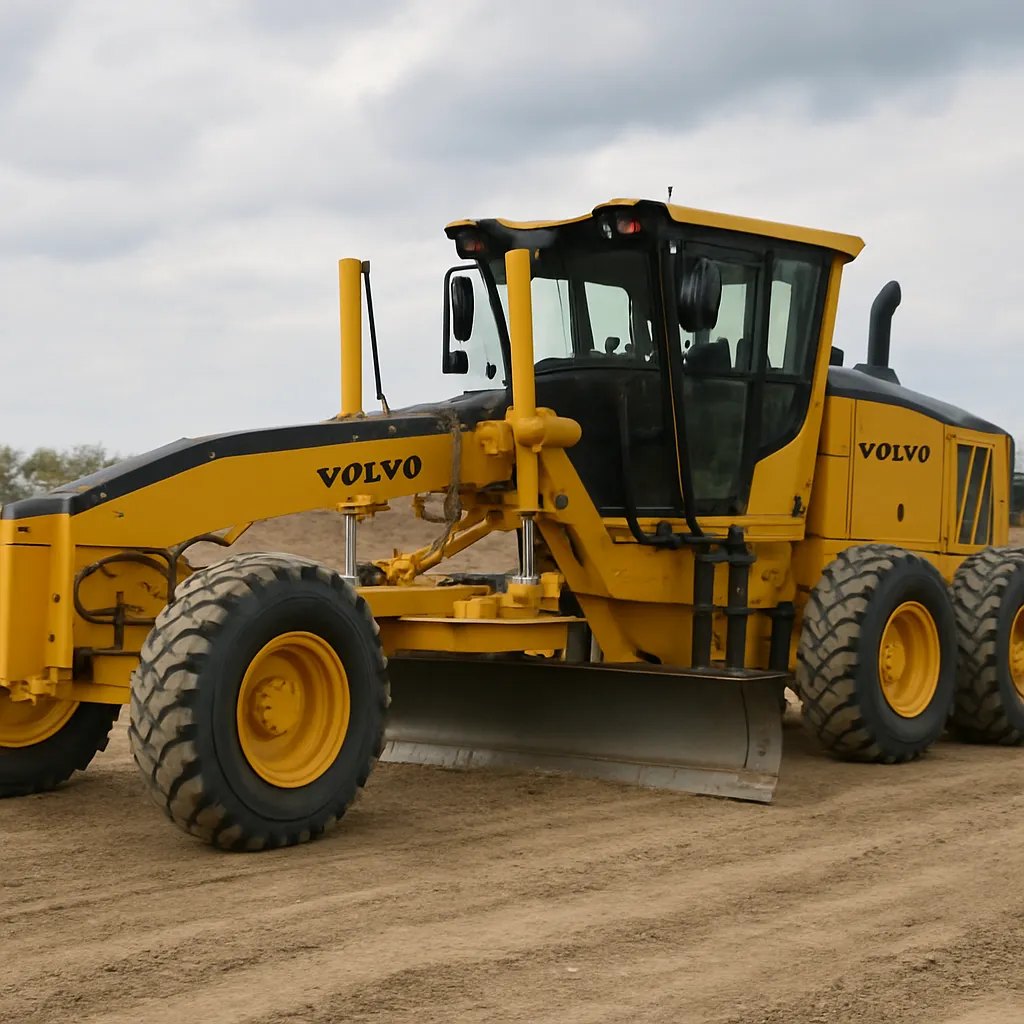
The Volvo G946C is a powerful example of a modern motor grader designed to handle demanding grading tasks across construction, mining, and infrastructure projects. Combining robust mechanical layout with ergonomic operator features and adaptable attachments, this machine is valued for its precision, versatility and long service life. The following article examines the technical character, typical applications, operational considerations, and practical information valuable to operators, fleet managers and buyers. Wherever possible, approximate figures and industry-contextual data are provided; exact specifications depend on configuration, market and production year.
Design and engineering overview
The Volvo G946C follows a design philosophy that emphasizes balance between power, visibility and serviceability. At its core, the machine integrates a durable frame, centrally mounted blade, and a powerful drivetrain. The overall layout is optimized for precise grading, with features that facilitate accurate material control and stable operation on variable surfaces.
Frame, articulation and steering
The grader’s frame is engineered to withstand high torsional loads encountered during heavy-duty applications such as road base leveling and quarry work. A hydraulically controlled articulation joint (often combined with circle and blade pitch controls) allows the grader to negotiate curves and perform angled grading without excessive repositioning. Steering systems are typically designed to give smooth response at low travel speeds while maintaining stability when traveling between sites.
Blade, moldboard and attachments
The heart of the grader is the moldboard or blade, which can range in width and curvature depending on the intended use. The G946C is compatible with a variety of blade types and lengths, including reversible cutting edges, high-capacity blades for heavy spoil, and specialized options for snow removal or fine finishing. Quick-change and bolt-on attachments for rippers, scarifiers and front blades extend the machine’s versatility.
Powertrain and hydraulics
Power is provided by a robust diesel engine paired with a transmission suited for both high-torque grading and highway travel. The hydraulic system provides the force and speed required to move the blade, articulation, circle rotation and additional implements. Key interests in design are heat management and hydraulic efficiency, often supported by dedicated cooling circuits and oil filtration systems to preserve component longevity.
Common applications and industries
Motor graders are indispensable across a broad spectrum of projects where precise surface shaping is required. The Volvo G946C is typically used in these areas:
- Road construction and maintenance: shaping subgrade, creating camber, finishing asphalt or gravel before paving.
- Airfield and runway maintenance: achieving smooth, even surfaces with strict tolerances.
- Mining and quarry sites: road maintenance inside mines where frequent grading preserves haul road integrity and safety.
- Agriculture and forestry: land leveling, creating terraces, and preparing fields or access roads.
- Snow removal and winter services: with appropriate blades and attachments the grader can operate effectively in clearing runways, highways and large parking areas.
- Utility and pipeline work: creating stable beds and access roads for pipeline installation and maintenance.
Operator comfort, controls and safety
One of the critical aspects of modern graders is the human-machine interface. The G946C places emphasis on operator visibility, comfort and intuitive controls to reduce fatigue and increase productivity. A typical cab layout includes adjustable seating, climate control, anti-vibration mounting, and an optimized sightline to the blade and front frame.
Controls and monitoring
Control systems may include pilot-operated joystick controls or precise hydraulic levers that give fine incremental motion for blade and articulation. Many machines integrate digital displays that provide real-time feedback on engine parameters, fuel levels, work hours and diagnostic alerts. Advanced systems can offer grade-control interfaces or compatibility with GPS-based machine control for automated precision grading.
Safety features
Safety components include ROPS/FOPS-certified cabs, rear-view cameras, lighting packages for night operation, and emergency shutdown systems. Service access panels, non-slip walkways and well-placed handrails also contribute to safer maintenance and daily inspections.
Maintenance, serviceability and lifecycle costs
Fleet managers prize graders that minimize downtime and reduce total cost of ownership. Design choices in the G946C facilitate routine servicing: grouped service points, easy-access filters, prolonged change intervals for major components and modular assemblies simplify repairs. A proactive maintenance program—regular lubrication, wear-part inspection (especially cutting edges and circle teeth), and hydraulic system checks—greatly extends operational life.
Wear parts and replacement
The cutting edges, circle components, bearings and hydraulic hoses are among the parts most exposed to wear. Stocking commonly replaced items and having a service plan in place reduces delays. Proper blade management (rotating reversible edges, matching edge profile to the job) can significantly reduce operating expenses.
Fuel economy and emissions
Fuel consumption depends on load, duty cycle, terrain and operator technique. Modern graders integrate engine management and fuel-efficient hydraulics to lower consumption. While exact figures for the G946C vary by configuration, graders of this size class often exhibit fuel use measured in liters per hour during active grading cycles, with reductions achieved through improved hydraulic control, auto-idle systems and optimized powertrain mapping. Emissions controls such as DOC (diesel oxidation catalysts), DPF (diesel particulate filters) and SCR (selective catalytic reduction) may be present in variants meeting regional emission standards.
Performance data and typical specifications
Exact manufacturer specifications for the G946C differ based on year and market, but here are typical ranges for mid-size graders to provide context. These figures should be used as general guidance; confirm details with official product documentation or dealer resources.
- Operating weight: approximately 18–28 tonnes (depending on attachments and optional equipment).
- Engine power: roughly 180–300 horsepower (varies by engine tune and emissions package).
- Moldboard length: commonly 3.6–4.2 meters; height and curvature vary by blade type.
- Maximum blade articulation angles: lateral and pitch adjustments enabling precise cutting and windrowing.
- Ripper configurations: up to 3–5 shanks for heavy scarification tasks.
- Travel speed: ranges designed for both slow-precision grading and transport between sites (often 30–50 km/h road speed capability depending on gearing).
- Fuel consumption: in-work grading cycles often range from approximately 10–30 liters per hour depending on load and environment.
These numbers represent a snapshot; nuances such as hydraulic flow rate, hydraulic oil cooler capacity, differential locks and axle ratings influence real-world capability. Telemetry and modern electronics can also change performance profiles and service intervals.
Case examples and field performance
Across multiple deployments, machines like the G946C demonstrate notable benefits in mixed-traffic and heavy-material environments. Examples include:
- Road rehabilitation projects where precise final shaping reduces asphalt usage by improving first-pass paving accuracy.
- Quarry access maintenance where frequent grading reduces vehicle wear and lowers fuel consumption for transport trucks by maintaining consistent gradients and drainage.
- Airport runway resurfacing where tight tolerances and high surface finish quality are met by graders equipped with specialized navigating and smoothing tools.
Success in these applications is driven by proper matching of blade geometry, operator skill and planned maintenance. Upgrading operator training often yields immediate improvements in fuel use and productivity.
Buying considerations and fleet integration
When evaluating a grader such as the Volvo G946C, consider the following factors to ensure best fit and long-term value:
- Duty profile: light finish grading versus heavy scarification needs different spec blades and ripper options.
- Operating environment: extreme climates or dusty mining conditions influence filtration and cooling choices.
- Attachments and versatility: front blades, snow wings, or GPS-ready packages increase machine utility over the year.
- Service network and parts availability: a strong dealer network speeds repairs and minimizes downtime.
- Resale value and total cost: higher initial spec can yield lower lifecycle costs if it increases uptime and longevity.
Technology trends and future outlook
The grader segment is evolving through innovations in automation, telematics and electrification. Emerging trends relevant to the G946C class include:
- Machine control and GPS integration: semi-autonomous grading improves precision and reduces rework.
- Telematics: remote diagnostics and usage monitoring enable predictive maintenance and optimized fleet scheduling.
- Electrification and hybrid powertrains: while full-electric large graders remain limited, hybrid systems and electrified auxiliaries are increasingly explored to reduce fuel consumption and emissions.
- Operator-assist features: stability control, automatic blade return-to-grade and advanced camera systems reduce operator workload and enhance safety.
Practical tips for operators
To maximize the life and performance of a machine like the G946C, operators should adopt consistent best practices:
- Perform daily walk-around checks of lights, tires, cutting edges and hydraulic hoses.
- Follow recommended hydraulic and engine oil change intervals; keep accurate logbooks.
- Use correct blade angles and cutting methods for the material to reduce unnecessary stress on frame and circle components.
- Train operators on fuel-efficient grading techniques and the benefits of engine idle management.
- Leverage telematics data to fine-tune maintenance intervals and identify inefficient operating patterns.
Durability, resale and lifecycle considerations
A primary reason fleets invest in established grader lines is the long lifecycle offered by these machines—often measured in many thousands of hours. The combination of a robust engine, reliable hydraulics and well-designed blade components contributes to overall durability. Resale value is influenced by maintenance history, hours logged, and the condition of high-wear components. Proper care—timely replacement of cutting edges, use of OEM parts when possible, and routine inspections—preserves value and reduces unplanned costs.
Summary
The Volvo G946C exemplifies the core strengths expected of a modern mid-size grader: adaptability across tasks, strong mechanical design, operator-oriented features and a landscape of attachments that expand its usefulness. While exact specifications vary by market and production year, graders in this category reliably deliver precision grading, solid operating economy and extended service life when maintained correctly. Whether used on roadworks, in mining, or for winter services, these machines are essential tools for achieving accurate, durable surface profiles.


)
)