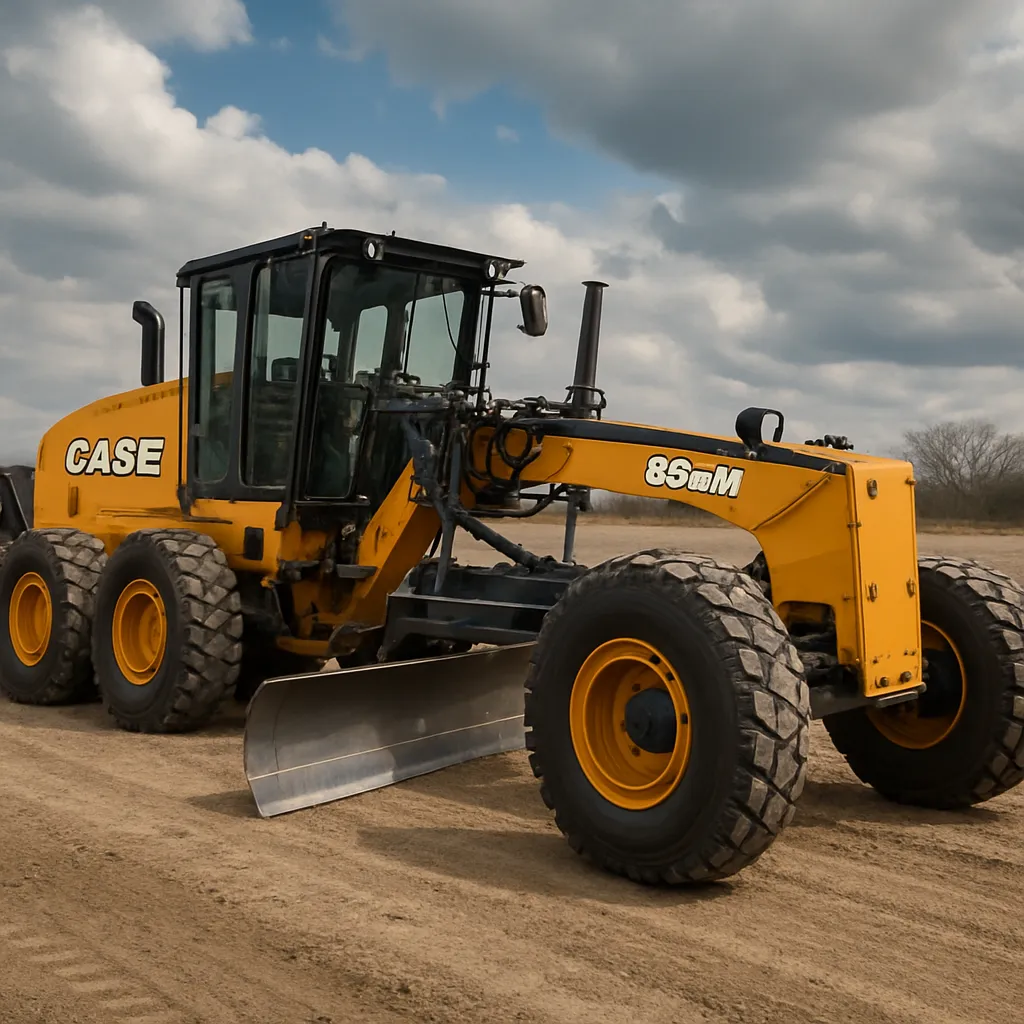
The following article examines the CASE 865M motor grader — a heavy-duty earthmoving machine designed for fine grading, road construction, maintenance, and a wide range of civil engineering tasks. The text covers the machine’s general design philosophy, typical technical characteristics, areas of application, operator environment, maintenance considerations, available attachments, and its position in the market. Wherever numerical data or performance indicators are cited, they are presented as typical values or ranges that depend on configuration, local emissions packages, and optional equipment.
Overview and key characteristics
CASE has long been recognized for producing construction equipment that balances durability and operator comfort. The CASE 865M is part of the manufacturer’s line of large graders intended for contractors, road authorities, and large infrastructure projects that require a combination of power, precision, and endurance. As a platform, the 865M emphasizes accurate blade control, robust driveline components, and a modern cab that reduces operator fatigue.
At its core, the 865M is engineered to deliver high levels of productivity on tasks such as road base formation, gravel road maintenance, subgrade preparation, and snow removal. The hallmark of such machines is the central moldboard (blade) system with hydraulic controls allowing for fine adjustments in angle, tilt, side shift, and pitch. The design also permits the use of rear implements such as rippers and scarifiers, expanding the machine’s functionality beyond simple grading.
Technical specifications and performance (typical ranges)
Exact specifications for the CASE 865M depend on the market and optional equipment. Below are representative ranges and facts commonly associated with large M-series graders; these figures should be checked against CN’s official specification sheets or a local dealer for final procurement decisions.
- Engine: The 865M is typically powered by a Tier- or Stage-compliant diesel engine providing robust torque for heavy-duty grading. Typical gross power ranges are in the mid-hundreds of horsepower, often around 240–300 hp (approximately 180–224 kW), depending on configuration and emissions package.
- Operating weight: Machines in this class commonly weigh between about 25,000 and 32,000 kg, including ballast and commonly used configurations. Weight affects traction, grading stability, and fuel consumption.
- Blade (moldboard): Typical moldboard lengths range from about 3.7 to 4.3 meters (12–14 feet), offering a broad cutting arc and capacity for large-width grading passes. Hydraulic controls allow for complex blade orientations.
- Transmission and driveline: Power-shift transmissions with multiple gear ranges provide smooth travel speed control and the ability to maintain torque at low working speeds. Differential locks, limited-slip differentials, or multiple-axle drive options improve traction on soft or uneven surfaces.
- Fuel capacity and consumption: Fuel tank sizes in this category are often in the 300–500 L range. Actual fuel burn can vary widely: light grading might consume under 10–15 L/h, while heavy ripping and full-load operations could approach 20–30 L/h or more. Fuel consumption is influenced by ground conditions, engine tuning, and operator technique.
- Hydraulics: High-capacity hydraulic pumps support multi-function responsiveness, powering blade articulation, circle drive, ripper, scarifier, and optional attachments. Hydraulic flow and pressure are designed to maintain steady blade control under varying loads.
- Working speeds and travel speed: Typical working speeds are relatively low (a few km/h) for precision grading; transport speeds can reach higher values, often up to 40–50 km/h depending on transmission and gearing.
Primary applications and typical use cases
The versatility of a machine like the 865M allows it to serve across multiple sectors. Its principal applications are centered on earthworks and road construction, but optional attachments extend its utility.
- Road construction and rehabilitation: Fine grading of base layers, shaping shoulders, and establishing proper drainage profiles are core tasks for the 865M. Its precision blade control makes it well suited to creating consistent longitudinal and cross slopes.
- Maintenance grading: Municipalities and contractors commonly use graders for maintaining gravel and unpaved roads, redistributing material, and restoring crown and drainage to reduce washboarding and potholes.
- Snow removal: With front plows or widened blades, large graders remove snow from highways and wide pavements efficiently. Their mass and traction enable pushing large snow loads with stability.
- Site preparation and subgrade leveling: Prior to paving or building, the grader creates smooth, consistent surfaces and can work in tandem with dozers and compactors for a complete site-prep workflow.
- Agricultural and mining access roads: Maintaining haul roads, farm lanes, and temporary access routes benefits from the grader’s ability to restore smooth surfaces and manage drainage.
- Utility corridor grading: Laying out linear infrastructure such as pipelines and powerline access routes often requires long straight runs and precision, tasks at which graders excel.
Operator environment, controls, and ergonomics
Operator comfort and effective control are crucial to productivity, especially for multi-hour shifts. The 865M’s cab is designed to reduce fatigue while giving precise feedback to the operator.
Modern graders offer ergonomically arranged controls, adjustable seats, climate control, and excellent visibility to the cutting edge. Joystick or lever control layouts provide variable response for blade movement and steering. Some machines include advanced displays for engine diagnostics, hydraulic settings, and optional guidance systems.
CASE and other manufacturers increasingly integrate features that improve operator effectiveness:
- Suspension seats and reduced-vibration mounting to decrease fatigue
- High-visibility sightlines to the blade, front, and rear work areas
- Multi-function joysticks with haptic feedback or proportional controls for smoother grading
- Heated and cooled cabs for extreme climate operation
A skilled operator can dramatically impact fuel economy, cycle times, and final surface quality by utilizing precise throttle and hydraulic control, which reduces rework and material waste.
Technology, automation, and telematics
In recent years, motor graders have incorporated increasing levels of technology to enhance accuracy and fleet efficiency. The 865M can be equipped with optional electronic and GPS-based systems that automate repetitive grading tasks and provide real-time performance data.
- Machine control systems: Integrated GNSS or laser-based machine control can guide blade position automatically, reducing the need for staking and constant operator adjustments. These systems improve first-pass accuracy and reduce material overuse.
- Telematics and fleet management: Telematics packages offer remote monitoring of location, fuel use, hours, and fault codes. Fleet managers use this data to optimize scheduling, preventive maintenance, and fuel logistics.
- Electronic diagnostics: Onboard diagnostics and fault code logging expedite troubleshooting and reduce downtime. Quick access to service reminders and component health status supports proactive maintenance.
Attachments, versatility, and modular options
One advantage of a platform like the 865M is the variety of optional implements that expand jobsite capabilities. The machine can be customized to match project needs.
- Rippers and scarifiers: Rear-mounted breakouts for loosening compacted material. Useful for road reconstruction and preparing frozen ground.
- Front blades and snow wings: For heavy snow removal and widened clearing paths.
- Rear tophats and counterweights: To adjust balance and traction depending on attachments and ground conditions.
- Specialized moldboards: Replaceable cutting edges, reversible bits, and carbide options extend wear life in abrasive conditions.
- Extendible circle systems and articulation packages: For improved blade reach and maneuverability in confined areas.
Maintenance, uptime, and lifecycle considerations
Total cost of ownership for heavy equipment often outweighs the initial purchase price. The 865M is designed to minimize downtime through serviceability and support infrastructure.
Key maintenance considerations include:
- Service intervals: Regular engine oil, hydraulic fluid, and filter changes are essential. Greasing of blade linkages, circle bearings, and pivot points is a frequent task in grading applications.
- Access panels and grouped service points: Thoughtful design of daily access points speeds routine checks and reduces time required for oil and filter changes.
- Wear components: Cutting edges and end bits are consumables and should be inspected frequently. High-wear environments will increase replacement frequency.
- Diagnostics and OEM support: Access to manufacturer-supported diagnostics and a regional spare parts supply chain reduces extended downtime.
Planned preventive maintenance and operator training are among the most effective ways to maintain resale value and productivity. Fleet operators typically track mean-time-between-failures (MTBF) and plan rebuilds or major overhauls based on hours and condition monitoring.
Safety features and regulatory compliance
Safety in heavy applications is multifaceted, covering operator protection, site visibility, and machine stability. The 865M typically includes ROPS/FOPS-certified cab structures, multi-angle mirrors, rear and front lighting packages, and optional camera systems to reduce blind spots. Safety packages may also include automatic engine shutdown for low oil pressure, audible reverse alarms, and operator presence systems that lock functions when the operator is not seated.
Environmental and emissions compliance depends on the engine package selected. Manufacturers offer Tier/Stage-compliant engines to meet region-specific regulations, sometimes with selective catalytic reduction (SCR), diesel particulate filters (DPF), or exhaust gas recirculation (EGR) systems.
Comparisons, market position, and resale considerations
The heavy grader market includes competitors from manufacturers such as Caterpillar, John Deere, Komatsu, and Volvo. CASE positions the 865M as a machine that balances price, support, and capability. When considering procurement, buyers typically compare:
- Fuel efficiency per cubic meter of earth moved
- Serviceability and dealer network depth
- Operator comfort and available automation features
- Total lifecycle costs including parts, service, and resale value
Resale value tends to be influenced by service history, hours, and regional demand for graders. Machines with telematics-enabled maintenance logs and documented service records generally command higher resale prices due to predictable upkeep and lower risk for buyers.
Typical performance metrics and productivity
Productivity for graders is a function of ground conditions, operator skill, machine setup, and available attachments. Typical metrics used by fleet managers include:
- Area graded per hour (m²/h): varies greatly; optimal conditions with a skilled operator and machine control could yield several thousand square meters per hour on routine grading.
- Material moved per hour: Varies with blade depth and number of passes. Heavy ripping and reclamation tasks will be limited by follow-on hauling or dozing capacity.
- Fuel consumed per shift: Dependent on intensity of use; tracking fuel per hour helps identify opportunities for efficiency improvements.
Machine availability is often reported as percentage uptime; best-in-class maintenance programs can push availability above 90% on well-maintained fleets, while reactive maintenance strategies tend to lower productive uptime substantially.
Selection criteria for buyers
When selecting a grader like the 865M for a fleet or single-project use, consider the following:
- Scope of work: Frequency of heavy ripping vs. fine grading will influence required horsepower and attachment selection.
- Operating environment: Harsh, abrasive, or corrosive environments require more robust wear packages and protective features.
- Dealer support: Local parts availability and service expertise reduce logistics costs and downtime.
- Technology needs: If precision grading and reduced staking are priorities, specify GNSS machine control and telematics options.
- Lifecycle costing: Analyze purchase price plus estimated fuel, parts, service labor, and expected resale value over a planned ownership horizon.
Real-world considerations and tips for operators
To get the most from a CASE 865M, operators and fleet managers often adopt these practical approaches:
- Daily pre-start inspections: Quick checks of hydraulic lines, cutting edges, and tire pressure or track condition prevent small issues from escalating.
- Blade management: Use appropriate cutting-edge profiles and rotate or flip reversible bits when signs of wear appear to preserve moldboard performance.
- Operator training: Investing in skill development for blade control and efficient travel patterns lowers fuel consumption and increases first-pass accuracy.
- Data-driven maintenance: Use telematics to monitor trends in fuel burn, idle time, and fault codes to plan interventions before breakdowns occur.
- Attachment matching: Choose rippers, scarifiers, and wings that match soil type and project needs to avoid over-stressing the machine.
Environmental and sustainability aspects
Sustainability considerations for heavy equipment include emissions reduction, fuel efficiency, and longer component life to reduce scrap. Selecting appropriate engine and emissions packages helps meet regulatory targets, while telematics-driven idle reduction strategies and optimized routing can materially lower fuel use and emissions per unit of work. Replacing cutting edges and wear parts with more durable alloys or carbide-tipped options can reduce the frequency of replacements and the associated environmental footprint.
Summary and final notes
The CASE 865M is a capable and adaptable large grader platform suited for contractors and agencies facing demanding grading tasks. Its combination of blade control, configurable attachments, operator-focused cab features, and options for modern machine control and telematics make it a competitive choice for highway construction, maintenance operations, and heavy site preparation. Key decision factors include the specific scope of work, dealer support in the operating region, and lifecycle cost comparisons across similar machines.
For those evaluating an 865M, direct engagement with local CASE dealers for exact specifications, optional packages, and localized support offerings is recommended. On-site demonstrations and comparative productivity trials are especially useful to quantify benefits in the specific soil and climate conditions where the machine will operate. Properly configured and maintained, the 865M can be a high-productivity, reliable asset that helps contractors meet schedule and quality targets while controlling operating costs. Its engine and hydraulic systems are built for heavy continuous use, while attention to maintenance and operator training preserves value over time. With optional telematics and modern control aids, the grader achieves enhanced accuracy and fleet efficiency, underlining its versatility for a broad range of civil works. The central cutting component, the blade, remains the heart of the machine, enabling the CASE 865M to perform precise shaping tasks that keep infrastructure projects on specification and on schedule. Finally, a well-supported operator is essential to unlock the machine’s full potential in the field.


)
)