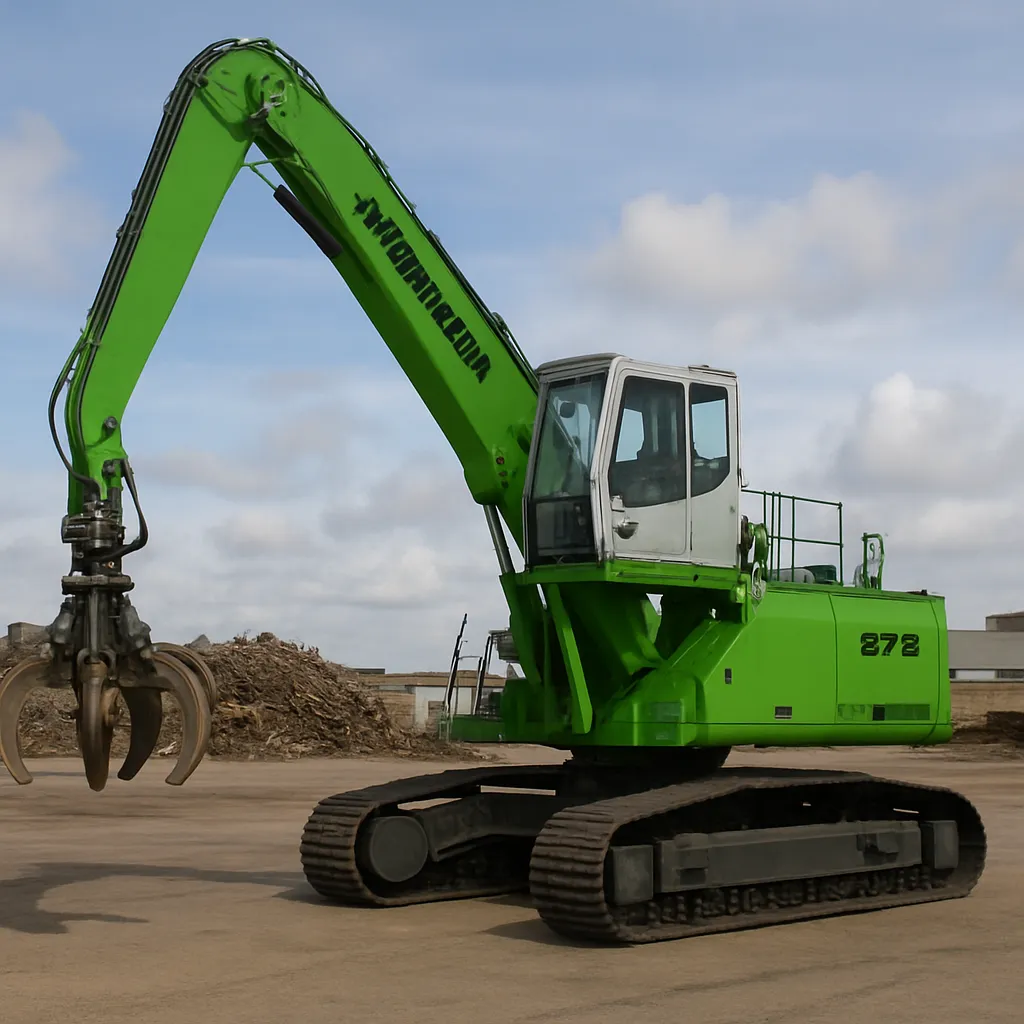
The SENNEBOGEN 875 E is a modern, heavy-duty material handler designed primarily for demanding tasks in ports, scrap yards, recycling centers, and bulk material handling facilities. Combining advanced hydraulics, an energy-efficient drive concept and a cab designed for long shifts, the 875 E targets companies looking for powerful handling performance with reduced emissions and lower operating costs. This article examines the machine’s typical uses, technical and ergonomic features, economic and environmental benefits, and practical tips for selection, operation and maintenance.
Applications and typical environments
The SENNEBOGEN 875 E is engineered for continuous material handling tasks where reach, precision and endurance are essential. Common application environments include:
- Port and terminal operations: loading and unloading bulk cargos such as coal, grain, wood chips and scrap metal, as well as handling containers and general cargo.
- Scrap yards and steelworks: sorting, loading and feeding scrap into furnaces, where robust attachments and good visibility are crucial.
- Recycling centers: separating and moving mixed materials, building stockpiles and feeding processing lines.
- Timber handling: moving logs, wood products and biomass with grapples and specialized forks.
- Bulk material terminals and stockyards: stacking and reclaiming bulk commodities with a long reach and stable load handling.
- Demolition and industrial cleanup: selective dismantling and material segregation with versatile attachments.
Because of its combination of reach, power and flexibility, the 875 E is especially popular where continuous 360-degree handling is required and where downtime or high fuel consumption are costly. The machine’s strength lies in repetitive cycle work: precision picking, loading trucks and railcars, and building or reclaiming stacks in a controlled, efficient way.
Key technical characteristics and design highlights
The SENNEBOGEN 875 E is part of SENNEBOGEN’s E-series focusing on electrification and efficiency. While specific numbers can vary with configuration and optional equipment, several core technical traits define the machine:
Drive concept and powertrain
- Electric drive: The 875 E uses an electric-hydraulic concept designed to reduce local emissions, noise and running costs. The machine can be run on a plug-in power supply where available, enabling zero-emission operation at the jobsite. In configurations for off-grid sites, hybrid or diesel-electric options may be offered depending on market and application.
- Energy recovery systems: Modern E-series handlers often include energy recovery during hydraulic lowering and swing phases, reducing overall power consumption and smoothing peak loads.
Hydraulic system and handling performance
- High-performance hydraulic circuits provide smooth, proportional control of boom, arm and attachment movements. This translates into precise material handling even with heavy or awkward loads.
- Designed for continuous operation, the hydraulic components and cooling systems are optimized for extended duty cycles typical in ports and scrap yards.
Reach and lifting capability
The 875 E is available in different boom and stick configurations to match reach and height requirements. Depending on the configuration, operators can expect:
- Long reach options for stacking and vessel loading/unloading.
- Shorter, more powerful configurations for heavy-duty scrap handling and loading tasks.
- Lifting capacity scaled to the intended role: strong close-in lift for grapples and clamshells, and sustained performance at working radii typical for bulk handling.
Chassis and mobility
- Available undercarriage options include tracked, wheeled and portal/gantry setups, depending on ground conditions and mobility requirements.
- Robust stabilization systems ensure safe operation when working at reach or handling heavy loads.
Operator environment and controls
- Operator comfort is a priority: panoramic cabs with excellent visibility, ergonomic joystick controls, adjustable seating and climate control are standard or widely available.
- Advanced displays and camera systems offer 360-degree awareness and assist with attachment control and safety.
- Intuitive control layouts and programmable settings let operators tailor the machine response to the task and personal preference.
Attachments and versatility
A significant strength of the 875 E is its ability to accept a wide variety of attachments, making one base machine suitable for many tasks:
- Hydraulic grapples for scrap and recycling
- Clamshell buckets for bulk handling and ship/unloading work
- Demolition and sorting grapples for selective dismantling
- Log grapples and timber forks for forestry and biomass
- Magnetic attachments and electromagnets for ferrous scrap handling
- Forks and lifting hooks for palletized goods and odd loads
The modularity of the machine permits rapid changeover between tasks, often within a single shift, which contributes to improved fleet utilization and lower capital cost per operation. Quick-coupler systems, hydraulic feed-throughs and electrical interfaces make switching attachments efficient and safe.
Environmental and economic benefits
The shift towards electrified material handlers like the 875 E is driven by both regulatory pressure and operational economics. Key benefits include:
- Sustainability: When operated on grid power supplied from renewable sources, the machine can achieve near-zero local emissions, improving air quality in ports and urban recycling facilities.
- Lower operating costs: Electricity can be significantly cheaper than diesel on a per-energy-unit basis. Additionally, reduced mechanical complexity in electric drivetrains often leads to lower maintenance bills.
- Noise reduction: Electric systems run quieter, which is beneficial for night operations in ports or near residential areas and reduces operator fatigue.
- Reduced heat and exhaust emissions enhance worker comfort and can lower site-level ventilation or dust-suppression demands.
Manufacturers and fleet operators report fuel savings and maintenance reductions when exchanging diesel-only machines for modern electric or hybrid handlers. Typical claims for such machines include reductions in fuel or energy costs by up to 30–60% and maintenance cost savings due to fewer mechanical components requiring routine servicing. These figures can vary widely with duty cycle, electricity tariffs and the exact powertrain configuration chosen.
Safety features and operator assistance
Safety in heavy material handling is paramount. The 875 E incorporates several systems to protect people, equipment and cargo:
- Comprehensive camera packages with rear and downward views, object detection and optional 360-degree systems reduce blind spots.
- Load monitoring systems and stability assist features help prevent overloads and tipping incidents.
- LED work lighting and audible/visual alarms increase jobsite safety during night or low-visibility operations.
- Optional remote-control capabilities or semi-autonomous assist modes allow operators to handle high-risk operations from safer positions.
Maintenance, diagnostics and lifecycle management
Modern handlers like the SENNEBOGEN 875 E are designed for straightforward servicing and long life. Key aspects include:
- Maintenance-friendly design: easy access to hydraulic components, filters and service points reduces downtime for routine checks and servicing.
- Integrated telematics and diagnostics provide real-time data on machine health, energy consumption and operating hours. Remote diagnostics can help minimize service visits and plan predictive maintenance.
- Modular component replacement and standardized parts lower repair times and spare-parts complexity across mixed fleets.
Telematics systems also supply managers with utilization metrics (hours, load cycles, idle time), which can be used to optimize scheduling and reduce total cost of ownership (TCO). Fleet operators commonly use these data streams to plan preventive maintenance and to identify operator training needs.
Performance benchmarks and typical specifications
Exact specifications for the SENNEBOGEN 875 E depend on configuration and market options. Below are representative, approximate figures and performance expectations compiled from manufacturer positioning and industry practice. Treat these as indicative ranges rather than exact guarantees:
- Operating weight: often in the range typical for large material handlers — mid tens to lower hundreds of tonnes depending on undercarriage and counterweight options (configurable to application).
- Working reach: multiple boom combinations allow working heights and reaches commonly up to roughly 20–25 meters in long-reach setups.
- Lifting capacity: high close-in lifting capacity for grapples and clamshells with safe lifting loads of several tonnes; capacity diminishes with increasing radius as per typical load charts.
- Power source: electric drive with grid or hybrid options; when electrified, operators commonly report significant reductions in fuel-related operating costs and noise emissions.
- Cycle times and productivity: optimized hydraulics and operator interfaces improve pick-and-place cycles versus older machines, particularly when combined with efficient attachment selection.
For procurement decisions, always consult the official SENNEBOGEN load charts and configuration sheets: lifting capacity varies by boom, stick, counterweight and attachment, and exact machine mass depends on undercarriage and options.
Economic considerations and return on investment
Investing in a high-capacity material handler like the 875 E involves evaluating capital cost, operating expense, resale value and jobsite productivity. Factors to weigh include:
- Energy cost differential: availability and price of electricity vs diesel at the operating site will strongly influence payback time for an electric or hybrid machine.
- Duty cycle: machines used in continuous, repetitive tasks (e.g., port unloading) tend to demonstrate faster ROI due to higher utilization and energy savings.
- Regulatory environment: emissions restrictions, noise regulations and incentives for low-emission equipment can make electric handlers more attractive financially.
- Fleet commonality: standardized attachments and shared components across a fleet reduce spare parts inventory and training complexity.
Operators report that in many port and recycling scenarios, electrified handlers achieve payback periods through combined savings in fuel, maintenance and downtime within a span that can be acceptable for medium to large operators — often measured in a few years depending on utilization. Exact ROI depends on local conditions.
Comparison with other machines and market positioning
Within SENNEBOGEN’s lineup and compared to competitor material handlers, the 875 E is positioned as a powerful, energy-efficient option for high-duty, continuous handling tasks. Key differentiators include its electric-drive focus (in E-series models), flexible attachment support and ergonomic cab design. Competitors may offer similar-sized handlers with diesel or hybrid drivetrains; the decision often comes down to energy availability, noise restrictions and life-cycle cost.
When comparing options, consider:
- Attachment compatibility and hydraulic power
- Available reach and lifting envelopes
- Energy and emissions profile
- Service network and parts availability in your region
Practical tips for selection and operation
To maximize the benefits of the SENNEBOGEN 875 E, consider the following practical guidance:
- Define the primary tasks: choose boom and undercarriage configurations optimized for the most frequent operations (e.g., long reach for stacking vs. compact, heavy-duty setup for scrap handling).
- Assess power availability: if operating at a port with shore power, a fully electric setup may be ideal. For remote sites, discuss hybrid or diesel-electric alternatives.
- Optimize attachments: invest in multi-use attachments and quick-change systems to reduce downtime and increase deployment flexibility.
- Leverage telematics: implement remote monitoring from day one to gather data that supports preventive maintenance and operator training.
- Train operators: take advantage of programmable control settings and ensure operators are trained to use energy-saving modes and attachment-specific techniques.
Case studies and real-world usage examples
Examples from the industry show that electrified material handlers like the 875 E excel where emissions reductions, noise limits or continuous heavy cycles are priorities. Typical outcomes reported by operators include:
- Improved throughput in ports due to continuous operation with less heat and noise-related pauses.
- Better working environment in recycling plants with lower airborne contaminants and reduced engine fumes.
- Reduced night-time disturbance near urban terminals due to quieter operation and cleaner emissions.
- Lower total maintenance hours per year when compared to older, diesel-only handlers in similar roles.
Final considerations
The SENNEBOGEN 875 E represents a blend of power, flexibility and modern drive concepts geared toward operators who want to minimize emissions, reduce operational costs and maintain high handling productivity. When evaluating whether the 875 E is right for a particular operation, the most important aspects to consider are the primary application (ports, scrap, recycling, timber), energy availability (grid power vs remote site), and desired attachments. Combining an optimal machine configuration with operator training, telematics-led maintenance and a strategic attachment portfolio typically yields the best lifecycle value and performance.
Key attributes that make the SENNEBOGEN 875 E attractive to modern material handlers include its efficiency, modularity, operator comfort, reliability, and potential for significantly improved environmental performance. For exact technical specifications, load charts and configuration options, consult an authorized SENNEBOGEN dealer to ensure the machine matches your operational needs.


)
)