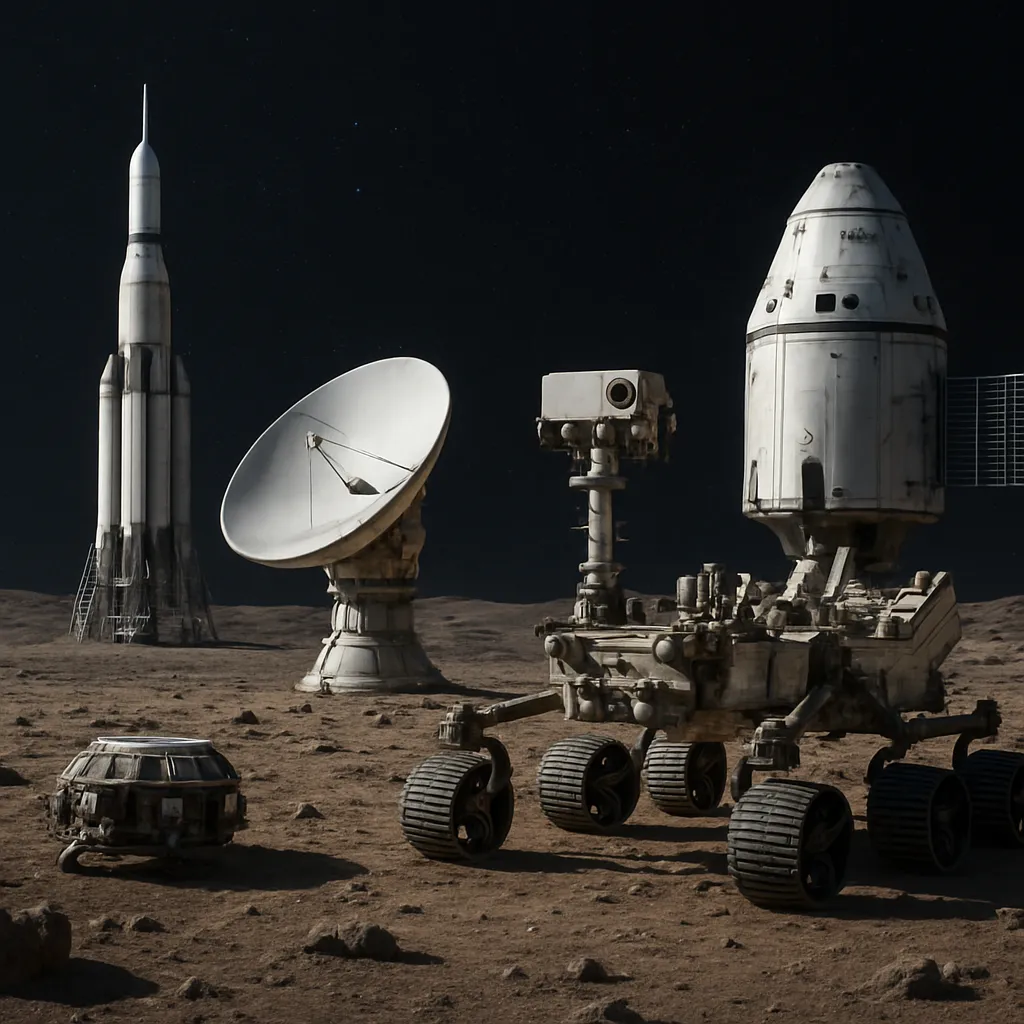
The exploration of space has driven the development of some of the most remarkable machines ever built. From robotic rovers traversing alien landscapes to spacecraft propelled by revolutionary engines, these technological marvels embody human ingenuity and drive the boundaries of our knowledge. This article examines the cutting-edge machines at work in space exploration, highlighting their unique capabilities, design challenges, and the future directions that promise to unlock the secrets of the cosmos.
Advanced Robotics for Extraterrestrial Terrain
Exploring other worlds requires machines with durability to withstand extreme conditions, precision to perform scientific tasks, and resilience to adapt to unexpected obstacles. Robotic explorers have become the stalwart pioneers on the surfaces of Mars, the Moon, and beyond.
Martian Rovers: Pushing Boundaries
- Curiosity: Equipped with a chemistry lab, environmental sensors, and multiple cameras, Curiosity has characterized Martian rocks and atmosphere since 2012, demonstrating remarkable resourcefulness in its autonomous decision-making.
- Perseverance: Launched in 2020, this rover features the SHERLOC instrument for detecting organic compounds, an advanced robotic arm, and the Ingenuity helicopter—the first powered flight on another planet. Its combination of mechanical dexterity and onboard computing exemplifies innovation.
- VIPER: Designed to prospect for water ice at the lunar south pole, VIPER will drill into permanently shadowed regions. Its robust design underscores the necessity of durability in cryogenic environments.
Lunar Hoppers and Surface Scouts
Smaller robotic platforms are emerging to explore difficult terrains:
- Hopping Robots use spring-loaded mechanisms or small thrusters to traverse craters where wheels cannot reach.
- Swarm Scouts work in groups, coordinating with artificial intelligence algorithms to map regions quickly and share data back to a lander or orbiter.
Innovative Propulsion Systems
Propelling spacecraft across vast distances demands breakthroughs in engineering and a deep understanding of physics. The evolution of propulsion is central to mission success, affecting travel time, payload capacity, and mission flexibility.
Chemical Rockets and Their Evolution
Chemical rockets remain the workhorse for escaping Earth’s gravity. Continuous improvements in propellant formulations, engine nozzle designs, and lightweight materials have increased thrust-to-weight ratios and reliability. Notable engines include:
- RS-25 (Space Shuttle Main Engine): Renowned for its reusability and high performance.
- Raptor (SpaceX): A full-flow staged combustion cycle engine running on methane and liquid oxygen, representing a leap in efficiency.
Electric and Ion Engines
Electric propulsion systems achieve higher efficiency by expelling ions at high velocities, trading thrust magnitude for extended burn time:
- Hall Effect Thrusters: Use a magnetic field to accelerate xenon ions. Employed on communication satellites for station-keeping.
- Gridded Ion Engines: Featured on NASA’s Dawn mission, they powered continuous low-thrust operations, enabling visits to Vesta and Ceres.
Next-Generation Concepts
- Solar Sails: Harnessing photon pressure from sunlight, they can achieve acceleration without propellant, illustrating ingenious use of natural forces.
- Nuclear Thermal Propulsion: Heating propellant with a nuclear reactor offers higher specific impulse, cutting transit times to Mars.
Autonomous Spacecraft and AI-driven Systems
Communication delays and limited bandwidth necessitate spacecraft endowed with onboard decision-making capabilities. Autonomy allows machines to respond rapidly to unforeseen conditions and carry out complex tasks without real-time human intervention.
Onboard Artificial Intelligence
AI systems handle tasks such as hazard avoidance, science target selection, and system health monitoring. Examples include:
- AutoNav: Used on the Deep Space 1 mission to autonomously navigate through an asteroid belt.
- Cognitive Electronics: Embedded in rovers to optimize power usage, extend mission life, and reroute tasks after component failures, showcasing adaptability.
Deep Space Network and Edge Computing
While the Deep Space Network provides critical communication, onboard robotic platforms rely on edge computing to process sensor data locally. This approach reduces the need for constant uplink/downlink and enables real-time responses.
Future Machines Shaping Deep Space Missions
Advancements in materials science, additive manufacturing, and system miniaturization are paving the way for unprecedented mission architectures. Upcoming machines promise to further expand humanity’s reach into the cosmos.
In Situ Resource Utilization (ISRU) Systems
Harvesting local materials aboard the Moon or Mars could sustain long-term endeavors. ISRU prototypes include:
- Regolith Processors: Convert lunar soil into oxygen and building materials.
- Water Extractors: Deployable drills that tap into subsurface ice to provide life support and propellant feedstock, emphasizing resourcefulness.
3D Printing and Autonomous Assembly
Robotic construction systems aim to manufacture habitats and large structures in space. Key developments:
- Sandhya: A Mars-based 3D printer that uses regolith simulant to build protective shelters.
- Self-Assembling Modules: Configurations of robotic cubes that autonomously connect to form spacecraft elements, reflecting unprecedented innovation.
Long-Duration Surface Drones
Future explorers may include atmospheric drones on Titan, solar-powered balloons on Venus, or submersible vehicles in Europa’s ocean. Each design will demand unique solutions in energy management, pressure resistance, and navigation.
Conclusion