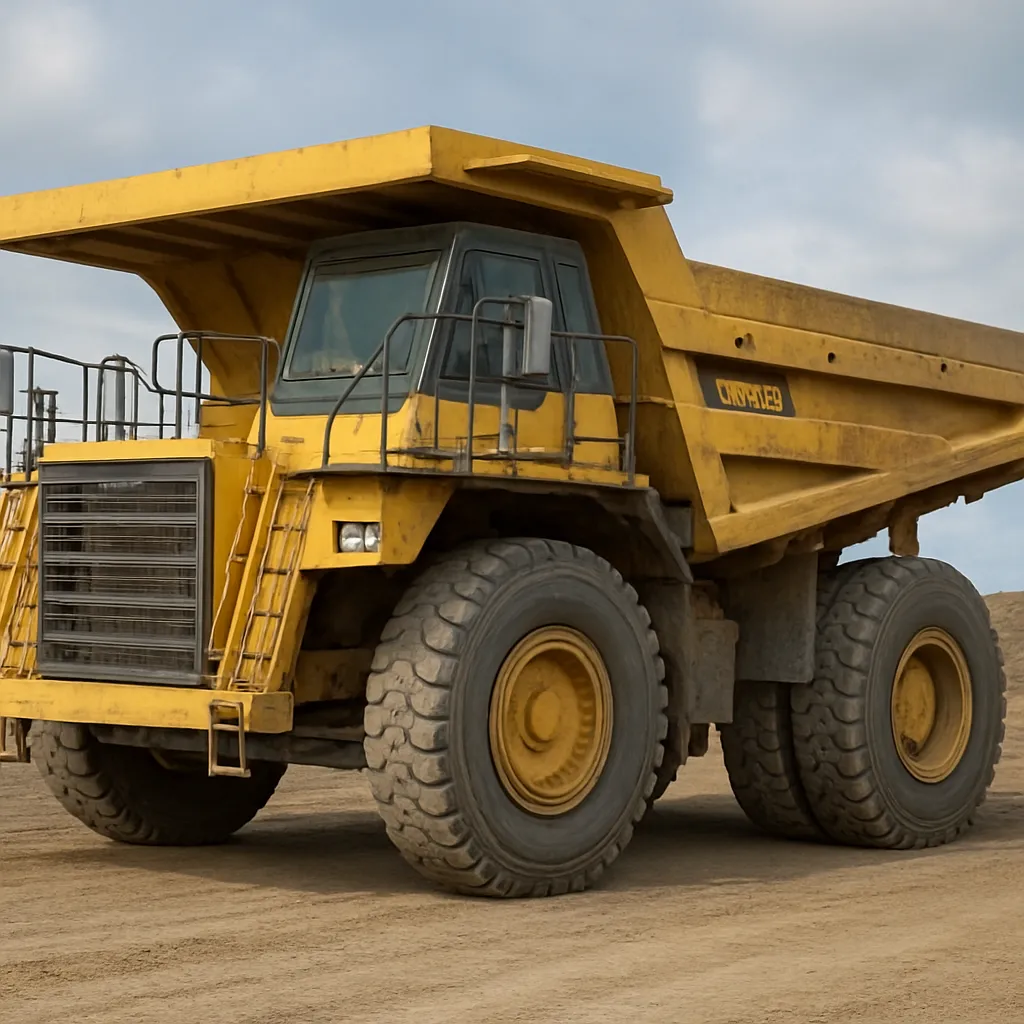
The Komatsu HD785-7 is a heavy-duty rigid frame haul truck designed for large-scale mining, quarrying and earthmoving operations. Combining Komatsu’s decades of experience in off-highway equipment with a focus on reliability and serviceability, the HD785-7 delivers robust performance in tough environments. In the following sections you will find an overview of its design and technical concepts, typical applications, operational and maintenance considerations, and relevant performance statistics and real-world implications.
Overview and key design features
The HD785-7 is part of Komatsu’s HD series of rigid-frame haul trucks and is intended to carry heavy loads over rough terrain while offering straightforward maintenance and high uptime. The truck’s structure and components are engineered to withstand continuous operation under abrasive and high-impact conditions commonly found in open-pit mining and large construction sites.
- Robust frame: The chassis is built to resist fatigue and torsional stresses associated with heavy payload cycles.
- Powertrain: Designed to provide reliable traction and gradeability with an emphasis on torque delivery and cooling capacity for sustained heavy work.
- Body and dump system: Steel bodies with optional wear packages and tailored dump angles for efficient material discharge.
- Serviceability: Ground-level service points, modular component layout and accessible filters to reduce downtime.
- Telematics and monitoring: Integration with fleet management tools for productivity tracking and remote diagnostics.
The HD785-7 balances simplicity with modern features. Instead of overcomplicated systems, Komatsu focused on components that improve life-cycle availability — from easy-to-replace wear parts to cooling and filtration systems that extend maintenance intervals.
Typical specifications (approximate and configuration-dependent)
Values and figures for heavy equipment vary by market, specification package and optional equipment. The following figures are provided as representative ranges and should be verified against the exact vehicle configuration and Komatsu documentation before procurement.
- Rated payload: approximately 60–65 metric tonnes (about 66–72 short tons)
- Gross operating weight: depending on configuration, typically in the order of 100–120 metric tonnes
- Engine power: diesel power units in this class commonly deliver in the range of 500–700 kW (670–940 hp) depending on tuning and emissions package
- Top speed: on level ground typically 50–60 km/h (31–37 mph), though actual speed varies with load and safety settings
- Fuel capacity: large tanks in the 1,000–1,500 litre range to support long shift operations without frequent refuelling
- Turning radius: designed for mining road geometry with steering and braking tuned for heavy loads
- Tires: radial off-road mining tires, sizes and ply ratings vary by operating conditions
These indicative data points provide a picture of a truck capable of moving tens of thousands of tonnes per shift when integrated into a coordinated mining haul cycle. Final specification sheets from Komatsu or an authorized dealer will provide exact engine model numbers, emission tiers (e.g., Tier 3, Tier 4 / Stage IV compliance depending on market), and option packages.
Applications and industries
The primary application for the HD785-7 is high-productivity material transport in rough terrain and long-cycle haulage:
- Open-pit mining: Haul roads, ore benches and waste rock removal, especially where a combination of payload, durability and maintainability is required.
- Large quarries: Movement of blasted rock to crushers and processing plants.
- Major earthworks and infrastructure projects: Road construction, dam building and large-scale excavation where bulk material must be moved efficiently.
- Stockpile and transfer: Integration into conveyor and loading systems for bulk handing operations.
Because the HD785-7 is built for sustained heavy duty cycles, it excels in operations that require regular, repeated loading and hauling of abrasive materials. The truck is particularly well-suited to fleets that prioritize high uptime and straightforward on-site repairs.
Performance, fuel consumption and productivity
In heavy haulage, measured performance is not only about top speed or peak horsepower; it is about the combination of cycle times, payload utilization, tyre life, and fuel efficiency. Several factors determine real-world fuel consumption and productivity for the HD785-7:
- Haul road profile (grades and curvature)
- Average payload per trip and load factor
- Type of material (density and abrasiveness)
- Operator behavior and settings (engine maps, retarder usage)
- Auxiliary equipment and climate control demands
Typical fuel consumption for machines in this payload class under mixed duty can range from roughly 60 to 150 litres per hour depending on load and duty cycle. Productivity gains are realized by optimizing cycle time (minimizing empty travel and maximizing payload per trip), improving loading efficiency and reducing downtime through preventive maintenance. For instance, a properly maintained truck operating near its rated payload on well-maintained haul roads can move several thousand tonnes per shift; exact throughput depends on local conditions and fleet logistics.
Operator comfort, controls and safety systems
Komatsu designs operator compartments to reduce fatigue and improve visibility, which contributes to safety and higher productivity over long shifts. The HD785-7 includes ergonomic seating, well-arranged controls and instrumentation, and effective HVAC systems to maintain operator performance.
- Cab layout: Elevated seating position for improved sightlines over the hood and dump body.
- Ergonomics: Adjustable seats, armrests and controls to reduce fatigue.
- Visibility aids: Optional cameras and mirrors to reduce blind spots around the truck.
- Safety systems: Rollover protection, high-visibility paint options, and braking systems designed for heavy loads. Many operators fit proximity detection systems and automatic payload/overload warnings.
- Telematics: Fleet management integration (e.g., Komatsu’s fleet monitoring systems) provides remote data on location, fuel use, operating hours and fault codes.
These elements combine to give fleet managers the data and operators the tools needed to improve cycle efficiency and reduce incidents related to human error or component failure.
Maintenance, uptime and lifecycle costs
One of the selling points of Komatsu’s HD trucks is a focus on reducing total cost of ownership through extended service intervals, modular components, and dealer support networks. Key maintenance considerations include:
- Preventive maintenance: Scheduled inspections of powertrain, driveline, brakes and hydraulic systems to detect wear early.
- Wear parts: Easily replaceable dump body plates, tires, brake components and undercarriage consumables.
- Cooling and filtration: Heavy-duty filters and cooling packages to protect the engine under dusty and hot conditions.
- Remote diagnostics: Telematics enable remote fault detection and parts ordering to minimize downtime.
Lifecycle cost is influenced by fuel consumption, parts availability, ease of service and operator practices. Fleets that adopt continuous monitoring and condition-based maintenance typically realize significant reductions in unscheduled downtime and cost per tonne moved. Komatsu dealers often provide service agreements and parts support that further stabilize operating costs.
Environmental and regulatory considerations
Large haul trucks are subject to emissions regulations and noise limits in many jurisdictions. Komatsu offers engine configurations and after-treatment systems to meet regional requirements (for instance, various tiers and stages of diesel emissions). Operators should verify compliance when importing or deploying equipment in countries with strict emissions standards.
- Emissions options: Selectable engine packages and exhaust after-treatment to match local rules.
- Fuel strategies: Optimization of engine maps and retarder use to reduce fuel burn and CO2 output.
- Noise mitigation: Cab insulation and mufflers to reduce operator exposure and community impacts near work sites.
Using telematics and fuel management tools, mines and construction firms can track fuel consumption per tonne moved and benchmark improvements from operational changes or equipment upgrades.
Case studies, fleet integration and real-world examples
In many open-pit operations, Komatsu HD-series trucks are integrated with wheel loaders, excavators and dump infrastructure to create efficient work cycles. Typical improvements reported by mines on similar trucks include:
- Reduced downtime via scheduled parts replacement and telematics-based fault management
- Improved payload compliance through onboard weighing systems and driver feedback
- Lower fuel burn per tonne by coordinated fleet routing and optimized engine maps
For example, a quarry that replaced older-generation haul trucks with HD-series units often sees an initial jump in availability and a decline in maintenance man-hours due to simplified servicing and better parts coverage. Specific percentage improvements depend on baseline conditions, but fleet managers commonly report double-digit reductions in unscheduled maintenance events within the first year after modernization.
Buying considerations and fleet planning
When evaluating the HD785-7 for purchase or lease, consider the following:
- Match capacity to demand: Avoid oversizing or undersizing trucks relative to excavator or loader capacities to maintain balanced cycles.
- Consider tyre strategy: Tyre choice and life have a major impact on operating cost and should be tailored to road surface and rock type.
- Check local support: Availability of spare parts and qualified technicians from dealers reduces potential downtime.
- Spec options: Evaluate optional packages such as upgraded cooling, heavy-duty body liners and advanced telematics to meet site-specific needs.
- Lifecycle economics: Analyze total cost of ownership, not just acquisition price—include fuel, parts, expected tyre life, and resale value.
Work with Komatsu representatives and independent consultants to model expected tonnes-per-hour and cost-per-tonne over the truck’s lifetime, using site-specific data for haul distances, grades, and material characteristics.
Final remarks and practical tips
The Komatsu HD785-7 is a capable and pragmatic solution for operations requiring large, reliable rigid-frame haul trucks. Its design emphasizes durability, serviceability and integration with modern fleet management systems. To extract maximum value consider the following practical tips:
- Implement telematics early to establish baseline performance and detect trends.
- Train operators on fuel-efficient driving techniques, payload targeting and proper use of retarders to extend brake and engine life.
- Plan tyre procurement and rotations to balance cost and uptime.
- Adopt condition-based maintenance for major components to extend service intervals where appropriate.
- Review emission and noise regulations to select the correct engine and after-treatment package.
By combining solid equipment selection with disciplined operational practices, the HD785-7 can be a cornerstone of a high-throughput, cost-efficient hauling fleet capable of meeting the demands of modern mining and large civil engineering projects.


)
)