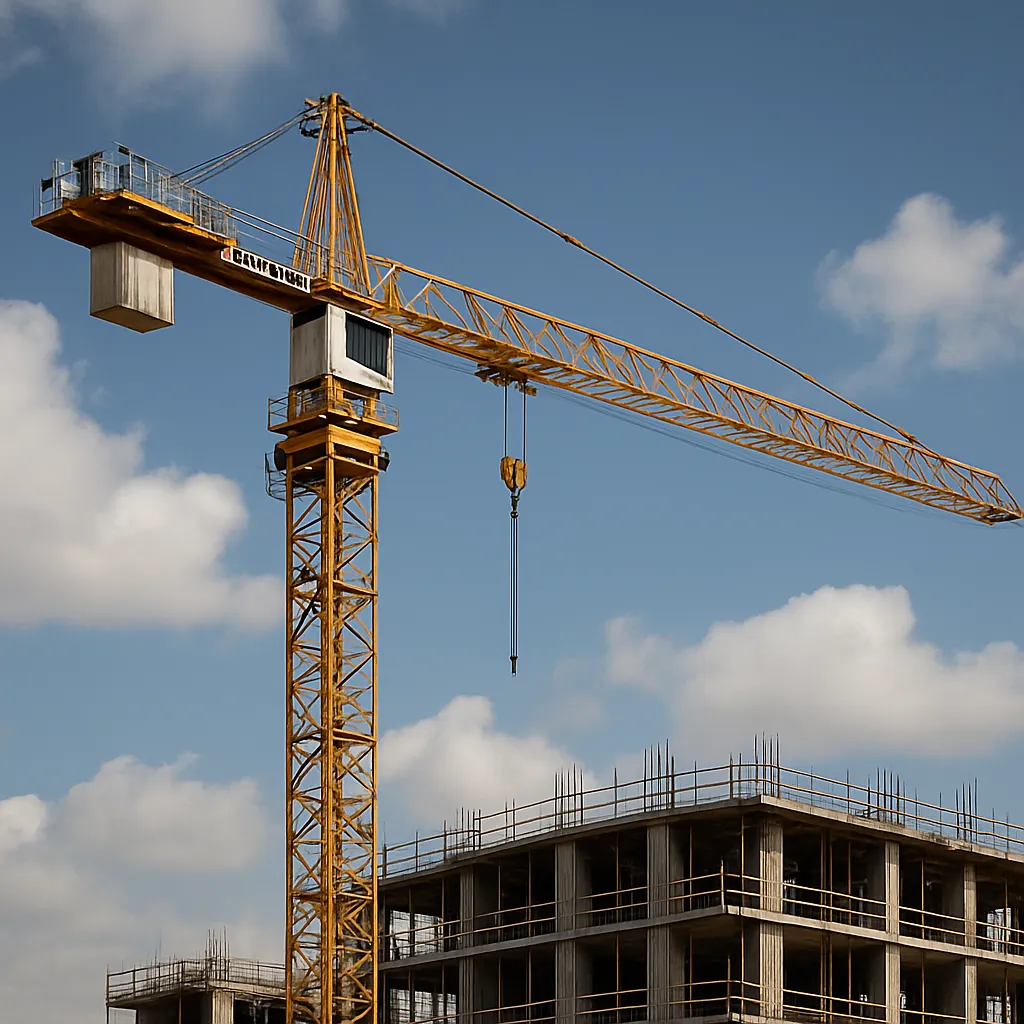
The Liebherr 630 EC-B Litronic is a representative of modern high-capacity tower crane engineering, combining tried-and-tested mechanical design with advanced electronic controls. Used widely on large construction, industrial and infrastructure sites, this machine exemplifies the emphasis on safety, reliability and operational efficiency that contractors demand. The following article describes the crane’s design principles, typical applications, technical characteristics, operational considerations and relevant industry information to help owners, operators and project planners understand where and how this model performs best.
Design and key technical features
The Liebherr 630 EC-B Litronic series belongs to a class of flat-top tower cranes engineered for demanding projects where a combination of reach, height and lifting performance is required. The suffix Litronic denotes the integrated electronic control architecture that Liebherr uses to supervise hoist motors, slew drives, load moment limiting, and operator interfaces.
Core design elements include:
- Robust mast and slewing system – the crane’s mast sections are modular to permit flexible adjustment of free-standing height and tower tie-in intervals, while the slewing unit is sized to handle continuous rotational loads and frequent repositioning during complex lifts.
- Modular jib – the jib (or boom) is supplied in sections allowing various maximum radii depending on the site requirements. This modularity lets owners tailor reach versus lifting capacity trade-offs.
- Advanced control system – the Litronic control package integrates load monitoring, limiting and automatic safe-operations logic, with diagnostics and sometimes remote status reporting, reducing downtime and improving safety margins.
- Efficient powertrain – new-generation frequency-controlled electrical drives for hoist and trolley motors deliver smoother motion profiles, better load control and improved energy use; many installations also incorporate energy recovery or stand-by management.
- Transport and erection concept – the crane is engineered for comparatively quick assembly using adapted components that can be transported on standard low-loaders and assembled on-site with minimal auxiliary equipment, depending on layout.
Applications and where the crane is used
The 630 EC-B Litronic is designed for large-scale construction and industrial operations. Typical applications include:
- High-rise residential and office towers where tall mast heights and long jibs are required to deliver materials across working faces.
- Commercial complexes and shopping centers with heavy prefabricated concrete elements that demand reliable high-capacity lifts.
- Industrial sites such as power plants, refineries and factories where heavy, awkward components (heat exchangers, generators, presses) are installed.
- Bridge and civil engineering works, where long reach and fine positioning are necessary to place sections and formwork.
- Wind turbine and large infrastructure assembly tasks when coupled with special lifting accessories and experienced rigging crews.
Projects that favor the 630 EC-B typically require a combination of mid-to-long radius reach and substantial point load capability near the mast. The model’s adaptability means it frequently appears on urban developments where footprint constraints and the need to work around neighboring structures are significant considerations.
Performance characteristics and typical specifications
Manufacturers often offer several configurations and optional packages, so exact numbers vary by market and build. The following figures reflect typical ranges and performance characteristics commonly associated with cranes in the 630 EC-B family and similar Liebherr EC-B models.
- Lifting capacity (maximum): typical maximum hook load ranges from approximately 6 to 12 tonnes in standard configurations. At shorter radii the crane can handle its highest capacities, while capacity decreases toward the jib tip.
- Rated moment and load curve: load-moment characteristics vary by jib length and ballast arrangements. The crane’s load chart is used to determine permitted loads at each radius, and modern Litronic systems provide real-time monitoring to enforce these limits.
- Jib length (radius): depending on the configuration, jib lengths are commonly available in modules that allow overall lengths from about 40 m up to 70–80 m for extended-reach versions.
- Height under hook: free-standing height and tie-in heights depend on mast section count. Typical solutions deliver hook heights from 30 m up to 80+ m when freestanding or tied into building structures; with climbing kits, substantially greater heights are feasible for skyscraper construction.
- Hoist speeds: main hoist hoisting speeds usually range from a few meters per minute (for heavy loads) up to 100–160 m/min on light loads. Trolley speeds typically range up to 40–50 m/min depending on configuration.
- Slewing speed: the crane’s slewing drive provides variable rotational speeds optimized for safe and efficient load handling; typical maximal slewing speeds are in the range of several revolutions per minute depending on load and control settings.
- Power: electric drives are commonly employed, with total installed motor power depending on the option package (motors for hoist, trolley, slewing, and auxiliary systems). Site supply commonly requires three-phase electric power at appropriate voltage levels or use of onsite generators when mains are unavailable.
These ranges are indicative. For project planning, always consult the manufacturer’s official load charts and configuration documentation supplied with the specific crane order to determine exact capacities at given radii, heights and ballast conditions.
Controls, automation and safety systems
The Litronic control suite is a core differentiator. It integrates multiple safety and automation features:
- Real-time load monitoring and load-moment limiting to prevent operation beyond rated capacity.
- Active safety interlocks such as velocity limits, anti-collision logic, and wind-monitoring inputs.
- Operator ergonomics including intuitive displays, programmable lifting profiles, and error diagnostics to reduce human error and simplify troubleshooting.
- Optional anti-collision systems for managing multiple cranes on congested sites; these coordinate positions and movement envelopes to prevent interference.
- Remote diagnostics and data logging (in many installations) that allow fleet managers to track performance, maintenance needs and usage statistics to optimize utilization.
Safety is further enhanced by mechanical redundancies (e.g., secondary brakes), certified wire ropes and slings, and manufacturer-prescribed inspection regimes. Operators must be trained and certified in accordance with local regulations and site rules, and lifting plans should always reflect the crane’s certified load charts.
Maintenance, inspection and lifecycle management
Reliable operation depends on a proactive maintenance strategy. Typical maintenance and inspection items include:
- Daily pre-shift visual and operational checks of hoist ropes, brakes, safety devices and electrical systems.
- Periodic lubrication of slewing bearings, hoist drivelines and pivot points as specified by the manufacturer.
- Scheduled thorough inspections (monthly/quarterly) to detect early wear in ropes, sheaves, couplings and structural members.
- Annual statutory inspections and load-testing in many jurisdictions to confirm continued safe service.
- Planned component replacement cycles for high-wear parts such as wire ropes and braking linings.
- Software updates and control system calibration to maintain accuracy of protections and diagnostics.
Ownership costs are influenced by duty cycle, environmental conditions (corrosive environments accelerate wear), and the quality of preventive maintenance. The Litronic diagnostic tools help reduce downtime by enabling condition-based maintenance and early fault detection.
Economic and environmental considerations
From an economic perspective, the 630 EC-B Litronic seeks to maximize uptime and reduce operating costs by combining robust mechanical design with electronic controls. Key points include:
- Reduced labor and time for complex lifts due to precise control and programmable lifting sequences.
- Lower fuel costs where electric drives are used and site power is available; compared to diesel-driven mobile alternatives, electric tower cranes can have lower operational expenses.
- Long-term value retention when maintenance schedules and manufacturer recommendations are followed, helping preserve resale value.
Environmental benefits often come via energy-efficient motors and control strategies that minimize peak power demand. Additionally, quieter electric drives reduce noise pollution on urban sites. For projects requiring low emissions, the combination of electric crane operation and careful scheduling supports greener construction practices.
Operational best practices and site planning
Optimizing the crane’s role on a construction site begins at the planning phase:
- Integrate the crane’s load charts and footprint into the project schedule and material logistics planning to minimize repositioning and auxiliary lifting.
- Plan for appropriate ballast, counterweights, and crane foundations early in the civil and structural design to prevent costly late changes.
- Define coordinated lift and exclusion zones for safety, and apply anti-collision coordination when multiple cranes operate on a single site.
- Schedule lifts to take advantage of lower wind periods and coordinate with other trades to ensure unobstructed lift paths.
- Use manufacturer training and certified operators to reduce the risk of incidents arising from incorrect rigging or improper use of load charts.
Proper rigging, tag lines, communication between operator and rigger (via radio or signal) and adherence to documented lifting plans are integral to safe lift completion.
Case examples and industry statistics
The 630 EC-B Litronic family is typically selected for jobs where combination of reach and capacity is important. Examples of project types where similar Liebherr cranes have been deployed include large urban mixed-use developments, heavy industrial plant upgrades and bridge segment erections. While exact deployment numbers for a single model like the 630 EC-B are not publicly enumerated by most manufacturers, some broader statistics and observations help contextualize its market role:
- Liebherr is among the global leaders in tower crane manufacture, with thousands of tower cranes of various models operating worldwide across residential, commercial and industrial segments.
- Market demand for flat-top, high-capacity tower cranes tends to increase in regions with dense urban construction and high-rise development, notably parts of Europe, Asia and the Middle East.
- Fleet management data from construction companies generally shows that cranes with integrated diagnostic systems reduce unscheduled downtime by a measurable margin (often quoted improvements in uptime of 10–25% depending on maintenance discipline).
- Modern tower crane electrification and high-efficiency drive packages can reduce energy consumption per lift cycle compared with older models, contributing to lifecycle cost reductions over typical service lives of 15–25 years or more with proper refurbishment.
Because detailed production or sales figures for a particular model are commercially sensitive, project managers typically evaluate the 630 EC-B Litronic through direct consultation with Liebherr or regional dealers to obtain configuration-specific performance data and total cost of ownership estimates.
Advantages and limitations
Advantages of the 630 EC-B Litronic include:
- Balanced combination of reach and capacity for many heavy-duty urban and industrial applications.
- Advanced control electronics that improve safety, diagnostics and operator support.
- Modular design that allows adaptation to different site constraints and tower heights.
- Potential energy savings and lower operational noise compared with older designs.
Limitations and considerations:
- Transport and assembly require careful planning, particularly in constricted urban environments where road and crane access is limited.
- Initial capital and installation cost can be high relative to small mobile cranes, but are often justified by productivity on large projects.
- Specialist maintenance and operator training are required to fully benefit from the Litronic systems and preserve safety margins.
Buying, renting and lifecycle options
Contractors usually choose between purchasing, long-term lease or short-term rental depending on project duration and fleet strategy. Considerations include:
- For single, complex projects with extended timelines, purchasing or long-term leasing may be more economical.
- For short-term needs or when a fleet must remain flexible, renting with a supplier that offers erection and operator services can reduce logistical burdens.
- Refurbishment and upgrade programs (for example, control system upgrades or replacement of ropes and winches) can extend economic life considerably.
- Manufacturers and dealers typically offer tailored support packages including training, spare parts kits and maintenance contracts to match owner preferences and budget.
Summary and final remarks
The Liebherr 630 EC-B Litronic is a versatile, modern tower crane solution tailored to larger construction and industrial projects that require a reliable mix of reach, capacity and advanced electronic supervision. Its strengths lie in a modular structural design, an integrated control system that raises safety and productivity, and the capacity to be configured for a wide variety of jobsite conditions. While precise technical specifications vary with configuration and market, the crane’s design philosophy emphasizes operational efficiency, durability and ease of integration into complex construction logistics.
)
)