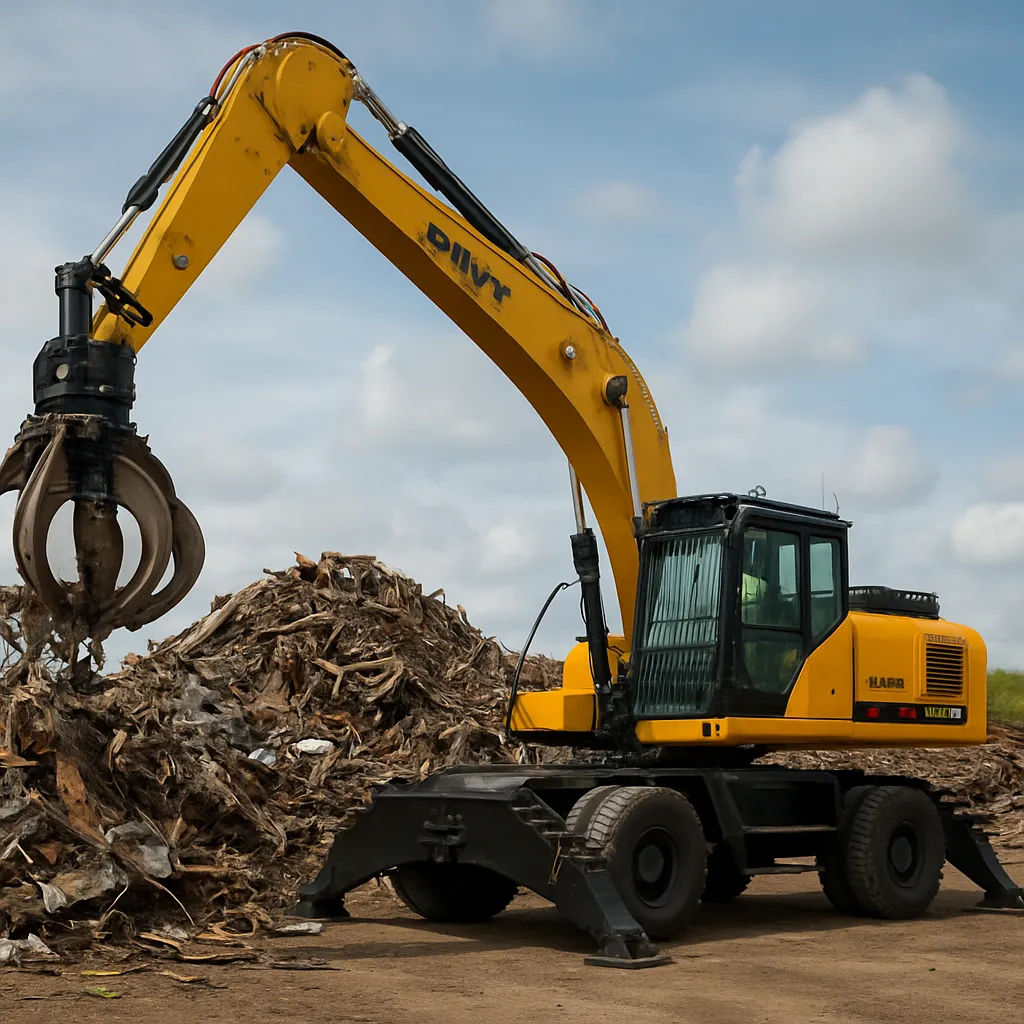
The SANY SMHC45 is a purpose-built material handler designed for heavy-duty loading, sorting and stacking tasks in industrial environments. Combining SANY’s manufacturing scale with targeted engineering for high-reach, high-durability operations, the SMHC45 targets sectors where precision, uptime and lifecycle cost matter most. In the following sections we will explore the machine’s design philosophy, typical technical characteristics, common applications, attachment options, operator features, maintenance considerations and economic impact. Wherever precise numerical figures are mentioned they are presented as typical or approximate values representative of this class of machines.
Overview and design philosophy
SANY positioned the SMHC45 within its lineup to answer demand for a versatile, reliable unit in the roughly 40–50 tonne category of dedicated material handlers. The core design priorities reflect three interdependent goals: maximize operational productivity, ensure long service intervals and improve operator ergonomics. That combination makes the SMHC45 suitable for continuous cycle tasks such as scrap handling, port operations, recycling yards and bulk material transloading.
Key design elements found in the SMHC45 series include a robust undercarriage with heavy-duty slewing ring and reinforced boom structure, a dedicated high-reach boom and stick arrangement (often with multi-section boom options), and an upper-structure layout that prioritizes service access to the engine, hydraulic pumps and filtration systems. The machine balances mass distribution to provide stable lifting characteristics during high-reach operations while maintaining the mobility and transportability required between job sites.
The cabin is typically mounted with full rotational visibility to the working area and is isolated from vibrations and noise to preserve operator comfort during long shifts. Modern SMHC45 units will often be offered with an optional rotating cab or fully rotating upper structure to provide flexibility in confined sites where repositioning the base is inefficient.
Technical features and typical specifications
While SANY offers variations and optional packages, the SMHC45’s class-defining characteristics are broadly consistent across markets. The model name indicates a machine optimized for medium-heavy material handling tasks, and the following figures should be treated as typical ranges for machines in this class rather than single definitive values.
- Operating weight: commonly in the range of 35,000–50,000 kg depending on configuration and counterweight choices.
- Engine power: diesel engines delivering approximately 150–300 kW (200–400 hp) depending on emission stage and tuning; many marketplace variants meet modern Tier 4 / Stage V or equivalent standards where required.
- Lifting reach: booms and sticks for the SMHC45 class are configured for reach between 8 and 15 metres (26–49 ft) for standard grapples; specialized long-reach options extend beyond this for specific port or scrap yard needs.
- Lifting capacity: safe working loads depend on reach and attachment — typical maximum lift close to the machine may be in the 6–8 tonne range, while rated lifts at full reach are substantially lower. These values vary with counterweight and attachment geometry.
- Hydraulic system: high-flow axial piston or variable-displacement pumps with load-sensing controls to provide smooth, efficient multi-function performance and compatibility with high-demand attachments such as electromagnets and shear units.
- Travel and swing: robust slew system (often with planetary gearing), travel motors sized for yard mobility rather than highway speeds, and swing speeds optimized for cycle efficiency and safety.
- Fuel consumption: depends on duty cycle and attachment — typical material-handler duty cycles yield specific fuel consumption lower than older generation machines thanks to hydraulic optimization and advanced engine controls; modern units often include eco and heavy modes.
The machine often integrates central lubrication points and grouped service locations, which reduce downtime for scheduled maintenance. Filtration systems for engine oil, hydraulic oil and fuel are engineered for heavy contamination environments typical of demolition and scrap handling.
Attachments and customization
A material handler’s versatility is defined primarily by its attachments. The SMHC45 is designed to accept a wide range of tools to address different materials and tasks. Typical attachments include:
- Hydraulic grapples — orange-peel grapples for scrap and general bulk; log grapples for timber; demolition grapples for selective dismantling.
- Electromagnets — for efficient handling of ferrous scrap in recycling yards and ports; magnet sizing and lift rating are matched to the machine’s hydraulic and electrical capacity.
- Shears and rotating shears — for cutting and sorting structural steel and scrap metals; often fitted with quick-change couplings for rapid tool swaps.
- Clamshell buckets — for bulk materials and transloading operations in ports and terminals.
- Sorting and rotating grapples — with motorized rotation for precise placement and orientation of loads.
Customization options from the factory or authorized dealers commonly include extended-reach booms, different counterweight packages for improved stability, weatherproofing for marine environments, and integrated camera systems for blind-spot reduction. Quick coupler systems are standard options that significantly reduce downtime when switching tools, increasing machine utilization on multitask sites.
Applications: where SMHC45 excels
The SMHC45’s capabilities suit it to a broad set of industrial scenarios. Primary application areas include:
- Scrap and recycling yards: high-frequency pick-and-place cycles, sorting of mixed waste streams, and loading/unloading of trucks and rail wagons.
- Ports and terminals: handling of breakbulk materials, steel products, coils and scrap using grapples and electromagnets; the machine can be configured for quay-side work or for stacking in open storage areas.
- Timber yards: log stacking, sorting, and loading operations where specialized log grapples and cab visibility are essential.
- Demolition and material recovery: selective dismantling, sorting of demolition debris, and feed operations to crushers and conveyors when equipped with shears and sorting grapples.
- Industrial yards and bulk material handling: managing ores, aggregates and processed bulk where clamshell or grapple attachments are used.
In each of these applications, the material handler’s distinguishing trait is its ability to combine reach and dexterity with continuous-duty hydraulic systems that handle repetitive cycles without thermal or power degradation.
Operator comfort, controls and safety features
Long shifts and precision handling demand an operator environment that reduces fatigue and increases situational awareness. Common cabin and operator features for the SMHC45 include:
- Ergonomic controls: proportional joysticks with low-effort actuation, adjustable pedals, and configurable control maps for different operators or tasks.
- Visibility aids: large glazed areas, 360-degree windows in some configurations, and optional 360° camera systems with zoom and object-tracking overlays.
- Climate control: heating and A/C with filtered ventilation to reduce dust ingress, improving comfort and component longevity.
- Noise and vibration reduction: cab mounts and acoustic insulation tailored for yards with continuous operations.
- Safety systems: overload protection, boom/cab interlocks, load-moment indicators (LMI), emergency stop systems and optional anti-collision packages for crowded terminals.
Telematics integration is increasingly standard: remote monitoring provides data on operating hours, fuel consumption, fault codes and geolocation. Fleet managers use these insights to schedule preventative maintenance, optimize machine allocation and analyze productivity per shift or per attachment.
Maintenance, serviceability and uptime strategies
Material handlers operate in abrasive, high-shock environments. The SMHC45’s design emphasizes easy access to wear items and routine service points to maximize uptime:
- Grouped service points for filters and fluids to reduce service time.
- Robust protection for hydraulic hoses and cylinders, with abrasion guards in contact areas.
- Replaceable wear plates on the boom foot and attachment pins sized for quick change.
- Monitoring systems for hydraulic oil condition and engine parameters to predict failures before they occur.
Routine maintenance intervals vary by duty cycle but typically include daily visual checks, weekly greasing and filter inspections, and more comprehensive servicing at manufacturer-recommended hour milestones (e.g., 250h, 500h, 1000h intervals). Using OEM parts and authorized service networks preserves warranty coverage and supports residual value at resale.
Economic considerations and productivity metrics
Purchasing or leasing an SMHC45 involves capital cost as well as operational expenses. The total cost of ownership (TCO) should consider:
- Acquisition cost: depends on options, attachment packages and local taxes/import duties.
- Fuel costs: shaped by duty cycle; high-frequency short-cycle scrap handling will show different consumption patterns than long-reach port stacking.
- Maintenance and parts: wear components (teeth, pins, hoses, seals) are consumables whose replacement cadence determines maintenance spend.
- Productivity: often measured in tonnes per hour (t/h) or cycles per hour; an SMHC45 equipped and operated optimally can deliver high throughput compared with smaller handlers or wheeled loaders when working at heights or in sorting tasks.
- Resale value: depends on maintenance history, hours, condition of the upper structure and presence of high-value attachments like electromagnets.
To quantify productivity, operators often benchmark throughput for a specific attachment and task. For example, in scrap handling with an orange-peel grapple, a well-configured handler in a busy yard might average from 150 to 400 t/h depending on load density, cycle times, operator skill and logistics flow. These are indicative ranges and actual results will vary.
Environmental and regulatory factors
Environmental regulations influence engine choice and emissions controls. SANY and other OEMs provide engines meeting relevant regional standards (e.g., EPA Tier 4 Final / EU Stage V) and often include selective catalytic reduction (SCR) or diesel particulate filter (DPF) systems. Benefits include:
- Reduced NOx and particulate emissions to meet local air-quality rules.
- Improved fuel efficiency through electronic engine management.
- Optional hybrid or electrified solutions on some material handler lines (where available) that lower site emissions and noise — especially beneficial for indoor or urban terminals.
Sustainability considerations also extend to recyclability of materials, remanufactured components, and programs to reduce life-cycle carbon footprint. Site managers increasingly weigh emissions and noise profiles when selecting equipment for urban or sensitive locations.
Market position and competitive context
SANY competes in the material handler market against established European and Japanese manufacturers known for specialized heavy-handling machines. The SMHC45 seeks to differentiate through competitive pricing, a comprehensive warranty and a wide dealer network in many regions. Important comparative dimensions include:
- Price vs features: SANY typically offers aggressive pricing with comparable nominal features to established competitors, making it attractive to cost-conscious buyers.
- Service and parts: local dealer presence and parts distribution are decisive for operators who prioritize uptime.
- Technology: offering telematics, advanced hydraulics, and emissions-compliant engines helps position the SMHC45 alongside peers for large customers with fleet management needs.
Fleet procurement teams commonly perform total cost of ownership analyses comparing initial purchase price, expected fuel and service costs, and projected resale value over typical ownership horizons (3–7 years). In many markets SANY has closed the gap by improving after-sales support and adding factory-backed telematics.
Case examples and typical job-site workflows
To illustrate practical use, here are two typical workflows demonstrating how an SMHC45 might be deployed:
Scrap yard sorting and loading
- Attachment: 5-tine orange-peel grapple with hydraulic rotator.
- Workflow: material is staged in piles; the handler sorts and segregates metals by grade, loads trucks and feeds a shredder.
- Productivity focus: reduce truck turnaround time, minimize double-handling and maintain steady feed to downstream process.
- Operator aids: camera system for truck bed loading, LMI to avoid overloading the truck, and telematics that track cycles and idle time for performance monitoring.
Port-side coil and scrap handling
- Attachment: electromagnet for ferrous scrap; alternative clamshell for bulk cargo.
- Workflow: unload rail cars or vessels, place material into stockpiles, and load trucks for onward transport.
- Productivity focus: maximize quay productivity (tonnes moved per hour) while operating safely in a constrained environment.
- Operator aids: integrated scale or load monitoring, cameras for quay-side visibility, and anti-slip platform features for safe walking during maintenance.
Buying considerations and lifecycle planning
When evaluating an SMHC45 purchase, consider the following checklist:
- Define the primary attachments and ensure the machine’s hydraulic and structural specs match expected load cycles.
- Confirm emission compliance for the operating region and whether optional after-treatment systems are required.
- Assess dealer service coverage and the availability of trained technicians in the operational area.
- Plan for spare parts stocking based on duty cycle — wear parts such as pins, bushings and hoses are common consumption items.
- Evaluate telematics and remote support options to reduce unplanned downtime and enable data-driven fleet management.
A strong maintenance contract and operator training program will maximize availability and optimize the machine’s residual value when it comes time to replace or remarket the unit.
Summary and outlook
The SANY SMHC45 represents a pragmatic choice for operations that require a balance of reach, durability and cost-effectiveness in the medium-heavy material-handler class. It thrives in scrap yards, ports, timber operations and demolition sites where specialized attachments and continuous duty cycles define value. Key strengths include a configurable platform for multiple attachments, emphasis on operator comfort and the potential for good total cost of ownership when supported by a robust dealer network.
Industry trends point toward greater telematics integration, lower emissions and improved fuel efficiency; buyers considering an SMHC45 should evaluate available options for emissions controls, remote monitoring and operator-assist technologies. Properly configured and maintained, an SMHC45 can deliver strong throughput and a competitive lifecycle cost in demanding material-handling environments.
For specific, model-year specifications and certified performance figures (lifting diagrams, exact engine options, and detailed weight breakdowns), consult SANY’s official technical documentation or an authorized distributor — they can provide machine-specific data sheets, certified lifting charts and regional compliance details tailored to your intended application.


)
)