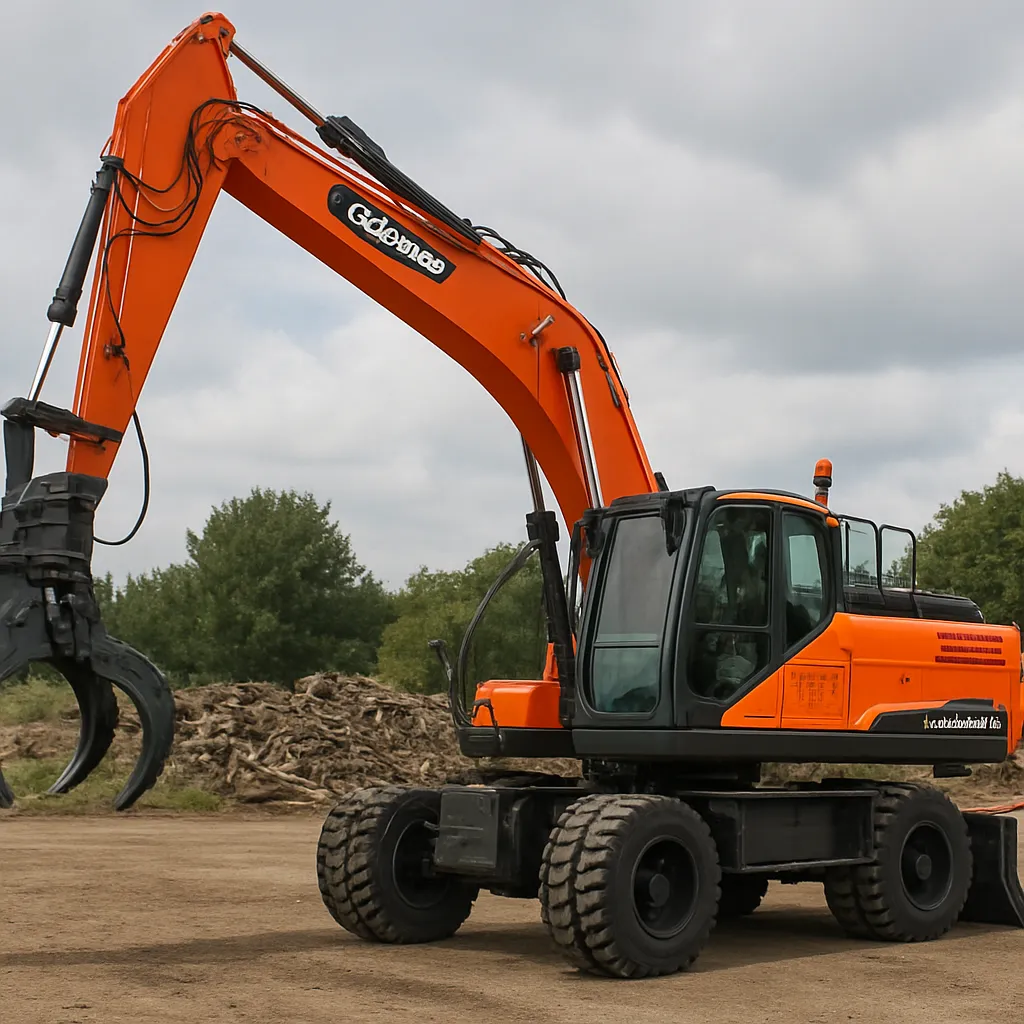
The Doosan DX225MH is a purpose-built material handler derived from Doosan’s proven excavator platform, engineered to meet the demands of industries that require safe, efficient and versatile bulk handling. Combining robust hydraulics, an elevated operator station (in many configurations) and a range of purpose-made attachments, the DX225MH is used where continuous loading, sorting, lifting and moving of loose or bulky materials is required. In the following sections, we explore its typical applications, technical characteristics, attachment options, operator ergonomics, maintenance considerations, and how it performs in real-world settings.
Overview and typical applications
The Doosan DX225MH occupies a niche between standard excavators and dedicated material handlers. It is commonly deployed in environments where reach, rotation, and specialized end-effectors are more important than heavy excavation power. Typical applications include:
- Scrap yards and metal recycling facilities — for sorting, loading and stacking scrap metal and vehicles.
- Ports and bulk terminals — handling loose bulk cargo such as scrap, timber, and miscellaneous breakbulk items during loading and unloading operations.
- Demolition and dismantling — selective material removal and sorting after primary demolition work.
- Waste and recycling centers — moving municipal solid waste, construction debris, and recyclable materials between stages of processing.
- Timber yards and biomass handling — loading and stacking logs, chips and other biomass products.
- Industrial yards and manufacturing sites — internal material handling where a combination of reach and dexterity is required.
Because the DX225MH emphasizes reach, rotation and controlled hydraulic flow over earthmoving grunt, it is especially well-suited to continuous cyclical operations where operator visibility and attachment versatility are priorities.
Design features and chassis modifications
The DX225MH is based on the proven DX225 excavator family but includes a number of structural and functional modifications to optimize it for material handling tasks. Key design features often found on material handler variants include:
- Reinforced upperstructure and stronger boom mounting points to cope with lifting loads at extended radii.
- Extended or telescopic booms and specially designed dipper arms to increase reach and provide better control over loads.
- Counterweight adaptations to improve stability when working with long-reach configurations or heavy loads.
- Grouser or widened undercarriage options and sometimes hydraulically extendable track frames to increase the footprint and stability during lifts.
- 360-degree rotation combined with smooth, responsive slew drives for precise material placement.
These modifications are intended to balance reach and lifting capability while preserving the durability associated with heavy civil-excavator components.
Powertrain, hydraulics and performance
Material handlers such as the DX225MH prioritize hydraulic responsiveness, steady lifting capacity and efficient power delivery. While exact powertrain specifications can vary by year and market, typical characteristics include:
- Engine power in the region of approximately 120–140 kW (160–190 hp), providing reliable torque for hydraulic systems and accessories.
- High-flow hydraulic systems designed to operate large grapples, magnets and multi-function attachments with consistent force and smooth control.
- Variable-displacement pumps and hydraulic load-sensing technology to optimize fuel efficiency and control under varying loads.
- Duty cycles tuned for repetitive lifting rather than excavation cycles: slower, powerful movements with an emphasis on stability and precision.
In practice, these systems translate to brisk cycle times for pick-and-place work, consistent lifting at moderate radii, and reliable performance under continuous daily use. The hydraulic architecture often includes circuits and couplers configured for common material-handling attachments such as grapples, clamshells, and hydraulic rotators.
Attachments and configurations
One of the DX225MH’s greatest strengths is the ability to be configured with a wide range of attachments to suit specific applications. Popular options include:
- Orange peel grapples — ideal for scrap and irregular bulk material handling.
- Magnet booms or magnet carriers — for fast loading and unloading of ferrous scrap at ports and yards.
- Clamshell buckets — for bulk materials in ports and terminals.
- Demolition grapples and sorting thumbs — for selective removal and sorting tasks.
- Hydraulic rotators and quick couplers — to increase attachment versatility and reduce downtime when switching tools.
- Long-reach sticks — for extended reach when stacking or reaching into trucks and containers.
Choosing the right combination of boom, stick and attachment allows the DX225MH to be tailored precisely to a job, balancing reach, lifting capability and cycle speed. For example, a magnet-equipped long-reach configuration will maximize sorting throughput at a scrap yard, whereas a short, heavy-duty configuration with an orange peel grapple will provide higher lifting capacity at short radii.
Operator environment, visibility and controls
Operator comfort, visibility and precise controls are crucial in material handling operations, where cycle frequency and safety are paramount. Doosan’s material handler variants typically include:
- Elevated or cab-mounted platforms (on many models) offering a higher line of sight over stacks and trailers, improving safety and accuracy when placing loads.
- Panoramic glazing and large windows to provide unobstructed views of the work area.
- Ergonomic seats with multiple adjustments, climate control and reduced vibration for extended operator comfort.
- Advanced joystick controls or proportional levers with multi-function operation to manage attachments, rotation and outreach precisely.
- Integrated camera systems and sensor options to further improve awareness around blind spots and to monitor load positions.
These features help reduce operator fatigue and improve accuracy and throughput in repetitive handling tasks. The smoothness and responsiveness of the hydraulic control system also allow experienced operators to speed cycles without compromising safety.
Stability, lifting capacity and reach characteristics
Material handlers trade a portion of excavation power for reach and steadiness. Several factors influence a DX225MH’s lifting performance:
- Counterweight and undercarriage footprint — increasing counterweight or widening tracks improves lifting capacity at extended radii.
- Boom and stick geometry — long-reach configurations increase reach but reduce maximum lifting capacities as leverage increases.
- Attachment weight and center of gravity — heavier attachments reduce the dynamic lifting envelope.
As a general guideline (and depending on configuration): at short radii a material handler built on a 22–26 tonne base machine can often lift several tonnes safely, while at the maximum reach the safe lifting capacity drops significantly — sometimes to less than a tonne. Exact load charts are always configuration-specific and should be consulted on the particular machine and boom/stick/attachment specification before operation.
Fuel efficiency and environmental considerations
Fuel efficiency for material handlers depends on hydraulic system design, duty cycle, and operator technique. Typical strategies and features that improve fuel efficiency include:
- Load-sensing hydraulics and smart pump management to deliver oil flow only as needed.
- Eco modes and engine management systems that reduce rpm during idle and light-load periods.
- Operator training to reduce unnecessary movements and use optimized pickup and placement techniques.
Modern Doosan engines also meet regional emissions standards (Tier/Stage regulations) through combustion tuning, selective catalytic reduction (SCR) and diesel particulate filters (depending on market and specification). This helps reduce NOx and particulate output in busy urban terminals and recycling centers.
Maintenance, serviceability and total cost of ownership
Material handlers built on excavator platforms benefit from mature service networks and readily accessible parts. Points to consider regarding maintenance and operating cost:
- Routine maintenance — regular hydraulic, engine and undercarriage checks are critical given the cyclic lifting loads typical of material handling work.
- Component wear — attachment pivot points, grapples and magnet carriers experience heavy wear and should be inspected frequently.
- Service access — well-designed access panels and centralized service points reduce downtime for filters, oil changes and inspections.
- Resale and lifecycle value — machines with documented maintenance histories and commonly used attachment interfaces retain higher second-hand value in the scrap and recycling markets.
Because material handlers are used in high-cycle environments, the total cost of ownership is strongly influenced by operator habits, preventive maintenance practices and the robustness of attachments. Investing in predictive maintenance and regular component replacements can substantially reduce unexpected downtime and repair costs.
Safety features and site integration
Safety is a central concern when moving heavy, irregular or stacked materials. Typical safety-focused features and practices for DX225MH applications include:
- Load moment indicators and stability warnings to prevent overload situations at extended reaches.
- Cameras and proximity sensors to eliminate blind zones and detect personnel or obstacles near the swing area.
- Stabilizing outriggers or widened track systems on some configurations to prevent tipping when lifting asymmetrical loads.
- Safety interlocks that limit swing or movement when doors or service panels are open.
Operational safety is also achieved via site rules: exclusion zones, dedicated travel paths for equipment, clear stacking protocols and mandatory operator certification in handling specialized attachments such as magnets or clamshells.
Real-world performance and statistics
Specific performance metrics for any DX225MH in the field depend on jobsite configuration, operator skill and the chosen attachments. However, some representative observations from material-handler operations include:
- Cycle rates — for typical scrap handling with a magnet or orange-peel grapple, experienced operators can complete multiple pick-and-place cycles per minute; productivity often exceeds what a conventional excavator could sustain due to specialized booms and rotation systems.
- Fuel consumption — varies widely based on load and attachments; many operators report fuel use comparable to heavy excavators during heavy handling shifts, with significant improvement when using eco/hybrid hydraulic strategies.
- Uptime — preventive maintenance and quality hydraulic components commonly yield high availability in industrial environments; planned maintenance schedules are critical to preserve uptime.
Industry-wide, the use of dedicated material handlers has grown with increasing volumes of recycled materials and the need for efficient port handling. While precise sales numbers for the DX225MH model vary by region and fiscal year, Doosan’s material-handler platform is recognized among mid-sized handlers for combining excavator robustness with handling specialty.
Choosing the right configuration: tips for procurement
Selecting the right DX225MH configuration requires understanding the primary tasks, typical load sizes, and site constraints. Consider the following steps:
- Define typical loads — average load weight, maximum block weight and material type (ferrous, timber, loose bulk).
- Determine reach and height requirements — container/truck bed heights, stacking heights, and any obstructions that influence boom geometry.
- Select attachments — choose the primary grapple, magnet or clamshell and consider multi-attachment capability with quick couplers.
- Assess stability needs — if high lifts at extended radii are frequent, opt for counterweight packages or extended undercarriage options.
- Plan for service — ensure local dealerships can support maintenance, parts and attachment servicing.
Engaging with vendors for demonstration days and on-site trials is highly recommended to validate productivity and operator comfort before purchase decisions are finalized.
Advantages and limitations
Advantages of the Doosan DX225MH include:
- Versatility — adaptable to multiple industries via attachments.
- Cost-effectiveness — based on an excavator platform offering well-known serviceability and parts availability.
- Operator-centric design — elevated cabs, enhanced visibility and refined controls for efficient handling.
Limitations to be aware of:
- Lifting envelope — as with any material handler adapted from an excavator, maximum reach reduces available lifting capacity; specialized high-capacity handlers may be required for extreme lifting demands.
- Attachment wear — grapples and magnets in high-cycle environments require scheduled servicing or component replacement.
- Initial configuration decisions — choosing the wrong boom or attachment set can limit productivity or lead to higher operating costs.
Concluding perspective
The Doosan DX225MH represents a practical balance between the ruggedness of an excavator and the specialized needs of material handling industries. With a focus on hydraulic responsiveness, operator visibility, and attachment flexibility, it serves scrap yards, ports, timber yards and recycling centers efficiently. Success in the field depends as much on choosing the right configuration and attachment set as it does on maintenance practices and operator skill. For mid-sized operations seeking a durable, versatile handler with a strong dealer network and reliable parts support, the DX225MH is a compelling option.
Key highlighted attributes: material handler, hydraulics, reach, lifting capacity, attachments, cab, productivity, fuel efficiency, stability, maintenance.


)
)