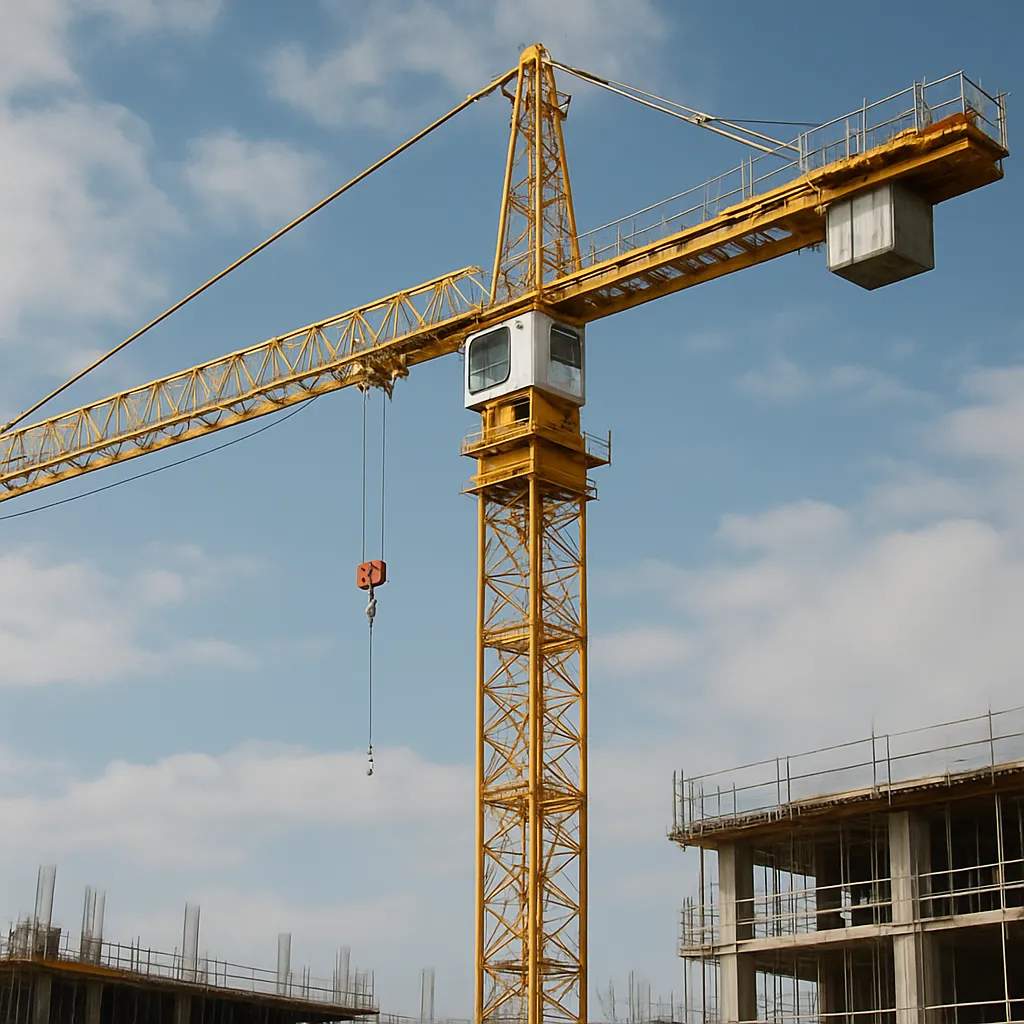
The Wolff 133 B is a robust example of modern European tower crane engineering, designed to meet the demands of medium- to large-scale construction projects. Combining practical modularity with reliable mechanical systems, this crane model is valued for its adaptability on dense urban sites, high-rise developments and industrial construction. In the following sections you will find a comprehensive description of its design, typical applications, operational procedures, safety and maintenance considerations, plus general technical information and market-context observations that may help equipment managers, site planners and engineers evaluate its suitability for specific projects.
Overview and design philosophy
The Wolff 133 B belongs to a family of tower cranes produced with an emphasis on durability, ease of assembly and operational precision. As a tower crane, it is engineered to provide extended working radii and elevated hook heights while occupying a small ground footprint — essential features in urban construction. The design philosophy balances structural strength with modular components so that the crane can be configured according to site constraints, available transport resources and required capacities.
Typical design features include a lattice tower mast, a slewing unit mounted at the top of the mast, a long horizontal jib for lifting loads laterally, and a shorter counter-jib that supports the counterweights and machinery. The crane can be erected on a conventional foundation, on temporary baseplates or anchored to a building structure for climbing with the building as construction progresses. Key mechanical systems — the hoist, slewing drive and trolley mechanisms — are engineered for smooth, predictable performance under variable loads and environmental conditions.
Typical technical characteristics and specifications
Exact specifications for the Wolff 133 B vary by configuration and market, as customers can select different mast sections, jib lengths and drive options. Below are representative figures commonly associated with this class of crane. These values should be treated as indicative; always consult the manufacturer’s official data sheet for certified numbers.
- Lifting capacity: nominal maximum up to approximately 8–12 tonnes in base configurations, with rated loads decreasing toward the tip according to the load chart.
- Jib length: modular jibs available typically in ranges from 40 m to 70 m in increments (e.g., 40, 50, 60 m), enabling adaptation to site span requirements.
- Maximum tip load: often in the range of 1–2 tonnes at the maximum jib length (dependent on configuration).
- Rated load at shorter radii: can typically exceed 8 tonnes near the tower, again depending on chosen configuration.
- Maximum free-standing height: depends on mast sections; free-standing heights of 40–60 m are achievable, with much greater heights possible when tied to structures.
- Max hook height when tied or climbing: effectively limited by mast extension and project needs — often several hundred meters in staged climbing configurations.
- Hoist speed: variable, with multiple gearbox ratios or VFD-controlled motor options to provide fine control for heavy lifts.
- Rotation: continuous 360° slewing via slewing ring and drive that provides precise positioning.
- Power: typically electric drive (e.g., 400 V three-phase) with options for frequency conversion and remote diagnostics.
- Operator environment: enclosed operator cabin or remote control options for improved visibility or safety, and ergonomic controls for long shifts.
Manufacturers often provide several optional packages: extensions for greater height, alternative jibs, remote monitoring modules, variable speed drives and extra safety systems such as anti-collision. The modularity allows rental companies and contractors to standardize on a base crane while adapting it to diverse projects.
Applications and typical use cases
The Wolff 133 B is suited to a wide range of construction tasks where a balance between reach, lifting capacity and site adaptability is needed. Typical applications include:
- High-rise residential and commercial developments where the crane must achieve significant hook height and long reach while minimizing footprint.
- Urban infill projects that require a crane with flexible jib configurations to serve tight site geometry.
- Industrial construction such as power plants and factories where higher moment loads and repeated precise placements are required.
- Bridge components and precast concrete installation, where controlled heavy lifts and good positioning accuracy are essential.
- Infrastructure retrofits and building conversions in dense downtown settings, where transportability and fast assembly/disassembly reduce downtime.
Beyond construction, tower cranes like the Wolff 133 B are sometimes used in event rigging, shipbuilding yards and large-scale maintenance operations due to their vertical reach and predictable hoisting characteristics.
Operation, controls and safety systems
Proper operation of the Wolff 133 B combines well-trained personnel, robust procedural controls and integrated safety systems. Modern tower cranes incorporate redundant watchdogs, overload protection, and programmable logic controllers for operational limits. Typical safety and control features include:
- Load moment limiting systems that prevent lifting loads beyond rated capacities at any radius (integrated with the load chart logic).
- Wind and sway monitoring warnings that alert the operator or automatically lock movements under unsafe conditions.
- Anti-collision systems when multiple cranes operate on the same site, coordinating slewing and trolley positions to prevent incidents.
- Emergency lowering functions and fail-safe brakes on hoist and slewing drives to secure loads if power is lost.
- Operator assistance features like precise speed control, inching modes, and cameras or mirrors to improve visibility for blind lifts.
A modern installation will often include provisions for operator cabin comfort and safety: ergonomic seats, climate control, reduced noise levels, and CCTV feeds for better site awareness. Increasingly, remote-control operation is used to place the operator at ground level for complex lifts, improving safety and visibility in congested zones.
Site preparation, foundations and assembly considerations
One of the strengths of the Wolff 133 B family is configurational flexibility in mounting and foundation design. Foundation options include concrete pad foundations, ballast systems on temporary bases and tie-in bracing for climbing. Key considerations for site preparation are:
- Ground bearing capacity under the base: the foundation must be sized to distribute loads and moments safely. Geotechnical input is essential to determine the required pad thickness and reinforcement.
- Hardstanding size and access routes for crane erection gear, ballast trucks and delivery of mast and jib components.
- Space for counterweight storage and assembly area for the jib and trolley systems.
- Height restrictions from nearby buildings, airspace regulations around airports, and rights-of-way for slewing and load lowering.
Assembly typically involves modular mast sections lifted and bolted sequentially. For tall projects, the crane may be fitted with climbing frames allowing it to grow with the building, anchored at intervals to the structure. The assembly plan must incorporate safe access, certified riggers and adherence to local regulations governing lifting and work at height.
Maintenance, inspection and lifecycle management
Regular maintenance is crucial to the long service life and safe operation of a tower crane. Preventive maintenance schedules include daily checks, weekly inspections, quarterly lubrication routines and annual comprehensive examinations by accredited inspectors. Typical maintenance tasks:
- Routine lubrication of slewing bearings, hoist drums and trolley mechanisms to prevent wear and corrosion.
- Checking and tensioning of all bolts, pins and connections in the mast and jib lattice, especially after transport or hard use periods.
- Electrical system diagnostics, testing overload cut-outs, limit switches and emergency stop circuits.
- Replacement of hoist cables and inspection of hooks for deformation and wear.
- Non-destructive testing (NDT) of critical welds or high-stress components at intervals prescribed by regulations or manufacturer guidance.
Lifecycle management also includes tracking operating hours, environmental exposure and retrofit options. Modern fleet managers increasingly use telematics and remote monitoring to track operating parameters, predict component failures and schedule maintenance using condition-based rather than strictly time-based intervals.
Regulatory compliance and certifications
Tower cranes must comply with regional and national standards that govern design, manufacture, installation and operation. Common standards include European Machinery Directive compliance, EN 14439 and related lifting equipment directives, as well as ISO standards for cranes. Necessary certifications and paperwork typically include:
- Manufacturer’s conformity declaration and technical documentation.
- Installation and assembly records signed by competent personnel.
- Periodic inspection reports (e.g., annual thorough examinations).
- Operational permits for working at height and lifting heavy loads, particularly in urban or regulated zones.
Compliance with these standards is not only a legal requirement in many jurisdictions but also a practical necessity to ensure predictable performance, minimize downtime and reduce insurance and liability exposures.
Economic and market considerations
Purchasing, renting or specifying a Wolff 133 B must consider lifecycle cost, site needs, and rental market dynamics. Tower cranes are capital-intensive assets: acquisition costs are substantial, but rental markets can amortize capital costs across many projects. Typical economic considerations include:
- Upfront acquisition cost versus rental rates — many contractors prefer renting to maintain flexibility.
- Transport and erection costs — modular cranes reduce transportation complexity but require certified erection crews.
- Downtime risks — efficient maintenance and remote diagnostics reduce unexpected failures and revenue loss on site.
- Resale value and compatibility — standardization across mast sections and jibs improves marketability in the second-hand market.
Industry-wide statistics indicate that well-maintained tower crane fleets have long usable lives, often two to three decades with major overhauls. Modernization packages (upgrading electrical drives, adding remote monitoring or retrofitting cabins) can extend the operational life and improve safety while keeping replacement costs in check.
Case studies and practical examples
Examples from typical construction scenarios help illustrate how the Wolff 133 B is applied:
Urban high-rise residential project
On a 25-storey apartment building, the crane was chosen for its combination of reach and lifting capacity. A 60 m modular jib allowed the crane to serve multiple tower cores from a single location. The crane was anchored to the structure at several points as the building rose, enabling hook heights to exceed 80 m without excessive foundation depth. The project benefitted from the crane’s precise hoist controls and the operator’s good sightlines from the operator cabin, reducing cycle times and improving safety.
Industrial plant installation
For lifting heavy prefabricated units in a factory expansion, the crane’s robust slewing and hoist systems provided steady and controlled lifts of large assemblies. The use of a shorter jib and higher capacity near the tower allowed handling of loads in the 6–10 tonne range with small lateral movements, increasing efficiency in the tight assembly area.
Advantages and limitations
Advantages of the Wolff 133 B include modularity, reliable mechanical systems, adaptability to climbing or fixed installations and typically lower lifecycle costs when properly maintained. It is particularly effective where combination of reach and moderate-to-high rated capacity is needed without the footprint of mobile cranes.
Limitations include transportation logistics for long jibs, the need for skilled erection crews, and sensitivity to extreme wind or seismic conditions which may require additional engineering controls. Also, in very heavy-lift scenarios (loads well above the model’s rated capacity) specialized heavy-lift cranes will be preferred.
Final considerations for selection
When selecting the Wolff 133 B for a project, planners should analyze the project’s lifting envelope, maximum required lifts, site access, and lifecycle cost. A detailed lift plan, geotechnical input for foundations and comprehensive risk assessments are essential. Where possible, engage with the manufacturer or an experienced rental provider to tailor the crane configuration — jib length, mast sections, counterweight selection and optional safety packages — to the specific tasks at hand.
Summary
The Wolff 133 B is a flexible and reliable tower crane option for a wide range of construction scenarios. Its modularity, solid mechanical design and available safety and monitoring features make it suitable for urban, industrial and specialized lifting tasks. Attention to proper foundation design, regular maintenance and adherence to regulatory standards ensures a long, productive service life. For exact numerical data and certified performance charts, consult the manufacturer’s technical documentation or an authorized dealer to configure the crane specifically for your project requirements, and to obtain the official load chart and certification documents required for safe operation.


)
)