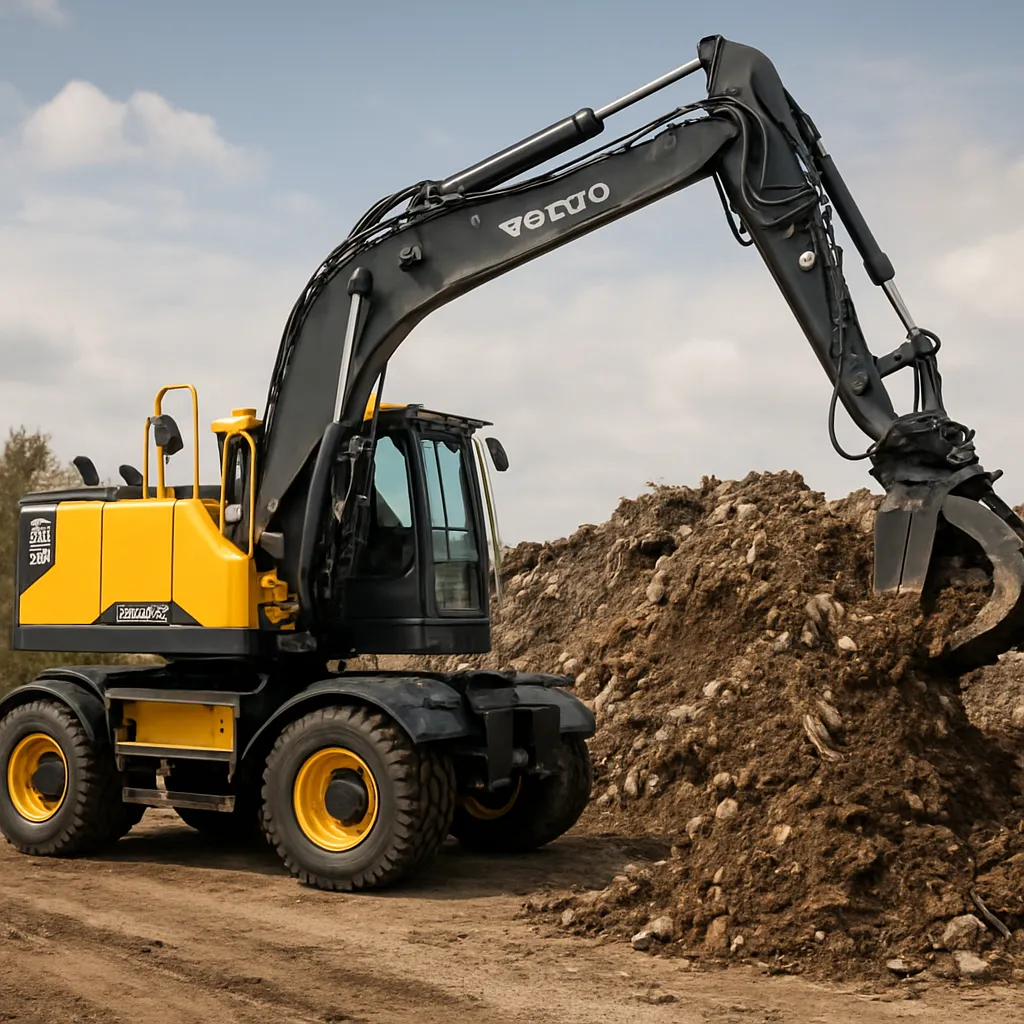
The Volvo EW160E MH is a purpose-built wheeled material handler derived from Volvo’s well-known EW160E platform, adapted for demanding duties in scrapyards, ports, recycling centres and other material handling environments. Combining the mobility of a wheeled excavator with extended reach, specialised booms and handling attachments, this machine aims to deliver high productivity, operator comfort and long-term reliability. The following article explores the machine’s design, typical applications, technical characteristics (approximate figures where official configuration-dependent values apply), attachments and operational considerations, and its role in modern material handling fleets.
Design and technical overview
The Volvo EW160E MH is based on the compact but powerful EW160E wheeled excavator chassis, reworked for the specific demands of material handling. Key modifications usually include a reinforced undercarriage and upper-structure, specialised material-handler boom options with extended reach, heavy-duty counterweights and a strengthened swing system. These changes are intended to optimise the machine’s stability and lifting performance while maintaining the agility that wheeled machines offer on paved surfaces and hard yards.
Platform and structural features
- The base machine retains Volvo’s focus on serviceability, with accessible service points, grouped filters and maintenance-friendly layouts.
- Material handler conversions typically include a purpose-designed boom (single or multi-piece) with increased lift capacity at height and improved visibility to the working area.
- Counterweight options are commonly offered to match different lifting and stability requirements, allowing the machine to be tailored to site needs.
- Hydraulic systems are upgraded to support high-flow attachments such as rotators and large grapples; auxiliary circuits and piping are made robust for frequent use.
Volvo emphasises operator ergonomics and safety: the cab often features a high-visibility layout, strengthened glazing, optional heated and suspended seats, and control consoles configured for material handling tasks. ROPS/FOPS certification and additional guarding packages are usually available for hostile environments.
Powertrain and emissions
The EW160E MH is typically powered by a mid-range diesel engine that meets prevailing emission standards (Stage V/ Tier 4 Final where applicable). Volvo’s E-series machines are tuned to deliver a balance between torque for lifting operations and fuel-efficient cruising between working positions on site. Common machine features to reduce operating fuel include engine idle-shutdown, ECO modes, and intelligent hydraulic flow management.
Typical applications and operational contexts
Material handlers such as the Volvo EW160E MH are specialised machines built for tasks that require frequent lifting, precise placement and good travel mobility across paved or semi-paved surfaces. Their typical environments include:
- Scrap yards and recycling centres — sorting, loading/unloading, and feeding secondary processors.
- Ports and intermodal terminals — handling breakbulk cargo, scrap, timber and bulk packages.
- Demolition and salvage — grabbing, sorting and removing demolition materials.
- Forestry yards and biomass handling — stacking logs and moving bulk biomass.
- Waste management facilities — transferring refuse, recyclables and bulky waste between processing stages.
- Industrial plants — in-plant material handling where mobility on paved surfaces is crucial.
Compared with dedicated tracked material handlers, the EW160E MH shines where mobility between work points, minimal ground pressure outside of soft soil concerns and road travel capability are priorities. Its wheeled undercarriage enables faster repositioning and reduced surface damage on paved yards.
Operational performance and statistics (typical figures)
Material handler performance depends heavily on boom configuration, counterweight, attachment and tyres. The values below are indicative ranges based on the EW160-class machines adapted for material handling and should be verified against specific manufacturer or conversion specifications for exact numbers:
- Operating weight: typically in the range of 15,000–18,000 kg depending on counterweights and boom options.
- Engine power: commonly between 100–130 kW (approximately 135–175 hp), tuned for torque at low RPM for lifting operations.
- Maximum reach: with material-handler booms, reach can extend to 9–12 metres (boom tip to ground), with specialised long booms available from some converters.
- Lifting capacity at near-attachment: close-in lifting can reach multiple tonnes (e.g., 3–6 tonnes) depending on counterweight and configuration.
- Lifting capacity at mid-reach (6–8 m): typical lift figures may range from 1–3 tonnes; capacity diminishes with reach and high offsets.
- Hydraulic flow: auxiliary high-flow circuits can provide 150–250 L/min in material handler configurations to operate rotators and powered grabs.
- Fuel consumption: highly dependent on duty cycle; typical working averages might be in the range of 8–18 L/h. Light duties (spot repositioning) are much lower; continuous heavy-duty loading may approach the higher end.
- Travel speed: wheeled chassis allow road speeds of up to 20–40 km/h depending on local regulations and machine gearing.
These figures illustrate the machine’s role as a mid-class material handler — powerful enough for most yard and port tasks while remaining nimble on site. Fleet managers should consult exact machine-specific specification sheets and lifting charts for precise limits before selecting or operating the EW160E MH.
Attachments and customisation
One of the main strengths of material handlers is the wide array of compatible attachments. The EW160E MH can be equipped for very different tasks by fitting:
- Grapples (orange peels, hydraulic scrap grapples) for picking and sorting scrap, demolition debris and bulk materials.
- Rotators paired with grapples to precisely orient loads.
- Clamshells and buckets for bulk handling of loose materials or loading operations.
- Thumbs and magnets for handling ferrous scrap and improving cycle times when loading or sorting metal.
- High-reach booms for stacking and long-reach tasks; these may be factory-or third-party fitted depending on the conversion provider.
- Quick couplers to switch between tools rapidly, minimising downtime.
Customisations may include reinforced hydraulic piping, heavy-duty slewing rings, additional lighting packages for night operations, CCTV systems for improved visibility and heated cabs for cold climates. Tyre choices and undercarriage configurations can be selected to match ground conditions and mobility requirements.
Safety systems and operator ergonomics
Safety is critical in material handling, where heavy loads are often moved near personnel and infrastructure. Common safety and operator-focused features on the EW160E MH include:
- High-visibility cab glazing and elevated cab positioning to improve sightlines over stacks and piles.
- Optional protective guards (mesh or co-polymer screens) to prevent flying debris from damaging the cab.
- Load monitoring systems and warning beacons to prevent overload situations and to alert ground personnel.
- Stability-assist features and well-documented lifting charts to guide safe operation at height and reach.
- Ergonomic controls (joysticks, adjustable seats) and climate control to reduce operator fatigue and improve productivity.
Many owners add ground-protection measures and marked safety zones to optimise site safety when operating material handlers in busy yards.
Maintenance, telematics and lifecycle considerations
Volvo emphasises long-term durability and low lifecycle costs. For material handlers, maintenance and monitoring are critical because attachments and dynamic loading put significant stresses on the chassis and hydraulics. Important considerations include:
- Scheduled maintenance and rapid access to service points reduce downtime. Frequent grease points on booms and pins demand routine attention in material handler service plans.
- Telematics — Volvo’s telematics systems (often available as factory-fit or dealer-installed) provide remote monitoring of engine hours, fuel consumption, fault codes and maintenance reminders. These tools help predict failures before they occur and optimise utilisation.
- Component modularity — commonality of parts across Volvo machines can simplify inventory and repairs for mixed fleets.
- Attachments wear — grapples, rotators and booms can be high wear items; inspection programmes and replacement schedules should be established based on duty cycles.
- Resale and residual value — well-maintained, factory-converted material handlers from reputable manufacturers like Volvo tend to retain value in the used market, especially if telematics logs and maintenance records are complete.
Economic and environmental aspects
When evaluating a material handler purchase or lease, fleet managers look at total cost of ownership (TCO): upfront price, operating fuel costs, maintenance, downtime and resale. The EW160E MH is positioned as a machine that can reduce TCO through:
- Fuel-efficient engines and operation modes that reduce consumption in non-peak tasks.
- Durable components and easy servicing that reduce repair time and labour costs.
- High productivity per hour due to hydraulic performance and suitability for continuous pick-and-place tasks.
Environmental aspects are increasingly important: lower-emission engines, efficient hydraulics, and smart idling and shutdown functions all contribute to reduced site emissions and potentially lower regulatory impacts in urban or regulated port environments.
Market positioning, competition and buying considerations
The Volvo EW160E MH typically competes with similarly classed wheeled material handlers from other major OEMs and specialist conversion houses. When selecting a unit, buyers should consider:
- Whether a factory-supported conversion or an aftermarket conversion provides the best warranty and integration.
- The availability of dealer service and local parts support for both machine and attachments.
- Attachment compatibility and the availability of manufacturer-approved rotators, grapples and counterweights.
- Telematics and fleet-management offerings which can be decisive for larger fleets seeking operational efficiencies.
Because the material handler market is characterised by a variety of customised solutions, establishing clear duty specifications (typical loads, maximum reach, ground conditions, cycle times) is essential before choosing a specific model or conversion.
Practical tips for operators and fleet managers
- Match counterweight and boom selection to the most common lifting scenarios rather than solely to maximum theoretical capacity — this yields better fuel efficiency and stability in daily work.
- Maintain a proactive greasing and inspection schedule for pins, bearings and hydraulic couplings to prevent costly downtime.
- Use telematics to establish true average fuel consumption and operating patterns — this helps right-size the machine for the job and identify driving habits that waste fuel.
- Standardise attachments and quick-coupler interfaces where possible to reduce swap time and spare parts complexity.
- Provide operator training specific to material handling tasks — safe boom operation at height and correct use of stabilising aids are critical for both safety and productivity.
Concluding observations
The Volvo EW160E MH is a solid choice for operations that require the versatility and mobility of a wheeled excavator combined with the reach and specialised tooling of a dedicated material handler. Its combination of operator comfort, strong hydraulic systems, adaptable attachments and the backing of a major OEM’s service network make it suitable for scrapyards, ports, demolition and many industrial handling tasks. Exact performance and capacities depend on the chosen boom configuration, counterweights and attachments, so detailed consultation with the dealer or conversion specialist is recommended when specifying a machine for a particular fleet role.
Material handler, attachments, lift capacity, reach, fuel efficiency, telemetry, safety, durability, productivity and maintenance are the key themes that determine how well the EW160E MH will perform in any given operation.


)
)