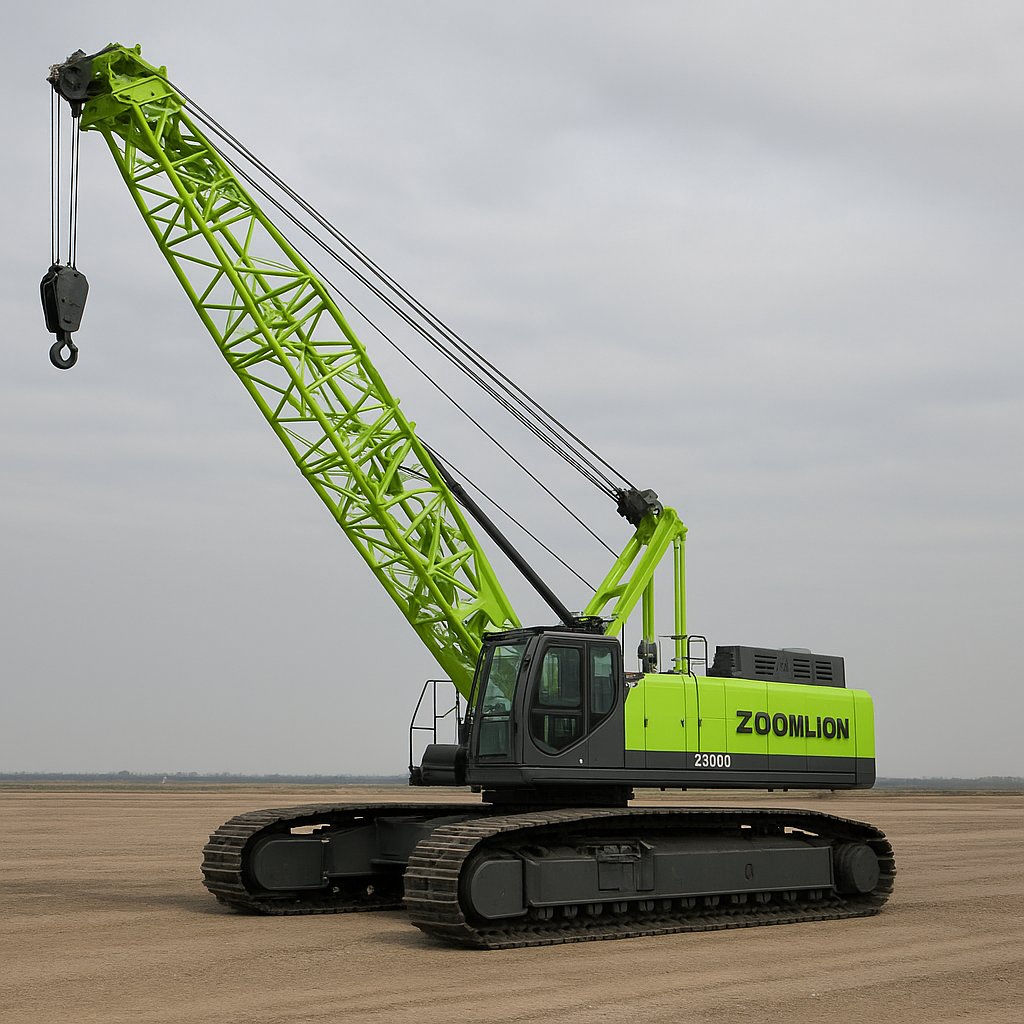
The Zoomlion Z3500 is a heavy-duty crawler crane designed for demanding lifting tasks in construction, energy, and industrial sectors. Combining the robust platform of a tracked undercarriage with a powerful superstructure, the Z3500 offers a balance of lifting performance, mobility on soft or uneven ground, and adaptability through modular boom and jib configurations. This article explores the machine’s design, technical aspects, typical applications, operational considerations, and economic and safety factors relevant to contractors and fleet managers.
Design and key technical characteristics
The Z3500 is engineered as a purpose-built crawler crane that emphasizes robustness and versatility. Its main structural components include the tracked chassis (crawler), the rotating superstructure (housing engine, winches, and operator cab), the main boom and detachable jib, and a configurable counterweight system. Typical design priorities for this class of machine are lifting capacity, ground pressure management, transportability of modules, and ease of on-site assembly.
Typical specifications (approximate)
- Lifting capacity: Around 300–400 metric tons at the main hook block in standard configurations; the model designation Z3500 commonly indicates a nominal capacity in the mid-300-ton class.
- Main boom: Telescopic or lattice sections commonly offering lengths from 30 m up to about 70–80 m depending on configuration and optional extensions.
- Jib: Lattice or heavy-duty swing-away jibs with lengths ranging 10–40 m to increase tip height or outreach.
- Engine power: Diesel engines in the 200–400 kW range (approx.), optimized for hydraulic power generation and winch operation.
- Crawler undercarriage: Wide-tracked chassis designed to spread load and operate on soft ground; track gauge and shoe width are selected for reduced ground pressure.
- Counterweight: Modular counterweight bricks allowing on-site adjustment of ballast to match lift charts and transport constraints.
- Operating radius: Safe working radii commonly up to 40–50 m with reduced capacity at maximum outreach.
- Approximate transport weight in component form: tens to low hundreds of metric tonnes depending on counterweight and boom options (transport modularity intended for road moves).
Because Zoomlion offers different options and can adapt equipment to market needs, exact figures can vary by selected package. The manufacturer provides lift charts and configuration-specific data for safe operation in every setup. Inspectors and planners should consult the official load charts for the precise arrangement used on site.
Primary applications and industries
The Z3500 is suited for a range of heavy-lift applications where high capacity and off-road mobility are required. Its crawler chassis allows movement across construction yards, undeveloped sites, and within industrial complexes without the need for permanent crane pads. Key sectors where the Z3500 finds application include:
- Construction — Erecting structural steel frames, placing precast concrete elements, and installing high-rise façade components where heavy loads must be lifted to elevation.
- Energy — Wind turbine tower and nacelle erection (particularly for medium-to-large turbines), power plant installations, and transformer placement in substations.
- Oil & gas and petrochemical — Lifting pressure vessels, columns, and large modular skids during plant construction or turnaround activities.
- Heavy industry and manufacturing — Installation of heavy machinery, presses, and industrial modules in factories and shipyards.
- Civil infrastructure — Bridge segments, bridge girder launching in incremental launching projects, and beam setting in viaduct construction.
- Demobilization and relocation — Dismantling heavy equipment and modular plant sections for relocation or disposal.
Because crawler cranes like the Z3500 can traverse soft or rough terrain and carry significant loads without extensive cribbing, they are often preferred where fixed-base cranes would require large preparatory works. Their ability to change configuration on site (e.g., different booms and jibs) enhances flexibility across multiple tasks.
Operational considerations and safety features
Operating a large crawler crane safely and efficiently requires trained personnel, careful planning, and strict adherence to lift charts and local standards. The Z3500 typically incorporates a range of features intended to enhance operator control and safety:
- Advanced load moment protection systems (LMI) that monitor boom angle, radius, and payload to prevent overload.
- Multi-mode winch and hoist controls providing precise lift and lowering speeds for sensitive operations.
- Redundant hydraulic and control systems for reliability under heavy usage.
- Operator ergonomics in the cab — good visibility, HVAC, joystick controls, and integrated monitoring displays.
- Integrated cameras and sensors for boom tip and rear visibility when required.
- Emergency stop systems and fail-safe brakes for the hoists and swing drive.
Lift planning for a Z3500 includes site assessment (soil bearing capacity, slope, obstructions), transport and assembly sequencing, selection and installation of counterweights, and detailed lift charts matching the precise boom/jib and counterweight configuration. Typical safety practices include the use of certified riggers, taglines to control loads in wind, exclusion zones clear of non-essential personnel, and daily pre-shift inspections.
Ground conditions and cribbing
Stability is a function of counterweight, track footprint, and ground bearing pressure. Even though crawlers distribute weight better than wheeled carriers, soft or uneven soils require timber mats, steel plates, or engineered crane pads to prevent settling or tilting. Proper cribbing design is part of the lift plan and must be dimensioned for the maximum ground pressure of the configured crane.
Transport, assembly, and logistics
One advantage of the Z3500 series is its modularity. Major components can be broken down for highway transport and reassembled on site using auxiliary cranes or self-erection features, depending on the configuration. Key logistics points include:
- Component weights and dimensions: Main modules such as crawler frames, superstructure, boom sections, and counterweight blocks are sized to meet road transport regulations.
- Assembly time: With an experienced crew and standard components, initial assembly can often be completed within a day or two, while more complex configurations require longer setup times.
- Use of mobile cranes for erection: On constrained sites, a smaller mobile crane may assist in installing heavier boom sections or counterweights.
- Disassembly and reconfiguration: The modular approach allows operators to change the boom/jib or counterweight package between lifts to match different tasks and to optimize transport weight.
Logistics planning must also account for permits, escorts for oversized loads, and staging areas for counterweight blocks. Many fleets standardize on modular transport packages to reduce turnaround times between jobs.
Maintenance, lifecycle costs, and fleet management
For large cranes, lifecycle cost is often more significant than initial purchase price. Maintenance practices and parts availability play a major role in uptime and operational cost-effectiveness. Recommended approaches for managing a Z3500 fleet include:
- Preventive maintenance schedules tied to operating hours — engine service, hydraulic system checks, winch brake inspections, and track maintenance.
- Monitoring systems for real-time performance data to predict component wear and plan parts procurement.
- Stocking critical spare parts locally to reduce downtime, especially hydraulic pumps, winch components, and electronic control modules.
- Training programs for operators and technicians to ensure proper use of safety systems and efficient troubleshooting.
Fuel consumption, parts replacement, and the need for specialized transport and assembly crews are major contributors to operational cost. However, high utilization on medium-to-large lifts typically results in good return on investment for heavy-lift crawler cranes like the Z3500 compared with hiring multiple smaller cranes or specialized lifting solutions.
Performance data, market context, and statistics
Exact sales figures and field performance statistics specific to the Z3500 may vary by market and year. In the broader crawler crane market, Zoomlion has been expanding its international presence with competitive pricing and increasing product ranges. Observed trends relevant to the Z3500 class include:
- Growing demand in renewable energy (wind and solar farm construction), where tower and nacelle lifts require mid-to-high capacity cranes with good off-road mobility.
- Steady need in infrastructure projects, especially in regions investing in bridges, tunnels, and mass transit systems.
- Fleet owners favoring modular cranes with scalable counterweight systems to maximize flexibility across different job types.
From a performance perspective, cranes in the 300–400 t class often achieve high utilization rates on multi-month construction projects. On average, heavy crawler cranes used in wind turbine erection or large civil projects can be deployed for lifts ranging from a few days to several months; utilization statistics depend on regional construction cycles and project pipelines. For specific numeric sales or utilization rates, contact local Zoomlion representatives or industry rental associations for region-specific data and fleet surveys.
Innovations, alternatives, and comparative advantages
Manufacturers, including Zoomlion, continuously update control systems, materials, and modularization to increase lifting efficiency and reduce assembly time. Innovations often seen in modern crawler cranes include:
- Advanced telematics and remote diagnostics to reduce downtime and predict failures.
- Improved hydraulic and electronic control integration for smoother, more energy-efficient operation.
- Lighter high-strength materials for boom sections to increase reach without proportionally increasing weight.
- Modular counterweights designed for faster handling and smaller transport packages.
When compared to lattice-boom and telescopic mobile cranes, the Z3500 and similar crawler cranes offer several comparative advantages: inherent mobility on rough terrain, high lifting capacity without the need for outriggers or cranes pads in some situations, and efficient load handling for repetitive heavy lifts. However, they may be slower to reposition on highways and require componentized transport for long-distance moves, which can be a disadvantage compared with all-terrain cranes for certain projects.
Case uses and practical tips for operators
Project planners and operators can maximize the value of a Z3500 by applying these practical tips:
- Match the crane configuration (boom length, jib, and counterweight) exactly to the task — avoiding over-configuration reduces transport complexity and fuel consumption.
- Plan lifts to keep the crane’s working radius as small as possible for higher capacity and better stability.
- Invest in operator training and use of the crane’s digital load monitoring tools to reduce risk and speed up lift cycles.
- Coordinate with transport and rigging teams early to minimize assembly delays and ensure all temporary works (cribbing, mats) are ready.
- Maintain a parts and service plan with local dealers or authorized service centers to reduce downtime on long projects.
In practical deployments, the Z3500 has proven versatile for a wide array of lifts — from placing heavy precast segments in a bridge project to lifting turbine components on a wind farm. Its adaptability through modular configurations makes it a common choice for contractors who need a dependable middle-weight crawler solution capable of repeated, heavy lifts.
Final observations
The Zoomlion Z3500 represents a class of medium-to-large crawler cranes tailored for heavy construction, energy, and industrial projects where a combination of mobility, robust lifting capacity, and flexible configuration is required. While precise specifications and performance metrics vary by the chosen package and region, the typical strengths of this machine are clear: good off-road capability, scalable boom and counterweight options, and modern control systems that enhance safety and productivity. For contractors considering the Z3500 for their fleets, the important next steps are to review manufacturer lift charts for the exact configuration, confirm transport logistics for the site, and plan for ongoing maintenance and operator training to unlock the crane’s full operational potential.


)
)