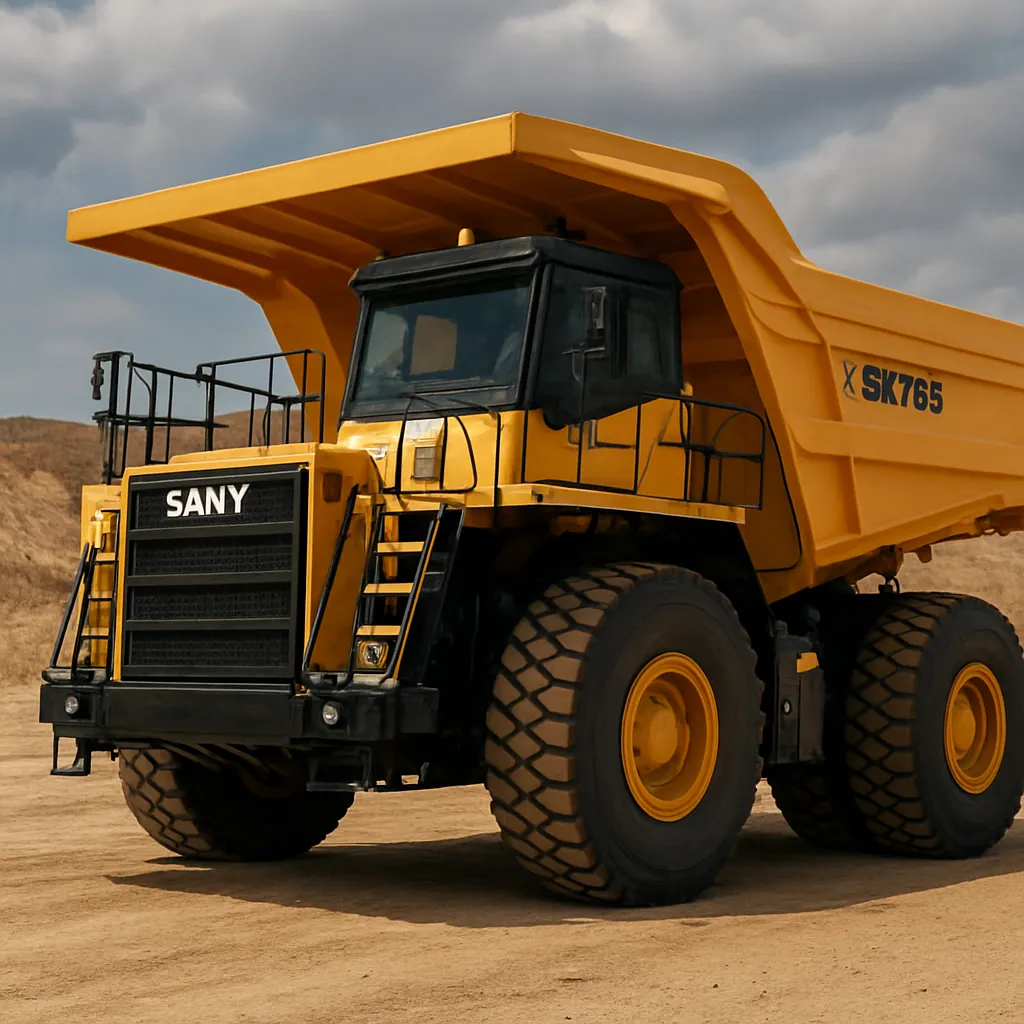
The SANY SKT65 is a modern, heavy-duty rigid dump truck designed for demanding haulage tasks in **mining**, quarrying and large-scale construction projects. Combining robust engineering with contemporary operator comforts and digital monitoring systems, the SKT65 aims to deliver high productivity, manageable operating costs and improved safety on site. In the following sections we explore its design, typical applications, technical characteristics, operational economics, maintenance considerations and future trends affecting this class of vehicle.
Design and engineering overview
The SANY SKT65 is built around a purpose-designed frame and dump body optimized for high-cycle, high-tonnage work. As a rigid-frame haul truck, it differs from articulated dump trucks by using a single, integrated chassis and a rear dump body, which provides better stability under heavy payloads and simpler power transmission layouts. Key design focuses include structural rigidity, durability of high-stress components, and ease of maintenance.
Chassis and body
- The main chassis typically uses high-strength steel sections with reinforced joints where the dump body mounts and at the suspension/axle interfaces. This improves resistance to fatigue from repeated loading and dumping cycles.
- The dump body is usually designed to maximize usable volume while ensuring a low center of gravity for stability when travelling loaded. Body liners, wear plates and optional rock buckets are common to extend service life in abrasive environments.
- Hydraulic hoist systems are engineered for reliable dumping even under full payload; these systems incorporate redundant safety features and controlled lowering valves.
Powertrain and driveline
The SKT65 class haul trucks commonly pair a high-torque diesel engine with heavy-duty transmissions and final drives designed for constant high-load operation. Emphasis is placed on torque at low engine speeds to accelerate heavy loads from stops and to climb grades. The driveline frequently uses planetary final drives, sealed axles and robust differentials to handle the shock loads typical in mining and quarry service.
Brakes and suspension
- Braking systems are hydraulic or air-assisted with multiple redundancies and often include retarder systems to control speed on descents and reduce brake wear.
- Suspension setups are designed to balance load support and ride comfort. While rigid trucks do not have the articulation of ADTs, suspension tuning and tire technology play an important role in operator comfort and component lifespan.
Applications and typical operating environments
The primary role of the SANY SKT65 is bulk material transport where large volumes of material must be moved repeatedly between loading and dumping points. Typical applications include:
- Mining — transporting ore, waste rock and overburden in surface mines. The SKT65 is used in medium-scale open-pit operations where payloads around the 60–70 tonne class are appropriate for economic haulage.
- Quarrying — moving aggregate, crushed stone and raw materials from benches to crushers, stockpiles or processing facilities.
- Large civil projects — earthworks, dam construction, and major infrastructure projects that require high-volume earth and material movement over repetitive cycles.
- Port terminals and bulk handling facilities where site geometry favors rigid dump trucks over articulated machines.
Operationally, the SKT65 thrives where routes are reasonably consistent, grades are within the vehicle’s capability, and loading/dumping points are well established. It is less suited for highly confined sites or very rough, rutted access roads where articulation and greater ground clearance would be advantageous.
Technical specifications and performance metrics
Manufacturers and dealers typically report a range of specifications depending on options and market. The following figures reflect common parameters for a 65-ton-class rigid haul truck like the SKT65; exact numbers should be verified from current SANY documentation or distributor data for the specific configuration you plan to acquire.
- Payload capacity: approximately 60–70 tonnes (metric tons). The model designation SKT65 indicates a nominal ~65 t payload class.
- Body volume: depending on material density and body design, typical struck/heaped capacities range from 30–40 m3 (cubic meters) for dense materials to higher volumes for low-density loads.
- Engine power: in this class, engines commonly produce between 350 kW and 500 kW (≈470–670 hp). Power selection depends on site grade profile and cycle requirements.
- Top speed: unloaded top speeds may be 50–60 km/h and loaded speeds lower, often limited for safety and driveline protection.
- Fuel consumption: highly variable by cycle, grade and operator behavior. Typical site-averaged fuel burn might be in the range of 40–80 L/h under heavy operation; many operators measure fuel use per ton-kilometer to compare performance.
- Gradeability: designed to climb significant grades with full load; capability depends on engine power and gearing but is commonly in the 10–20% range for sustained operation (short bursts higher).
- Tires: large radial off-the-road (OTR) tires sized to match load and ground conditions; tire choice strongly influences ride, rolling resistance and life.
Beyond raw numbers, the true performance of an SKT65 on site is measured in productivity metrics such as tonnes moved per hour, cycle time (load, haul, dump, return) and available operating hours per shift. Optimization of loading equipment match, route design and operator training usually yields larger gains than marginal differences in rated engine power.
Operational efficiency, productivity and economics
When evaluating a haul truck such as the SKT65, owners focus on total cost of ownership (TCO) and productivity. Key economic considerations include:
- Payload efficiency — the ratio of payload to empty vehicle weight affects the amount of useful material transported per trip and influences fuel consumption per tonne.
- Fuel efficiency — while diesel remains the primary fuel, improvements in engine management, drivetrain efficiency and telematics-driven operator coaching can reduce consumption.
- Maintenance costs — availability of local parts, dealer support and the simplicity of service points reduce downtime and repair expenses.
- Residual value — brand reputation and global support networks influence resale values for large capital assets.
Example productivity calculation (illustrative):
- Payload: 65 tonnes
- Cycle time (load–haul–dump–return): 15 minutes
- Trips per hour: 4
- Tonnes per hour: 260 t/h
On a 12-hour shift, a single SKT65 could theoretically move over 3,100 tonnes; actual numbers vary with site layout, equipment matching and downtime. Fleet managers commonly calculate cost per tonne, incorporating fuel, maintenance, labor and capital costs to compare machine options.
Operator comfort, safety and onboard technology
Modern haul trucks emphasize not only durability but also operator ergonomics and safety systems. The SKT65 is expected to include or offer as options:
- Comfortable, climate-controlled cab with ergonomic seating and controls for long shifts.
- Advanced instrument clusters and diagnostic displays providing real-time engine, transmission and hydraulic status.
- Telematics and fleet management systems that track location, fuel consumption, payload, and maintenance alarms. These systems enable preventive maintenance and operator coaching to improve fleet efficiency.
- Safety features such as rear-view cameras, proximity detection, speed governors, and load monitoring to prevent overloading.
- Structural protections like ROPS (Roll-Over Protective Structure) and FOPS (Falling Object Protective Structure) to enhance operator safety in hazardous work environments.
Telematics deserves emphasis: integrated fleet systems can reduce unscheduled downtime by predicting component wear, scheduling maintenance windows, and identifying inefficient operator habits—often improving effective fleet output without hardware changes.
Maintenance practices and common wear items
Rigorous maintenance discipline is essential for achieving the long service life expected from heavy haul trucks. Typical wear items and maintenance focus areas include:
- Tires — among the most significant operating costs; correct inflation, rotation and selection for terrain extend life and reduce fuel penalties.
- Brake systems — frequent inspections and pad/liner replacement are vital due to heat and wear under heavy loads.
- Hydraulic systems — hoses, seals and cylinders on the hoist must be monitored to prevent leaks and loss of dumping capability.
- Drivetrain components — final drives, differentials and half-shafts are subject to shock loads and require scheduled monitoring and oil changes.
- Engine and emissions systems — regular servicing, filter changes and fuel system maintenance ensure reliability and compliance with emissions rules.
Effective maintenance plans combine OEM-recommended intervals with condition-based monitoring. Many operators use oil analysis, vibration monitoring and telematics fault codes to move toward predictive maintenance models that minimize downtime and repair costs.
Comparative market position and competitors
The SKT65 competes in the medium-to-large rigid haul truck segment. Buyers compare such machines against offerings from both global incumbents and other manufacturers that increasingly target price-sensitive markets. Important comparative factors include:
- Initial purchase price and financing terms.
- Availability of spare parts, local dealer network and technical support.
- Operating efficiency — fuel use, payload capacity and reliability statistics.
- Customization and application-specific options such as high-capacity bodies, rock buckets, or winterized packages.
In many regions, Chinese OEMs like SANY have improved product quality and aftersales support to narrow performance and reliability gaps with established Western and Japanese brands, creating competitive pressure across price and performance dimensions.
Environmental considerations and future trends
Environmental regulations and sustainability goals are shaping the future of haul trucks. Key trends include:
- Emissions reduction — modern diesel engines include aftertreatment systems (DOC, DPF, SCR) to meet local emissions standards. Regular maintenance of these systems is crucial for performance and compliance.
- Fuel alternatives and hybridization — trials of hybrid electric drivetrains and trolley-assist systems in mining show the potential to reduce fuel consumption and emissions for large haul fleets.
- Electrification — battery-electric haulage is emerging in confined-site applications and on shorter-haul routes; however, for long-haul surface mining routes, full electrification requires significant infrastructure changes.
- Automation and autonomy — autonomous haul trucks and driver-assist features increase safety and can raise productivity by enabling continuous operations and optimized routing; many mines are adopting semi-autonomous or autonomous fleets.
Adoption of these technologies depends on site economics, capital budgets and infrastructure readiness. Even without full electrification, improvements in engine efficiency, telematics-enabled optimization and hybrid systems can incrementally reduce the environmental footprint of a fleet.
Practical purchasing and deployment tips
For buyers and fleet managers considering an SKT65 or similar class haul truck, consider the following practical points:
- Match truck capacity to loader/crusher cycle times to avoid bottlenecks; oversized trucks can sit idle waiting for loaders, while undersized trucks force more cycles and higher operating hours.
- Assess site topology and grades carefully—engine and gearing options should be chosen to meet climb requirements under full load.
- Factor in total cost of ownership, including spare parts logistics and local dealer support, not only the purchase price.
- Invest in operator training and telematics—operator behavior significantly affects fuel use, tire life and cycle times.
- Plan maintenance facilities and spare parts inventories based on realistic lead times, especially in remote operations.
Summary
The SANY SKT65 represents a compelling choice in the 60–70 tonne rigid haul truck class, combining rugged construction, modern cab ergonomics and digital monitoring tools that support high productivity in mining, quarrying and large civil works. While exact specifications such as engine power and fuel consumption depend on configuration and site conditions, the model’s design balances payload capability, serviceability and operator comfort. Maximizing the value of an SKT65 fleet requires attention to machine matching, maintenance discipline, and the use of telematics and training to improve fuel efficiency and uptime. As the industry evolves, trends like hybrid systems, electrification and autonomy will further influence how operators deploy machines in this category.


)
)