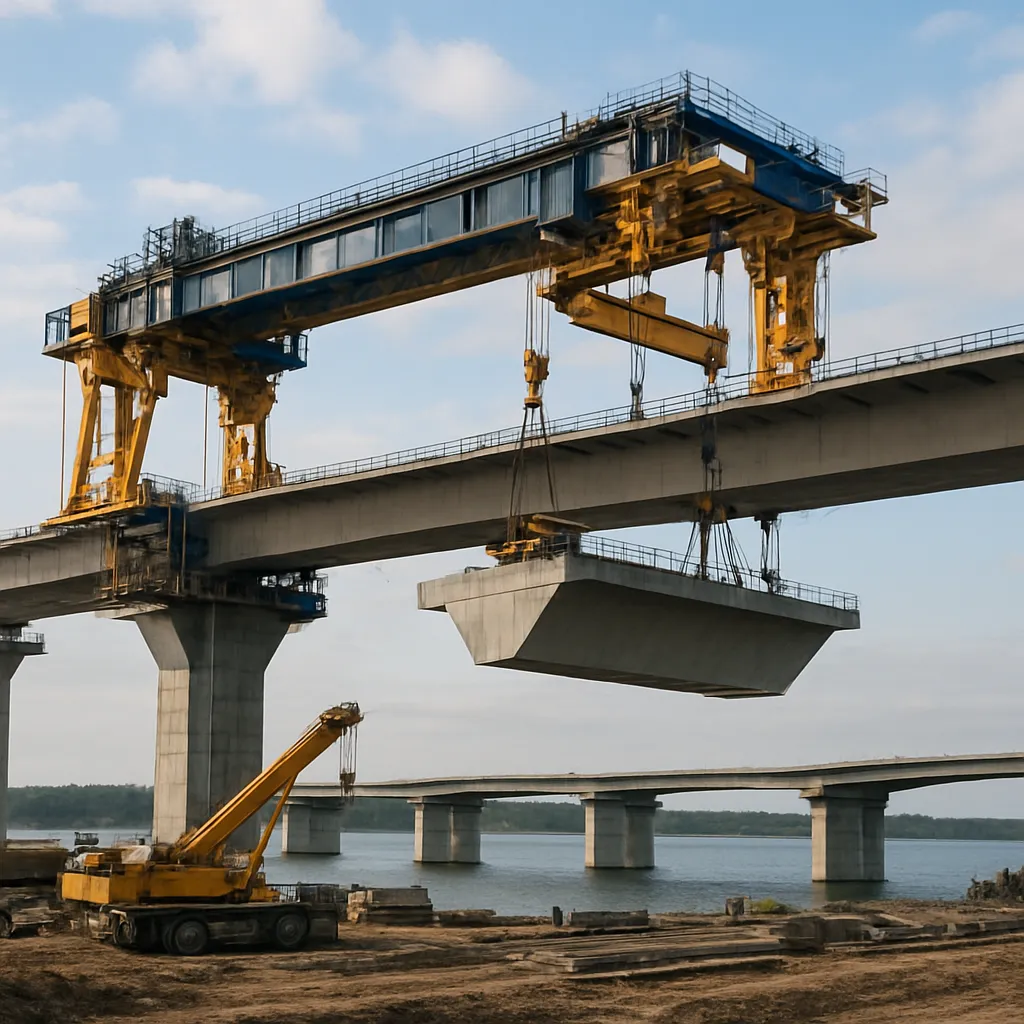
Bridges stand as testaments to human **ingenuity**, enabling societies to traverse previously impassable obstacles. Behind every span lies a fleet of colossal machines, each engineered for **precision**, **durability**, and **efficiency**. From the earliest launchers to cutting-edge robotic assemblers, these mechanical marvels have transformed bridge-building into a symphony of power and coordination.
Pioneering Heavy-Duty Launchers
Incremental Launch Systems
One of the most revolutionary methods for constructing long spans over rivers or valleys is the incremental launching technique. A mobile gantry pushes prefabricated bridge segments forward across temporary supports, rolling into position with hydraulic **automation**. This approach minimizes on-site scaffolding and reduces environmental impact, making it ideal for sensitive locations.
- Hydraulic jacks: Provide the raw force to slide massive segments.
- Sliding bearings: Ensure friction-controlled movement.
- Temporary piers: Offer stable, yet removable, support.
Balanced Cantilever Erectors
In situations where launching from one end isn’t feasible, balanced cantilever machines build outward from piers on both sides. These self-contained units carry form travelers that shape and cast concrete in situ. Their **modularity** allows rapid reconfiguration for varied span lengths, and advanced sensors guarantee the structure remains perfectly aligned.
High-Capacity Cranes and Their Roles
Floating Cranes
When constructing over water, floating cranes—sometimes known as crane barges—lift and position **steel girders** weighing several hundred tons. Equipped with stabilizing outriggers and dynamic positioning systems, these vessels maintain station even under adverse conditions. Their versatility is crucial for assembling arch bridges and placing massive caissons on the seabed.
Heavy-Lift Land Cranes
On land, crawler cranes with enhanced boom lengths and load capacities can hoist prefabricated trusses in a single lift. Key features include:
- Counterweight systems that adapt to changing load geometries.
- Robust tracks for mobility on uneven terrain.
- Remote-control interfaces for increased operator safety.
These cranes often collaborate with transporters and jacks to maneuver sections into place in a choreographed sequence.
Specialized Substructure and Scaffolding Machinery
Caisson and Cofferdam Installations
Foundations in deep water demand caissons—large watertight chambers that are sunk, dewatered, and filled with concrete. Specialized floating platforms carry these caissons, using winches and guide frames to lower them with **meticulous** accuracy. Once in place, high-pressure pumps remove water, allowing workers to prepare a stable base.
Automatic Falsework Robots
An emerging trend is the use of robotic systems to assemble and retract falsework (temporary support structures). These robots can:
- Lock and unlock modular frames with hydraulic arms.
- Monitor load distribution in real time.
- Retract supports in a coordinated manner to reduce stress on the fresh concrete.
This **automation** cuts labor costs and improves safety, especially for towering multi-span bridges.
Emerging Innovations and Robotic Systems
3D Printing and Additive Manufacturing
Large-scale 3D printers are beginning to fabricate **complex** concrete and composite elements on-site. By extruding layers of material, they can produce intricate forms previously impossible or too costly using traditional molds. Benefits include:
- Material optimization that reduces waste.
- Rapid prototyping for custom joint designs.
- On-demand production to accelerate schedules.
Autonomous Assembly Drones
Aerial drones equipped with magnetic grippers or specialized clamps can assist in positioning lightweight components, such as bridge decking panels or safety barriers. Coordinated by an AI-driven control network, these drones maintain precise formation, ensuring each panel is placed within millimeters of its intended location.
Smart Monitoring Platforms
Once a bridge is under construction, fleets of ground and aerial robots patrol the site, performing non-destructive testing. Using ultrasonic scanners and infrared cameras, they detect flaws in welds or anomalies in concrete curing. This continuous **monitoring** helps engineers intervene before minor issues escalate into significant delays.