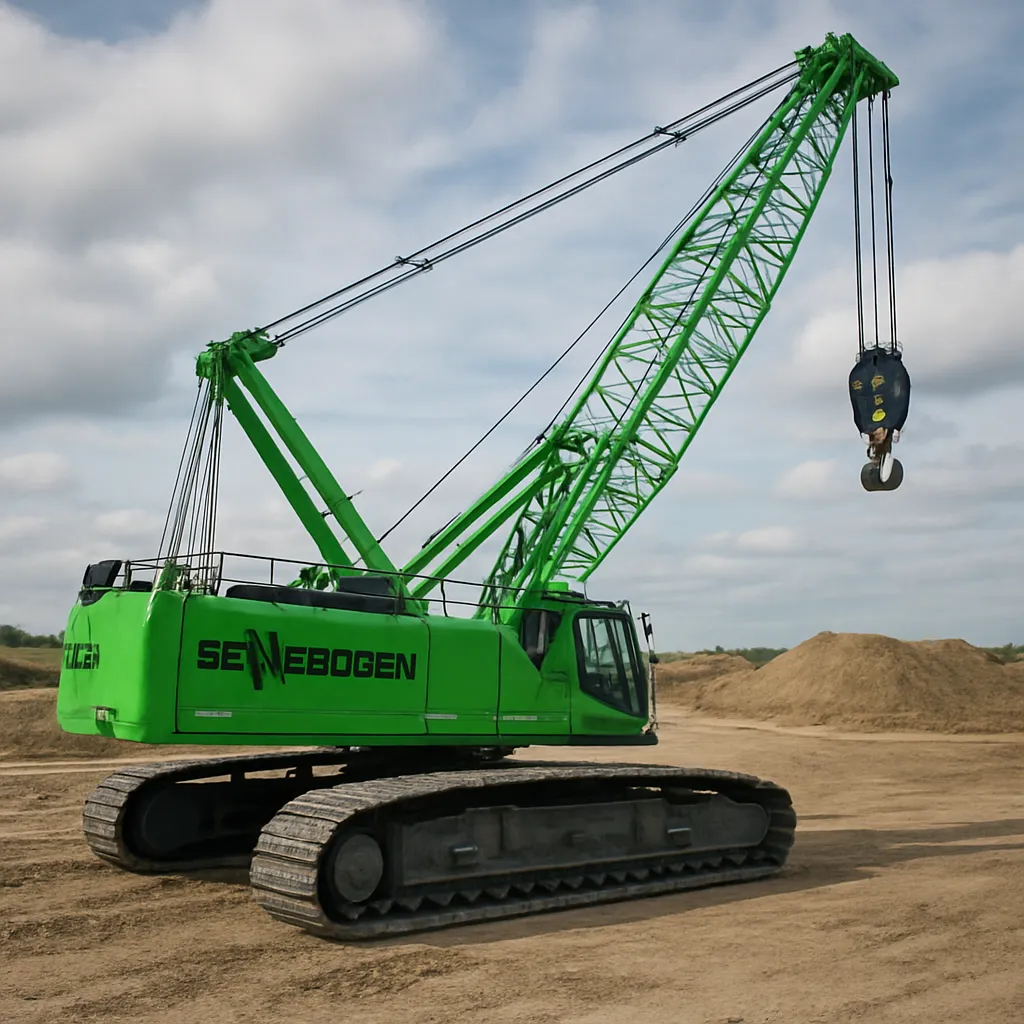
The SENNEBOGEN 5500 Star-Lifter represents a class of high-capacity lattice crawler cranes engineered for the most demanding heavy lifting tasks. Combining robust structural design, modular transportability, and advanced control systems, this machine is aimed at projects where sheer lifting power and site versatility are essential. The following article explores the machine’s design philosophy, typical technical characteristics, fields of application, operational considerations, safety aspects and maintenance needs, along with practical notes on transport and economics. Where exact numerical specifications vary by configuration, ranges and typical values are given to reflect real-world setups.
Design and technical overview
The SENNEBOGEN 5500 Star-Lifter is built around a high-strength lattice boom and a heavy-duty crawler undercarriage that together provide the platform for very large lifts and long reach operations. The structural components are engineered to optimize stiffness-to-weight ratio, enabling the crane to carry significant loads at extended radii while maintaining stability.
Key design elements include a modular counterweight system, multiple boom and jib configurations, and an advanced operator cab with integrated monitoring systems. The modular approach allows the machine to be adapted to a variety of lifting tasks by changing the length of the main boom, adding luffing or fixed jibs, and configuring counterweights to match required capacities and transport constraints.
- Modular lattice boom sections for flexible reach
- Hydro-mechanical or hybrid drive options for slewing and winch performance
- Large-capacity winches equipped with multi-fall reeving systems
- Modular counterweight blocks for on-site ballast adjustment
- Integrated electronic safety systems: load moment indicator (LMI), anti-two-block protections, and overload cutouts
Typical manufacturer and industry practice for cranes in this class provides a range of technical figures rather than a single universal specification, because the exact lifting capability depends strongly on boom/jib combination and counterweight configuration. Generally, machines marketed as 5500 Star-Lifters are capable of handling loads in the upper hundreds of tonnes category, with maximum lifts and radii dependent on configuration choices.
Powertrain and hydraulics
The power unit for a large crawler like the 5500 Star-Lifter usually combines a high-output diesel engine (meeting current emission stages where possible) with hydraulic systems sized for continuous, high-duty operation. Many modern machines also offer advanced electronic engine controls and telematics for remote diagnostics and performance optimization.
Typical powertrain attributes:
- High-efficiency diesel engine(s) with power outputs suited to heavy-duty lifting and slewing demands
- Redundant hydraulic systems for winch and boom functions to enhance safety and uptime
- Electronic control units for precise load handling and responsive operator interfaces
Cab, controls and monitoring
Operator ergonomics and control sophistication are central to the 5500 Star-Lifter’s usability. The cab is usually climate-controlled, sound insulated, and fitted with multi-function joysticks, large displays showing real-time load charts, diagnostics, camera feeds and telematics. Advanced systems support variable lift modes, automatic load limiting, and logging of operational parameters for later analysis.
Applications and typical job sites
The SENNEBOGEN 5500 Star-Lifter is designed for sites where high lifting capacity, reach and stability are non-negotiable. Its versatility lets it perform a broad range of roles across multiple industries.
- Infrastructure construction — large bridge segments, precast concrete element placement, viaduct assembly and heavy-span installations.
- Energy sector — erection and maintenance of power plant components, installation of turbines, boilers, and heat exchangers.
- Wind industry — foundation elements, tower sections and nacelle installations, especially for onshore projects requiring heavy-lift capacity.
- Offshore and port operations — load-ins and load-outs of heavy machinery, installation of jack-up units or modules at quayside staging areas.
- Industrial plant builds — assembly of steelwork for refineries, chemical plants and large manufacturing facilities.
- Heavy civil and mining — positioning heavy processing equipment, large-scale structural components, and relocation of oversized loads within job sites.
Because of its crawler undercarriage, the 5500 Star-Lifter can operate on softer ground than comparable wheeled cranes, distributing loads over a larger footprint. This makes it particularly suitable for remote or undeveloped sites where preparing a paved crane pad would be costly or slow.
Examples of typical tasks
- Setting multi-ton bridge girders into final position where long reach and high lifting moment are required.
- Lifting modularized plant sections during power plant or petrochemical facility assembly.
- Installing heavy foundations for onshore wind turbines and positioning tower sections prior to nacelle installation.
- Performing heavy lifts in port environments — handling oversized components from ship to shore.
Performance figures and statistical context
Exact performance numbers for a SENNEBOGEN 5500 Star-Lifter depend on chosen configuration, counterweight, and boom/jib arrangement. Instead of a single value, it’s useful to consider typical ranges and the factors that affect them.
- Lifting capacity: machines in the “5500” class are built to perform heavy lifts in the high hundreds of tonnes. Typical on-paper maximums for similar lattice crawler cranes range from around 300 tonnes to more than 600 tonnes in specific configurations.
- Boom length and reach: main lattice booms commonly extend into the dozens of meters; combined main boom and jib configurations frequently reach well beyond 70–100 meters of hook height or reach, depending on the setup.
- Operating weight: total machine and ballast weight for large crawlers can be in the low to mid hundreds of tonnes, with counterweights adding significantly more mass when full capacity is required.
- Engine power: heavy crawler cranes typically employ engines in the range of several hundred kilowatts to meet hydraulic and slewing power demands.
Operational statistics relevant to fleet managers include fuel consumption, utilization rates and lift cycles. Fuel burn for a crane of this size during heavy lifting may range widely based on duty cycle, but it is a significant operational cost and an important factor when comparing total cost of ownership across machines. Modern control systems, efficient hydraulic circuits and optionally staged engine modes help reduce fuel usage during light or idling periods.
Transport, assembly and site preparation
One of the advantages of a modular crawler design is the ability to break the machine down into transportable modules that conform to road regulations and weight limits. The 5500 Star-Lifter is designed with demountable boom sections, carrier modules and stackable counterweights so that it can be moved between sites without requiring excessive special permits or escorts in most regions.
- Transport modules typically include crawler frames, engine-house and counterweight segments, boom sections, and winch units.
- Assembly is performed using lighter auxiliary cranes or gantry systems, depending on the weight of the heaviest module to be lifted during erection.
- Site preparation includes ground improvement as necessary, placing crane mats or reinforced pads under the tracks and ensuring adequate space for the machine’s footprint and swing radius.
Because the crane’s lifting capacity is sensitive to ground conditions, careful geotechnical assessment and preparation often represent a crucial portion of project planning when such cranes are specified.
Operation, safety systems and best practices
Safety and precision are central to the operation of any high-capacity crawler crane. The SENNEBOGEN 5500 Star-Lifter typically integrates multiple safety and assistance systems to support operators and rigging crews:
- Load moment indicator (LMI) and overload protection that prevent lifts exceeding configured safe working loads.
- Anti-two-block systems and limit switches to avoid hook block collisions with boom tip.
- Redundant braking and mechanical backstops on slewing and winch systems.
- Comprehensive camera coverage for blind-spot monitoring and alignment assistance.
- Telematics for remote monitoring of machine health, operating hours and diagnostic codes.
Operator training is essential. Certified crane operators with experience in lattice crawler cranes, supported by competent riggers and a qualified lifting supervisor, form the backbone of safe operations. Pre-lift planning, detailed lift plans and the use of certified lifting accessories and slings are mandatory for heavy lifts. In many jurisdictions, a formal crane lift plan and lift-by-lift risk assessment are legal requirements for large-capacity lifts.
Common best-practice measures
- Detailed pre-lift calculations using manufacturer load charts tailored to the exact boom and ballast configuration.
- Ground bearing capacity verification and the use of crane mats or reinforcement as necessary.
- Strict adherence to wind speed and weather limits for specific boom/jib configurations.
- Communication protocols (radio, signals) and exclusion zones for personnel beneath suspended loads.
Maintenance, lifecycle and reliability
Longevity and uptime are heavily influenced by maintenance regimes and operating practices. Regular inspections, scheduled maintenance and timely replacement of wear components are standard for cranes of this size. Common maintenance activities include:
- Routine inspection of boom sections for cracks, corrosion and fastener integrity.
- Nondestructive testing (NDT) for critical structural welds and high-stress areas.
- Lubrication schedules for pins, slewing rings and wire ropes.
- Winch drum and wire rope replacement at defined service intervals based on wear and fatigue metrics.
- Hydraulic fluid and filter replacement following manufacturer recommendations.
Because transport and repeated assemblies generate wear on couplers and joints, lifecycle management often includes scheduled refurbishment of bolted connections and replacement of wear plates. Telematics and on-board diagnostics further enable predictive maintenance by flagging anomalies before they develop into failures.
Economics and lifecycle cost considerations
Purchasing or renting a heavy crawler crane like the 5500 Star-Lifter involves consideration of capital cost, transport and assembly expenses, operating costs (fuel, personnel, maintenance), and project utilization. For owners and contractors, total cost of ownership depends on how effectively the crane can be matched to project portfolios requiring its capabilities.
- High initial cost but lower per-lift unit costs when the crane is used at sufficient utilization rates across projects requiring heavy lifts.
- Transport and assembly can add substantial project costs, so optimizing logistics and reducing number of site moves improves economics.
- Fuel efficiency enhancements, hybridization options and modern control systems reduce operating expenses over the machine’s life.
Sustainability and environmental considerations
Environmental impact is an increasing focus in heavy equipment design and project planning. For large crawlers, sustainability can be advanced through:
- Efficient engines meeting stringent emissions standards (Stage V, Tier 4 equivalent) to reduce NOx and particulates.
- Idle-reduction strategies and eco-modes to lower fuel consumption during non-lift activities.
- Potential electrification or hybrid drive systems for use on sites with available electrical supply, reducing onsite emissions and noise.
- Reduced need for extensive site preparation (compared with wheeled cranes), lessening earthworks and disturbance in sensitive areas.
Case studies and illustrative projects
While individual projects vary, typical examples demonstrating the 5500 Star-Lifter’s strengths include:
- Bridge construction projects where large precast segments (hundreds of tonnes) must be hoisted into place with long-reach booms spanning constrained valley or water crossings.
- Power plant installations requiring the precise placement of heavy heat-exchange modules or turbine sections within confined construction spaces.
- Onshore wind farms handling foundation elements or preassembled tower segments that exceed the capacity of smaller mobile cranes.
- Port-based module assembly for offshore platforms where heavy topside modules are transferred from quayside to waiting barges.
In these environments, the machine’s ability to deliver controlled heavy lifts with a stable footprint and modular transportability is a decisive advantage.
Comparisons and positioning within the market
The SENNEBOGEN 5500 Star-Lifter competes with other heavy lattice crawler cranes from established manufacturers. Buyers choose between models based on criteria such as maximum lift capacity, boom and jib options, transportability, fuel efficiency, local service networks and total lifecycle cost. The Star-Lifter branding emphasizes a balance between raw capacity and operational flexibility, catering to firms that regularly undertake very large lifts but need a machine that can be adapted quickly from one job to the next.
Final operational notes
When deploying a heavy crawler like the 5500 Star-Lifter, early engagement of lifting engineers, transport specialists and rigging crews produces the most efficient outcomes. Detailed site and lift planning, careful management of ballast and boom configuration, and disciplined adherence to maintenance and safety protocols ensure that the crane delivers the performance expected by project planners and operators.
With its combination of robust lattice construction, modularity and modern controls, the SENNEBOGEN 5500 Star-Lifter is positioned to meet a wide range of heavy-lift challenges — from infrastructure and energy projects to heavy industrial assembly and port operations. When matched to appropriate tasks and supported by capable crews, it becomes a cornerstone asset in high-capacity lifting fleets.


)
)