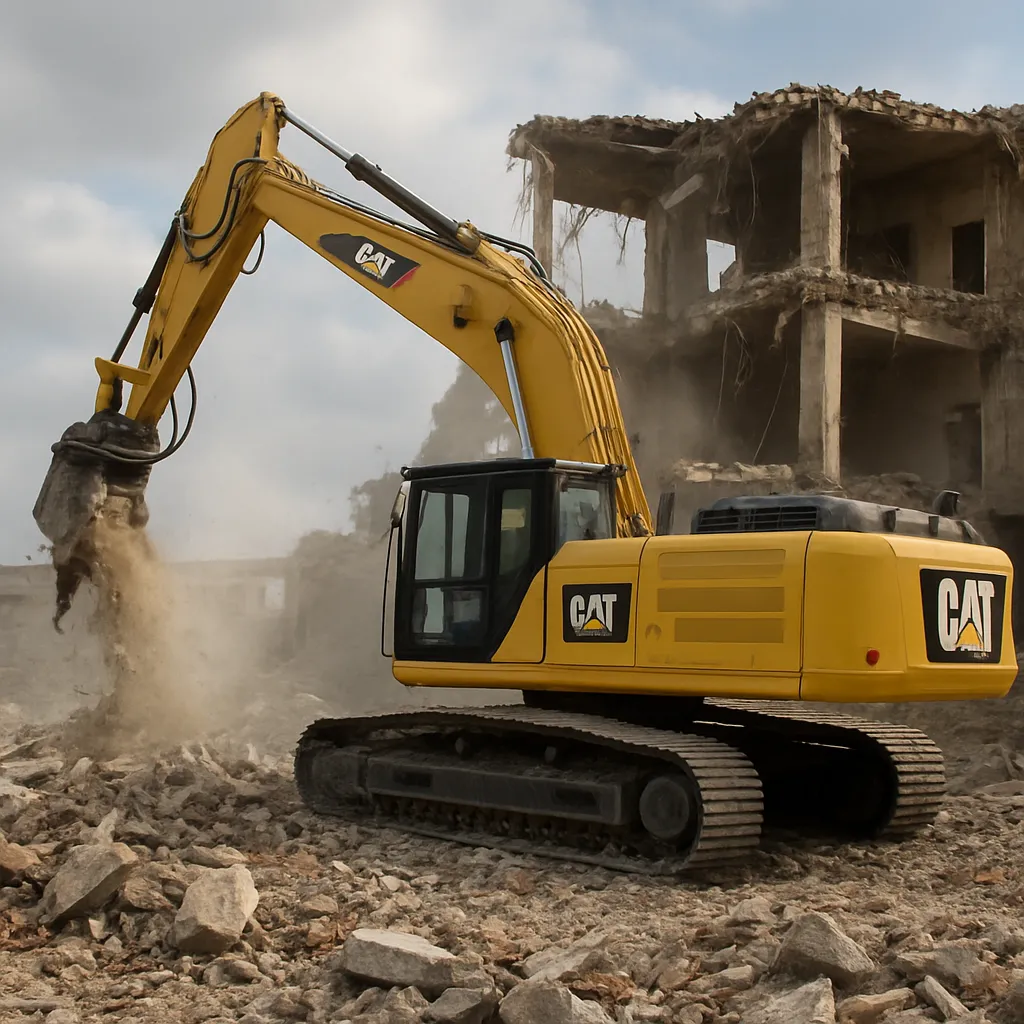
The CAT 340 UHD is Caterpillar’s purpose-built solution for heavy-duty, high-reach demolition projects. Designed to combine reach, strength and operator-focused technology, this machine is tailored to tackle selective dismantling, high-rise removal and complex structural deconstruction where precision and safety are paramount. In the text below you will find an overview of the model’s role in modern demolition, typical configurations and attachments, operational benefits, safety and maintenance considerations, and market-context information that helps explain why contractors choose the 340 UHD for demanding jobs.
Overview and key characteristics
The CAT 340 UHD (Ultra High Demolition) is an excavator variant optimized for demolition tasks that require extended vertical and horizontal reach and enhanced visibility, protection and stability. Unlike general-purpose excavators, the UHD configuration emphasizes a reinforced undercarriage, extended boom and stick options, and structural modifications to support heavy demolition attachments and the dynamic loads associated with dismantling multi-story structures.
At its core, the 340 UHD focuses on delivering controlled, reliable force at distance. Typical design objectives include extended working envelope, improved structural fatigue life, and operator protection systems. In practical terms, that means the machine is engineered to handle the stresses of cutting, shearing, and lifting while offering features that reduce downtime and improve on-site efficiency.
Important technical and configuration aspects to consider include:
- reach and working envelope: UHD variants prioritize long booms and sticks to access upper stories without requiring scaffolding or cranes.
- attachments compatibility: heavy-duty rotators, hydraulic shears, crushers, hammers and grapples are standard elements of a demolition setup.
- hydraulics and flow: robust hydraulic systems supply consistent power to attachments and support high-cycle operations.
- stability and counterweight: special counterweight options and undercarriage reinforcements are used to balance extended-reach loads safely.
Applications and typical job types
The CAT 340 UHD is used across a wide range of demolition and deconstruction contexts where reach, precision and safety are critical. Some common applications include:
- High-rise and multi-story building demolition where floor-by-floor removal is required to protect adjacent structures.
- Selective demolition and interior strip-outs where delicate removal of structural elements, façade work or mechanical systems is needed without damaging remaining areas.
- Industrial plant decommissioning, including dismantling of steel structures, tanks and heavy process equipment.
- Bridge and elevated structure removal where extended reach reduces the need for lane closures, temporary shoring or cranes.
- Disaster recovery and collapse clearance where controlled removal of hazardous elements is essential for safety.
These machines excel in environments where access is constrained and precision matters. Contractors often choose UHD excavators over crane-and-man basket combinations because the excavator provides stronger demolition force, continuous power for hydraulic attachments, and more robust operator protection packages.
Attachment ecosystem
One of the 340 UHD’s greatest strengths is the breadth of productive attachments it can employ. Demolition jobs typically require a sequence of specialized tools, and the 340 UHD supports a modular approach that maximizes utility across the job lifecycle:
- Hydraulic shears for cutting steel and rebar.
- Hydraulic breakers for concrete fragmentation and pad removal.
- Concrete crushers and pulverizers for primary and secondary crushing tasks.
- Multi-tine grapples for sorting and handling debris and recyclable materials.
- Rotating and tilting quick couplers to position attachments precisely at awkward angles.
Matched attachments enable the 340 UHD to move quickly from gross demolition to final cleanup and materials handling, lowering overall project duration and improving salvage rates.
Design, safety and operator environment
Demolition work imposes unique demands on both equipment and personnel. The CAT 340 UHD integrates multiple design features to protect operators and bystanders while maintaining productivity:
- safety systems: reinforced cabs with FOPS/ROPS protection, external rear and side cameras, and specialized guards for glass and joints help shield operators from falling debris and impacts.
- Visibility and controls: enlarged windows, optimized cab orientation and camera systems provide a wide field of view, making precision cuts and manipulations easier.
- Structural protection: reinforced towers, pillow blocks and boom connection points extend fatigue life under high-cycle demolition loading patterns.
- Access and egress: ladders, platforms and handrails are designed for safe movement when personnel need to inspect or service upper boom areas or attachments.
- Control features: fine hydraulic control, programmable hydraulic circuits and attachment presets let operators switch tools and operating modes quickly while maintaining precise motion control.
Operator comfort also affects safety and productivity. The 340 UHD cab typically includes climate control, ergonomic seating and control layouts, and acoustic dampening to reduce operator fatigue during long shifts. Telemetry and remote monitoring systems allow fleet managers to track machine health and usage, pre-emptively schedule maintenance and enforce safe working hours.
Maintenance and serviceability
Downtime in demolition projects can be expensive. To minimize interruptions, the 340 UHD is engineered with serviceability and durability in mind:
- Accessible service points for filters, fluids and routine checks reduce the time mechanics spend on-site.
- Heavy-duty undercarriage and wear components are selected for abrasive environments often encountered in demolition sites.
- Modular attachment mounts make swap-outs faster and safer, minimizing time spent in potentially hazardous positions.
- On-board diagnostics, often paired with Cat’s telematics offerings, provide early warnings for hydraulic, electrical or engine issues so repairs can be scheduled rather than reactive.
Performance, economics and environmental considerations
When evaluating a demolition excavator such as the 340 UHD, contractors weigh purchase or rental cost against operational performance, fuel consumption and secondary savings (faster cycle times, reduced crane rental, fewer workers at height, etc.). The machine is designed to improve overall job economics by:
- Increasing throughput: long reach and powerful hydraulics enable the machine to remove large volumes of material quickly.
- Reducing auxiliary equipment: integrated demolition capabilities reduce reliance on cranes, scaffolding and additional labor.
- Improving salvage and recycling rates: precision dismantling preserves recyclable materials, improving resale or recycling returns.
- Enhancing fuel and maintenance efficiency: modern engines and hydraulics are tuned to deliver better fuel economy and lower lifecycle maintenance compared with older, less-specialized machines.
Market and industry statistics provide context for these economic factors. While specific figures for the CAT 340 UHD production volumes are proprietary to Caterpillar and vary year-to-year, general industry trends help explain demand:
- Global demolition equipment demand aligns with construction renovation and urban redevelopment cycles; many markets have seen steady growth in selective demolition and deconstruction driven by recycling mandates and urban densification.
- Industry reports in the 2020s indicated moderate growth in the demolition equipment segment, with an estimated compound annual growth rate (CAGR) in the low single digits to mid-single digits (generally reported between ~3–6%) depending on region and report methodology.
- Fuel efficiency and emissions regulations have accelerated adoption of newer equipment. Contractors replacing older fleets often see single-digit to low-double-digit percentage improvements in fuel consumption and emissions per hour, depending on duty cycle and attachment use.
These statistics underline why modern UHD excavators are considered strategic investments for firms that perform frequent high-reach demolition or complex decommissioning jobs.
Operational best practices and planning
To maximize the value and safety of a CAT 340 UHD on site, operators and managers should follow established best practices:
- Pre-job planning: conduct detailed structural assessments, establish fall zones and designate spoil handling and salvage areas to minimize rework.
- Attachment selection: sequence attachment changes to move from gross demolition (crushers, shears) to sorting and handling (grapples, magnets) to minimize swap frequency and hydraulic reconfiguration time.
- Stability management: always configure counterweights and travel positions according to lift charts and manufacturer instructions; avoid operating at extreme reach with heavy attachments without proper ballast and outriggers (if applicable).
- Operator training: invest in specialized demolition training focusing on attachment handling, reach management and situational awareness around falling debris and rebar hazards.
- Environmental controls: use dust suppression (water misting), noise mitigation tactics and material containment to meet regulatory requirements and community expectations.
Safety protocols and regulatory considerations
Regulatory and safety requirements are strict in demolition operations. The CAT 340 UHD supports compliance through built-in features, but companies must maintain robust procedures, including:
- Permitting and structural assessments before any demolition work begins.
- Confined space and hazardous material surveys (asbestos, lead, PCBs) with proper abatement prior to mechanical demolition.
- Exclusion zones and signage to protect workers and the public from falling debris and machine swing radii.
- Regular inspection regimes for wear on booms, pins and attachment mounts to prevent catastrophic failures.
Case studies and typical outcomes
Real-world deployments of UHD excavators demonstrate typical benefits and measurable outcomes:
- Urban façade removal: contractors report reduced closure and disruption time when using a single UHD excavator with long reach compared to crane-based methods. Projects that would otherwise require lane closures and multiple lifting setups can often be completed with less interference to surrounding infrastructure.
- Plant decommissioning: a single 340 UHD equipped with shears and a rotating grapple can complete staged dismantling of elevated process lines more quickly than multi-equipment approaches, lowering both equipment rental and labor costs.
- Material recovery: selective deconstruction employing UHD excavators often yields higher recovery rates of recyclable steel and concrete, boosting the value returned from salvage and reducing landfill disposal volumes.
While outcomes depend on job specifics, these examples illustrate why demolition-focused excavators have become standard for contractors engaged in complex removal projects.
Choosing between purchase, rental and fleet strategies
Deciding whether to buy or rent a CAT 340 UHD hinges on utilization forecasts, capital availability and project timelines:
- Purchase is often justified if utilization is high (multiple long projects per year). Ownership provides control over attachment fitment and machine configuration to optimize long-term operating costs.
- Rental or short-term lease can be cost-effective for occasional high-reach projects, allowing access to the latest machine and attachment technology without large capital outlays or long-term maintenance obligations.
- Managed fleet services or Cat Certified Used machines are intermediate options, offering reduced capital exposure while keeping service and parts support from Caterpillar networks.
Whichever route is chosen, integrating telematics (for example, Product Link and VisionLink) into fleet management delivers measurable benefits in utilization tracking, preventative maintenance scheduling and total cost of ownership analysis.
Summary and final considerations
The CAT 340 UHD occupies a critical niche in demolition and deconstruction: it combines long reach, heavy-duty attachment compatibility and safety-oriented design to meet the demands of modern demolition projects. Contractors value the machine for its ability to reduce reliance on auxiliary equipment, improve salvage rates and shorten project timelines. Key considerations when deploying the 340 UHD include proper attachment selection, rigorous stability management, trained operators and a maintenance regime that leverages on-board diagnostics and telematics data.
As urban redevelopment and sustainability pressures increase, demolition strategies that emphasize selective dismantling, recycling and minimized site disruption will grow in importance. Machines like the CAT 340 UHD are engineered to support those goals—providing both the physical capability and the technological tools needed to complete complex deconstruction tasks safely and efficiently.
Highlighted keywords:
- demolition
- reach
- attachments
- hydraulics
- stability
- efficiency
- safety
- productivity
- versatility
- telemetry


)
)