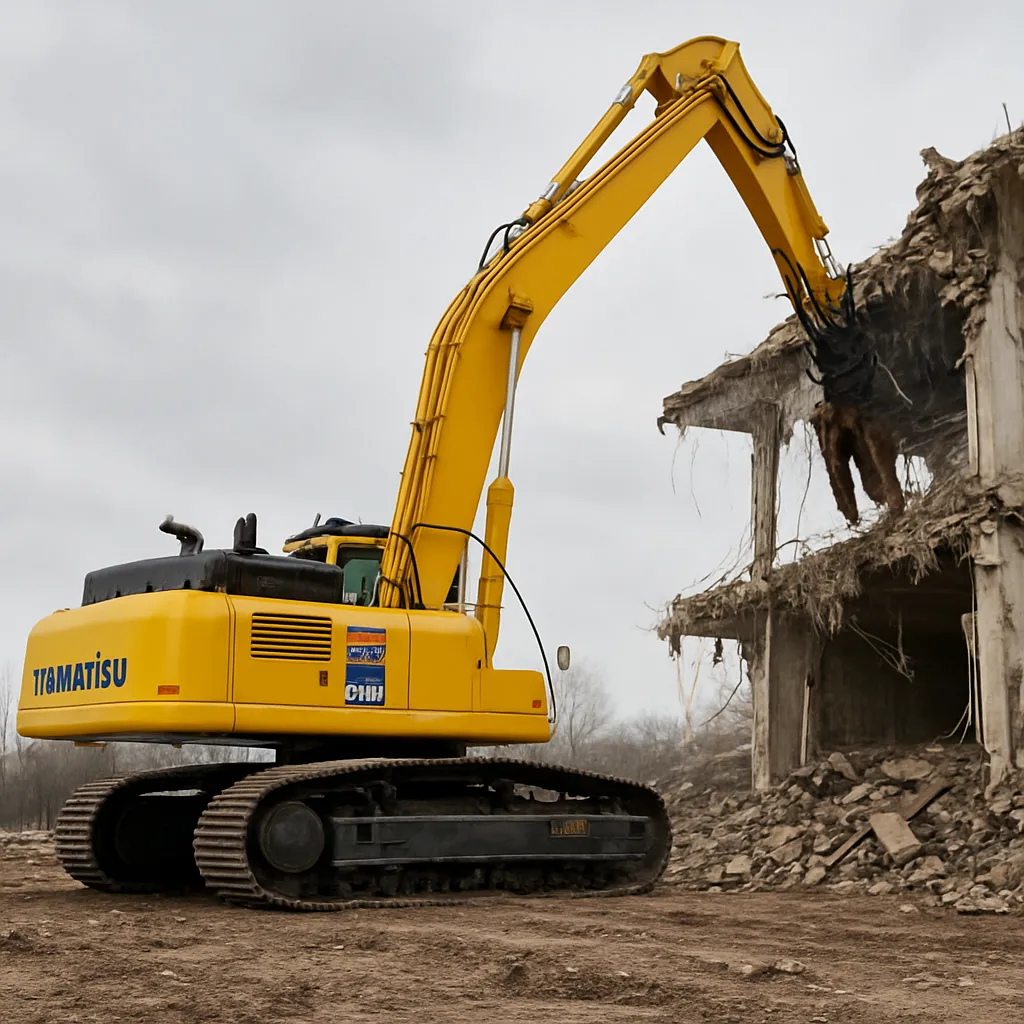
The Komatsu PC700LC HR represents a specialized branch of large excavators engineered specifically for the demands of high-reach demolition. Combining the rugged base platform of a heavy-duty excavator with extended booms and purpose-built attachments, this machine is designed to safely and efficiently dismantle structures that would otherwise require extensive scaffolding, cranes, or manual labor. In the following sections, we explore its design, typical applications, operational best practices, attachments, and practical statistics that illustrate why such machines are increasingly central to modern demolition projects.
Design and key features
At its core, the PC700LC HR is a derivative of Komatsu’s heavy excavator family adapted for the unique stresses of high-reach work. Modifications focus on structural reinforcement, hydraulic capacity, operator visibility, and safety systems. The result is a machine that balances raw power with precision control when working at elevation.
- Structural reinforcement: Extended booms and arms are engineered with thicker sections and reinforced joints to withstand the bending moments and dynamic loads experienced during demolition. Counterweights and undercarriage adaptations often accompany the conversion to preserve stability.
- Hydraulic system: Enhanced hydraulic pumps and circuits deliver the consistent flow and pressure necessary for long-reach booms and heavy attachments like shears and crushers.
- Operator cab and controls: Cabs are adapted for improved sightlines to elevated work areas. Many models offer remote cameras, joystick controls adapted for fine manipulation at height, and ergonomic improvements to reduce operator fatigue.
- Modular boom configurations: Manufacturers and retrofitters supply interchangeable boom sections that allow operators to tailor reach and tipping load for specific jobs—trading reach for lifting capacity as required.
- Integrated safety systems: Load-moment indicators, boom angle alarms, winch backups, and emergency lowering functions are frequently integrated to reduce the risk of overreach, tip-over, or equipment failure during demolition operations.
Typical applications and job-site roles
High-reach excavators like the PC700LC HR are specialized tools for vertical dismantling tasks. Their principal advantage is the ability to perform work from the ground, minimizing the need for workers to operate at dangerous elevations.
- Selective demolition of multi-story buildings — efficiently removing upper floors and façades while preserving lower structures for renovation or adaptive reuse.
- Facade removal — detaching curtain walls, brickwork, stone cladding, and other exterior elements with precision to protect adjacent buildings or infrastructure.
- Industrial plant dismantling — breaking down tall chimneys, silos, and steel frames where reach and controlled demolition are critical.
- Urban demolition — working in tight city sites where using large cranes or explosives is impractical or prohibited due to safety, noise, or vibration concerns.
- Controlled deconstruction for salvage — enabling piece-by-piece removal of reusable materials with minimal contamination and improved recycling rates.
Attachments and configurations
One of the PC700LC HR’s greatest strengths is its compatibility with a wide range of heavy-duty attachments that extend its utility beyond simple tearing. Selection of the appropriate tool is crucial to match demolition goals, productivity targets, and site constraints.
- Hydraulic shears — designed to cut structural steel and rebar; ideal for dismantling frames and cutting beams cleanly for removal or recycling.
- Concrete pulverizers and crushers — reduce concrete to manageable sizes for removal and recycling while separating rebar for salvage.
- Hydraulic breakers — used for precise breaks or to tackle particularly dense concrete where shears or crushers are less effective.
- Grapples and multi-processor heads — handle debris, pick and place large elements, and sort materials for recycling.
- Specialized boom variants — combinations of articulated and telescopic sections that optimize reach, payload, and visibility for different building geometries.
Safety and operational considerations
Operating a high-reach excavator introduces unique safety challenges compared to standard excavation. Proper planning, operator training, and machine configuration are essential to protect personnel and assets.
Risk management and site planning
- Conduct a thorough structural assessment to understand how upper floors will be supported during staged demolition.
- Establish exclusion zones beneath the work area to protect workers and the public from falling debris.
- Plan for material handling and traffic flow to avoid bottlenecks and reduce the risk of secondary incidents.
Operator skills and training
- Operators must be trained not only in heavy equipment operation but specifically in high-reach demolition techniques, including recognition of changing load dynamics as reach and boom angle change.
- Familiarity with electronic load-moment systems and safe winching procedures is critical.
- Regular drills for emergency lowering and machine shutdown improve response times in critical situations.
Machine configuration and monitoring
- Use of real-time load monitoring and angle sensors helps prevent exceeded capacities at long reaches.
- Visual aids (cameras, spotters, and mirrored sightlines) are commonly required to maintain safe visibility on complex sites.
- Routine pre-shift inspections focused on the boom, pins, hydraulic lines, and attachment mounts mitigate the risk of catastrophic component failures.
Maintenance, lifecycle and economics
The economics of owning and operating a high-reach excavator differ from standard machines. Purchase or retrofit costs are higher, but the productivity and safety gains can yield favorable return on investment when used regularly on complex demolition projects.
- Initial investment: Factory-built high-reach variants or professionally engineered retrofits add substantial cost. Buyers should consider the expected utilization rate and contract pipelines before investing.
- Maintenance intensity: Extended booms and specialized hydraulic systems require tighter maintenance intervals and vigilant inspection schedules. Pins and bushings, boom cylinders, and high-pressure hoses are consumption items that affect uptime.
- Operating costs: Fuel consumption is typically higher than regular excavators due to heavier loads and longer hydraulic cycles. However, machine efficiency in replacing scaffolding and crane hours often offsets fuel and maintenance costs in overall project budgets.
- Residual value and resale: Well-maintained demolition units command strong resale prices in markets where urban redevelopment is active. Conversely, specialized machines can be harder to repurpose in markets lacking demolition demand.
Typical performance figures and statistics
Specifications for the PC700LC HR vary by manufacturer configuration, boom length, and attachments. Below are typical figures and operational statistics to give a realistic picture of performance. These should be treated as representative ranges rather than fixed values because conversions and custom builds lead to wide variation.
- Operating weight: Commonly in the range of approximately 60–80 tonnes depending on counterweights and boom configuration.
- Maximum vertical reach: High-reach conversions often provide vertical reaches between 20 and 30 meters; some custom or telescopic solutions may exceed this range for specialized tasks.
- Engine power: Typical heavy excavator power for this class is in the range of 300–450 kW, adjusted for emissions standards (Stage V/Tier 4F and equivalents in different markets).
- Attachment weight limits: Depending on boom configuration, tip loads can vary widely—operators often trade maximum reach for increased attachment capacity when heavier tools are needed.
- Cycle times and productivity: Demolition productivity is highly variable—removal rates depend on material type, attachment choice, and structure complexity. On average, high-reach machines significantly reduce the time to reach and dismantle upper floors compared with scaffold-based methods.
- Utilization statistics: In mature demolition markets, high-reach machines can account for 20–40% of large building demolition contracts where selective dismantling and material segregation are required.
Environmental and regulatory considerations
Using high-reach excavators can support more environmentally responsible demolition practices when compared with explosive demolition or extensive manual dismantling.
- Dust and noise control: High-reach operations are usually quieter than controlled explosives and can be combined with localized water sprays and misting systems to mitigate dust at the source.
- Material segregation and recycling: The precision of high-reach tools supports higher salvage rates for steel, concrete, and façade materials, improving recycling rates and reducing landfill volumes.
- Regulatory compliance: Urban demolition often requires adherence to vibration, noise, and dust regulations; high-reach excavators facilitate compliance through staged, controlled removal.
Case uses and real-world examples
Around the world, high-reach machines like the PC700LC HR have been instrumental in a variety of high-profile and everyday projects. Typical examples include:
- Conversion of redundant office towers where the façade and upper floors are removed to allow partial retention of lower levels for repurposing.
- Deconstruction of old industrial chimneys and stacks within operational plants by working from the ground without needing extensive scaffolding or large cranes.
- Urban infill projects where adjacent buildings remain occupied and demolition must be staged precisely to limit impact on neighbors.
Operators and contractors report significant time savings when using high-reach machines for façade removal as opposed to forming temporary access platforms. In many municipal projects, the ability to work from one position with a long-reach boom reduces the footprint of demolition work and lowers overall public disruption.
Selecting the right machine for your project
Choosing a PC700LC HR or similar high-reach excavator requires balancing reach, attachment payload, mobility, and cost. Key questions to address include:
- What is the maximum height or façade length that must be reached?
- Which materials will be processed, and what attachments are necessary?
- Will the job require frequent relocation, or can the machine work from a few fixed positions?
- Are there nearby height, width, or ground-bearing constraints that affect machine size or counterweight?
- What are the local regulatory requirements regarding emissions, noise, and dust?
Engage with manufacturers or experienced retrofit specialists early in project planning to model tipping loads, boom reach, and attachment compatibility. This ensures realistic productivity estimates and helps avoid costly on-site modifications.
Conclusion
The Komatsu PC700LC HR and similar high-reach demolition excavators represent a mature solution for complex dismantling tasks where reach, control, and safety matter most. By combining reinforced structures, specialized hydraulics, and a wide array of attachments, these machines enable selective demolition, higher material recovery rates, and safer operations in dense urban and industrial environments. Although initial acquisition and maintenance costs are higher than for standard excavators, the productivity gains, reduced reliance on scaffolding and cranes, and improved environmental outcomes make high-reach machines an attractive option for contractors focused on efficient and responsible demolition work.


)
)