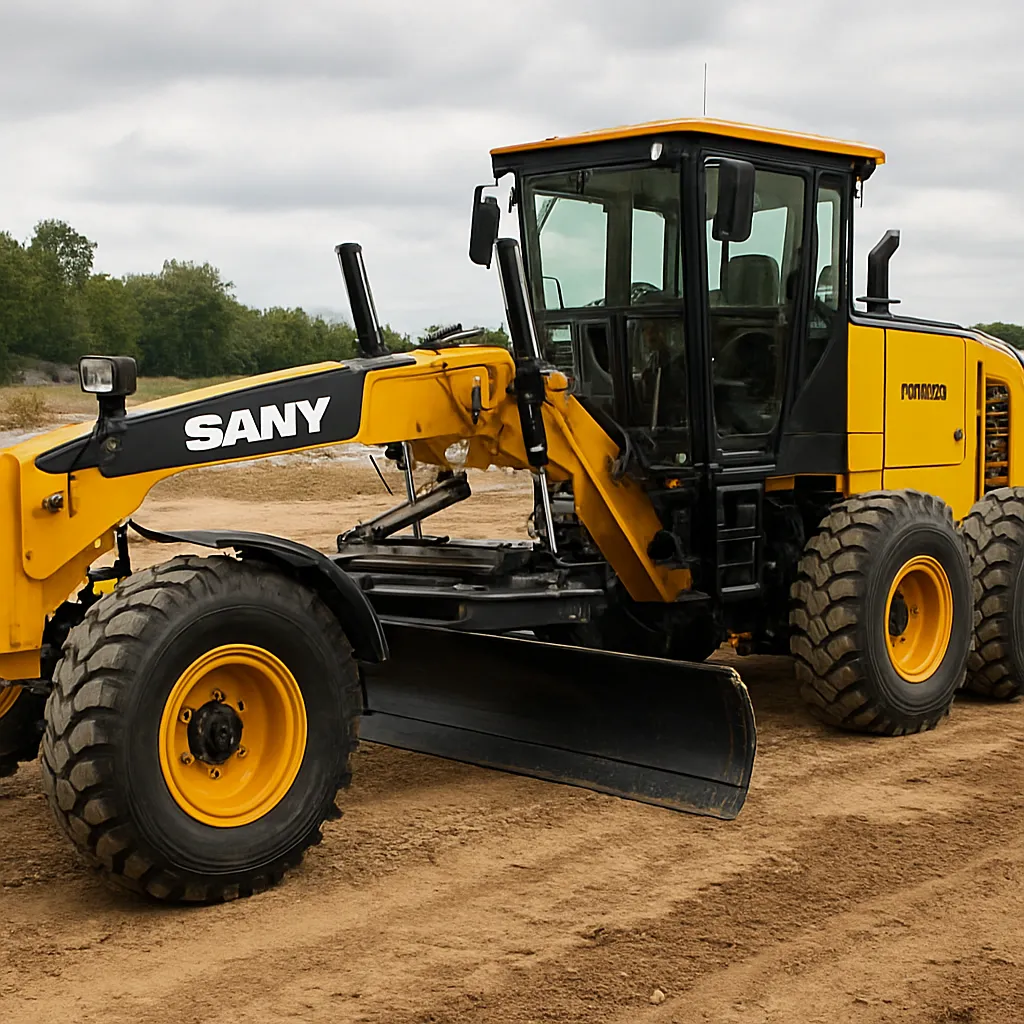
The SANY STG160 motor grader is a versatile piece of heavy equipment designed for road construction, grading, and earthmoving tasks where a balance of power, precision, and cost-effectiveness is required. Built by SANY, one of the world’s largest manufacturers of construction machinery, the STG160 aims to deliver robust performance for contractors, municipal authorities, and large-scale infrastructure projects. This article examines the machine’s design, typical technical characteristics, real-world applications, operational tips, maintenance considerations, and the economic and environmental aspects that make the STG160 a competitive choice in its class.
Design and typical technical characteristics
The SANY STG160 is built on a platform that emphasizes structural strength, ease of service, and operator ergonomics. The grader is commonly positioned in the 150–180 horsepower segment, making it suitable for medium to large grading tasks. Below are typical specifications that are commonly associated with models in the same family; exact values may vary by market, optional packages, and production year, so buyers should always confirm the final spec sheet with an authorized SANY dealer.
Typical specifications (approximate)
- Engine power: around 160 horsepower (approximately 119–130 kW).
- Operating weight: commonly in the range of 15,000–17,500 kg (33,000–38,500 lb), depending on optional attachments and counterweights.
- Maximum travel speed: typically around 35–45 km/h (depending on transmission and axle ratios).
- Blade length: commonly a 4.8–5.2 meter cutting blade (varies by configuration).
- Hydraulic system: closed center or open center systems with multi-function valve for precise control of blade, circle, and articulation.
- Transmission: power-shift or hydro-mechanical options, often with multiple forward and reverse gears for versatility in grading tasks.
- Articulation and steering: articulated frame plus front-wheel steering for a tight turning radius and improved maneuverability on job sites.
- Optional rear attachments: ripper (single or multi-shank), rear scarifier, and towing packages.
The STG160 typically combines a durable frame, a heavy duty circle and blade assembly, and a well-balanced weight distribution. The manufacturer often focuses on modular components to simplify spare parts logistics and to reduce downtime during repair. Many units use engines compliant with regional emission standards (e.g., Stage IIIA/Stage V, Tier 3/Tier 4 depending on market) and may include after-treatment systems when required.
Applications and work environments
The SANY STG160 finds its place in a wide variety of construction and maintenance contexts. Its design makes it especially effective where a combination of precision and load-moving capacity is necessary. Typical applications include:
- Road construction and maintenance: fine grading and finishing of base courses, shaping shoulders, and maintaining gravel or dirt roads.
- Site preparation: leveling building pads, grading drainage channels, and creating smooth surfaces before paving.
- Airport and runway maintenance: achieving tight tolerances for runway shoulders and service roads.
- Mining and quarry support: creating haul road profiles and maintaining gradients for heavy truck traffic.
- Snow removal and winter maintenance: equipped with plows and wings for clearing snow on highways and airports.
- Utility and pipeline work: forming stable work roads, backfilling and grading over trenches.
Because of its reliable hydraulics and adjustable blade control, the STG160 can be used both for heavy material displacement and for precision finishing tasks. In municipal fleets it often functions as an all-season machine thanks to simple attachment swaps (blade to ripper to wing), adding to its value proposition for smaller agencies or contractors who need a single machine to perform many jobs.
Performance, productivity and fuel economy
Performance of the STG160 is influenced by engine tuning, hydraulic system design, drivetrain efficiency, and operator skill. SANY aims to optimize the balance between raw power and fuel consumption, often promoting the STG160 as a machine with competitive fuel efficiency for its class.
Cutting capacity and grading precision
The STG160’s blade and circle assembly are engineered for repeatable results. With the ability to adjust blade pitch, angle, and height precisely, the grader can produce consistent cross slopes and longitudinal grades. The circle drive should be robust enough for extended heavy-duty use with minimal backlash, contributing to sustained precision over long shifts.
Hydraulic and transmission considerations
Hydraulics on the STG160 are tuned for a balance of speed and power. A responsive hydraulic system improves cycle times for blade movements and ancillary attachments such as rippers, directly affecting productivity. Transmission options that offer efficient power transfer and multiple gear ranges support better fuel consumption during travel and heavy grading operations.
Fuel consumption
Fuel use varies significantly with task type, ground conditions, load, and operator behavior. Typical medium-duty grading operations for machines in this class often consume in the neighborhood of 12–25 liters per hour (3–7 gallons/hour) under normal working loads. Aggressive ripping or continuous heavy grade cutting can increase consumption. Many owners achieve better economy through proper engine maintenance, using recommended lubricants and filters, and matching blade depth and speed to the job.
Operator cabin, controls and ergonomics
Operator comfort and intuitive controls are increasingly important because they influence productivity, safety, and operator fatigue. The STG160’s cabin is often marketed with noise insulation, adjustable seating, and logically laid out controls to reduce strain during long shifts.
- Visibility: an elevated cab with wide windows provides a good view of the blade and surrounding work area; many designs minimize blind spots for safer operation.
- Controls: joystick or lever-based control layouts facilitate precise blade and circle movements, with smooth hydraulic response to reduce overcorrection.
- Climate control: heating and air conditioning options keep the operator productive across seasons.
- Instrumentation: digital displays and easy-to-read gauges help monitor engine performance, hydraulic pressure, and service reminders.
Ergonomic improvements such as adjustable arm rests, low-effort steering, and vibration damping all contribute to operator comfort and sustained accuracy over multi-hour tasks.
Maintenance, reliability and lifecycle costs
Maintenance and total lifecycle cost are critical when evaluating graders. The STG160 is positioned to offer a reasonable balance between upfront purchase price and long-term operating costs. Key maintenance and reliability considerations include:
- Routine service intervals for oil, filters, and coolant—keeping to SANY’s recommended schedule extends engine life and reduces unplanned downtime.
- Hydraulic system maintenance: clean fluid and timely filter changes preserve pump and valve life and maintain precision.
- Wear items: blade cutting edges, circle teeth, and ripper shanks are consumables; accessibility for replacement reduces service time.
- Parts availability: SANY’s global network generally provides reasonable spare parts supply in many regions, which helps maintain fleet uptime.
- Diagnostics: onboard fault codes and modular components simplify troubleshooting for trained technicians.
To minimize lifecycle costs, fleet managers should focus on preventive maintenance programs, operator training to reduce misuse, and keeping a small stock of fast-moving spare parts such as filters, belts, lights and cutting edges. Corrosion protection, especially in wet or coastal environments, can reduce long-term structural and hydraulic deterioration.
Safety systems and regulatory compliance
Safety is a top priority on construction sites. The SANY STG160 typically includes foundational safety features: rollover protective structures (ROPS), falling object protective structures (FOPS) options, seat belts, backup alarms, and visibility aids such as mirrors and cameras. Always confirm which safety packages are included or optional for the specific unit.
- ROPS/FOPS: protective cab structures or frames compliant with local safety standards.
- Lighting and signaling: LED or halogen lights for night and low-visibility operation.
- Backup systems: audible alarms and rear-view cameras or sensors to prevent collisions during tight maneuvers.
- Operator training: certification and documented training programs reduce risks and improve machine life.
Modern regulatory standards for emissions and occupational safety will affect specifications and available configurations in different markets, so units sold in Europe, North America, or China may differ to meet local requirements.
Attachments, customization and versatility
One of the STG160’s strengths is the ability to equip a wide range of attachments that extend its function beyond grading:
- Rippers and scarifiers for breaking up compacted ground and preparing surfaces for grading.
- Snow wings and plows for winter maintenance operations.
- GPS and machine control integrations for automated or semi-automated grading to achieve sub-centimeter accuracy on large projects.
- Rear hitch and towing packages for utility trailers or specialized equipment.
Using GPS or total-station machine guidance systems significantly increases accuracy and reduces rework. Integration with telematics systems supports remote monitoring of machine hours, fuel use, fault codes, and location, which is valuable for large fleets.
Economic considerations and market positioning
When selecting a grader, buyers evaluate purchase cost, financing, operator availability, parts supply, and long-term resale value. The SANY STG160 often competes on the basis of a lower initial price than comparable Western-branded machines, while offering competitive features and a growing global support network.
- Purchase price: typically positioned to be cost-competitive for contractors and municipalities seeking value for money.
- Resale value: depends on maintenance history, hours, condition, and regional demand; diligent upkeep preserves residual value.
- Financing and warranty: local dealers may offer leasing and warranty packages that influence total cost of ownership.
- Operational ROI: productivity gains from attachment versatility, fuel efficiency, and lower downtime drive return on investment.
For fleet operators, pairing the STG160 with telematics and preventive maintenance planning often leads to measurable reductions in unscheduled downtime and overall operating costs.
Environmental footprint and emissions
Environmental considerations include both engine emissions and the machine’s fuel footprint. SANY offers engines that comply with regional emission standards; however, in many markets buyers can choose different emission-package engines that meet local regulations. Strategies to reduce environmental impact include:
- Using the correct engine configuration to meet or exceed regulatory requirements.
- Optimizing jobsite logistics to reduce empty travel and idling time.
- Adopting eco-mode operations or engine-management strategies where available to lower fuel consumption.
- Proper waste management for fluids and used parts to reduce environmental contamination.
Transition options such as hybrid or fully electric powertrains are emerging across heavy equipment segments, but availability of such technologies for medium-class motor graders varies by manufacturer and market. Retrofitting for reduced emissions is usually limited to engine upgrades and improved emissions controls provided by the OEM.
Purchasing tips and return on investment
Purchasing an STG160 requires a clear assessment of intended tasks, required attachments, and local support infrastructure. Consider these practical steps:
- Define job profiles: hours per year, dominant tasks (grading vs. ripping), and types of surfaces to be worked.
- Request a demonstration: test the grader on representative tasks to validate performance and fuel consumption.
- Check dealer support: evaluate parts availability, technician training, and warranty coverage in your region.
- Plan for training: operator skill level often makes the biggest difference in fuel use, safety, and machine longevity.
- Review telematics options: remote monitoring helps optimize utilization and maintenance scheduling.
A properly matched STG160 that is well maintained and operated efficiently can deliver strong productivity for roadwork and site-preparation contracts, improving margins compared to outsourcing or using less-suitable equipment.
Summary and final observations
The SANY STG160 motor grader is a practical, capable machine for contractors and public agencies seeking a balance of power, precision, and cost-effectiveness. With typical engine output near 160 hp and an operating weight frequently in the mid-15-tonne range, the grader suits medium-to-large grading tasks across road construction, maintenance, and site preparation. Its strengths lie in versatility—multiple attachments, robust hydraulics, and available guidance systems—combined with a value-oriented market position and growing global service network.
For buyers and fleet managers, the most important considerations are verifying the specific machine configuration for regional emissions standards, ensuring local dealer support, and investing in operator training and preventive maintenance to protect the machine’s reliability and long-term productivity. When aligned with the right job profiles and support systems, the STG160 can be a highly productive asset within a mixed fleet, delivering dependable grading performance and competitive lifecycle costs.


)
)