Engineering marvels are transforming the way inspections are conducted across critical infrastructure such as pipelines and bridges. By integrating AI with advanced robotics, these machines deliver unprecedented accuracy, safety, and efficiency. This article explores the driving forces behind this revolution, the key technologies that power autonomous inspections, industrial case studies, associated challenges, and the road ahead for maintaining vital networks.
The Rise of AI-Powered Inspection Robots
Inspection tasks have traditionally demanded extensive human labor, specialized equipment, and often hazardous field conditions. Subterranean pipelines can stretch for thousands of kilometers through remote terrain, while bridges endure constant stress from weather, traffic, and aging materials. Manual inspections leave gaps in data coverage and expose workers to risks such as confined spaces, falls, or exposure to toxic substances.
With the advent of autonomy and data analytics, companies have begun deploying robots equipped with sensors, cameras, and on-board processing units to inspect assets with minimal human intervention. These machines can traverse complex environments, detect flaws at micron-level scales, and adapt their behavior in real time. As they collect and stream critical information to cloud-based platforms, infrastructure operators can prioritize maintenance, optimize resource allocation, and predict failures before they occur.
Core Technologies Enabling Autonomous Inspection
Sensing and Perception
- Sensors: High-resolution cameras, ultrasonic transducers, LiDAR, and thermal imagers capture structural details and anomalies.
- Inertial Measurement Units (IMUs): Track orientation, acceleration, and position, enabling robots to navigate curved pipes or twisted bridge girders.
- Environmental Monitors: Detect temperature, humidity, gas composition, or corrosion byproducts that signal material degradation.
Artificial Intelligence and Machine Learning
On-board AI algorithms process vast data streams to identify cracks, corrosion spots, leaks, weld defects, or alignment irregularities. Machine learning models, trained on labeled datasets, can classify damage types and estimate severity levels. Reinforcement learning frameworks allow robots to optimize inspection routes based on prior experiences, balancing coverage with energy consumption.
Robotic Platforms and Mobility
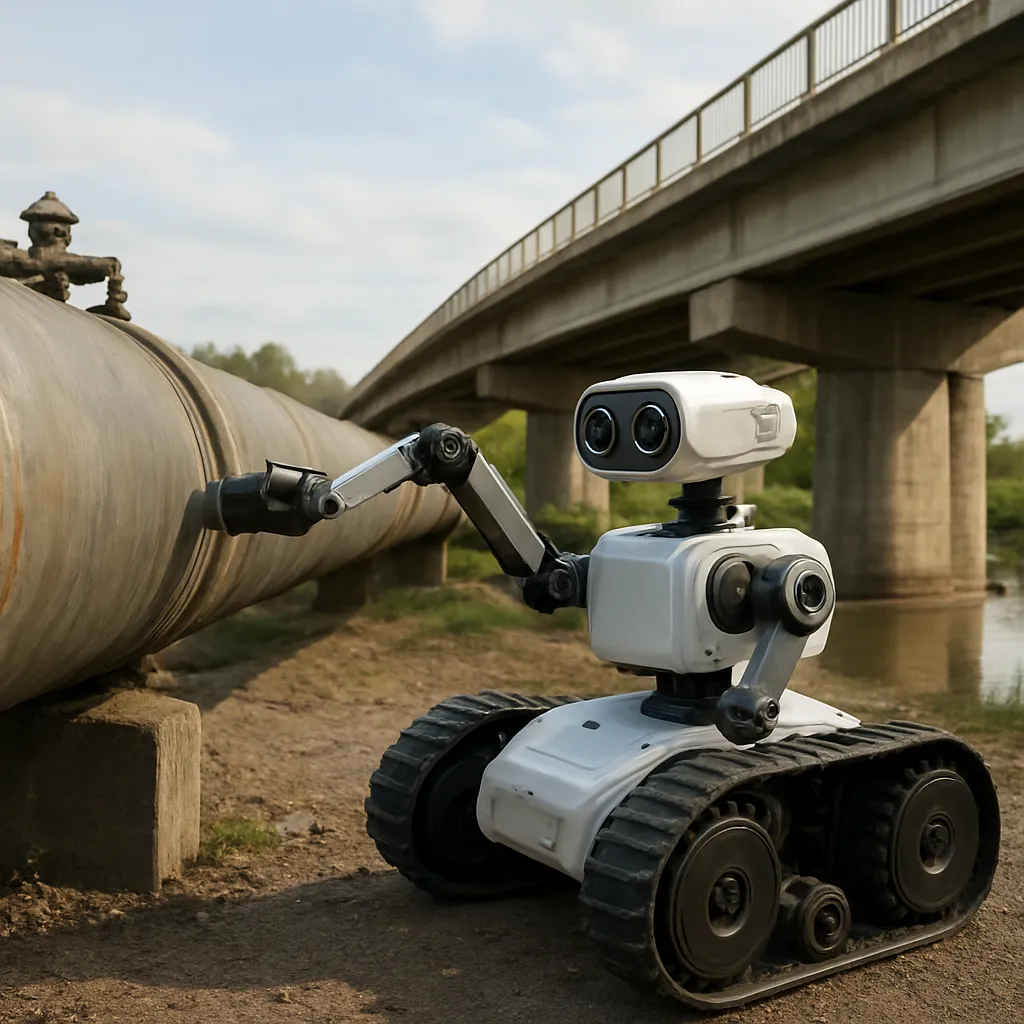
- Crawler Bots: Rugged, track-driven platforms capable of gripping inner pipe walls and negotiating complex junctions.
- Drones: Aerial robots suited for bridge deck surveys, suspension cable inspections, and underside overhang assessments.
- Hybrid Systems: Combinations of ground and aerial units collaborate, sharing data wirelessly to ensure end-to-end coverage.
Communication and Edge Computing
Real-time analysis demands low-latency data links. Robots often rely on edge-computing modules that run deep learning inferences locally, reducing the need to transfer raw video streams. When connectivity is limited, stored data can be batch-uploaded to centralized servers for more comprehensive analysis.
Case Studies: Pipelines and Bridges
Pipeline Inspections in Harsh Environments
A leading energy company deployed a fleet of autonomous crawler bots to inspect over 5,000 kilometers of natural gas pipelines in arid and subzero climates. Each unit carries ultrasonic thickness gauges, laser scanners, and leak detection probes. By continuously logging wall thickness and corrosion rates, operators identified high-risk sections before rupture occurred.
- Reduced unplanned shutdowns by 40%.
- Saved over 20,000 man-hours annually.
- Enhanced safety by eliminating confined-space entries.
Bridge Deck and Understructure Surveillance
Municipalities face mounting costs to maintain over 100,000 public bridges. A team of researchers introduced aerial drones equipped with infrared cameras and crack-detection software. Flying at low altitudes, drones scanned deck surfaces and underside beams, flagging hairline fractures invisible to the naked eye.
- Average inspection time reduced from days to hours.
- Early detection of stress fractures prevented critical failures.
- Data integrated into a maintenance management system for scheduling repairs.
Benefits and Challenges
Key Advantages
- Safety: Minimizes human exposure to dangerous conditions.
- Efficiency: Accelerates inspection cycles and coverage.
- Cost-Effectiveness: Reduces labor expenses and unplanned downtime.
- Data-Driven Maintenance: Enables predictive models that extend asset life.
Implementation Hurdles
- Regulatory Compliance: Ensuring robots meet safety and data protection standards.
- Integration Complexity: Linking diverse platforms with existing asset management software.
- Environmental Constraints: Operating in extreme temperatures, high-pressure conduits, or underwater segments.
- Power Management: Balancing onboard battery life with mission-critical tasks.
Future Directions for Inspection Robotics
Emerging trends point toward swarms of miniature robots that collaborate to map entire sections in parallel. Developments in battery chemistry and wireless power transfer will extend mission durations, while improvements in autonomy will allow machines to self-diagnose malfunctioning sensors and recalibrate. Integration of augmented reality for remote operators promises immersive control panels, where live data overlays reveal structural conditions in 3D.
As infrastructure ages and demand for uninterrupted service grows, AI-powered inspection robots will become indispensable. By continuously refining machine vision, learning algorithms, and rugged platform design, the industry is marching toward a safer, more reliable future for pipelines, bridges, and beyond.