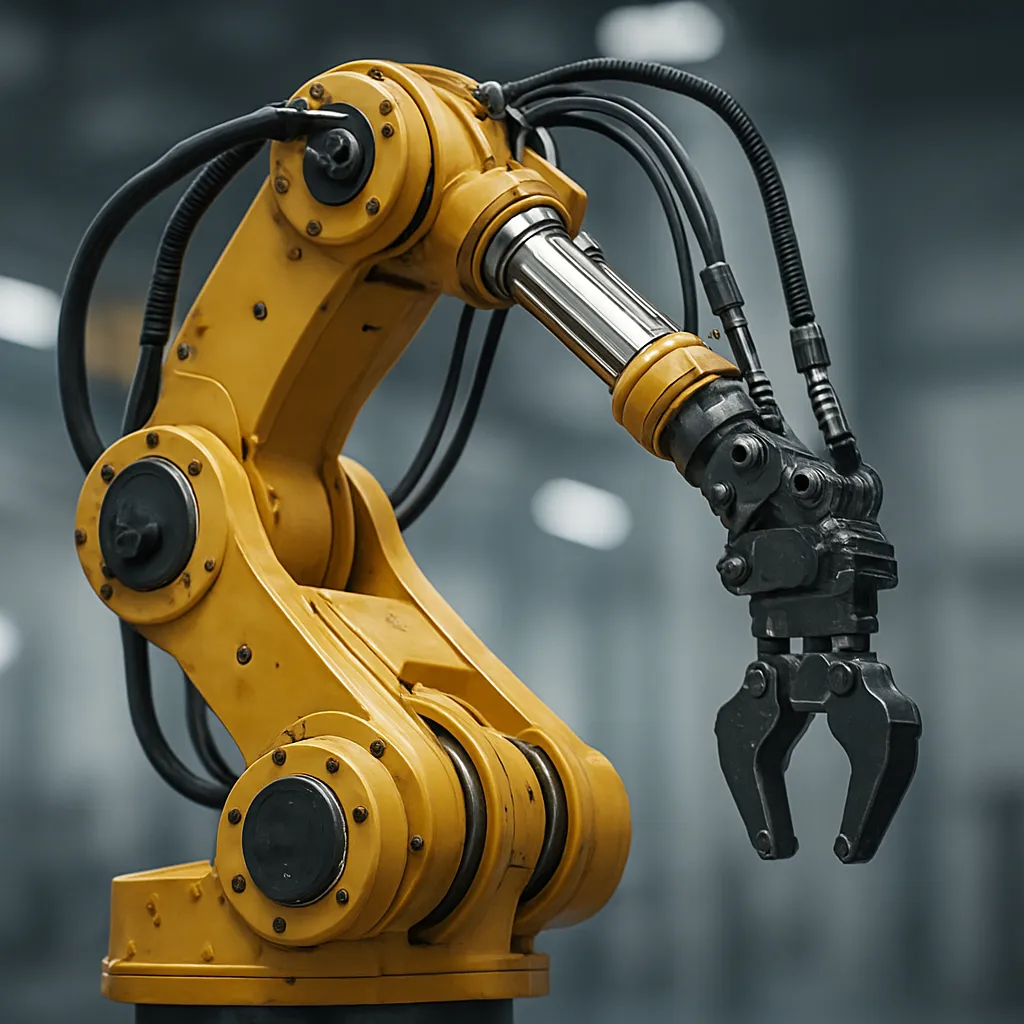
The Science Behind Perfectly Engineered Hydraulic Arms explores how modern industrial machinery achieves unprecedented levels of strength and control. From the heart of construction sites to automated assembly lines, these marvels of innovation merge fluid dynamics with mechanical design to deliver unparalleled performance. This article delves into the core principles, critical components, and advanced control systems that make hydraulic arms a cornerstone of contemporary manufacturing and heavy equipment.
Fundamentals of Hydraulic Power
At its core, a hydraulic arm relies on Pascal’s principle, which states that pressure applied to a confined fluid is transmitted undiminished throughout the fluid. By harnessing this phenomenon, engineers transform simple liquids into high-force actuators. Understanding these basic concepts is essential for anyone involved in engineering or maintenance of hydraulic machinery.
Pressure and Flow
- Pressure generation: Created by pumps that pressurize hydraulic oil to levels often exceeding 3,000 psi.
- Flow rate: Determines the speed at which the arm extends or retracts, measured in gallons per minute (GPM).
- Newton’s third law: Ensures that every action has an equal and opposite reaction, enabling smooth operation under heavy loads.
Hydraulic Fluids and Viscosity
Choosing the right fluid is crucial. Viscosity affects lubrication, heat dissipation, and energy efficiency. Specialized synthetic oils maintain consistent viscosity across wide temperature ranges, enhancing durability and reducing wear on seals and valves.
Designing Components for Peak Performance
A perfectly engineered hydraulic arm depends on meticulous design of its key components. Each part must be optimized for load-bearing capacity, precision, and longevity. Collaboration between mechanical and materials engineers ensures that the final assembly meets rigorous industrial demands.
Cylinders and Pistons
Cylinders convert pressurized fluid into linear motion. Precision-machined bores and pistons maintain tight tolerances, minimizing internal leakage and maximizing efficiency. Rod coatings, such as hard chrome or ceramic, protect against corrosion and abrasion.
Hydraulic Pumps and Motors
- Piston pumps: Provide high pressure and are used in heavy-duty applications.
- Gear pumps: Simpler and more compact, suitable for moderate-pressure systems.
- Vane pumps: Offer a balance between pressure and flow consistency, ideal for precision tasks.
Valves and Manifolds
Control valves regulate the direction, pressure, and flow of hydraulic fluid. Solenoid-operated and proportional valves enable real-time adjustments, enhancing system responsiveness. Manifolds consolidate multiple valve functions into a compact block, reducing leakage paths and simplifying maintenance.
Control Systems Driving Precision
Modern hydraulic arms integrate electronic controls and sensors to achieve micron-level accuracy. The synergy between hydraulics and digital technology underpins next-generation automation across sectors such as aerospace, automotive manufacturing, and offshore drilling.
Closed-Loop Feedback
Encoders and pressure transducers feed live data into a central controller, which continuously adjusts valves and pump speeds. This control strategy compensates for thermal expansion, fluid compressibility, and external disturbances, ensuring consistent motion profiles.
Programmable Logic Controllers (PLCs)
- Task scheduling: Coordinates multiple actuators for complex sequences.
- Safety interlocks: Prevents collisions by enforcing positional limits.
- Diagnostics: Monitors system health, identifying issues before they escalate.
Human-Machine Interfaces (HMIs)
Touchscreen displays and handheld controllers allow operators to fine-tune movement parameters, set work cycles, and visualize pressure curves in real time. Intuitive graphics reduce training time and minimize operational errors.
Real-world Applications and Future Trends
Hydraulic arms are omnipresent in industries that demand high force and precise movement. From excavators digging deep foundations to robotic welders assembling intricate components, the versatility of these machines continues to expand.
Construction and Mining
Heavy equipment relies on hydraulic arms for tasks like material handling, drilling, and earthmoving. Advanced boom designs incorporate multi-stage telescoping cylinders, delivering extended reach and variable lifting capacity without compromising stability.
Manufacturing and Automation
- Automotive assembly lines use robot arms for welding, painting, and part transfer, achieving cycle times below one second per operation.
- Injection molding machines feature hydraulic clamps with precise pressure control to produce plastic components with consistent quality.
Marine and Offshore Operations
Underwater remotely operated vehicles (ROVs) utilize hydraulic manipulators to perform subsea inspections and maintenance. Corrosion-resistant materials and closed-loop sealing systems ensure reliable function in harsh environments.
Emerging Innovations
- Electro-hydraulic hybrids: Combine electric servo motors with hydraulic amplifiers for improved energy recovery and reduced heat generation.
- Smart fluids: Magnetorheological liquids change viscosity under magnetic fields, enabling adaptive damping and precise force modulation.
- 3D-printed manifolds: Lower weight and accelerate prototyping by integrating complex internal flow channels in a single component.
As industries push the boundaries of automation and heavy-duty performance, perfectly engineered hydraulic arms will continue to evolve. By mastering the interplay of components, hydraulics, and digital controls, engineers unlock new possibilities for machines at work across the globe.