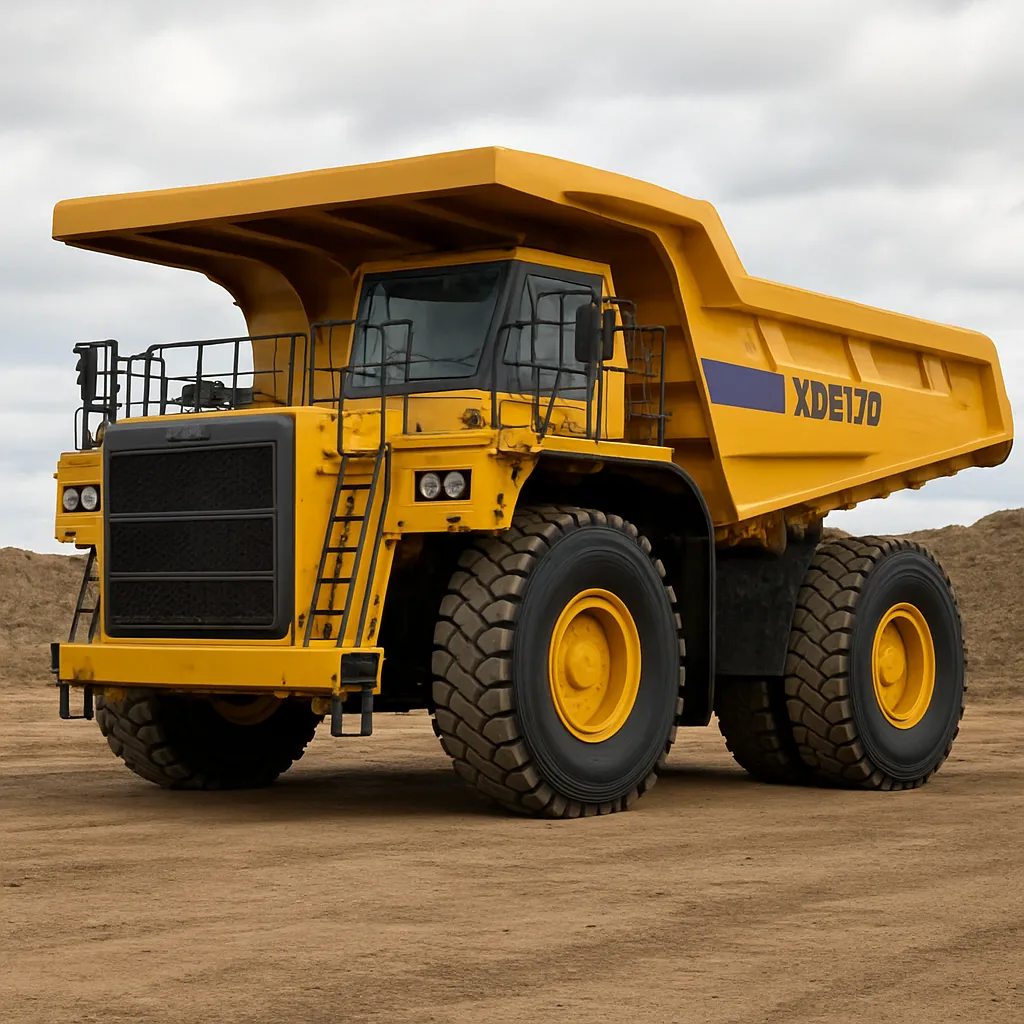
The XCMG XDE170 is a heavy-duty haul truck designed for high-capacity material movement in large mining and earthmoving operations. Combining robust engineering with features aimed at reducing operating cost and maximizing on-site productivity, the XDE170 targets operators needing a reliable machine for continuous, high-volume cycles. This article explores the machine’s design philosophy, typical applications, key specifications and operational considerations, as well as insights into maintenance, safety and market positioning.
Overview and positioning
XCMG, one of the largest manufacturers of construction and mining equipment, markets the XDE170 as part of its heavy haul truck lineup. The model name suggests a rated payload roughly in the 170-metric-ton class. In modern mining fleets, machines of this size serve as workhorses for transporting overburden, waste rock and ore between digging faces, crushers and stockpiles. The XDE170 is intended to deliver high-cycle performance while balancing fuel consumption and durability under severe conditions.
From a fleet-manager perspective, the XDE170 is engineered to provide predictable performance for large open-pit operations. Key selling points typically emphasized by manufacturers and dealers include improved fuel economy, simplified service access, and enhanced operator ergonomics—each contributing to reduced hourly operating cost and higher asset utilization.
Typical applications
The XDE170 finds its primary use in several heavy-duty scenarios:
- Large-scale open-pit mining: hauling ore and waste across mine benches and ramps.
- Quarry operations: continuous movement of blasted rock to crushing plants and stockyards.
- Major civil earthworks: moving massive volumes of material on dam, highway and large infrastructure projects.
- Aggregates and bulk terminals: where frequent, heavy loads are transferred between sites or process points.
Because of its size and cycle capability, the XDE170 is rarely used for small or urban sites; it excels where long continuous hauls and heavy payloads are the norm.
Design and key technical characteristics
XCMG’s heavy haul designs emphasize durability and serviceability. Typical technical highlights for a 170-ton-class truck (specifications vary by region and configuration) include a high-capacity body, heavy-duty frame, and driveline options tailored to mine operators’ preferences.
- payload: nominally around 170 metric tonnes (manufacturer-rated payload may vary by bucket/box design and local regulations).
- engine power: typical engines in this class deliver roughly 1,000–1,200 horsepower (≈750–900 kW), depending on tuning and emission-package options.
- Drive systems: traditional mechanical transmissions, torque-converter automatic transmissions, or diesel-electric/electric drive configurations may be offered to optimize traction and efficiency.
- Braking: multi-disc service brakes complemented by retarding systems (engine brake or electric regen where applicable) for safe control on steep mine ramps.
- Fuel capacity: large tanks sized to support long shifts between refuels—commonly in the range of 1,500–3,000 liters depending on cycle demands and regional setup.
Typical dimensions for this class are substantial: overall lengths often exceeding 11 meters, widths above 6 meters and heights in the 5–6 meter range from ground to top of cab or exhaust stack. Operating (empty) weight for a truck in this class commonly falls into a range that, when combined with payload, produces a gross vehicle mass measured in the hundreds of tonnes—necessitating specialized transport and maintenance infrastructure.
Performance, efficiency and on-site productivity
Performance metrics for the XDE170 depend heavily on site conditions (grade, haul distance, material density), but several consistent themes emerge:
- fuel efficiency: Modern designs seek to reduce liters-per-ton-kilometer through improved powertrain efficiency, optimized gearing and telematics-enabled operator coaching. Operators can expect notable gains over older-generation trucks when employed in steady-cycle haul operations.
- Cycle time and throughput: with higher payload capability, each cycle moves more material, directly improving tonnage-per-hour when matched with appropriate loaders and shovel sizes.
- Top speed and ramp performance: unloaded speeds are typically higher than loaded speeds, with safety-limited velocities on ramps; acceleration and hill-climb capability depend on torque delivery and transmission selection.
Achieving maximum economic benefit from the XDE170 requires careful matching of the truck to loaders/shovels, pit ramp design and maintenance regimes. For example, pairing trucks with under- or over-sized shovels reduces effective utilization and increases cost-per-ton.
Operator comfort, control and safety systems
Cab design and operator interfaces directly influence both productivity and safety. The XDE170’s cab is typically designed for long-shift comfort, with adjustable seating, climate control and low-noise insulation to reduce operator fatigue.
- operator comfort: ergonomically arranged controls, high-visibility glazing and HVAC systems are standard considerations for long-duration mining operations.
- safety features: modern haul trucks usually incorporate ROPS/FOPS-certified cabs, perimeter cameras and proximity detection systems, automated brake-assist features, lane-departure alarms and advanced lighting packages for work at night or in poor visibility.
- Telematics and fleet management: integrated systems deliver real-time data on location, fuel burn, utilization and fault codes—supporting preventive maintenance and operational decisions.
Maintenance, uptime and lifecycle economics
A heavy haul truck’s value is realized through sustained availability and low unscheduled downtime. XCMG’s design approach typically emphasizes accessible service points, modular components and global parts support. These choices help maintenance teams perform quicker inspections and repairs underground or in remote pits.
- maintenance: routine services include drivetrain inspections, hydraulic and electrical checks, brake and tire inspections, and scheduled engine servicing. Predictive diagnostics enabled by telematics can reduce emergency breakdowns.
- uptime: high uptime is achieved through planned maintenance programs, operator training, and stocking critical spares on-site. Many operators target availability rates above 90% for primary haul fleet assets.
- total cost of ownership: when evaluating the XDE170, consider acquisition cost, fuel consumption, tire replacement frequency, parts and labor and residual value—each plays a role in lifecycle economics.
Standard industry practice is to analyze cost-per-ton over expected service life. For haul trucks in this size class, small improvements in fuel economy or uptime yield outsized savings because of the machine’s high hourly productivity.
Environmental considerations and emissions
Regulatory and corporate sustainability drivers push manufacturers and operators to reduce emissions and noise. Options typically available for mine-grade trucks include engines configured to meet Tier 2/3/4 or Stage V standards (depending on region), selective catalytic reduction (SCR) systems and particulate filters.
Electrification—partial or full—has become a major trend. Diesel-electric drivetrains (for example, diesel engine powering generators for electric traction motors) offer potential benefits in fuel economy and regenerative braking, especially on long ramps and repetitive cycles. Additionally, idle-reduction technologies and optimized engine maps help lower greenhouse gas emissions and operating cost.
Comparisons and fleet integration
In the global market, XCMG competes with established players like Caterpillar, Komatsu, Liebherr, BelAZ and Volvo. When selecting the XDE170 or a competitor product, fleet managers evaluate:
- Compatibility with existing shovels and loading equipment.
- Dealer and spare-part network density within the operating region.
- Operator training and availability of certified technicians.
- Financing, warranty and in-service support packages.
Integration into mixed fleets often requires careful attention to braking and diesel particulate control systems, as well as telematics compatibility for consolidated fleet management.
Statistical context and practical figures
While exact specifications for factory-configured machines vary by customer and region, a reasonable set of illustrative figures for a 170-ton-class haul truck follows (use these as indicative ranges, not definitive guarantees):
- Rated payload: approximately 170 metric tonnes.
- Engine power: typically 1,000–1,200 hp (≈750–900 kW) depending on emission package and tuning.
- Fuel tank capacity: commonly between 1,500 and 3,000 liters.
- Typical empty weight (operating weight): roughly 100–140 metric tonnes; gross operating mass when loaded: often in the range of 270–320 tonnes.
- Top empty speed: in the range of 45–60 km/h; loaded speed and ramp speed will be lower based on safety settings.
- Service intervals: oil and filter changes scheduled by hours of operation or engine hours—common intervals revolve around 250–500 hours for medium-level checks and longer intervals for major overhauls, depending on duty cycle.
Actual numbers will depend on configuration choices such as tires, body type, driveline selection and the final market specification. Procurement teams should request official datasheets and performance guarantees from XCMG or authorized dealers for contractual use.
Operational best practices and case usage
To get the most from an XDE170-class truck, mines often follow several best practices:
- Match truck payload and shovel dipper size to minimize short- or long-loading cycles.
- Optimize haul road geometry to reduce fuel burn and braking wear—gentle grades and well-maintained surfaces increase productivity.
- Implement telematics-driven operator coaching to reduce idling and harsh accelerations, improving fuel economy.
- Maintain a critical-spares inventory and establish scheduled exchange programs for high-wear components like brakes, driveline parts and tires.
Typical deployments place these trucks in permanent shovel-truck circuits where their high payload capability delivers consistent, predictable throughput. Where haul distances are long and ramp sections steep, diesel-electric versions can offer operational advantages.
Conclusion and purchase considerations
The XCMG XDE170 represents a modern entry in the ultralarge haul truck category, suited to heavy mining and bulk-material environments that demand high-volume movement. When assessing the XDE170 for fleet inclusion, buyers should weigh not only the advertised payload and power ratings but also dealer support, parts logistics, lifecycle maintenance plans and the machine’s fit with existing mine infrastructure.
Key evaluation points before purchase:
- Obtain a detailed factory specification sheet and confirm emission-package compliance for your region.
- Request real-world fuel consumption data from reference sites with similar geology and haul profiles.
- Verify dealer and parts availability near your operations, including planned maintenance support.
- Consider total lifecycle cost rather than initial acquisition price—factors such as fuel economy, maintenance intervals and residual value are critical.
In well-configured fleets, machines like the XDE170 can significantly improve hourly tonnage and reduce unit costs—provided they are matched appropriately to site conditions and supported by strong maintenance and operational discipline.
)
)