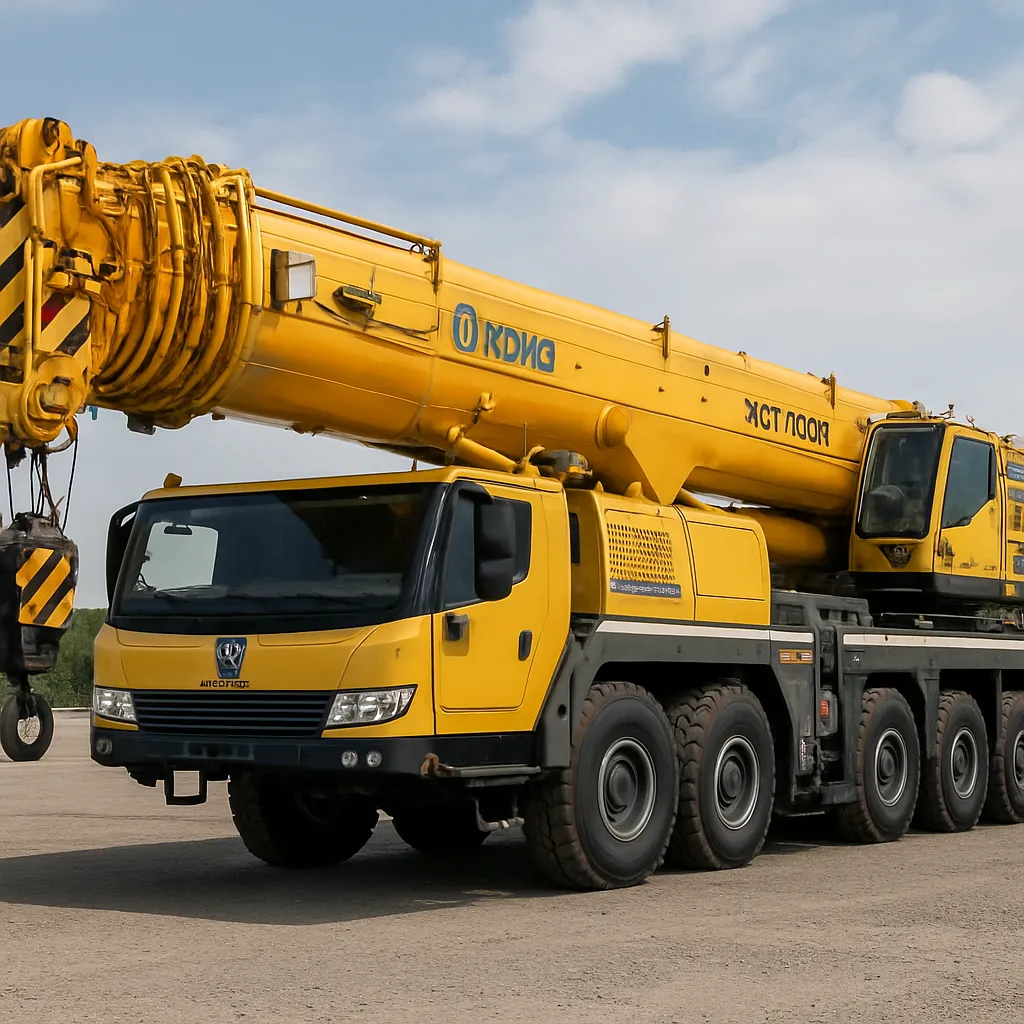
The XCMG XCT1200 is a modern all-terrain crane that combines mobility, lifting power and on-site versatility. Designed to operate both on highways and on rougher job sites, it targets contractors and rental fleets that need a balance between road travel efficiency and strong lifting performance. In the following sections you will find a detailed look at its design philosophy, typical technical characteristics, practical applications across industries, operational and safety features, and key considerations for ownership and maintenance.
Design philosophy and key features
The XCMG XCT1200 is built around the idea of combining the best aspects of a truck crane and a lattice-tower crane: it offers the high-speed travel and roadability of a truck-mounted unit while retaining the lifting performance and flexibility of a more specialized crane. This hybrid approach makes the XCT1200 a versatile asset for projects where frequent repositioning and diverse lift tasks are required.
- Modular boom design — A telescopic main boom that can be extended and retracted quickly to match lift geometry and transport constraints.
- Hydraulic systems — Advanced hydraulic circuits provide smooth boom extension, hoisting and slewing control, improving precision during complex lifts.
- Drive and chassis — A purpose-built multi-axle chassis gives the XCT1200 road capability while offering high ground clearance and load distribution for off-highway travel.
- Counterweight system — Removable and adjustable counterweights allow operators to configure the crane for higher capacity lifts or for lighter transport weights.
- Operator ergonomics — Modern cabs with intuitive controls, visibility improvements and climate control for operator comfort and effectiveness on long shifts.
Typical technical specifications (typical/market-dependent)
Specifications for the XCMG XCT1200 can vary by market, options and year of manufacture. The values below represent the typical characteristics of a 120-ton class all-terrain crane from XCMG and should be confirmed with the manufacturer or dealer for a specific machine.
- Rated lifting capacity: approximately 120 tonnes (120 t) at the minimum radius
- Main boom: telescopic sections providing a typical extended length range from under 12 m in stowed configuration to around 40–60 m when fully extended (depending on configuration)
- Jib options: lattice or telescopic jibs typically available in the 10–30 m range to increase tip height and reach
- Maximum tip height: with boom and jib combinations, tip heights often in the range of 50–80 m, depending on setup
- Engine power: diesel engines sized for mobility and hydraulic power, commonly in the 250–400 kW range for cranes in this class
- Number of axles: multi-axle chassis (commonly 4 to 6 axles depending on region and configuration) providing roadability and axle load distribution
- Operational systems: electronic load moment indicator (LMI), anti-two block (A2B), optional remote monitoring and diagnostics
- Transport dimensions/weight: transport weight and dimensions vary with counterweight and boom configuration; many machines are designed to comply with highway weight limits in target markets or be modular for transport
Note: The exact values for boom length, engine power, maximum radius and tip height depend on optional packages, regional homologation and the specific serial configuration. Always consult the official XCMG data sheet for the exact model year and variant.
Where the XCT1200 is used (industry applications)
The versatility of an all-terrain crane like the XCT1200 makes it suitable for a wide variety of industries and tasks. Its combination of travelability and lifting capability is particularly valuable when lifts must be performed at multiple sites across a project or when access conditions are mixed.
Construction and civil engineering
- Structural steel erection for mid-rise buildings and industrial halls.
- Bridge construction and maintenance where frequent repositioning is required.
- Placement of precast concrete elements and heavy modular structures.
Energy and utilities
- Wind-turbine erection and maintenance — where boom reach and on-site mobility are important.
- Substation equipment installation and transformer handling — precise, heavy lifts in constrained spaces.
- Power line tower maintenance and replacement tasks.
Oil, gas and petrochemical
- Onshore platform module lifts and piping reroutes.
- Equipment skidding and installation inside refineries or processing plants.
Ports, shipyards and heavy industry
- Heavy equipment loading and unloading, component positioning for fabrication yards.
- Shipboard and dockside lifts where mobility across paved surfaces is beneficial.
Rental fleets and contractors
- Because of its all-terrain nature, the XCT1200 is popular with rental companies that provide flexible lifting solutions across many sectors.
Performance, safety and control systems
Modern all-terrain cranes are as much about electronic control and safety as they are about raw lifting power. The XCT1200 typically integrates multiple layers of safety and assistance systems to optimize both performance and risk management on site.
- Load Moment Indicator (LMI) — continuously monitors the load, boom angle and radius to warn the operator or automatically restrict operations when limits are approached.
- Anti-Two Block protection — prevents the hook block from contacting the boom tip, avoiding cable damage and overloads.
- Automatic outrigger leveling — makes deployment faster and more consistent, especially on uneven ground.
- Stability control — systems that integrate outrigger positions and counterweight setup to calculate safe lifting envelopes.
- Remote control options — allow ground staff to position the crane while maintaining excellent visibility of the lift.
These features not only enhance operational safety but also improve lift cycle times and reduce the likelihood of damage to the machine or surrounding structures.
Operational considerations and site logistics
Operating an XCT1200 efficiently requires planning that covers mobilization, setup and lift execution. Key considerations include transport permits, access roads, ground-bearing capacity and coordination with other trades on congested sites.
- Transport planning — determine whether the crane can be transported in one piece on public highways or whether modularization of counterweights and boom sections is necessary.
- Site access — evaluate turning radii, bridge capacities and overhead obstructions; all-terrain cranes provide improved flexibility but are not a substitute for careful access planning.
- Ground preparation — outriggers require firm bearing; mattresses or crane mats may be needed on soft or mixed ground to distribute load.
- Crew skill — complex lifts require certified crane operators and riggers familiar with LMI systems, lifting charts and tag-line control.
Maintenance, lifecycle costs and resale
Ownership costs for a machine like the XCT1200 include routine maintenance, periodic inspections, spare parts and downtime. Careful maintenance scheduling extends machine life and preserves resale value.
Routine maintenance
- Hydraulic oil and filter changes at manufacturer’s intervals.
- Inspection of wire ropes, sheaves and boom sections for wear and corrosion.
- Engine maintenance (oil, fuel filters, cooling system) and chassis checks.
- Calibration and testing of LMI, safety interlocks and electronic controls.
Common lifecycle costs
- Parts that typically require replacement during the lifecycle include wire ropes, hydraulic seals, brake components and electrical sensors.
- Major overhauls (engine or hydraulic pump) may be needed after several thousand operating hours depending on duty cycle.
- Investment in operator training and preventive maintenance programs lowers long-term costs by reducing unscheduled downtime.
Resale value depends on hours, maintenance history and market demand in the region. All-terrain cranes from reputable manufacturers with documented service records tend to hold value well in the secondary market.
Environmental and regulatory considerations
Environmental performance and compliance are increasingly important. The XCT1200’s diesel powertrain must meet local emissions standards (Tier, Stage or equivalent), and there is a trend toward reducing idling, improving fuel efficiency and offering hybrid or electrified auxiliary systems where regulations or site rules require it.
- Emissions compliance — choose engines that meet local requirements; options for SCR, DOC or particulate control may be available.
- Noise management — important for urban jobs; options such as acoustic enclosures or operational schedules can help.
- Site environmental planning — spill containment, responsible handling of hydraulic fluids and use of biodegradable oils where mandated.
Market position and comparisons
XCMG is among the larger global manufacturers of construction equipment and has expanded its all-terrain crane portfolio to compete with long-established European and Japanese brands. The XCT1200 aims to offer a competitive price-to-performance ratio, modern electronics and growing global aftersales support.
- Compared to older truck cranes, the XCT1200 offers greater off-road capability and faster deployment.
- Against premium European all-terrain cranes, it typically competes strongly on purchase price while offering feature parity in areas such as LMI, hydraulic control and modular counterweight systems.
- For rental markets, availability of parts and service networks is a key factor that can favor larger OEMs with global footprints; XCMG has been expanding dealer and service networks in many regions.
Operator training and best practices
To get the most from an XCT1200 while maintaining safety, operators and site personnel should receive machine-specific training. Best practices include:
- Understanding and following the manufacturer’s load charts for every boom and counterweight configuration.
- Pre-lift briefings that identify lift paths, exclusion zones and communication methods between operator and riggers.
- Regular verification of LMI and safety system function before critical lifts.
- Documentation of daily inspections and adherence to maintenance schedules.
Conclusion
The XCMG XCT1200 represents a practical solution for contractors and rental companies that require a blend of on-road mobility and robust lifting performance. With a typical rated capacity of around 120 tonnes, modular booms and a full suite of electronic safety and control systems, it fits applications across construction, energy, industry and logistics. Effective use depends on thorough planning, proper site preparation, trained operators and a disciplined approach to maintenance—all factors that preserve value and ensure safe, efficient lifting operations.


)
)