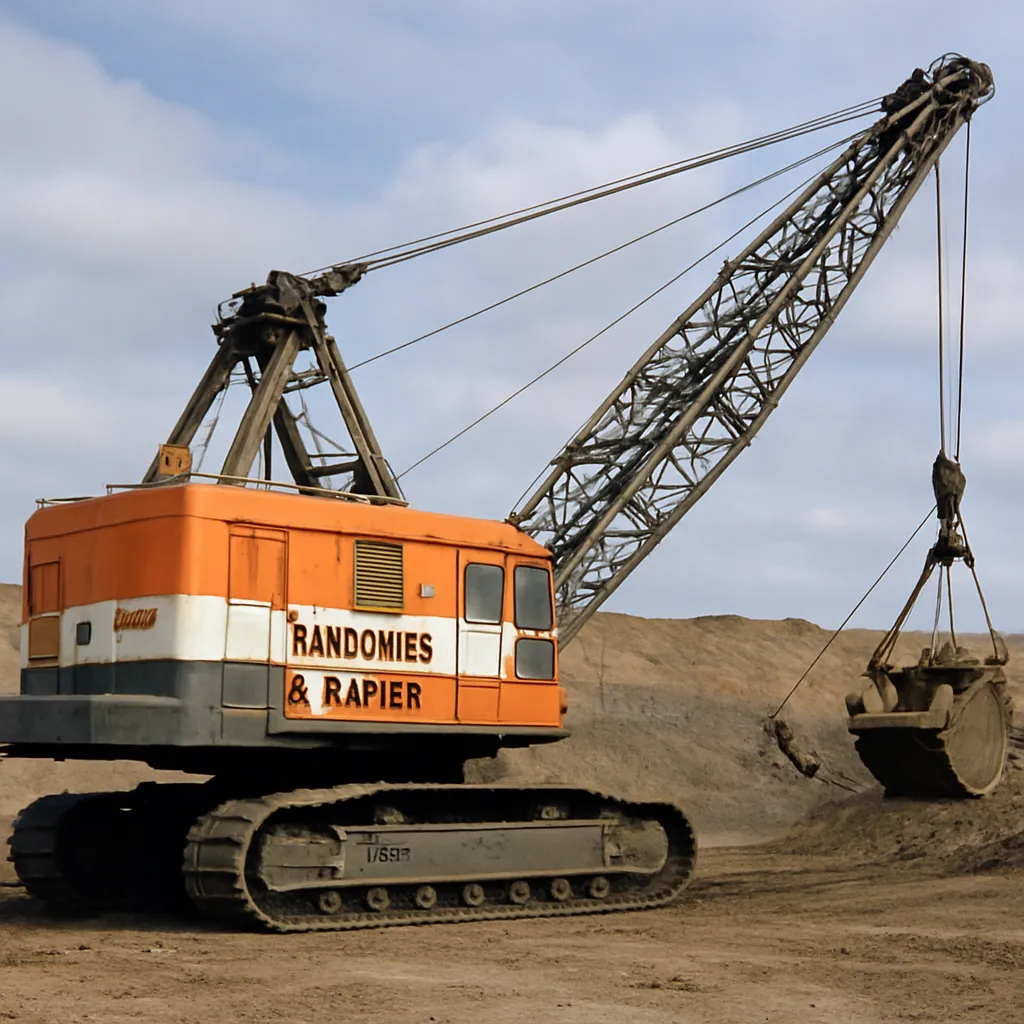
The Ransomes & Rapier W1500 is a representative example of large-scale excavation machinery known as a dragline. Designed for the demanding tasks of surface mining, civil engineering, and heavy earthmoving, this machine combines massive mechanical components with precise operational control to move huge volumes of material efficiently. In the following sections we explore its design, typical technical characteristics, fields of application, operational principles, maintenance needs, environmental considerations, and historical significance.
Design and core components
The heart of the W1500, like other draglines, is a relatively simple but robust configuration: a rotating house, a very long boom, wire ropes, winches, and a large bucket that scrapes and lifts material by being dragged toward the machine. The structural layout is optimized for reach and stability, allowing the machine to access large areas from a single position.
Major assemblies
- House: contains engines (or electric motors), winches, control cabin, and secondary systems. It rotates on a slewing ring to sweep the bucket across the working face.
- Boom: a lattice or box-section structure that provides leverage and clearance. Boom lengths vary widely and determine the maximum reach.
- Bucket: typically large-capacity, heavy-duty steel shell with teeth or cutting edge. Bucket capacity and teeth type are matched to the material and operating conditions.
- Hoist and drag ropes: heavy wire ropes routed over sheaves on the boom. The drag rope pulls the bucket toward the machine across the ground, while hoist ropes raise and lower it.
- Winches: provide controlled power to the ropes; their torque and gear ratios define lifting and dragging capacity.
- Undercarriage or base: may be crawler tracks, a circular track, or a ballasted platform depending on the installation and mobility requirements.
Ransomes & Rapier historically built rugged structures and precision parts. For the W1500 the emphasis was on durability and ease of maintenance, with large access panels and modular components to facilitate overhaul in remote sites.
Typical technical specifications and performance
Exact factory specifications for the W1500 can vary by build year and customer customization. The class name “W1500” generally suggests a mid-to-large size machine within Ransomes & Rapier’s offering. While I may not have a single canonical specification sheet for every W1500 ever delivered, the following values reflect typical ranges for machines of similar size and purpose.
- Bucket capacity: commonly in the range of 10 to 30 cubic meters for medium-large draglines; specialized units can be larger or smaller depending on application.
- Boom length: typically between 30 m and 80 m. Longer booms increase reach but require more structural strength and counterweight.
- Operating weight: often between 500 and 2,500 tonnes depending on counterweights, undercarriage, and attachments.
- Power source: either electric motors (fed by on-site power or generators) or diesel-driven hydraulic systems; installed power can range from several hundred to multiple megawatts in total system capacity for the largest configurations.
- Digging radius: influenced by boom length and cable geometry; typical coverage from a single set-up point can be several hectares.
- Production rates: highly dependent on deposit type, bucket size, and cycle time; average practical productivity often measured in thousands to tens of thousands of cubic meters per day under continuous operation in mining settings.
These figures give a frame of reference for the W1500 in operational terms. For precise numbers on a specific serial-numbered W1500, factory documentation or preserved manuals should be consulted.
Applications and industries
The W1500 is primarily associated with large-scale material handling and excavation tasks where reach and bulk movement matter more than precise, small-scale digging. Key usage areas include:
- Surface mining: stripping overburden and exposing coal, lignite, or mineral seams. Draglines are favored where the mine geometry allows long-reach stripping from a fixed location.
- Quarrying: removing overburden or low-grade strata to access valuable stone and aggregates.
- Large civil engineering projects: earthworks for dams, reservoirs, and major foundation excavations where bulk removal is required.
- Dredging and harbour works: adapted draglines can operate from coffer dams or barges to remove silt and deepen channels.
- Reclamation and environmental works: reshaping landscapes, moving spoil, and constructing containment embankments.
Because a dragline like the W1500 can access large volumes from a stable platform, it reduces the need to continuously reposition heavy shovels or haul trucks, which can be a major cost and time benefit in suitable terrains.
Operation principles and cycle
Operating a W1500 demands coordination between mechanical systems and skilled operators. The basic cycle comprises lowering the bucket, dragging it across the ground to fill, hoisting the bucket to break out, slewing to the disposal point, and dumping. Each stage requires precise rope control and timing.
Typical operational steps
- Positioning and site preparation: the machine must be stabilized and correctly oriented to the working face.
- Lowering and dragging: the drag rope pulls the bucket toward the machine across the face; teeth cut into the material.
- Hoisting and breaking out: hoist drums lift to free the bucket from the cut; rotation of the house aligns the bucket with the spoil pile.
- Dumping and repositioning: the hoist is released to dump material; the machine reorients for the next cycle.
Cycle time depends on rope speeds, winch capacity, operator skill, and material characteristics. Modern control aids and variable-frequency drives can smooth operations and improve energy efficiency compared with older mechanical systems.
Maintenance, reliability, and lifecycle
Because draglines are capital-intensive assets, their economic life can stretch decades with proper maintenance. The W1500 benefits from robust R&R engineering philosophy: over-dimensioned components, easy access for inspections, and modular components to minimize downtime during repairs.
- Routine maintenance: lubrication of bearings and sheaves, rope inspections, replacement of bucket teeth, hydraulic system checks where applicable, and electrical system testing.
- Major overhauls: periodic replacement of ropes (which have a finite fatigue life), refurbishment of winches, and structural inspections for metal fatigue, especially in high-stress nodes like boom pins and slewing rings.
- Reliability factors: rope life, winch gearbox condition, bearings, and the integrity of welds in the boom structure are primary determinants of uptime.
Operators typically maintain detailed condition-monitoring logs, including vibration analysis of bearings, ultrasonic rope thickness measurements, and thermal imaging for electrical cabinets. Proper spare-parts provisioning—especially for large custom components—reduces lead times for repairs.
Safety and environmental considerations
Working with machines of the W1500’s scale presents significant safety challenges. The combination of large moving masses, long booms, heavy buckets, and high-tension ropes requires strict procedural controls.
- Exclusion zones: strict controls to keep personnel clear of the swing radius and drop zones of the bucket.
- Rope and equipment failures: potential hazards mitigated through conservative design factors, regular testing, and fail-safe brakes on winches.
- Ground stability: continuous monitoring to ensure the machine’s platform or tracks remain stable under load, especially on reclaimed or wet ground.
- Environmental impact: while draglines can reduce truck traffic and related emissions by excavating directly from a fixed platform, they do cause large-scale landscape disturbance. Modern reclamation planning aims to minimize long-term ecological footprints and accelerate rehabilitation of mined areas.
Regulatory compliance, noise mitigation, particulate control (dust suppression), and water management are part of responsible operation. In many jurisdictions operators must submit rehabilitation plans that detail progressive restoration as mining proceeds.
Historical context and preservation
Ransomes & Rapier traces its roots to late 18th and 19th century British engineering. The company built a variety of heavy machinery including cranes, excavators, and mining equipment. Machines like the W1500 represent the mid-20th century evolution of dragline technology toward higher capacity and improved reliability.
Preservation efforts for historic machines vary. Some draglines are scrapped when uneconomical; others are restored and displayed in museums or preserved on industrial heritage sites. Restored units help interpret the technological and social history of mining communities and engineering practice.
Notable projects and case studies
While specific project lists for individual W1500 units vary, machines of this size and class historically contributed to:
- Large coal and lignite stripping operations across Europe and Asia, where continuous removal of overburden was required over multi-year campaigns.
- Major civil construction projects such as dam excavations where the bulk movement of material was preferable to truck-and-shovel logistics.
- Reclamation works for port development and shoreline engineering, where long-reach capability allowed operations from secure banks rather than barges.
On-site adaptations—such as specialized buckets, strengthened booms, or integrated power systems—allowed W1500s to be tailored to job-specific needs, extending their usefulness and competitiveness compared with other excavation methods.
Modern equivalents and technological evolution
Technology advances since the heyday of classical draglines have focused on improved controls, electrification, and materials science. Modern draglines may use:
- Variable-frequency electric drives for smoother and more efficient winch control.
- Advanced rope materials and improved lubrication to extend fatigue life.
- Condition monitoring systems with sensors feeding predictive-maintenance software.
- Enhanced operator ergonomics and remote monitoring, improving safety and reducing human error.
While some large modern mines prefer hydraulic shovels combined with truck fleets for flexibility, draglines remain competitive where long-reach, low-cost-per-cubic-meter removal of overburden is possible. The W1500 class showcases the enduring value of the dragline concept when matched to appropriate geology and mine layouts.
Economic considerations and lifecycle cost
Capital costs for a machine like the W1500 are high, but operating economics can be favorable in the right conditions. Key economic factors include:
- Initial purchase or refurbishment cost versus expected productive life.
- Operating costs: power consumption (electric or diesel), routine maintenance, rope replacement, and labor.
- Productivity advantages: reduced trucking, continuous operation capability, and large-volume moves from a single setup point.
- Residual value and potential for redeployment or resale at project end.
Owners often perform detailed life-cycle cost analyses comparing the dragline option to alternatives (shovel-and-truck, hydraulic excavators, or continuous miners). In many large-scale strip mines the dragline option provides the lowest long-term cost for overburden removal.
Conclusion
The Ransomes & Rapier W1500 exemplifies a class of heavy equipment designed for maximum reach and bulk excavation. Its utility in mining, civil engineering, and reclamation reflects a balance of mechanical simplicity and structural robustness. Although exact specifications vary with configuration and era, the core strengths—long boom reach, large bucket capacity, and cost-effective bulk movement—remain central to the dragline’s appeal. Proper maintenance, skilled operation, and careful environmental management extend the useful life of such machines, making them valuable assets in projects where large-scale excavation is required. For specific technical data on a particular W1500 unit, consulting original factory manuals, preserved maintenance records, or operator logs will provide the most accurate figures for bucket capacity, boom length, installed power, and operating weight.


)
)