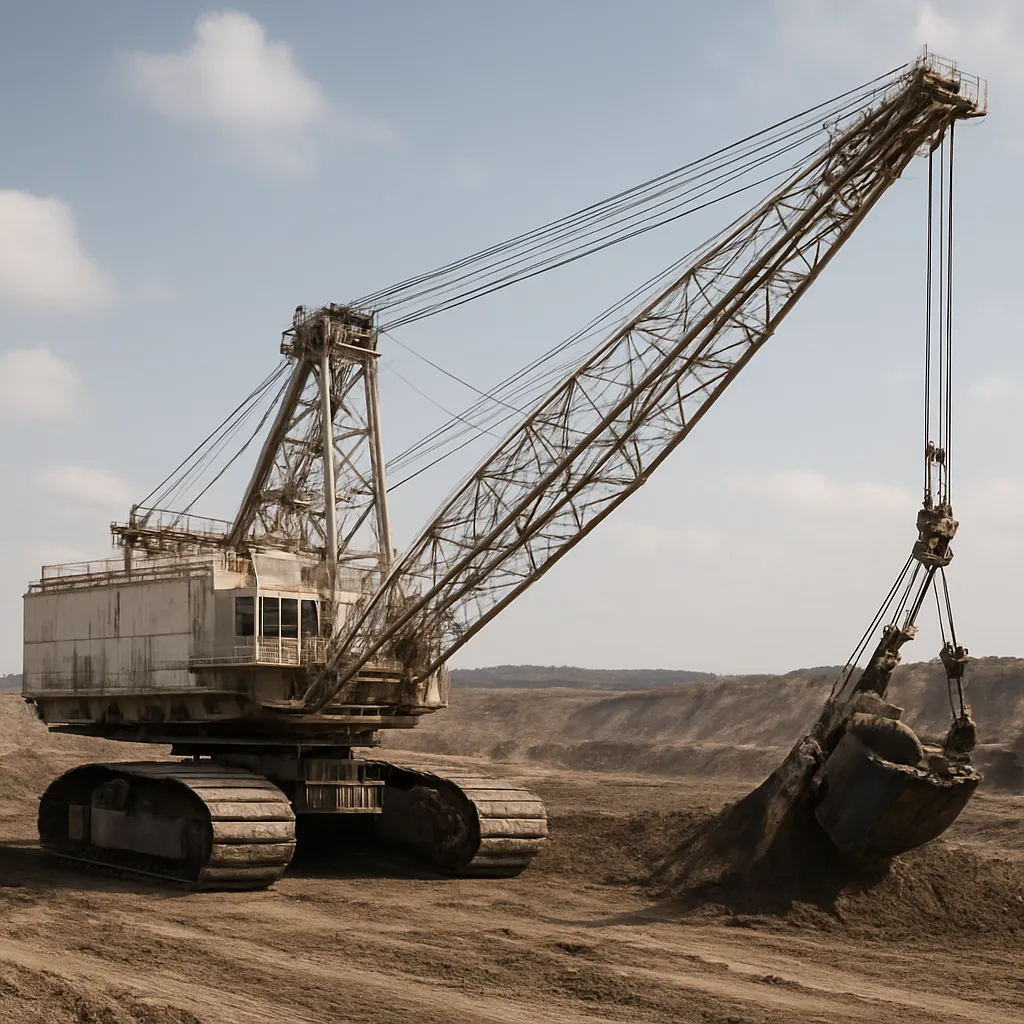
Walking Dragline 30/95 is a class of large surface-mining excavator designed to remove overburden and expose mineral seams with high efficiency and reach. The designation 30/95 is commonly interpreted in industry terms as approximately a 30 m³ bucket capacity combined with a 95 m boom length, though actual manufacturer model codes and configurations can vary. This article describes the machine’s design, typical applications, operational characteristics, maintenance and life-cycle considerations, as well as environmental, safety and economic aspects that make the walking dragline a distinct choice for major excavation projects.
Technical description and key features
A walking dragline differs from other excavators by combining a very long boom, a suspended bucket that is pulled by ropes (the dragline system), and a unique mobility system often called the “walking” mechanism. Instead of tracks or wheels, large draglines incrementally move on pads or shoes by a lifting and shifting action, allowing repositioning without the need for disassembly or transport on heavy trailers.
Basic components
- Base/house assembly: contains the operator cabin, powertrain, winches and hoists.
- Boom: a long lattice or tubular structure providing reach and height; for a 95 m boom the design prioritizes rigidity and weight optimization.
- Bucket: suspended by ropes and controlled by hoist and drag systems; the 30 m³ nominal capacity indicates the volume of a full dipper-bucket.
- Rope and hoist systems: heavy-duty wire ropes, large winch drums and braking systems manage the lifting and dragging motions.
- Walking mechanism: shoes or pads that alternately lift the machine and advance it using hydraulic jacks, mechanical rams or eccentric cams.
- Power system: electric drive is common for large models (fed from grid or onboard gen-sets), with auxiliary diesel systems for movement and local power.
Typical specifications (industry-typical ranges)
Exact numbers depend on the manufacturer and configuration; below are representative values for a machine described as a 30/95 walking dragline:
- Bucket capacity: ~25–35 m³ (nominal)
- Boom length: ~80–100 m
- Operating weight (approximate): 1,500–6,000 metric tonnes, depending on structural design and counterweight
- Maximum digging depth/reach: up to 40–60 m vertically, with horizontal reach exceeding the boom length due to geometry
- Installed power: frequently in the hundreds of kilowatts to several megawatts for electrical drive systems
- Mobility: walking step distances typically 0.5–2 m per cycle; relocation speeds are slow but permit repositioning on site
Where and how it is used
The walking dragline 30/95 is primarily configured for large-scale surface mining operations and major civil earthworks. Its long reach and high payload make it especially valuable where excavations require removing large volumes of overburden without frequent machine repositioning.
Primary applications
- Surface mining (coal, lignite, iron ore, bauxite): removal of overburden in open-pit and strip mining operations.
- Large-scale earthworks and infrastructure: construction of dams, reservoirs, channel dredging and other projects requiring deep, continuous cuts or fills.
- Bulk material handling in ports and stockyards: in some installations draglines are used for reclaiming or shaping large stockpiles when reach and capacity trump mobility speed.
- Mine reclamation: when reshaping spoil or restoring contours over wide areas.
Operational patterns
In a typical mining cycle, the dragline operator positions the bucket by swinging and extending the boom, drags the bucket through a cut to fill it, hoists to lift the load, swings the house/boom over the spoil or haul area and dumps the material. The walking capability allows the machine to advance along the bench with minimal site preparation. The combination of long boom and large bucket reduces the number of machine moves needed to cover a bench face compared to shovels or excavators.
Performance, productivity and statistics
Performance for a 30/95 walking dragline depends on duty cycle, material properties, bench geometry and operator skill. Below are illustrative productivity calculations and common statistical indicators used in project planning.
Productivity example
If a machine has a nominal 30 m³ bucket and achieves an average cycle time of 60 seconds (including drag, hoist, swing and dump), theoretical throughput is:
- 30 m³ × 60 cycles/hour = 1,800 m³/hour (theoretical)
Practical productivity will be lower when accounting for repositioning, fuel/electric interruptions, rope changes and non-productive time. Typical effective outputs for this class of machine in continuous operation can range from 700 to 1,800 m³/hour depending on conditions.
Key performance indicators
- Bucket fill factor (%) — how effectively the bucket fills relative to nominal capacity.
- Availability (%) — fraction of scheduled time the dragline is operational (important for capital-intensive equipment).
- Operating cost per cubic metre — fuel/electricity, maintenance and labor divided by throughput.
- Mean time between failures (MTBF) and mean time to repair (MTTR) — central to reliability planning.
Industry-scale numbers and context
Large draglines remain a small but crucial fleet asset in major open-pit operations. While exact counts vary, globally several hundred to low thousands of dragline-class machines operate, concentrated in high-volume coal and mining regions. The 30/95 class sits in the medium-large category: smaller than the giant draglines with 100+ m³ buckets but larger than compact shovels used in constrained sites.
Maintenance, lifecycle and logistics
Maintenance of walking draglines is intensive due to the extreme loads on structural members, ropes, winches and the walking system. Life-cycle management and planning are critical to keep unit costs competitive and to preserve machine value for many years of operation.
Routine maintenance tasks
- Rope inspection and replacement: wire ropes experience wear and fatigue; scheduled replacements depend on hours and visual/MTI inspections.
- Bucket and lip wear parts: cutting edges, teeth and liners require periodic change.
- Hydraulic and mechanical systems: regular servicing of cylinders, jacks, bearings and gearboxes.
- Structural monitoring: ultrasonic and non-destructive testing on boom, pins and critical welds.
- Electrical and control systems: verification of drives, brakes and safety interlocks.
Life expectancy and refurbishment
Walking draglines are capital-intensive but can have very long economic lives—often 20–40 years with periodic refurbishments. Major rebuilds typically include re-booming, re-powering, rope and drum replacements, and modernization of control systems. Because the walking dragline is a mobile site asset, logistics for moving large parts or replacing the machine require careful planning: on-site rebuilds are common to avoid the cost and complexity of transporting the whole machine.
Safety, automation and human factors
Safety is paramount on dragline operations. The combination of suspended loads, heavy moving parts and electrical power systems produces specific hazards that must be managed through engineering controls, procedures and training.
Primary safety considerations
- Load control and rope integrity: preventing drops or uncontrolled swings.
- Working near the walking shoes or pads: lockout procedures during walking cycles.
- Electrical safety: high-power systems require grounding and safe isolation procedures.
- Operator visibility and communications: large machines use cameras, radios and spotters to coordinate movements.
Automation and remote operation
Modern draglines increasingly integrate automation: semi-automated cycle control, GPS-based positioning for repeatable digs, and condition monitoring systems for preventative maintenance. Remote operation capability can reduce risk to operators and allow centralized control in some scenarios. However, full autonomy is limited by complex, varying ground conditions and the need for real-time decision-making during rope-based digging operations.
Environmental and economic aspects
Choosing a walking dragline often reflects a balance between environmental footprint, capital cost and long-term productivity. The dragline’s high production per hour and minimal ancillary equipment can present advantages in specific contexts.
Environmental considerations
- Lower diesel emissions when electric-drive machines are used and grid electricity is from lower-carbon sources.
- Reduced surface disturbance per tonne moved compared with multiple smaller machines because of reach and sweep.
- Dust and noise control measures: water sprays, enclosures and operational scheduling help meet environmental regulations.
- Rehabilitation benefits: draglines are effective in bulk spoil reshaping during reclamation, aiding post-mining land use.
Economic trade-offs
Initial capital cost for a walking dragline is high, but lifetime cost per cubic metre can be competitive for large, continuous operations due to:
- High hourly capacity with fewer operators per tonne moved.
- Lower requirements for supporting fleets (fewer haul trucks per unit of produced overburden when planning is optimized).
- Long service life and high residual value after refurbishments.
Practical considerations for procurement and site planning
When planning to deploy a 30/95 walking dragline, project teams must evaluate geology, bench design, haulage logistics and electrical infrastructure. Some practical considerations include:
Infrastructure needs
- Electrical supply: stable, high-capacity grid connection or on-site generation for electric-drive models.
- Site preparation: firm pads or levelling for walking operations and sufficient clear zones for boom swing and dumps.
- Spare parts and workshop facilities: capacity to support rope changes, gearbox servicing and major structural inspections.
Integration with mine plan
A dragline’s long reach is best exploited by creating bench and push-back patterns that allow continuous cuts without frequent repositioning of the bucket path. Coordination with haulage and stockpile design is essential to keep non-productive movements minimal and to maximize return on investment.
Recent trends and future outlook
Recent industry trends emphasize electrification, digital monitoring and selective automation. Walking draglines are benefitting from modern materials (lighter and stronger boom sections), improved rope and winch technologies, and integrated fleet-management systems that optimize utilization.
Digitalization and predictive maintenance
Condition monitoring (vibration analysis, rope wear sensors, thermal imaging) and predictive algorithms extend MTBF and reduce unexpected downtime. Data-driven scheduling helps align maintenance windows with low-productivity periods, improving effective availability.
Sustainability drivers
As mining companies pursue lower carbon footprints, electrically driven draglines powered by renewable grids become more attractive. The inherent efficiency of moving high volumes with a single large machine can also reduce total emissions per tonne moved compared with fragmented fleets of smaller diesel machines, depending on the electricity source.
Summary
The walking dragline 30/95 is a versatile, high-capacity excavator suited to large surface-mining and major civil earthworks where long reach and large bucket volumes reduce the frequency of machine moves and increase unit productivity. Its strengths lie in high-hourly volumes, long life expectancy and the ability to handle extensive benches with limited repositioning. Key trade-offs include high capital cost, demanding maintenance, and careful site preparation. Advances in automation, electrification and condition monitoring are improving availability, lowering operating cost per cubic metre and enhancing safety, while thoughtful planning and integration into mine design remain essential to fully realize the machine’s advantages.
Walking draglines continue to be a strategic asset where scale, reach and continuity of excavation deliver the best economic outcome for large open-pit operations and major earthworks projects.


)
)