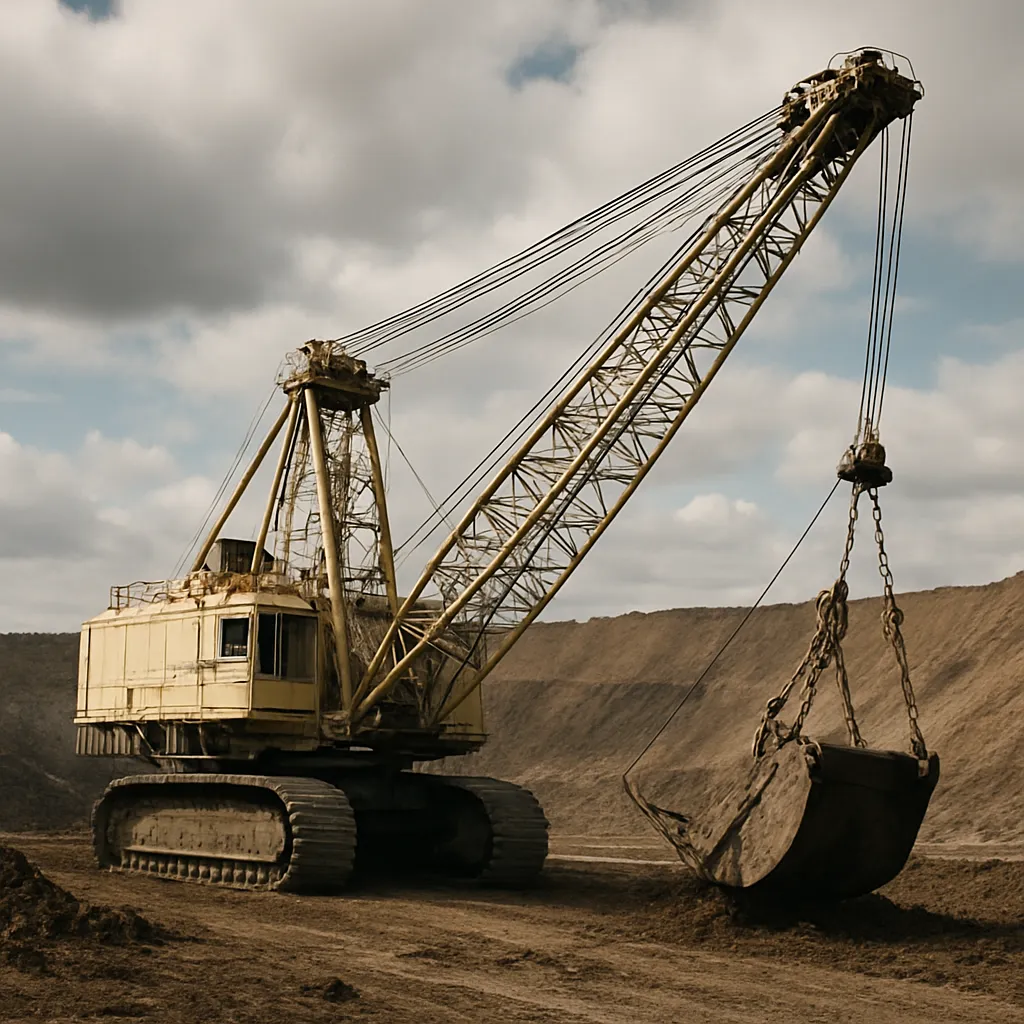
The OMZ ESH 25/100 is a heavy-duty surface mining dragline designed for large-scale excavating tasks where reach, endurance, and continuous operation are essential. Built for moving large volumes of material in open-pit mining and infrastructure projects, this machine represents a balance of proven mechanical principles and industrial customization. This article explores the machine’s design, typical applications, operational characteristics, and practical considerations for owners and operators.
Design and technical overview
The OMZ ESH 25/100 belongs to the family of cable-operated excavators known as draglines. These machines use a large bucket suspended from a long boom, with hoist and drag ropes to control the bucket’s motion for cutting and moving material. The designation 25/100 commonly indicates a nominal bucket capacity of around 25 cubic meters and a boom or working radius in the range of 100 meters (or the equivalent configuration length), though exact numbers depend on final configuration and local standards.
Key components
- Boom: A lattice-structured boom that provides the reach necessary to move material from bench to spoil or directly into haul units. For the ESH 25/100 the boom is engineered for both strength and controlled deflection under load.
- Bucket and rigging: A large multi-ton bucket attached via a system of ropes and sheaves. Draglines typically use a drag rope to pull the bucket toward the machine and a hoist rope to lift the load.
- Powertrain: Electric or electro-hydraulic drives are common, often supplied by substations on-site or mobile generator sets. The OMZ family emphasizes robust gearing and motors suited for continuous duty cycles.
- Superstructure and undercarriage: A large turntable supporting the machinery and operator cabin, mounted on heavy crawlers or a reinforced base to distribute load and permit limited repositioning.
- Control and instrumentation: Modern iterations include remote telematics, automated rope-length management, and operator assistance systems for productivity and safety.
Typical specifications (approximate)
Specifications for the OMZ ESH 25/100 can vary with era, customer options, and retrofits. The following are representative figures used in industry references for a machine of this general class:
- Bucket capacity: approximately 20–30 m³ (commonly quoted as 25 m³)
- Maximum boom length / reach: around 80–120 m depending on configuration
- Maximum digging depth: typically 15–30 m
- Operating (installed) power: tens of megawatts not typical for small machines; more realistic installed drive power ranges from several hundred kilowatts to a few megawatts depending on electric drive selection
- Machine mass: ranges widely depending on components; often several hundred to a few thousand tonnes in total assembled weight
Because OMZ supplies custom-configured units for mine specifications, exact numeric data should be confirmed with supplier documentation for a specific serial number or build year.
Primary applications and use cases
The OMZ ESH 25/100 is optimized for large-volume, repetitive earthmoving tasks. Its design makes it particularly effective in the following sectors:
- Coal and lignite surface mining: Draglines excel at removing overburden above shallow coal seams. The OMZ ESH 25/100 can strip benches quickly and place spoil strategically to minimise haulage costs.
- Open-pit metal mining: For copper, iron, and other deposits with broad benches, draglines reduce reliance on short-haul trucks and shovels during initial and intermediate stripping phases.
- Large-scale civil projects: Construction of reservoirs, canals, and earthworks where long reach and bulk excavation are required.
- Reclamation and environmental remediation: Moving and shaping spoil, reconstructing landscapes, and large bulk-material handling during remediation projects.
Key advantages in these contexts include the ability to move material from a distance without repositioning as often as other excavators, lower per-cubic-meter energy consumption under steady-state conditions, and long component lifetimes under proper maintenance.
Operational performance and productivity
Dragline productivity depends on cycle time (the time it takes to fill, swing, dump and return the bucket), the bucket capacity, material properties, bench height, bench geometry, and operator skill. The ESH 25/100 is commonly employed where continuous, high-throughput removal of overburden is required.
Factors that influence productivity
- Material type: softer overburden (sands, loams) increases effective bucket fill factor; compacted clays, gravel, and boulders reduce it and increase rope and structural wear.
- Bench arrangement and placement of spoil: optimal placement reduces re-handling and cycle times.
- Operator control and automation: modern controls and experienced crews can improve effective productivity by reducing non-productive time.
- Equipment availability and uptime: scheduled maintenance windows, spare parts logistics, and condition monitoring systems affect annual throughput.
As an indicative figure (subject to wide variation by site), a 25 m³-class dragline can move several thousand cubic meters per shift under favorable conditions. For long-term project planning, mining engineers typically use site-specific simulation models and historical data to forecast production rather than relying solely on generic numbers.
Maintenance, reliability and life-cycle management
Maintenance is central to achieving the expected service life and economics of a dragline like the OMZ ESH 25/100. The machine’s heavy structural loads and continuous rope-based operations require rigorous routines:
- Daily inspections: Visual checks of ropes, sheaves, wear plates, pins, and hydraulic/electrical systems.
- Rope management: regular nondestructive testing, controlled spooling, and replacement in accordance with usage hours and wear patterns.
- Component refurbishing: turntable bearings, gearbox, and motor maintenance on scheduled intervals to prevent catastrophic failures.
- Structural fatigue monitoring: strain gauges and periodic detailed inspections to detect crack initiation in the boom, boom pins, and supporting frames.
- Spare parts strategy: maintaining critical spares such as replacement ropes, bearings, and sheaves on-site or within rapid shipping distance minimizes downtime.
Well-maintained draglines can operate for multiple decades. Many mines refurbish and retrofit older machines with modern drives, control systems, and strengthened components rather than purchasing new units, because the fundamental structural elements are often durable and economically extendable.
Safety, ergonomics and environmental considerations
Safety is a major concern on dragline-equipped sites due to the large masses, long reaches, and potential for high-energy rope failures or falling material. The OMZ design philosophy addresses these by prioritizing controlled motion, redundant braking and hoist systems, and operator visibility/assistance.
- Operator protection: reinforced cabins, climate control, and ergonomic controls reduce operator fatigue and improve response.
- Exclusion zones: physical and procedural barriers around operating radius to prevent personnel exposure to swinging buckets or dropped material.
- Environmental footprint: draglines can have lower diesel fuel consumption than equivalent truck-and-shovel operations for stripping when electrically powered. Where grid power is used, emissions shifts to the power generation source and life-cycle assessments are site-specific.
- Noise and dust control: attachments and operational practices (e.g., watering, enclosed buckets) can mitigate local impacts.
Economic considerations and life-cycle cost
The economic case for deploying an OMZ ESH 25/100 depends on project scale, bench geometry, and the comparative cost of alternative methods (truck-and-shovel, in-pit crushers, conveyor systems). Key economic factors include:
- Capital expenditure: initial acquisition or refurbishment costs.
- Operating expenditure: power, maintenance, crew, and consumables (ropes, pins).
- Throughput and unit cost: draglines typically reduce cost per cubic metre in large, continuous stripping operations.
- Resale and salvage value: long life and repurposing potential enhance asset value when operations change.
Financial models for dragline deployment usually show breakeven at higher stripping volumes and where the mine plan includes extended, uninterrupted benches. For shorter-term projects, the mobilization and demobilization costs can outweigh productivity benefits.
Historical context, manufacturers and aftermarket
OMZ (United Heavy Machinery, Uralmash and affiliated enterprises in Russia) has long roots in heavy mining and metallurgical equipment production. Machines like the ESH 25/100 reflect a tradition of robust mechanical engineering aimed at extreme environments and long service lives. The global market for draglines is relatively specialized; manufacturers and large mining contractors often engage in bespoke adaptations of proven designs.
Aftermarket services, including modernization kits (electrical retrofits, rope-handling improvements, and telematics), are widely offered by OEMs and third-party engineering houses. These upgrades can significantly extend operational life and improve efficiency without full replacement.
Practical considerations for buyers and operators
Before procuring or operating an OMZ ESH 25/100, stakeholders should evaluate:
- Site compatibility: bench heights, spoil placement, and power availability.
- Maintenance infrastructure: availability of skilled mechanics, cranes for component replacement, and parts logistics.
- Regulatory environment: noise, dust, and emissions permitting that could affect operations.
- Training and human factors: certified operator programs, rotor/rope handling crews, and safety leadership.
In many cases, a total-cost-of-ownership (TCO) analysis that includes uptime assumptions and refurbishment cycles provides the clearest economic picture. Partnering with experienced service providers for initial commissioning and first-year maintenance often reduces early-life operational risks.
Conclusion
The OMZ ESH 25/100 is a purpose-built machine for high-volume surface excavation where long reach and continuous operation deliver economic advantages. Its core strengths are the combination of a sizeable bucket capacity, extended reach from a robust boom, and suitability for tasks such as coal stripping, large earthworks, and reclamation. Effective deployment depends on competent maintenance practices, appropriate site selection, and investment in safety and operator training. When these elements are aligned, the ESH 25/100 can be a highly productive, durable asset in a modern surface mining or large civil engineering fleet.


)
)