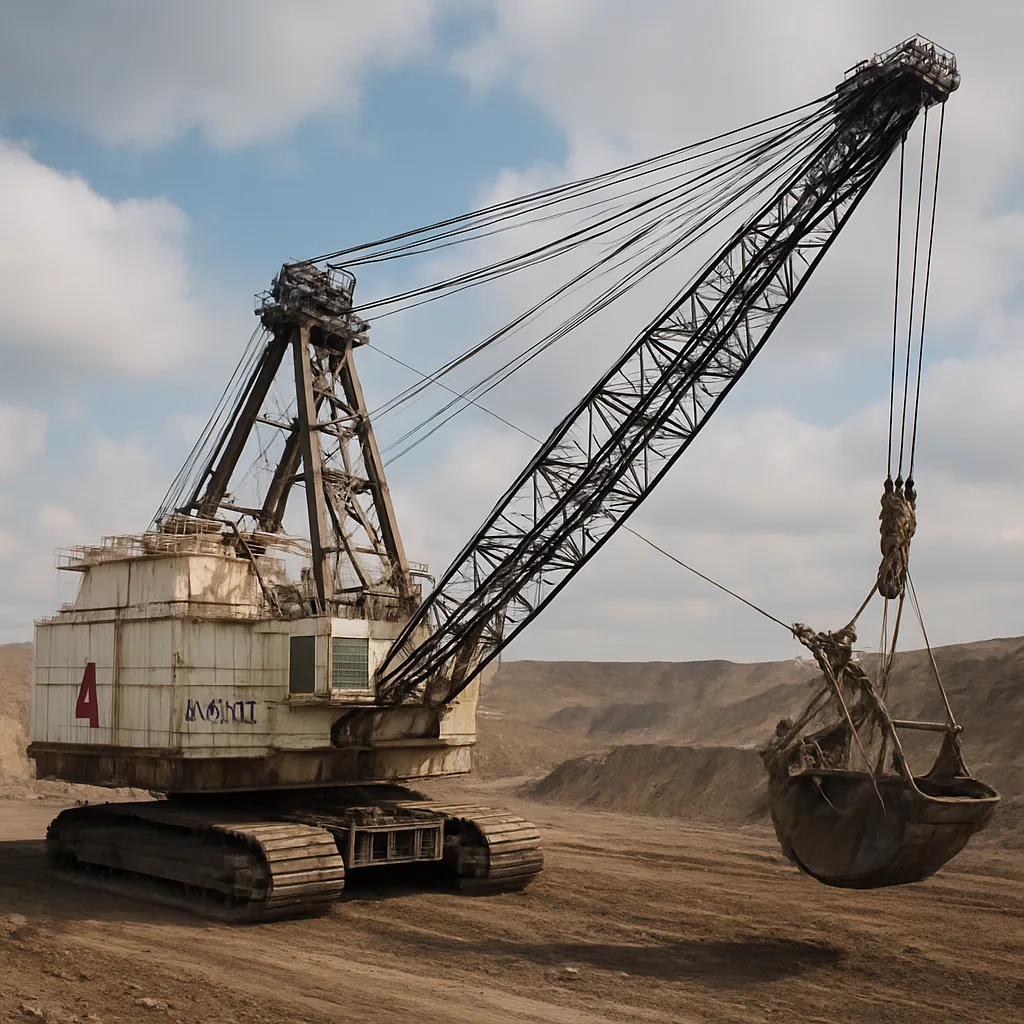
The Marion 111-M is a heavy-duty dragline excavator produced by the historic Marion Power Shovel Company. Designed for large-scale earthmoving tasks, the 111-M became known for its robust mechanical layout, adaptability to different mining conditions, and long service life in open-pit operations. This article describes the machine’s design, typical applications, operational characteristics, and broader significance within the history of large-scale excavation equipment. It also summarizes typical technical figures and operational statistics where available.
Design and engineering overview
The Marion 111-M was engineered around the core concept of efficient, long-reach excavation using a suspended bucket that is pulled across the ground by cables. Its mechanical architecture emphasized stability, lifting capacity, and the ability to operate continuously in large earthmoving cycles. Key components of the 111-M include a sturdy crawler or pedestal base, a tall steel boom that defines the reach, a cable-and-pulley rigging system, and a sash of powerful industrial electric motors and winches to control bucket movement.
Primary components
- Boom and rigging: The boom is the structural backbone that supports the dragline’s reach. The 111-M’s boom was fabricated from high-strength steel sections and designed to handle the combined stresses of heavy bucket loads and the long cantilevered moment at maximum outreach.
- Bucket and dragline system: The dragline bucket is controlled by a system of hoist, drag, and crowd cables. The drag cable pulls the bucket toward the machine to gather material, the hoist cable lifts the bucket, and auxiliary cables or crowd controls position the bucket for dumping.
- Powertrain: Most Marion draglines, including the 111-M, were electrically driven. Large synchronous or induction motors power the hoist and drag winches, swing drive, and propel mechanisms. The usage of electric drive allowed for smooth torque control and endurance in continuous operation.
- Operator platform and controls: Given the large scale of the machine, the Marion 111-M typically featured an elevated cab with multi-axis controls, visual sightlines along the bucket path, and instrumentation for electrical load, cable tensions, and system diagnostics.
Applications and operational roles
Draglines such as the Marion 111-M are specialized machines used where large volumes of overburden or unconsolidated material must be moved economically. The 111-M found use in a range of applications, with the most common being large-scale open-pit coal and mineral mining. Other notable roles included civil engineering projects and large dredging and reclamation works.
Mining and resource extraction
- Surface coal mining: Draglines are particularly suited to removing thick layers of overburden above coal seams. The 111-M could operate in continuous cycles, cutting benches of material and depositing spoil in tailored heaps or external dumps.
- Large ore bodies and minerals: Where economic seams are widespread and removal of large volumes is required, the 111-M’s combination of reach and bucket capacity offered cost advantages compared with fleets of smaller shovels and trucks.
Infrastructure and civil engineering
- Harbor dredging and reclamation: In projects requiring large-scale removal or redistribution of unconsolidated sediments, draglines can be used from engineered platforms or barges for land reclamation and harbor deepening.
- Canal and reservoir works: Construction of canals, levees, and large-scale earthworks have historically used draglines for their ability to move material long distances without repeated truck cycles.
Operational advantages
- Economy of scale: The Marion 111-M could move very large volumes per bucket cycle compared with conventional shovels, reducing the number of machine cycles and operator interventions.
- Reach and flexibility: The long boom allowed material to be deposited at considerable distance from the excavation face, enabling strategic spoil placement and minimizing haul distances.
- Continuous operation: Electrically driven systems provided durability for continuous multi-shift operation typical in major mines.
Typical technical specifications and statistics
Exact technical data for the Marion 111-M varied by production batch, customer configuration, and retrofit options. Below are representative figures and performance indicators frequently associated with dragline machines of the 111-M class. Where specific model variants exist, actual numbers may differ; the ranges given reflect the machine’s expected order of magnitude.
- Bucket capacity: Typical dragline buckets for machines in this class commonly range from roughly 20 to 60 cubic yards (15–45 cubic meters) depending on geological conditions and customer specification. Some special configurations could be larger or smaller to suit a mine’s needs.
- Boom length: Booms for machines like the 111-M often ranged from approximately 100 to 200 feet (30–60 meters), providing long reach for overburden removal and spoil placement. Longer booms improve reach but increase structural and control demands.
- Operating weight: The complete assembled unit, including counterweights, machinery house, and superstructure, commonly fell in the hundreds to thousands of tons. Typical operating weights for medium-to-large Marion draglines would often be measured in the range of several hundred to several thousand short tons (several hundred to a few thousand metric tonnes).
- Power requirements: Electrical power for a machine of this class can be substantial. The combined installed motor power for hoist, drag, swing, and propel might total several hundred to several thousand horsepower (several hundred kilowatts to multiple megawatts), usually supplied from high-voltage distribution in the mine or via on-site power generation.
- Cycle time and productivity: Cycle times depend on bucket size, operator skill, and geotechnical conditions. A single cycle taking anywhere from 30 to 90 seconds is typical for larger draglines, yielding hourly production rates that can range from a few hundred to several thousand bank cubic yards per hour under optimal conditions.
Because Marion draglines were often custom-built or modified in the field, owners and operators commonly tailored the 111-M to local requirements, including alternate bucket types (for friable or sticky soils), extended booms, and auxiliary systems for dust suppression or remote monitoring.
Operation, logistics, and maintenance
Operating a Marion 111-M requires coordinated teams, substantial logistical planning, and a well-defined maintenance regime. These machines were central assets at large mines and their uptime was critical to overall site productivity.
Site preparation and assembly
- Foundations and positioning: Depending on whether the 111-M was mounted on crawlers, a fixed pedestal, or a custom-built platform, foundations and ground-bearing capacity had to be analyzed. Massive counterweights and the dynamic loads during operation necessitated careful geotechnical assessment and site preparation.
- Transportation and erection: Major components were often shipped in sections and assembled on site using cranes and rigging crews. Assembly could take weeks to months, during which precise alignment and bolting practices were critical. Some components were modular to facilitate later relocation.
Routine maintenance and lifecycle
- Cable and wear part replacement: Drag cables, bucket teeth, pursing gear, and wear plates are high-wear items that require scheduled inspection and replacement. The integrity of cables is essential for safe operation; non-destructive testing and regular replacement schedules reduce the risk of catastrophic failure.
- Electrical systems: Large motors and switchgear need preventive maintenance, including insulation testing, bearing lubrication, and cooling system management. Power quality and controls also influence long-term durability.
- Structural inspection: The boom, pins, and pivot points are subject to cyclic loading and fatigue. Periodic inspections for cracks, corrosion, and deformation are routine, often supplemented by structural repairs or reinforcements during major overhauls.
Personnel and safety
- Skilled operators: Operating a dragline is a specialized skill. Operators must coordinate hoist, drag, and swing controls while maintaining awareness of cycle timing, ground conditions, and nearby personnel or equipment.
- Support crews: Maintenance crews, signal personnel, and ground guides are necessary during repositioning and heavy lifts. A clear safety protocol for cable failures, swing arcs, and electrical isolation is essential.
Economic and environmental considerations
From an economic perspective, the Marion 111-M represented a capital-intensive but high-throughput solution. When deployed properly in continuous operations, the dragline’s cost per unit of material moved could be substantially lower than truck-and-shovel fleets for equivalent bench heights and overburden characteristics.
Cost-benefit profile
- High initial investment: Purchasing, assembling, and commissioning a Marion 111-M involved large upfront costs. However, owners accepted this expense in exchange for lower operating labor and vehicle costs in high-production settings.
- Operational efficiency: With long reach and large bucket cycles, the dragline could reduce the need for haul trucks and the related fuel and maintenance expenses typical of truck-centric operations.
Environmental and social impact
- Landscape alteration: Draglines are associated with substantial surface disturbance. Their use in strip mining reshapes topography and necessitates reclamation planning.
- Emissions profile: Electrically powered machines can reduce on-site diesel use compared with truck fleets, but overall emissions depend on the electricity source. Where grid power comes from fossil fuels, indirect emissions remain a consideration.
- Reclamation potential: Because draglines can precisely place spoil material, they can be effective tools in reclamation and landscape engineering when integrated into environmental management plans.
Legacy, preservation, and modern context
The Marion 111-M is part of the larger story of 20th-century mechanization of mining and civil works. While newer technologies, automation, and material-handling strategies have evolved, many principles embodied by the 111-M remain relevant.
Preservation and historical significance
- Historic machines: Large draglines produced by Marion and peer manufacturers are sometimes preserved as museum pieces or static monuments to industrial heritage. These preserved units serve educational and commemorative roles, illustrating the scale of mid-century heavy engineering.
- Engineering lessons: The design choices in the 111-M—such as heavy steel fabrication, electric drives, and cable systems—continue to inform modern excavator and mining-equipment design, especially when scaling machines up for particular sites.
Modern equivalents and evolution
- Automation and remote operation: New machines increasingly use remote-control interfaces, semi-autonomous cycle control, and real-time monitoring to improve safety and productivity. While classic machines like the 111-M were manually operated, retrofits and modern machines draw on the same basic dragline principles with updated controls.
- Alternative strategies: In some contexts, fleets of high-capacity hydraulic electric shovels, haul trucks, and conveyor systems replace draglines. The choice depends on geology, mine plan, and economic factors.
Notable operational anecdotes and case studies
While specific jobsite histories vary, the Marion 111-M and its class were frequently credited with enabling rapid scale-up of coal and mineral operations, achieving sustained production where earlier methods were uneconomical. Examples from industry reportage and operator recollections often highlight:
- Reliability under heavy use: Operators reported long service lives when dedicated maintenance teams adhered to preventative schedules.
- Flexibility to local geology: By changing bucket geometry or boom setup, draglines adapted to shifting seam conditions or reclamation tasks on the same site.
- Community and workforce: The large machines required coordinated teams and became local landmarks in mining towns, influencing local employment and industrial culture.
Concluding perspective
The Marion 111-M exemplifies a generation of heavy equipment where mechanical robustness, electrical power, and thoughtful engineering combined to move vast quantities of earth efficiently. Its greatest strengths were reach, bucket capacity, and the ability to operate continuously under demanding conditions. While modern mining increasingly incorporates automation and alternative machine classes, the design principles and operational lessons from machines like the 111-M remain important to engineers and operators planning large-scale excavation and reclamation projects. For historians of technology and industry, the Marion 111-M is a testament to mid-century innovation in heavy equipment, and for practitioners, it offers enduring insights into how best to match equipment choices to site-scale earthmoving challenges.


)
)