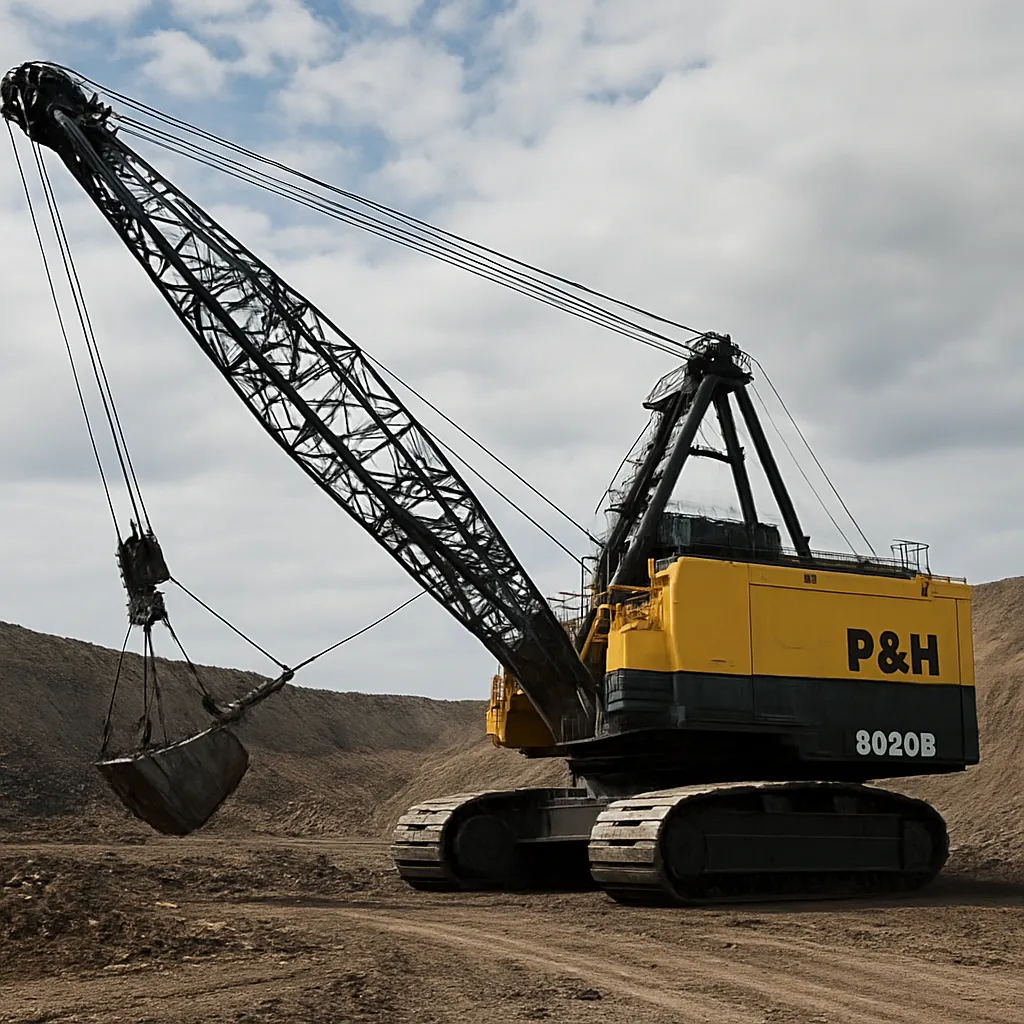
The P&H 9020B dragline represents a class of heavy-duty surface mining machines designed for large-scale earthmoving tasks. Built on decades of experience from P&H (now part of the Komatsu Mining family), machines like the 9020B combine massive mechanical components with sophisticated electrical and control systems to move large volumes of overburden, coal, sand, or other materials efficiently. This article examines the machine’s design principles, typical applications, operational performance, maintenance demands, environmental considerations, and the ways operators extract maximum value from such equipment.
Overview and historical context
P&H has long been recognized as a leading manufacturer of surface mining equipment, including electric shovels and draglines. The P&H 9020B fits into a lineage of large walking and fixed-base draglines that were developed to meet the needs of extensive open-pit operations where continuous, high-volume excavation of overburden is required. These machines evolved from early mechanical draglines into electrically powered giants that integrate advanced rope systems, hydraulics, and electronic controls.
Draglines such as the 9020B are specialized for one primary purpose: removing material by dragging a large bucket across the surface with wire ropes and hoists, then lifting and swinging the load to a spoil or stockpile area. Over the decades, improvements in metallurgy, rope and bucket design, and power electronics have increased efficiency, availability, and longevity of these machines.
Design and main components
The design of the 9020B centers on a few core subsystems that together determine performance and reliability. Each component is engineered to handle extreme loads and repetitive cycles over years of continuous operation.
Major subsystems
- Boom: A long, truss-style structure that provides reach and mechanical advantage. Boom length determines digging radius and maximum dumping distance.
- Bucket: A heavy-duty drag bucket designed to resist abrasion and impact. Bucket capacities for machines in this class typically range widely depending on the fleet configuration and intended application.
- Drag and hoist ropes: High-strength steel wire ropes that endure cyclic loading and abrasion. Rope management and condition monitoring are critical maintenance tasks.
- Hoist and drag winches: Electrically driven drums that control the bucket’s vertical lift and horizontal drag motion.
- Superstructure and machinery house: Houses motors, gearboxes, control systems, and operator cab. The superstructure sits atop a massive base or walking platform.
- Power system: Typically electric, supplied from the mine’s grid via substations and switchgear. Motors and power electronics convert grid power into controlled mechanical movement.
- Control and instrumentation: Modern draglines incorporate programmable logic controllers (PLCs), remote diagnostics, load monitoring, and ergonomic operator interfaces.
Key design priorities include structural strength to resist dynamic stresses, wear-resistant materials for buckets and booms, redundancy in critical systems to improve availability, and modular components to simplify major repairs and overhauls.
Typical applications and industries
The P&H 9020B and similar draglines are used primarily in operations where high-volume, repetitive excavation of unconsolidated or weakly consolidated material is needed. Common applications include:
- Strip mining for coal: Removing overburden above coal seams to expose coal for subsequent extraction.
- Oil sands surface mining: Excavating layers of sand and bitumen-rich material where very large bucket capacities and long reach are advantageous.
- Overburden removal at large open pits: For copper, iron ore, and other commodities where the ratio of waste-to-ore is high.
- Bulk earthmoving and reclamation: Construction of large infrastructure projects, port expansion, and landscape shaping where continuous, heavy excavation is required.
- Tailings and dredge support: Moving large volumes of spoils or tailings during mine expansions or dam construction.
Because of their scale, draglines are best suited for operations with predictable benches and large, uninterrupted working areas; they are less suited to highly fragmented or constrained sites where mobility and maneuverability are critical.
Performance, productivity, and typical statistics
Exact specifications for a particular P&H 9020B configuration depend on customer requirements and mine-site engineering. However, draglines of this class share characteristic performance ranges. The figures below are indicative ranges typical for large mining draglines and useful for planning and comparison:
- Bucket capacity: Commonly expressed in cubic yards (cy) or cubic meters (m³). Machines in this general class may use buckets ranging from approximately 50 to 200+ cubic meters (roughly 65–260 cubic yards), depending on design and application.
- Boom length: Boom lengths can vary substantially — typical spans for large draglines sit between 40 and 100 meters, with some specialized units using even longer booms to increase reach.
- Operating weight: Overall machine weights for large draglines commonly range from several thousand tonnes to well over ten thousand tonnes for the largest examples.
- Installed electrical power: Power requirements for drive motors, hoists, and auxiliaries often range from 2 MW up to 20+ MW for the largest machines; peak power draw is heavily task-dependent.
- Cycle time: Dragline cycles are relatively slow compared to hydraulic shovels; a single drag-fill-and-dump cycle can take from tens of seconds to several minutes depending on rope lengths, hoist speed, and swing distance.
- Productivity: Daily production and material moved per hour depend on bucket size, fill factor, cycle time, and site layout. Typical daily volumes can range from a few thousand to tens of thousands of cubic meters of overburden per day for a single machine operating continuously.
- Availability: Well-maintained draglines can achieve high availability (often 85–95% on planned continuous operations), but major component overhauls can require extended downtime measured in weeks or months if not planned.
These ranges serve as planning guides. For precise capability of a specific 9020B machine, consult the manufacturer’s datasheet and the mine’s performance records. In practice, production modeling also accounts for access roads, spoil placement distances, weather, and operator skill.
Operation, digging technique and site layout
Dragline operation is a distinct discipline that combines mechanical control of the bucket with strategic bench planning. The operator’s role — supported by site engineers — is to optimize swinging arcs, spoil placement, and rehandle volumes to minimize non-productive movement.
- Digging method: The bucket is dragged across the face to fill (drag), then hoisted and swung to the dumping site. Fill efficiency (fill factor) depends on bucket shape, face conditions and operator technique.
- Spoil placement: Strategic placement of spoil reduces rehandle and return distance for subsequent passes. Some operations employ multi-machine systems where a dragline feeds a bench-mounted shovel or conveyor.
- Walk and reposition: Many large draglines are walking machines — they can “walk” short distances to reposition for new benches. Walking is slow and used sparingly because it requires careful planning and ground preparation.
- Integration with other equipment: Draglines often work in tandem with trucks, shovels, conveyors and crushers. Their high-volume, continuous output makes them ideal for feed roles in large, integrated systems.
Maintenance, refurbishment and lifecycle management
Maintenance of a machine like the 9020B is central to its operational economics. The capital cost is amortized over decades, so well-managed maintenance can meaningfully improve unit costs per tonne moved.
Maintenance considerations
- Predictive monitoring: Rope condition, gear tooth wear, vibration and oil analysis are routine. Condition-based maintenance reduces unplanned downtime.
- Major component life: Ropes, buckets, boom members, winch drums, and traction systems are designed for large life cycles but will require replacement or refurbishment at intervals depending on operating hours and fatigue loading.
- Refurbishment: Full rebuilds or re-powering programs extend machine life; refurbished machines often receive modern controls, improved motors and updated safety systems.
- Spare parts and logistics: Long lead items (ropes, slewing bearings, motors) are kept in inventory or under standby agreements with manufacturers to minimize extended outages.
Typical lifecycle strategies include planned mid-life overhauls, continuous minor refurbishments, and upgrades to electrical drives and control systems to improve efficiency and diagnostics. When properly maintained, draglines can operate for 30 years or more with periodic major rebuilds.
Safety, environmental impact and mitigation
Operating very large draglines poses safety risks and environmental responsibilities. Modern machines incorporate both design and procedural controls to reduce hazards and environmental footprint.
- Operator safety: Ergonomic cabins, redundant controls, real-time load monitoring, and automatic cutoffs protect against overload and catastrophic failure.
- Ground stability: Thorough geotechnical assessment is required when positioning and walking a dragline; undermined ground or weak benches introduce collapse risks.
- Dust and noise: Dust suppression systems, schedule adjustments, and noise barriers are used to reduce site impacts. Electrically powered drives typically reduce local emissions compared to diesel-driven alternatives.
- Rehabilitation: Because draglines are used for surface mining, operators are required by regulation in most jurisdictions to plan progressive reclamation and final landform restoration.
- Energy and emissions: While draglines draw significant electrical power, the source determines their carbon footprint. Integration with low-carbon grid sources or on-site renewables can reduce lifecycle emissions associated with their operation.
Upgrades, digitalization and modern controls
Recent years have seen significant technological upgrades to legacy dragline fleets, improving safety, productivity and remote monitoring capabilities.
- Automation: Semi-autonomous operation assists operators with bucket positioning, rope tension management, and optimized swing patterns.
- Remote diagnostics: Real-time telemetry transmits operating parameters to central maintenance offices for predictive analytics.
- Energy management: Variable frequency drives (VFDs) and modern motor controls increase energy efficiency and reduce peak demand charges.
- Fleet optimization: Integration with mine planning software helps sequence dragline activity to minimize rehandles and improve overall site productivity.
Economics and decision factors for deployment
Choosing to deploy a P&H 9020B-like dragline requires a careful balance of capital investment, operating cost, expected production, and mine plan geometry:
- Capital vs operating cost: Draglines are capital-intensive but yield low operating cost per cubic meter moved when matched to the right mining geometry.
- Mine scale and life: Long-term operations with consistent, extensive benches justify the investment. Short-term or small-scale sites may not realize sufficient utilization.
- Material characteristics: Draglines perform best in unconsolidated to slightly consolidated overburden; very hard rock necessitates ripping or blasting prior to dragline work.
- Site layout: Adequate spoil placement areas and access for maintenance are necessary prerequisites for efficient dragline operations.
Selected practical considerations and best practices
Operators and site engineers adopt several practical measures to maximize the effectiveness of draglines such as the 9020B:
- Pre-planning spoil dumps to minimize rehandle and swing time.
- Coordinating bench heights and drill/blast cycles to maintain consistent face conditions for optimum bucket fill.
- Scheduling preventive maintenance during low-demand periods to preserve availability for peak production times.
- Implementing rigorous rope management programs to monitor wear, fatigue and ensure safe replacement before failure.
- Continuous operator training in advanced control features and energy-efficient operating modes.
Geographical distribution and notable uses
Draglines of the P&H family have been used worldwide in major coal basins and oil sands regions. Large-scale operations in Australia, Canada, the United States, Russia, and parts of Asia and Africa have deployed draglines to remove overburden and support high-throughput mining systems. Their utility is especially evident where long-term open-pit plans exist and conveyors or truck fleets would otherwise represent higher life-cycle costs.
Concluding perspective
The P&H 9020B-class dragline exemplifies the engineering tradeoffs that make large-scale surface mining viable: enormous moving capacity, long service life, and comparatively low unit operating cost when deployed in the right geological and operational context. Key success factors include strong maintenance regimes, strategic site planning, and ongoing investment in controls and monitoring to extend service life and extract value safely and responsibly. For any mining operation considering such equipment, a detailed techno-economic study that aligns machine capabilities with mine geometry, material properties and long-term production forecasts is essential.


)
)