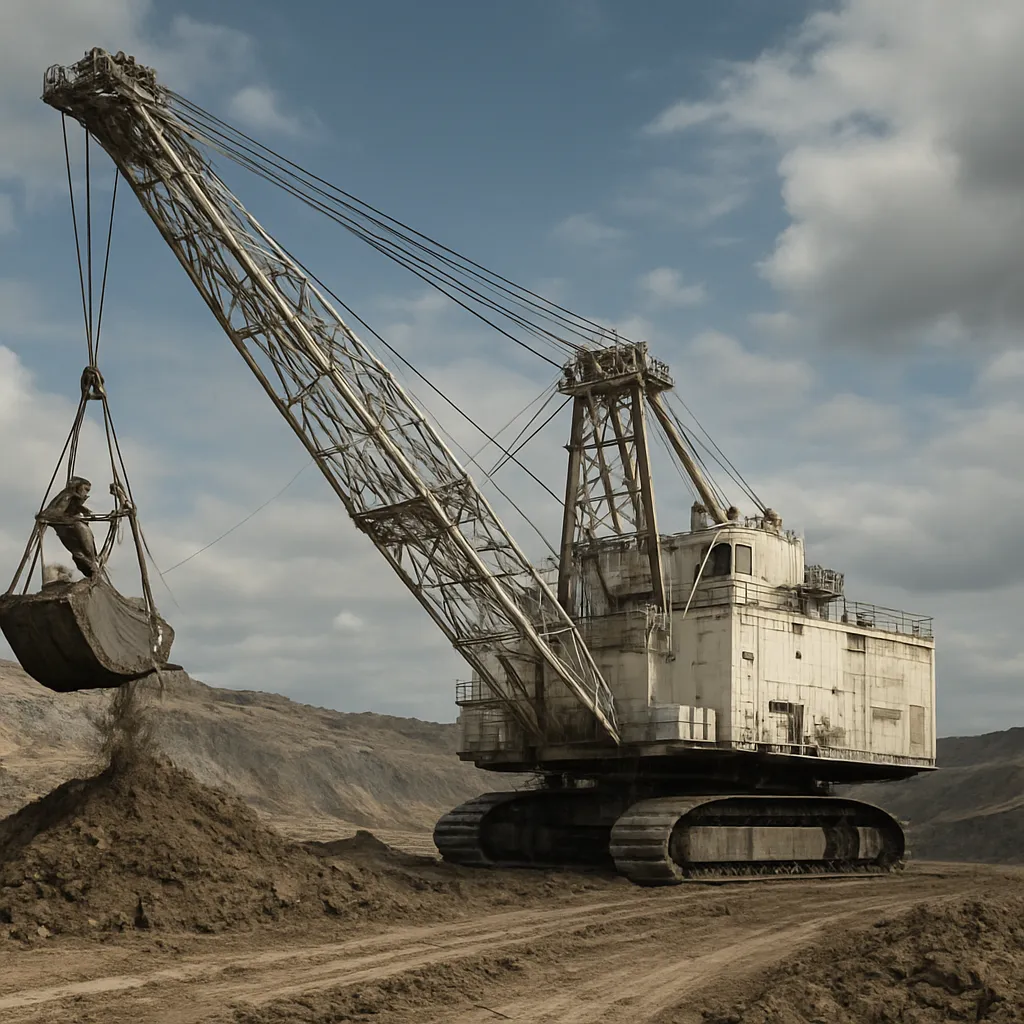
The Big Lou 2100 is a representative name for a class of large-scale dragline excavators designed to move enormous quantities of material in open-pit mining, bulk excavation and reclamation projects. In modern heavy-industry parlance, a machine in the “2100” class is engineered to combine long reach, sturdy structural design and high cycle productivity. This article examines the machine’s design, typical technical features, common applications, operational performance, maintenance requirements, environmental impacts and the broader economic and historical context for machines of this scale. Wherever helpful, typical performance ranges and realistic operational statistics are provided; specific numbers can vary by manufacturer, configuration and site conditions.
Design and technical features
At its core, the Big Lou 2100 is a type of dragline excavator: a large, stationary or semi-mobile machine that uses a suspended bucket dragged across the surface to collect material, then lifted and swung to deposit the load at a spoil location. The fundamental components are the boom, bucket and ropes, power and drive systems, house and platform, and the undercarriage or crawler system that supports the structure. Below are the principal design elements and how they contribute to machine capability.
Boom, bucket and rope system
The boom is the primary reach element. For a large dragline in the 2100 class, booms are engineered to provide long reach and the mechanical advantage necessary to lift heavy loads at extended radii. Boom lengths are a major determinant of the machine’s working envelope and thus its ability to access deep pit benches or wide spoil areas. The bucket, suspended by a network of wire ropes and controlled by winches, is typically a large, open bucket with teeth or a reinforced lip for penetrating packed overburden.
- Boom geometry combines stiffness and optimized weight distribution to minimize deflection during lifts, ensuring consistent bucket placement.
- Rope systems use specially designed high-strength wire rope for the drag, hoist and suspension lines; redundancy and abrasion resistance are critical.
- Bucket design varies by material: heavier-duty cutting edges for compact overburden, lighter shells for softer materials, and specialty shapes for dredging or coal handling.
Power and drive systems
Most modern large draglines are electrically powered, drawing energy from an external grid via trailing cables and substations on site. Electric drives provide good controllability and sustained torque for continuous heavy-duty operation. Some units use diesel-electric generation where grid access is limited. Power requirements scale with machine size and duty cycle.
- Electric traction and winches allow smooth control of the hoist, drag and swing motions.
- Variable frequency drives and modern power electronics improve energy efficiency and permit soft-starts, reducing mechanical shock.
Structural and control systems
The house and superstructure contain winches, gearboxes, operator cabins and often extensive monitoring equipment. For a Big Lou 2100-class machine, structural engineering focuses on resisting high bending moments at the boom base and ensuring stable support on the undercarriage. Advances in materials and finite-element analysis have reduced weight while preserving strength.
- Operator ergonomics and visibility are prioritized; cabins often have climate control, shock isolation and electronic displays for rope tension, swing angle and diagnostics.
- Automation and remote monitoring are increasingly common: load monitoring, predictive maintenance algorithms and operator aids reduce downtime and improve safety.
Applications and industries
The Big Lou 2100’s size and capabilities make it particularly suited to applications that require continuous, high-volume movement of near-surface material. Key sectors and use cases include:
- Open-pit mining — primary removal of overburden in coal, lignite and certain metalliferous mines where large, continuous cuts are needed.
- Bulk earthmoving for large civil works — construction of dams, canal digging, port entrance widening and reclamation projects.
- Aggregates and sand/gravel operations — handling wide-area deposits where draglines can produce low unit costs per cubic metre moved.
- Environmental reclamation — reshaping landscapes after mining, placing cover soils, and controlled placement of spoil that facilitates revegetation.
- River and harbor dredging — on specially adapted platforms, large draglines can perform nearshore dredging tasks.
Because of their long reach, draglines like the Big Lou 2100 excel at bench-to-bench operations where the machine can remain relatively stationary and remove multiple benches by repositioning the boom or relocating the undercarriage a short distance. This reduces the need for frequent heavy-haul truck cycles for overburden transport, lowering operating cost per cubic metre in favorable geology.
Operation, productivity and statistics
Operational performance depends on a combination of machine configuration, material properties, site layout and operator skill. Rather than present a single figure that may not apply to all installations, the following are realistic performance ranges and operational metrics for large draglines in the 2100 class.
Production rates and cycle performance
- Typical bucket capacities for large draglines vary widely; many large machines work with buckets from several cubic metres up to tens of cubic metres. A 2100-class machine commonly uses a bucket sized to deliver efficient cycles for the pit geometry.
- Cycle times (drag, hoist, swing, dump, return) can range from tens of seconds to over a minute; shorter, consistent cycles increase hourly throughput.
- Hourly production is frequently expressed in tonnes or cubic metres per hour. For large draglines, it is common to see throughputs in the range of hundreds to several thousands of tonnes per hour, depending on bucket size and material density.
Energy consumption and fueling
Electric big draglines draw significant power when under continuous operation. Power demand profiles include high short-term peaks during hoist operations and more moderate continuous loads for swing and winch holding. Energy efficiency improvements arise from optimized rope handling, electronic drives and duty-matching of equipment.
Crew and logistics
- Typical operating crew sizes are modest relative to the machine size: one operator is usually in the cabin for routine digging, with additional technicians and ground staff for repositioning, maintenance and electrical switching operations.
- Ground infrastructure includes power substations, cable management systems, maintenance shops and spare rope and bucket inventories. Logistical planning is crucial: draglines are highly productive but require significant support.
Maintenance, safety and environmental impact
Maintaining a Big Lou 2100-class dragline is a complex, planned activity. Frequent inspections, preventive maintenance and condition-based servicing minimize downtime and extend life. Safety systems and environmental controls are integral in modern operations.
Maintenance priorities
- Wire rope inspection and replacement — ropes are critical items subject to fatigue, abrasion and corrosion. Regular non-destructive testing and scheduled replacement are essential.
- Bucket and wear parts — lip, teeth and shell patches are wear items; planned refurbishing limits unplanned outages.
- Gearboxes and bearings — frequent oil analysis, alignment checks and thermal monitoring prevent catastrophic failures.
- Structural inspections — fatigue cracks in welds or high-stress regions are monitored with ultrasonic or magnetic particle testing.
Safety measures
Operational safety includes personnel exclusion zones, interlocked hoisting systems, anti-collision sensors (for sites with multiple machines), emergency stop protocols and fall protection for maintenance crews. Training for operators and ground staff is critical: despite many automation aids, human oversight prevents many incidents.
Environmental considerations
Draglines can have both negative and positive environmental impacts. Negative aspects include temporary landscape disturbance, dust generation and potential disruption of hydrology. Positive outcomes include the ability to undertake large-scale reclamation and rapid reshaping of disturbed land to a desired profile. Best practices include dust suppression, staged reclamation, progressive revegetation and careful management of water run-off.
Economic and life-cycle considerations
For large open-pit operations, the choice to use a dragline such as the Big Lou 2100 is an economic decision driven by unit cost per cubic metre removed, capital expenditure, availability of power and site geometry. Draglines excel in continuous, predictable overburden removal where their long reach and low operating cost per tonne outweigh the capital investment and logistical needs.
- Capital expenditure for a large dragline represents a major plant investment; total cost includes the machine, erection, and on-site infrastructure.
- Operating cost drivers include energy, scheduled maintenance, rope and bucket wear parts, and the cost of downtime.
- Depreciation and asset life — well-maintained draglines can remain productive for decades. Rebuilds and major refurbishments (for example, replacement of ropes, buckets and critical components) are common and can significantly extend service life.
Historical development and notable manufacturers
Draglines trace their industrial lineage to early steam and cable excavators; the technology matured through the 20th century with electrification, improved metallurgy and advanced controls. Some historically significant large machines — such as Big Muskie and Big Brutus — showcased the scale that draglines can reach. While the Big Lou 2100 is a modern-class exemplar rather than a singular historic machine, it follows the same evolution: larger booms, better power electronics and more data-driven maintenance.
- Major manufacturers historically and currently involved in large dragline production include companies such as Bucyrus-Erie (later part of larger groups), P&H (Joy Global), Marion, Komatsu, Hitachi and more recently SANY and other global heavy-equipment builders. Each brings different design emphases and support networks.
- Consolidation in the industry and increasing focus on electrification and automation have changed the vendor landscape over decades.
Notable deployments, case studies and statistics
Large draglines have historically been used in some of the world’s largest coal and lignite operations, and their performance provides benchmarks for what machines of the Big Lou 2100 class can achieve. Below are representative statistics and case-oriented observations—these numbers are indicative rather than prescriptive and should be adapted to specific site studies.
- Typical life span: With careful maintenance and periodic refurbishment, a large dragline can remain in service for 30 years or more.
- Productivity benchmarks: In favorable geology and with optimal equipment, draglines can move several thousand to tens of thousands of cubic metres per day. Hourly outputs are frequently in the hundreds to low thousands of tonnes per hour, depending on material density and cycle time.
- Economic breakpoints: Draglines become economically attractive when continuous overburden removal of large volumes is required and when energy and capital costs are balanced by the lower unit operating costs compared to truck-and-shovel fleets.
Examples of site adaptations include placing a dragline on a floating barge for nearshore dredging, or configuring the machine with a specially reinforced bucket for highly abrasive ore. Remote health-monitoring systems can reduce unscheduled downtime by as much as double-digit percentages in well-instrumented operations.
Adaptations, modern upgrades and future trends
Looking forward, machines in the Big Lou 2100 class trend toward increased automation, energy efficiency and integration with mine planning systems. Key areas of innovation include:
- Autonomous aids: semi-autonomous cycle optimization, collision avoidance and path planning to support a single operator handling complex sequences.
- Condition-based maintenance: sensors on ropes, bearings, gearboxes and structural components feeding predictive models reduce downtime and allow parts replacement just-in-time.
- Energy integration: use of on-site renewable generation and energy storage to smooth peak electrical demand from hoisting cycles, potentially lowering energy costs and emissions.
- Material science: improved alloys and wear materials for buckets, pins and bushings that extend service intervals and reduce total life-cycle cost.
Practical considerations for operators and site planners
Successful deployment of a Big Lou 2100 requires coherent planning across engineering, logistics, environmental management and economics. Key recommendations include:
- Conduct a thorough geotechnical and material-handling study to match bucket size and boom reach to the pit profile.
- Plan power delivery and redundancy; an electrical outage can halt a high-capacity dragline and incur significant cost.
- Invest in operator training and a proactive maintenance program to maximize availability and reduce unscheduled downtime.
- Incorporate progressive reclamation into the mining plan so that environmental restoration proceeds alongside extraction, reducing final rehabilitation cost and permitting risk.
Summary
The Big Lou 2100 class dragline exemplifies the engineering required for large-scale, low-unit-cost earthmoving. Its combination of long reach, large bucket capacity and electrically driven winch systems makes it a powerful tool for open-pit mining, bulk earthworks and reclamation. While exact specifications and economic performance depend on the chosen configuration and the site-specific geology, the overall value proposition of such draglines—reduced haulage requirements, high continuous productivity and long operational life—remains compelling where conditions fit. Ongoing advances in automation, predictive maintenance and materials will continue to enhance reliability, safety and environmental performance for these giants of excavation.


)
)