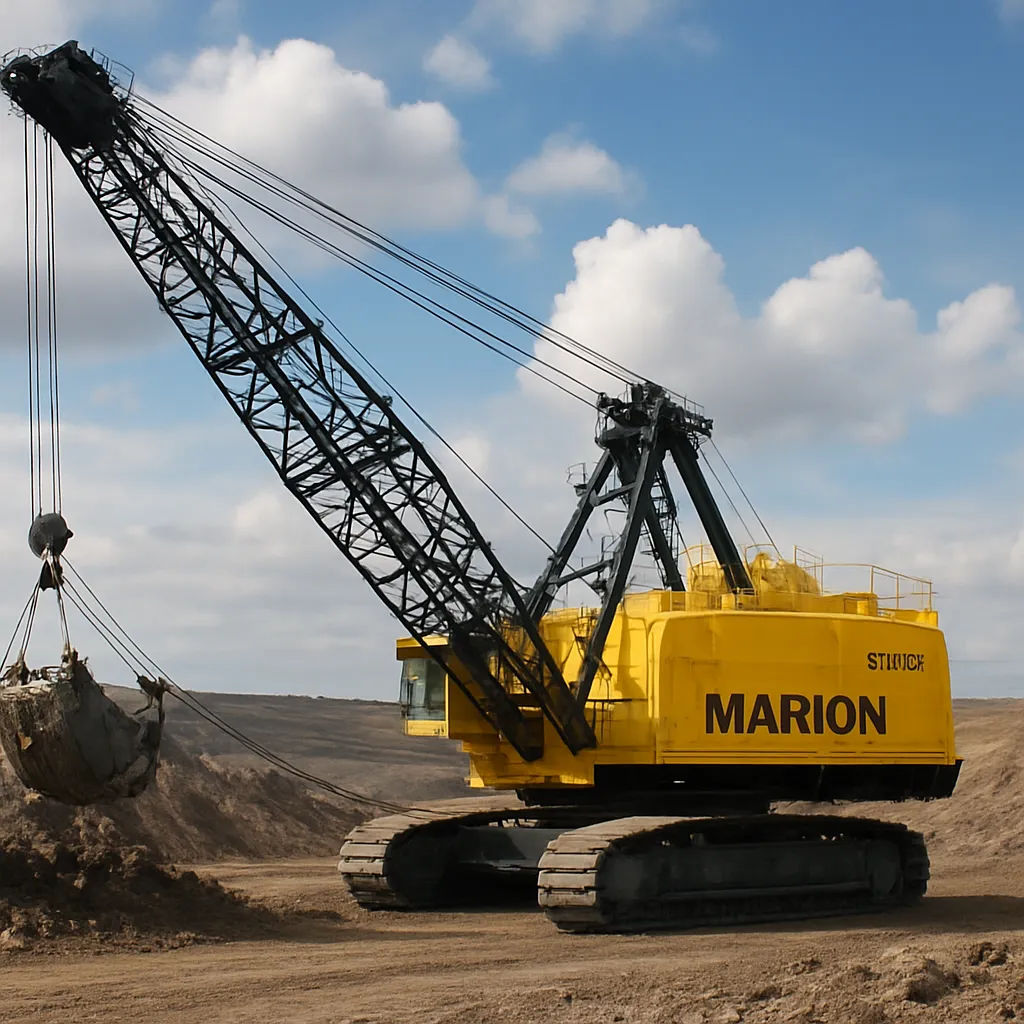
The Marion 8050 dragline represents a class of heavyweight excavation machines that have played an important role in large-scale surface mining and civil engineering projects throughout the 20th century. Although some specific archival specifications for the 8050 are not widely published, this article examines the machine’s design principles, typical technical characteristics, industries of application, operational practices, historical context and its continuing legacy. The goal is to provide a comprehensive picture of how a machine of this type functions, where it is used, and what advantages and challenges it brings to modern excavation work.
Design and technical characteristics
Draglines are among the largest mobile earthmoving machines ever built. The dragline family is defined by a system of cables and a suspended bucket used to excavate material from a cutting area and deposit it at a distance. The Marion 8050, as implied by its model number and Marion’s reputation for large machines, would be expected to share the same fundamental components and engineering principles as other large Marion draglines built for heavy duty mining operations.
Core components
- Bucket: A large, usually steel, bucket suspended from the end of the boom length by hoist and drag cables. Bucket capacities for large draglines typically range from dozens to several hundreds of cubic yards depending on the model and application.
- Hoist and drag cables: Steel wire ropes and drums control raising/lowering and pulling of the bucket back toward the machine to fill it and then swing it to dump.
- Superstructure (house): Contains the powerplant, operator cab, winches, and control systems mounted on a rotating platform.
- Undercarriage: For very large draglines this can be a crawler base or specially engineered track system able to support enormous weights and permit relocation on site.
- Lattice boom: A long truss-like structure that supports the cables and bucket. Boom length is a key parameter determining reach and digging radius.
- Powerplant: Diesel engines, electric motors, or hybrid systems that drive winches, swing motors and travel motors.
Typical technical ranges (large Marion-class draglines)
Because verified published specifications for the Marion 8050 are limited in public sources, the following ranges reflect typical values for large Marion and comparable draglines manufactured in the mid-to-late 20th century:
- Bucket capacity: commonly from about 30 to over 150 cubic yards (approx. 23 to 115 m3) depending on configuration.
- Boom length: often between 150 and 300+ feet (45–90+ meters) for major mining units.
- Machine weight (operating): frequently between several thousand to over 10,000 tons for the largest draglines.
- Installed power: from a few thousand horsepower equivalent to multiple electric drives or diesel/generator sets—typically in the range of several megawatts for continuous heavy operation.
- Digging radius and reach: can exceed 300 feet (90 m) enabling the machine to work over wide spoil areas without frequent repositioning.
These components and ranges determine the machine’s capability to move massive volumes of overburden or other materials efficiently. The Marion design tradition emphasized heavy-duty structural components, serviceable cable systems and robust winches intended for the continuous cyclic operation required in strip mining.
Applications and industries
The prime role of machines like the Marion 8050 is in large-scale earthmoving where high-volume, repetitive excavation is needed. Their principal applications include:
- Coal strip mining: Draglines have been particularly prevalent in the open-pit coal industry where they remove overburden to expose coal seams. Their ability to move large volumes in each cycle makes them economically attractive when the geology and site layout permit.
- Oil sands and other bulk-mining operations: Similar requirements for bulk excavation have led to dragline deployment in heavy-mineral and oil-sands contexts.
- Large civil engineering projects: Construction of major canals, levees, reservoirs, and large earthworks may use draglines when long reach and high-volume excavation reduce cost and time.
- Reclamation and spoil management: Draglines often play a role in redistribution and placement of overburden and spoil in reclamation schemes, especially when accurate spread over a wide area is needed.
Advantages for these applications include a long reach that reduces the need to move the entire machine frequently, a high per-cycle material volume, and relatively simple mechanical principles that are robust in heavy-duty settings. However, their advantages are site-specific: draglines require stable ground and sufficient space for the boom swing and spoil placement, so they are not suitable for constrained or steeply terrained sites.
Operational workflow and crew requirements
Operating a large dragline such as the Marion 8050 involves integrated teamwork and heavy equipment logistics. Typical workflow and crew considerations include the following:
Cycle of operation
- Positioning the bucket at the spoil edge and lowering it to the digging face.
- Engaging the drag line to pull the bucket across the digging face, filling it.
- Hoisting the filled bucket and swinging the superstructure to the dumping area.
- Dumping the bucket by releasing the drag line or hoist, then returning for the next cycle.
Crew and skillset
- Lead operator: responsible for bucket control, timing and safety of the digging cycle.
- Winch and maintenance teams: monitor cable wear, lubrication, and mechanical systems.
- Electrical/mechanical technicians: maintain large motors, gearboxes, brakes and control systems.
- Ground personnel: guide spoil placement, check ground stability and coordinate support vehicles.
Operating these machines safely and productively depends on precise coordination, careful monitoring of structural stresses (especially in the boom length and cable terminations), and regular inspection of the critical components like the bucket, drag rope, and hoist systems. Training is essential because the machine’s mass and reach multiply the consequences of mistakes.
Maintenance, reliability and lifecycle
Longevity and reliability define the value proposition of a heavy dragline. Machines like the Marion 8050 were often expected to run for decades with proper care. Key maintenance and lifecycle considerations include:
- Regular rope and drum inspection and scheduled rope replacement to prevent catastrophic failure from fatigue.
- Structural inspections for cracks, especially around boom joints and pin connections – ultrasonic and magnetic particle testing are common for preventive maintenance.
- Periodic refurbishment of buckets and teeth to maintain digging efficiency; bucket wear parts are replaced frequently in abrasive operations.
- Power system upgrades: older machines frequently undergo modernization with new electric drives or control systems to improve efficiency and reduce downtime.
- Planned major overhauls: rewinding, gearbox rebuilds and structural refurbishment performed at intervals measured in years or after a set number of operating hours.
Well-maintained draglines can have very long operational lives—some units have been in service for more than half a century, especially where owners invest in periodic overhauls and modernization. Because of their size, however, overhauls are major capital events often staged over months and requiring substantial logistical support.
Historical context and notable deployments
Marion Power Shovel and other manufacturers were instrumental in popularizing large draglines in the 20th century. While the specific production history of the Marion 8050 is less prominent in mainstream summaries than some other models, machines in this class were central to the expansion of surface mining after World War II. Notable historical themes include:
- Post-war scale-up of coal and mineral production that favored high-capacity surface mining techniques.
- Engineering innovations in boom design, rope technology and winch drive systems that enabled ever-larger machines.
- Long-term presence at major mining complexes where draglines became icons of industrial landscapes and local employment.
Some Marion-built draglines have become historically notable for their sheer size and longevity. They were key assets on large pits, often remaining operational as long as the mine’s layout permitted efficient use of their reach. Where preserved, large draglines are sometimes restored as static displays or museum pieces illustrating the scale of 20th-century mining technology.
Economic and environmental impacts
The use of draglines like the Marion 8050 has significant economic advantages and environmental consequences which need to be balanced by operators and regulators.
Economic factors
- High productivity per hour: The ability to move large volumes of overburden reduces per-ton removal costs compared with smaller machines when site geometry is favorable.
- Capital intensity: Large draglines represent major capital investments; their economic justification depends on long-term mining plans and consistent throughput.
- Operating costs: While fuel/electricity and maintenance are substantial, draglines often offer favorable life-cycle economics in large-scale strip mining.
Environmental and social considerations
- Landscape alteration: Dragline operations change the topography dramatically. Overburden removal and spoil placement can convert habitats and require extensive reclamation to restore land uses.
- Dust, noise and visual impact: Their operation generates dust and noise and produces a visible industrial landscape which can affect nearby communities.
- Reclamation potential: Because draglines can place material precisely over large areas without intermediate haulage, they can sometimes achieve more controlled spoil placement, offering reclamation advantages if planned from the outset.
In many jurisdictions the regulatory environment and public expectations have made environmental planning, progressive reclamation, and community engagement a major part of dragline deployment decisions.
Safety and regulatory aspects
Safety is paramount with machinery of this scale. Typical controls and regulations include:
- Strict procedures for rope handling and hoist operation to prevent dropped buckets or runaway hoists.
- Establishment of exclusion zones under the swing radius and during bucket operations.
- Routine training and competency certification for operators and maintenance crews.
- Engineering controls to detect structural fatigue and alarm systems to halt operations when parameters exceed safe limits.
Regulators in mining jurisdictions also require reporting of major incidents and audits of maintenance and inspection regimes, reflecting the potentially high consequences of failure.
Modern relevance and legacy
Today, while technology has advanced and other forms of mining equipment (such as high-capacity excavators and shovels combined with truck haulage) are widely used, large draglines remain competitive in specific situations because of their unmatched reach and low operating intensity per cubic meter moved in appropriate geometries. The legacy of the Marion 8050 and its peers persists in several ways:
- Some draglines remain operational worldwide, especially where geological and site conditions favor long reach and minimal repositioning.
- Many older machines have been retrofitted with improved electrical drives, digital controls and modern monitoring systems to extend useful life and improve efficiency.
- Historic recognition: preserved machines serve as educational exhibits that illustrate industrial heritage and the scale of mid-20th-century engineering.
Statistical perspective and known data constraints
Detailed manufacturer specifications for every historic model (including the Marion 8050) are sometimes difficult to locate in public archives. When seeking precise numbers for a particular unit—such as bucket capacity, exact boom length, installed power and operating weight—operators’ manuals, company archives and mining project engineering documents are the most reliable sources. Public summaries often provide reasonable ranges for machines in this class, but they should be validated for project planning or academic work.
Typical high-level statistics for large dragline classes (for orientation, not as definitive Marion 8050 figures):
- Cycle productivity: measured in cubic yards per hour, can range from several hundred to many thousands depending on bucket size and cycle time.
- Operating life: major draglines can have operational lives exceeding 30–50 years with periodic major refurbishments.
- Energy consumption: large draglines are energy intensive during operation; electrical drive systems often draw several megawatts during peak activity.
For a specific mining project or historical inquiry about a particular Marion 8050 unit, consulting mine records, manufacturer brochures or industrial heritage registries will yield the most accurate figures. Local museums, mining archives, or institutions that maintain collections of heavy-equipment documentation are also useful resources.
Summary and concluding notes
The Marion 8050 epitomizes the engineering approach to bulk excavation developed through the 20th century: long reach, simple cable-n-pulley mechanics, robust structural design, and a focus on maximizing material moved per cycle. These machines are specialized tools: extremely effective where the mine geometry and economics align, but impractical in constrained or highly fragmented work sites. Their maintenance demands and capital intensity are offset by exceptional per-hour productivity and long service life when properly supported.
Final practical point: if you are considering historical research, restoration, purchasing a used unit, or studying environmental impact, get access to original equipment documentation or project-level engineering records to ensure you work from verified technical data. The broad ranges and operational descriptions given above should be taken as a contextual guide rather than precise, model-specific guaranteed figures.


)
)