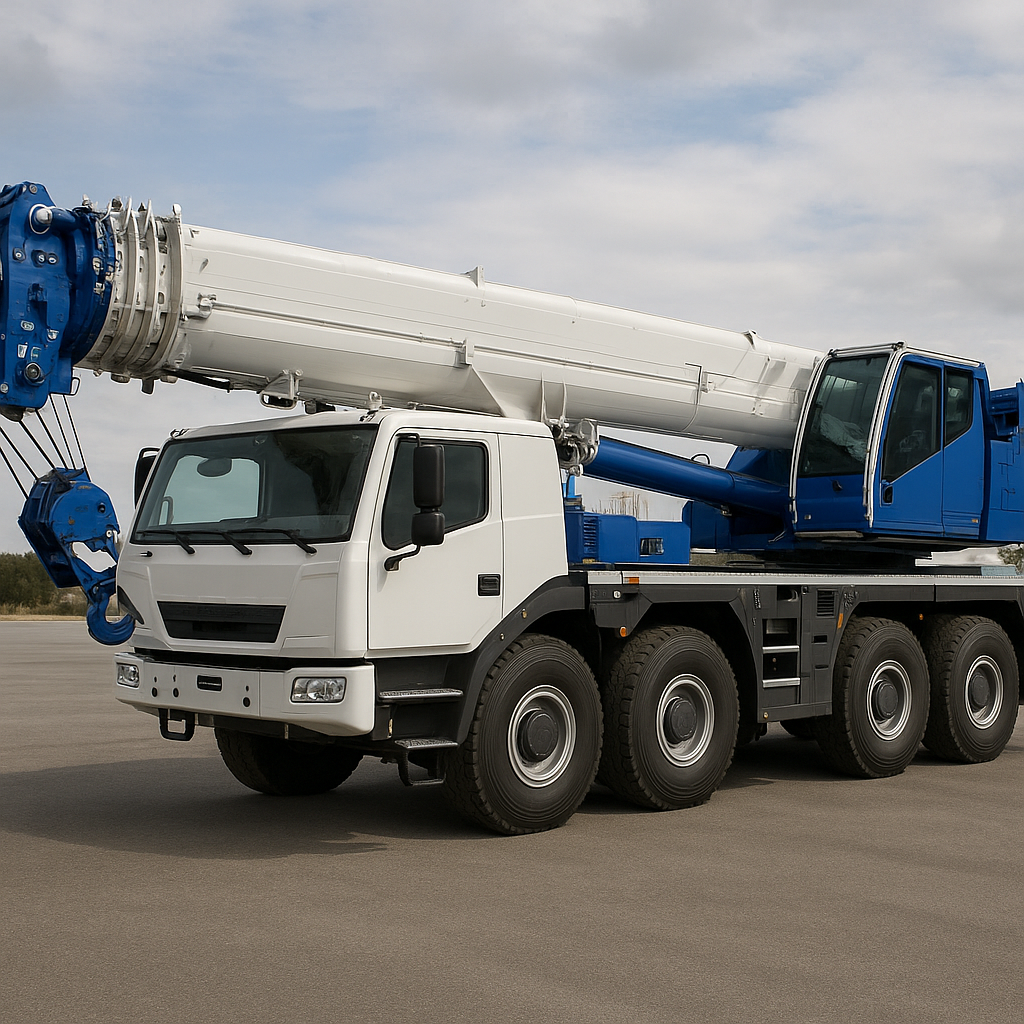
The Tadano ATF 600G-8 is a flagship example of modern heavy-lift, road-capable crane engineering. Designed to combine the travel convenience of a carrier-mounted machine with the on-site performance of a lattice boom crane, this model delivers versatile lifting solutions across construction, energy, petrochemical and heavy industry projects. Below you will find a detailed overview of its design, typical applications, technical highlights and operational considerations, including approximate specifications and real-world performance notes.
Design and technical features
At the heart of the Tadano ATF 600G-8 is a balanced combination of power, structural rigidity and mobility. Built as an Tadano ATF 600G-8 model, the machine is classified as an all-terrain crane that can travel on highways and operate off-road at job sites. Its chassis and superstructure are engineered to support heavy loads while providing operational flexibility and setup speed.
Carrier and chassis
The carrier chassis is designed to provide stable transport and on-site positioning. Multi-axle steering systems enhance maneuverability in confined areas and reduce tire scrub on roads. The suspension and frame configuration are tuned to withstand heavy lifting moments while keeping the transport weight within legal and practical limits for many regions.
Boom system and lifting equipment
One of the defining features of the ATF 600G-8 is its telescopic boom system. The main boom is a hydraulically extended, multi-section main boom offering a long reach for high or distant lifts. Auxiliary lattice or luffing jibs can be fitted to increase hook height and outreach for complex lifts. The crane’s modular swing-away jibs and lattice extensions enable configurations that suit job-specific demands, from close-in heavy lifts to extremely high-reach operations.
Outriggers and stability
The outrigger system of the ATF 600G-8 is engineered to provide rapid, reliable stabilization on uneven ground. Wide, variable-span outriggers distribute load effectively and permit high-capacity lifting with reduced ground bearing pressure. The outriggers are typically hydraulically deployed and have sensors that feed into the crane’s control system to ensure safe lifting envelopes.
Drive, power and controls
Powertrain options and crane hydraulics are designed for dependable performance. The crane’s engine delivers sufficient power for travel, winch operation and hydraulic functions. Modern Tadano units include advanced electronic control systems for load-moment limitation, boom positioning and multi-function coordination. Operator interfaces emphasize ergonomics and precision, with digital displays, load charts and real-time diagnostics.
Applications and industries served
The ATF 600G-8 is used where large, complex lifts are required but site access or transport restrictions make conventional crawler or stationary cranes impractical. Its combination of travel speed and lifting capacity supports a wide variety of sectors:
- Construction of large commercial buildings, stadiums and bridges where heavy prefabricated elements must be lifted and positioned.
- Wind energy installation and maintenance: transporting between sites on public roads and erecting heavy nacelles, tower sections and foundations.
- Petrochemical and refining plants: handling reactors, heat exchangers and heavy process modules during plant construction or turnaround projects.
- Power generation: erection of turbines, generators and structural components in thermal and hydroelectric projects.
- Industrial maintenance and heavy equipment relocation where precise heavy lifts are necessary in restricted spaces.
Because it retains road travel capability, the crane can serve multiple job sites across regions without requiring disassembly into transportable pieces, saving both time and mobilization cost when compared to lattice crawler alternatives.
Performance data and typical specifications
Below are typical technical figures associated with the Tadano ATF 600G-8. Exact numbers may vary by year, factory options and regional configurations. Where precise figures are not universal, ranges and approximate values are given.
Approximate key specifications
- Lifting capacity: approximately 600 tonnes (600 t) at ideal radius and configuration.
- Main boom: telescopic, multi-section. Typical fully extended length in standard form ranges from approximately 14–70 meters (values vary by configuration).
- Jib options: swing-away and lattice extension jibs available to increase tip height and outreach; some configurations allow over 100 m combined height with extensions.
- Number of axles: carrier with multiple axles (commonly 8-axle-class configurations) for road legality and load distribution.
- Gross vehicle weight: depends on configuration but often in the range that necessitates permits for heavy transport in many jurisdictions; designed to meet transport regulations where possible.
- Maximum travel speed: road-capable speeds suitable for highway transport; actual speed depends on local regulations and engine/gearbox choices.
- Outrigger span: wide variable spans for safe lifting—spread dimension depends on ground conditions and selected outrigger mode.
- Winches and hoist lines: multiple winch options provide high-line pull for heavy lifts and fine control for multi-part line reeving.
- Engine power and emissions: diesel engines sized to deliver robust hydraulic power; modern versions adhere to relevant emission standards depending on market (e.g., Stage V / Tier 4F where applicable).
Operational lifting charts, ground bearing pressures and specific boom load capacities are provided by the manufacturer and must be consulted for each lift. Load moment indicators and safety systems on the crane continuously monitor parameters to prevent overload and unsafe configurations.
Operational performance and examples
In practice, the ATF 600G-8 is chosen for assignments where lifting heavy modules quickly and with reduced setup time is a priority. Case examples of typical deployments include:
- Transport and erection of modular plant units: site-to-site moves and lift-in-place operations where the crane’s road travel and heavy-capacity boom minimize module breaks-down.
- Wind farm construction: the machine often lifts nacelles and tower sections in locations where access is limited but paved or improved roads allow movement between turbines.
- Bridge girder installation: high-capacity lifts combined with good outreach enable placement of long bridge segments without disassembling the crane.
Time savings come from fewer lifts to reconfigure the crane, faster setup using hydraulic outriggers and telescoping booms, and integrated control systems that speed up safe lift planning. On many projects, the ATF 600G-8 reduces the need for multiple cranes or more complex rigging arrangements, translating to lower labor and logistic costs.
Advantages, limitations and operational considerations
The ATF 600G-8 brings many operational advantages but also requires careful planning and infrastructure consideration.
Advantages
- Mobility: as an all-terrain unit it travels between sites without full disassembly, reducing mobilization time.
- Versatility: telescopic boom plus lattice jib options suit a broad range of lift types.
- Precision: modern controls and winch systems enable fine positional accuracy for heavy and delicate lifts.
- Safety: integrated load moment protection and sensor systems help maintain safe operating envelopes.
Limitations and considerations
- Transport regulations: despite its road-worthy design, extremely heavy configurations or long boom/jib assemblies may still require special permits or route planning.
- Ground conditions: although outriggers provide wide bearing, soft soil may still necessitate matting or ground improvement to safely distribute load.
- Logistics: while the crane reduces the need for additional lifting equipment, it requires skilled operators and rigging crews familiar with complex heavy lifts.
- Costs: acquisition, rental and operation costs are high relative to smaller cranes—selection should be matched to scope and frequency of heavy lifts.
Maintenance, safety systems and operator aids
Long-term performance depends on scheduled maintenance, proper inspections and adherence to manufacturer recommendations. Tadano equips its cranes with features intended to assist safe operation and simplify troubleshooting:
- Load Moment Indicator (LMI) systems that provide real-time warnings and automatic intervention if a lift approaches unsafe parameters.
- Hydraulic and electronic diagnostics that reduce downtime by highlighting faults early.
- Redundant safety systems for critical functions, including emergency lowering and braking features.
- Operator assistance tools, such as on-board load charts, digital displays, camera systems for blind spots and remote diagnostics support.
Maintenance regimes typically include periodic inspections of boom sections, winches, hoist ropes, hydraulic circuits, outrigger cylinders and structural welds. Rope and hook inspections follow industry standards and certified testing schedules.
Economic and environmental aspects
From an economic perspective, the ATF 600G-8 can deliver value by consolidating lifting roles and speeding project timelines. The ability to relocate quickly between sites reduces the need for multiple cranes and cut down on setup labor. For many contractors, owning or renting an all-terrain crane of this class is a strategic choice when heavy modular lifts are regular requirements.
Environmental concerns are addressed through more efficient engine and hydraulic designs in modern models, lowering fuel consumption per lift compared with older equipment. Additionally, reduced on-site setup and fewer transport moves can decrease overall project emissions. Operators should still plan for responsible fuel and waste management practices.
Choosing the ATF 600G-8 for your project
Deciding whether the Tadano ATF 600G-8 is the right machine for a given project involves assessing several factors:
- Lift magnitude and radii: confirm the crane’s load charts for the required load at the intended radius and boom configuration.
- Site access: assess road routes, bridge load limits, turning radii and local permit requirements.
- Ground bearing capacity: plan for outrigger support and matting if needed to protect underlying surfaces.
- Frequency of use: compare renting versus owning based on projected utilization and mobilization costs.
- Availability of certified operators and rigging crews with experience on large all-terrain cranes.
Engaging a qualified lifting engineer during the planning phase is advisable to optimize crane placement, rigging methods and lift sequencing.
Conclusion
The Tadano ATF 600G-8 represents a powerful option for heavy-lift tasks that demand both mobility and high capacity. With an approximate maximum lifting capability around 600 tonnes, a long telescopic main boom and adaptable jib systems, it serves diverse industries from construction to energy. Its combination of mobility, precision and integrated safety features make it a preferred choice where fewer crane changes, reduced mobilization time and reliable heavy-lift performance are priorities. Selecting this crane requires thoughtful logistical planning, adherence to safety and maintenance protocols, and alignment with project-specific lifting requirements.


)
)