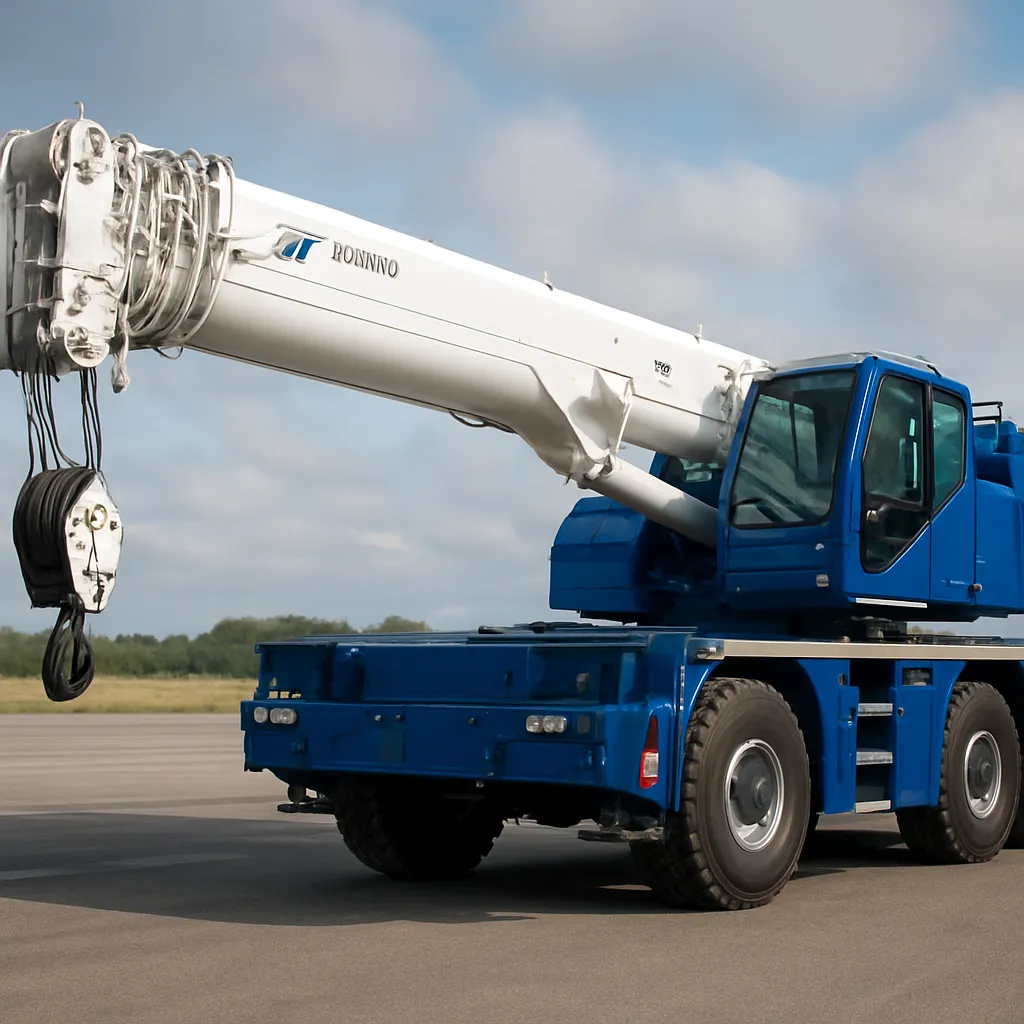
The Tadano AC 5.220-1 is a versatile example of a modern all-terrain crane designed to combine road travel performance with powerful on-site lifting capability. Built to operate in diverse environments—from urban construction sites to industrial yards and energy projects—this class of crane emphasizes mobility, flexibility and operator-centered safety systems. The following article explores the design, typical technical data, applications, operational considerations and lifecycle aspects of the Tadano AC 5.220-1 and similar machines, offering a comprehensive view for buyers, operators and project planners.
Design and key features
The design philosophy behind Tadano all-terrain cranes prioritizes a balance between chassis mobility and lifting power. The AC 5.220-1 (as identified by model nomenclature commonly used in the industry) is engineered to deliver robust performance while remaining adaptable to multiple site conditions.
Chassis and mobility
- The undercarriage is designed for highway travel as well as rougher access roads. A major advantage of the all-terrain concept is the ability to travel between sites without disassembly, reducing project downtime.
- Steering systems typically include multi-axle steering modes and an integrated drive system that supports high maneuverability in confined spaces.
- Suspension and axle load distribution are optimized to meet road regulations in many regions, enabling faster site-to-site transit and lower logistical complexity.
Superstructure and lifting systems
- The superstructure features a telescopic boom with multiple sections for variable reach. The geometry often combines a powerful main boom with an optional lattice or telescopic jib to extend reach and versatility.
- Hydraulic winches, advanced load moment indicators and computerized control systems allow precise, safe lifts under a variety of conditions.
- An integrated counterweight system that can be adjusted or staged provides stability for heavy lifts without requiring excessive setup time.
Cabins and ergonomics
- Operator cabins are typically climate-controlled and ergonomically designed for visibility and comfort. Controls integrate joysticks and touch displays with diagnostics and safety overlays.
- For road driving, the driver’s cab is separate and equipped with modern assistance systems. For crane operation, the operator cab offers panoramic views, camera feeds and load-display instrumentation to improve both safety and productivity.
Typical technical specifications and performance
Official manufacturer specifications for specific regional variants can vary, but cranes in the AC 5.220-1 class generally share similar performance envelopes. The values below reflect typical figures for a five-axle all-terrain crane with a nominal class around 200–250 tonnes.
- Lifting capacity: Typically up to approximately 200–220 tonnes at short radius configurations. Capacity reduces as boom extension and radius increase.
- Main boom length: Main telescopic boom lengths commonly vary between 40 and 60 meters, depending on configuration and optional sections.
- Jib options: Fixed lattice or telescopic jibs can extend tip height and radius; combined systems may reach 70–100 meters tip height.
- Engine power: Drive and crane engines are often in the range of 250–350 kW depending on emission standards and regional setups.
- Travel speed: Road travel speeds can reach up to 70–85 km/h where legal, allowing efficient relocation without disassembly.
- Axles: Five-axle chassis is common for this class, providing load distribution, steering versatility and compliance with transport limits in many jurisdictions.
- Outrigger footprint: Fully deployed outrigger spans are engineered for maximum stability while minimizing site preparation requirements; footprint dimensions vary by model and counterweight setup.
- Gross vehicle weight: Curb and GVW values depend on counterweight fitted; typical ranges for comparable machines are 60–90 tonnes depending on configuration and legal allowances.
Note: exact numbers for the AC 5.220-1 should be confirmed from Tadano’s regional datasheets because manufacturers produce variant configurations to suit market and regulation differences.
Applications and industry use cases
All-terrain cranes such as the AC 5.220-1 are widely used across sectors that require mobility combined with high-capability lifting. Their design enables them to perform in settings where dedicated crawler or truck-mounted cranes would be less efficient.
Construction and infrastructure
- High-rise concrete and steel erection where telescopic reach and travel speed provide significant logistical advantages.
- Bridge construction and maintenance tasks which require long reaches, precise placement and frequent repositioning across large sites.
- Urban projects where limited staging space and traffic rules make the all-terrain’s roadability a key benefit.
Energy sector
- Wind turbine installation and maintenance: the combination of high tip heights (with jib) and mobility makes all-terrain cranes valuable for nacelle and tower segment lifts.
- Oil, gas and petrochemical plant construction: heavy modules and equipment must be placed accurately and often in constrained yards.
- Hydropower and electrical substations: installation of transformers, switchgear and other heavy equipment.
Industrial and specialized lifting
- Prefabricated modular assembly: moving large prefabricated units into place quickly minimizes downtime.
- Plant shutdowns and turnarounds where speed of setup and lifting precision are critical to minimize production losses.
- Marine and port operations for on-dock lifting where a roadable crane reduces the need for dedicated port cranes.
Operation, safety and systems
Modern Tadano cranes integrate multiple systems to enhance safety and reduce operator workload. These features are essential for productive and compliant lifting operations.
Load control and safety features
- Electronic load moment indicator (LMI) systems continuously monitor load, boom angle, extension and outrigger status to prevent overload conditions.
- Anti-two-block devices, automatic moment-limiting, and safe lift interlocks protect both operators and equipment.
- Remote diagnostics offer real-time fault detection and can connect with service centers for rapid troubleshooting.
Operator assistance and training
- Integrated displays provide lift charts, load radius diagrams and permitted/forbidden zones for each configuration.
- Operator training on both theory and practical operation is crucial; many OEMs provide certified training programs to reduce risk and extend machine life.
Site setup and logistics
- Outrigger configuration planning tools and software help determine optimal setup without unnecessary ground preparations.
- Transport permits and route planning are often required for cranes of this class; the machine’s roadability reduces the number of loads, but heavy counterweights may still necessitate separate transport.
Maintenance, service life and total cost of ownership
The long-term economics of an all-terrain crane depend on maintenance practices, usage profile and support networks. For major brands like Tadano, global parts availability and authorized service centers can substantially reduce downtime.
Preventive maintenance
- Regular hydraulic system checks, wire rope inspection, boom and winch maintenance minimize unexpected failures.
- Scheduled engine service, emission system checks and electrical diagnostics extend component life and preserve resale value.
Lifespan and refurbishment
- A well-maintained all-terrain crane can remain in productive service for 15–25 years or more; refurbishment programs (re-booming, engine replacement, control upgrades) can extend usable life and modernize performance.
- Residual value depends on service history, hours, and the presence of updated safety and emissions equipment.
Fuel and operating costs
- Engine efficiency, eco modes in crane controls and optimized hydraulic systems reduce fuel consumption during both travel and operation.
- Cost-per-lift analyses should account for transit times, set-up labor and the need for specialized rigs or permits; the all-terrain’s multi-role capability frequently lowers overall project costs.
Environmental and regulatory considerations
Increasing regulatory emphasis on emissions and noise impacts crane design and operation. Manufacturers respond with cleaner engines and noise-damping features that help comply with stringent local regulations.
- Compliance with EU Stage V, US EPA Tier standards, or other regional emission requirements may influence engine selection and after-treatment systems.
- Electric-assist features and hybrid options are emerging in the mobile crane market to reduce fuel use during idling and low-load operations.
- Noise-reduction measures in cabins and hydraulic systems improve site acceptability, especially in urban environments with strict noise curfews.
Case studies and real-world examples
Although specific project references for the AC 5.220-1 will vary by region and operator, the machine type has proven its value in multiple contexts:
- Urban high-rise construction where multiple lifts per day and frequent relocation between sections of a large site demanded quick set-up and travel.
- Wind farm assembly projects where the crane provided both the necessary tip height and the mobility to serve multiple turbines without disassembly.
- Factory rollouts and heavy-equipment installations where precise placement of large modules reduced installation time and improved safety metrics compared to improvised lifting methods.
Buying, renting and fleet management considerations
Deciding whether to purchase or rent cranes like the AC 5.220-1 depends on project pipelines, capital availability and utilization rates.
- Buy when utilization is high and predictable: owning spreads cost over long-term use and provides control over configuration and maintenance.
- Rent for short-term projects or irregular demand: rental fleets offer quick access to the latest configurations and lower initial capital outlay.
- Fleet management strategies should track hours, maintenance schedules, parts inventories and operator certifications to optimize availability and asset value.
Future trends and innovations
The mobile crane market continues to evolve with an emphasis on digitalization, sustainability and modularity.
- Digital fleet management platforms provide predictive maintenance, utilization analytics and remote diagnostics—reducing unplanned downtime.
- Hybrid powertrains and electric drives are becoming more common in lower tonnage segments, and the technology is migrating upward as battery density improves.
- Modular counterweight systems and improved telescoping mechanisms reduce setup time and improve operational flexibility on constrained sites.
Concluding perspective
The Tadano AC 5.220-1 typifies the strengths of contemporary all-terrain cranes: a combination of road mobility, robust lifting capacity, advanced safety systems and operator-focused ergonomics. For contractors and plant operators that require a single machine capable of highway travel and demanding on-site lifts, cranes in this class offer a strong value proposition. Exact technical and performance figures should be confirmed with the manufacturer or authorized dealer to match a particular job’s requirements, but the broad capabilities described here illustrate why all-terrain cranes remain central to heavy lifting solutions worldwide.


)
)