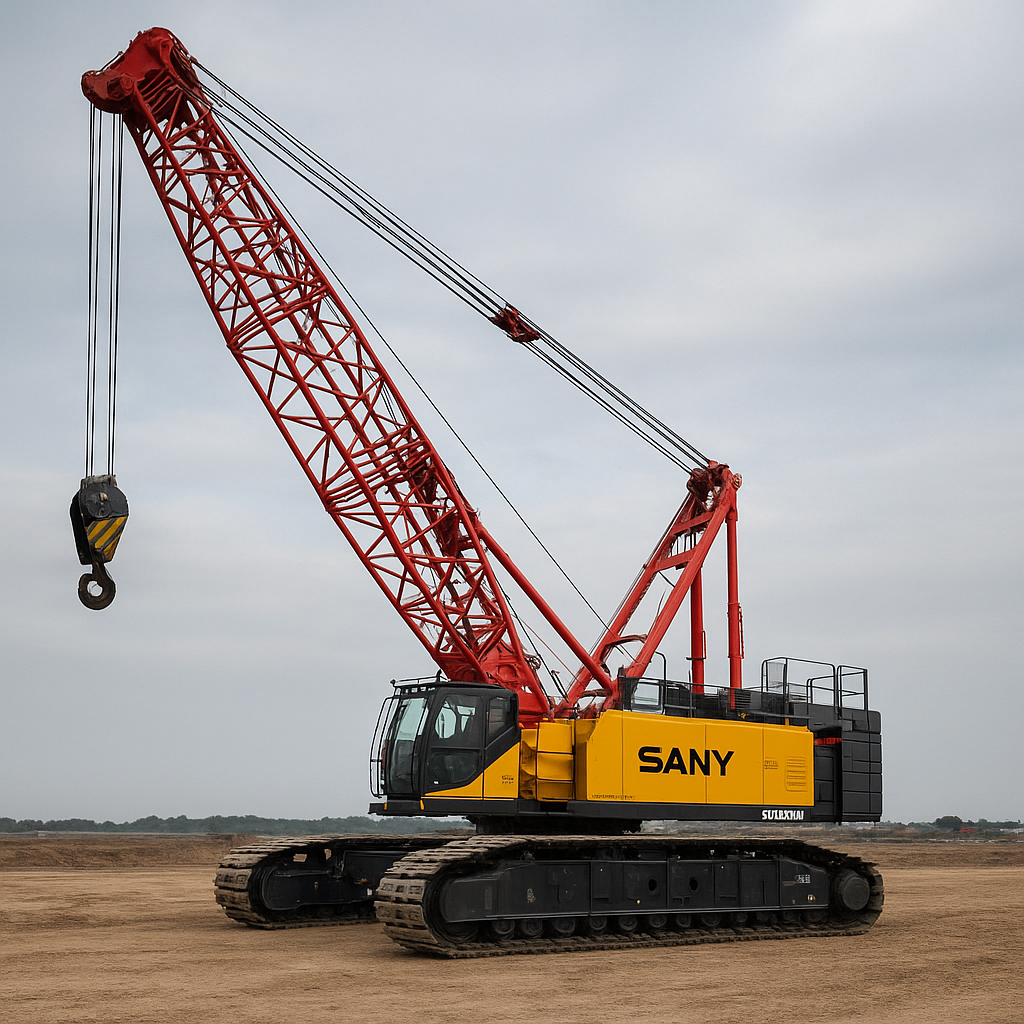
The SANY SCC40000A is a heavy-duty crawler crane designed for demanding lifting tasks in construction, energy, and industrial sectors. Combining robust structural components with modern control systems, this machine aims to deliver high lifting capacity, reliable performance and mobility on rough terrain. Below is an in-depth look at its design, applications, technical highlights, operational considerations and real-world uses.
Overview and purpose
The SANY SCC40000A is positioned as a high-capacity crawler crane intended for projects that require substantial vertical and horizontal lift capabilities combined with off-road maneuverability. Its main role is to handle heavy lifts where wheeled or truck-mounted cranes might not provide the necessary stability or ground pressure distribution. Typical uses include erecting steel structures, installing large plant equipment, lifting precast concrete segments, power plant and wind-turbine assembly, and civil works such as bridge construction.
- Primary role: heavy lifting in constrained or soft-ground environments
- Mobility: tracked undercarriage for low ground pressure and site access
- Versatility: modular boom and jib options for variable reach and height
Design features and construction
The SCC40000A is built around a durable lattice-boom design typical of modern large crawler cranes. The lattice boom offers an excellent strength-to-weight ratio and allows long reach while keeping transported segment weights manageable. Key design elements focus on structural rigidity, ease of assembly, serviceability and operator ergonomics.
Chassis and undercarriage
- The tracked undercarriage distributes machine weight over a wide area, reducing ground pressure and improving stability on soft soils.
- Modular track frames and sections enable transport in highway-legal loads and relatively quick on-site assembly.
- Tracks incorporate heavy-duty rollers and reinforced shoes to withstand abrasive conditions and prolonged operation.
Boom and load-handling system
- The lattice main boom is modular, allowing configurations that prioritize either maximum capacity or maximum reach.
- Auxiliary jibs and swing-away configurations extend the reach for high-elevation lifts like wind-turbine nacelles or tall building components.
- Hydraulic and mechanical systems control boom angle, hoist speed and load line management; modern systems often incorporate load moment limiters and advanced telemetry.
Powertrain and hydraulics
The crane is commonly powered by a turbocharged diesel engine that provides the hydraulic pumps with sufficient flow and pressure for hoisting, swing and travel functions. Hydraulic systems are tuned for smooth, proportional control to improve lift accuracy and reduce shock loads on rigging and structure.
Technical specifications (typical / indicative)
Technical parameters vary with exact configuration, attachments and optional packages. The numbers below are indicative and should be verified with the manufacturer or an equipment dealer for contractual work.
- Rated lifting capacity: approximately 400 tonnes (400 t) at minimum radius
- Maximum main boom length: typically up to about 80–90 meters depending on module selection
- Jib options: swing-away or fixed jibs extending reach by an additional 20–50 meters in many configurations
- Counterweight system: modular counterweights allowing tuning of ballast to match lift charts
- Engine power: diesel prime mover in a power band typical for cranes of this class (indicative range 300–600 kW depending on configuration)
- Travel speed: slow crawler travel for site repositioning (typical values around 1–2.5 km/h)
- Transportability: designed in modules to meet road transport limits in many regions
Note: The precise engine output, boom lengths and counterweight values depend on the configuration chosen and optional packages installed. Refer to SANY’s official documentation for exact charts relevant to your project.
Applications and industries
The SCC40000A serves multiple heavy-industrial and construction roles where high-capacity, stable lifts are required. Its tracked base makes it particularly suitable for sites that lack paved access or present uneven ground.
Construction and infrastructure
- Bridge and overpass erection — lifting long span girders and precast segments
- High-rise and large-scale building assembly — placing large prefabricated structural modules
- Urban redevelopment — working in constrained sites where ground conditions are compromised
Energy sector
- Wind farm construction — lifting nacelles, hubs and tower sections (often with specialized rigging jibs)
- Power plant installation — positioning heavy turbines, heat exchangers and boilers
Industrial and petrochemical plants
- Heavy equipment set-out — installing columns, reactors and heavy piping modules
- Turnarounds and maintenance lifts — replacing large components in confined plant environments
Marine and port operations
- On-dock heavy lifts — placing heavy cargo or equipment where ground conditions require low pressure tracks
- Shipyard work — launching or lifting large ship components and prefabricated sections
Operational advantages
Several characteristics make the SCC40000A attractive for contractors and project owners:
- Stability: The crawler undercarriage lowers ground pressure and enhances lift stability on non-ideal surfaces.
- Flexibility: Modular boom and counterweight design allow quick reconfiguration for different lift profiles.
- Site access: Tracks enable movement across rough terrain without the need for elaborate mats in many cases.
- Precision: Modern control systems and responsive hydraulics support fine positioning of heavy loads.
Safety systems and operator ergonomics
Safety is central in large crane design. The SCC40000A incorporates a suite of features aimed at preventing overloads and reducing human error:
- Load moment indicators (LMI) and overload protection that cut power or warn the operator when safe limits are approached.
- Redundant safety interlocks for boom hoist and swing circuits to prevent unintended motion during critical lifts.
- Advanced cab design with climate control, noise suppression and clear visibility to reduce operator fatigue and improve situational awareness.
- Telematics and remote monitoring options, allowing project managers to track machine status, operating hours and maintenance needs.
Transport, assembly and logistics
Despite being a large machine, the SCC40000A is engineered to simplify transport and erection on site:
- Modular components — boom sections, counterweights and track frames are sized to comply with typical road transport constraints in many regions.
- Pre-assembly options — certain subassemblies can be pre-fabricated off-site to reduce on-site erection time.
- Crew and equipment requirements — for major lifts the crane will typically be transported with support vehicles, rigging gear and possibly a mobile crane to handle certain assembly tasks.
Maintenance and lifecycle costs
Owning and operating a crawler crane involves ongoing maintenance to maximize uptime and safety. Key maintenance considerations include:
- Routine engine and hydraulic system servicing (filters, fluids, belts) as per manufacturer intervals.
- Track and undercarriage inspection — wear on shoes, rollers, and pins influences stability and ground pressure expectations.
- Structural inspections — regular checks for fatigue on boom pins, welds and lattice members, especially after high-cycle use.
- Software and electronics — updating control systems and calibrating load-monitoring devices to ensure accurate readings.
While initial acquisition costs for a crane like the SCC40000A are significant, the total lifecycle cost can be optimized via preventative maintenance, operator training and careful project planning that reduces unnecessary relocations and misuse.
Performance statistics and real-world metrics
Performance metrics vary widely by configuration and lift conditions. Below are representative data points that contractors consider when selecting a crane of this class:
- Lifting chart considerations: Maximum rated capacity (e.g., ~400 t) typically applies at minimum working radius. Capacity decreases substantially as radius increases — at medium radii lifts might be in the tens of tonnes range depending on boom length.
- Set-up time: Depending on site constraints and the need for auxiliary rigging, assembly and preparation for a heavy lift can take from several hours to multiple days.
- Utilization: In rental fleets, utilization rates for heavy crawler cranes can vary seasonally; high-demand projects in energy and infrastructure often drive multi-month hires.
- Operational uptime targets: Professional operators and maintenance regimes commonly aim for 90%+ uptime during campaign hires, though actual numbers depend on environment and intensity of use.
Comparisons with alternatives
When evaluating the SCC40000A against other crane types, consider the following trade-offs:
- Compared to truck-mounted cranes: crawlers excel on soft or rough ground and for very heavy lifts, but they are slower to reposition on highways.
- Compared to lattice-boom mobile cranes: crawler cranes can offer greater ground-bearing performance and modular counterweight schemes, but some large mobile cranes may provide faster set-up or easier road travel.
- Compared to all-terrain cranes: ATs give good on-road mobility and faster set-up in some cases, whereas large crawlers can carry heavier loads at low radii and remain stable without extensive matting.
Case studies and typical projects
Examples of projects where machines like the SCC40000A are commonly used include:
- Wind farm erection: transporting and lifting nacelles and tower sections on uneven rural terrains often require high reach and stable footing offered by crawlers.
- Bridge segment placement: handling long precast concrete sections where controlled, stable lifts are essential to maintain alignment.
- Power plant equipment installation: setting heavy turbines and heat-exchange modules into tight plant layouts that require careful load control.
Environmental and regulatory aspects
Large crawler cranes pose environmental and regulatory challenges that project planners must manage:
- Ground protection: even with low ground pressure, sensitive sites may require matting or temporary roadways to prevent soil compaction and site damage.
- Emissions and noise: modern engines and silencing packages reduce impact, but compliance with local emissions regulations and noise ordinances is essential.
- Permitting and routing: oversized loads for transport or restrictions on movement within urban environments may necessitate special permits and escort arrangements.
Buying vs renting decisions
Deciding whether to purchase or rent a SCC40000A-class crane depends on utilization forecasts, capital availability and project timelines.
- Purchase advantages: control over asset, potential long-term cost savings for frequent use, and customization options.
- Rental advantages: reduced capital outlay, flexibility for short-term or irregular needs, and access to operator and maintenance services from rental providers.
- Hybrid models: long-term leases or rent-to-own arrangements can suit firms that foresee increased but not immediate continuous usage.
Tips for planning lifts with a heavy crawler crane
Successful heavy lifts require meticulous planning and coordination. Practical tips include:
- Perform a thorough ground assessment to determine bearing capacity and matting needs.
- Use up-to-date lift charts from the manufacturer and account for dynamic effects like wind and load sway.
- Plan logistics early — transport windows, crane assembly crews and required auxiliary equipment must be coordinated.
- Implement a clear communications plan with rigging crews, signalers and engineers to manage complex lifts safely.
- Maintain an accessible and current maintenance log and pre-lift inspection checklist to minimize surprises on the day of the lift.
Future trends and technological enhancements
Large crawler cranes continue to benefit from innovation. Relevant trends include:
- Increased telematics and remote diagnostics enabling predictive maintenance and better fleet utilization.
- More sophisticated load monitoring, digital load charts and integration with site BIM (building information modeling) systems.
- Hybrid powertrains and engine efficiency improvements aimed at reducing fuel consumption and emissions.
- Automation aids such as assisted positioning, anti-sway controls and advanced operator support systems to improve safety and productivity.
Summary
The SANY SCC40000A represents a category of heavy crawler cranes designed for demanding lifting tasks across multiple industries. Its strengths lie in lifting capacity, stability on soft ground, modular boom configurations and modern safety systems. Proper planning, skilled operators and a disciplined maintenance program are essential to extract maximum value from the machine. For precise specifications, capacities at given radii and configuration options, consult SANY’s official technical documentation or an authorized dealer to ensure compliance with local regulations and project requirements.
Key highlighted concepts: crawler crane, lifting capacity, boom, counterweight, mobility, stability, modular design, hydraulics, safety systems, maintenance.


)
)