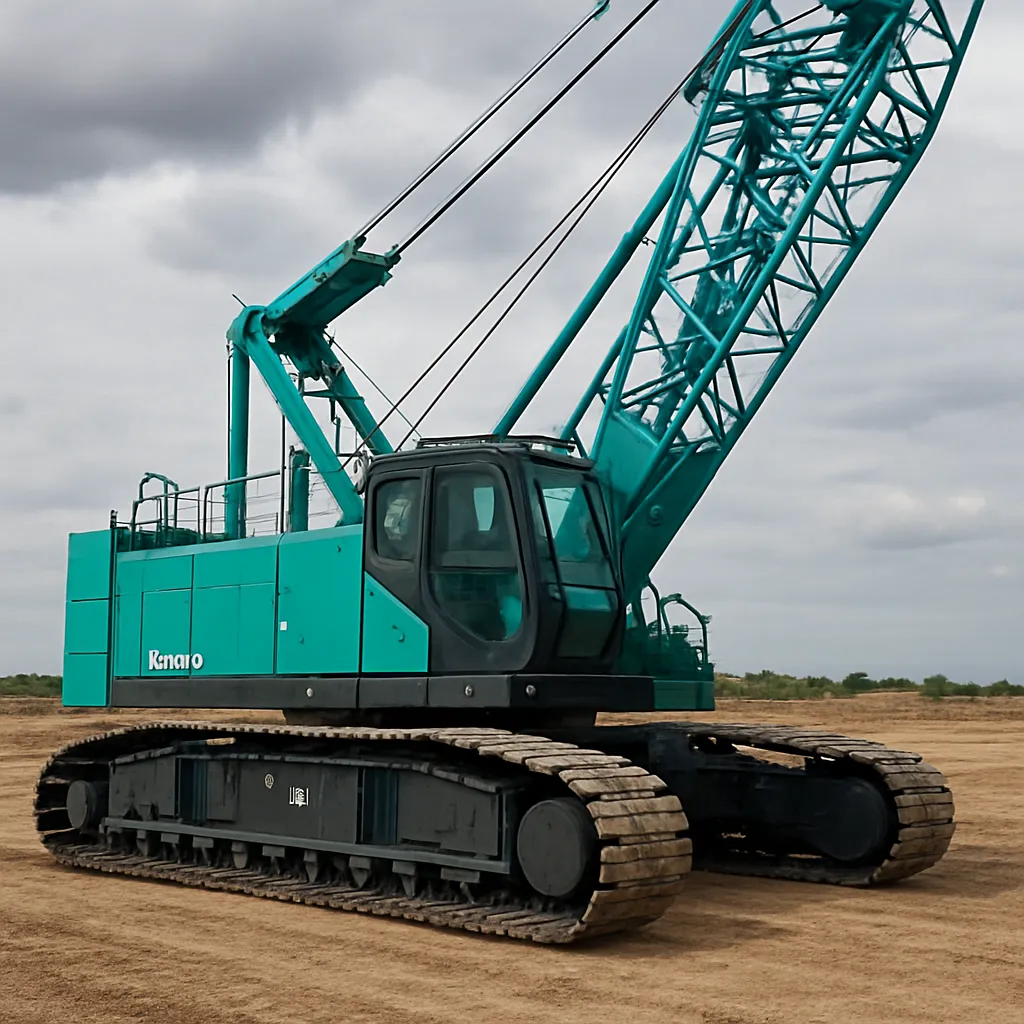
The Kobelco CKE2500 is a heavy-duty crawler crane designed for demanding lifting tasks in construction, energy, and industrial sectors. Combining robust mechanical systems, a versatile lattice boom design and a track undercarriage built for rough terrain, this model is aimed at projects that require high capacity, mobility on site and adaptability to diverse lifting scenarios. Below is a detailed look at the machine’s design philosophy, technical characteristics, typical applications, operational advantages, logistics, maintenance and market considerations.
Overview and design philosophy
The CKE2500, produced by Kobelco Construction Machinery, belongs to a family of large crawler cranes optimized for heavy lifts and challenging terrain. The machine emphasizes a balance between lifting capacity, transportability and setup time. Key design elements include a modular lattice boom and jib system, a powerful winch and drum arrangement, and a low ground-pressure track undercarriage that enables movement across uneven sites without the need for immediate assembly of large outriggers.
The crane’s architecture is focused on two competing needs: delivering high static lifting performance while remaining flexible enough for frequent reconfiguration on multi-site projects. The modular nature of the boom and counterweight system means operators can tailor the machine to specific lifts — trading boom length for lifting moment or adding jibs and extension sections to increase height when necessary. Modern iterations of Kobelco’s CKE series place additional emphasis on operator ergonomics and integrated monitoring systems to keep downtime and risk to a minimum.
Technical characteristics and performance (typical ranges)
Exact specifications vary with production year, regional configuration and options, but the CKE2500 generally falls into the class of cranes offering lifting capacities in the region of 250 metric tonnes (approximate nominal capacity). Important technical attributes typically include:
- Maximum rated lifting capacity: around 250 tonnes (depending on radius and configuration).
- Modular lattice main boom with commonly available lengths ranging from mid-range configurations up to long-boom setups; typical boom sections enable main boom lengths that can reach multiple tens of meters. With jib combinations, maximum hook heights can exceed typical main-boom heights significantly, enabling lifts at greater elevation.
- Winches: main and auxiliary hoists sized for heavy-line pull and high line speeds; multiple-drum arrangements allow tandem-line or independent operations for complex picks.
- Engine power: heavy-duty diesel engines tuned to provide high torque at low RPM for winching and travel under load, with power outputs suitable to the crane’s class (often several hundred kW in large-class crawler cranes).
- Undercarriage: wide, steel crawlers with exchangeable pads to control ground pressure; designed to provide stability and mobility on soft or irregular ground.
- Counterweight system: modular blocks that can be assembled to match the needed counter moment; transportable in standard heavy-transport packages.
- Load management systems: integrated Load Moment Indicator (LMI) and safety interlocks, digital displays, and in modern models telematics for remote diagnostics.
Load charts are the definitive source for safe working limits and vary by boom length, jib assembly, counterweight amount and ground conditions. Operators must consult the crane’s specific load chart for each configuration. Performance in real projects is influenced strongly by site layout, ground bearing capacity, transport logistics and environmental conditions such as wind.
Typical applications and industry uses
The CKE2500 is suited to a wide range of sectors where heavy lifting and on-site mobility are critical. Common applications include:
- Infrastructure construction: bridge sections, precast concrete segments, heavy girders and major structural assemblies.
- Power generation: installation of transformers, reactors and major components in thermal and hydroelectric plants.
- Wind energy: erection of wind turbine nacelles and towers at onshore sites where crawler mobility and lifting height are required.
- Industrial plant construction and maintenance: lifting large vessels, pressure tanks, heat exchangers and heavy modules during plant builds or turnarounds.
- Port and quay works: installation of quay walls, fenders and heavy handling equipment where the crane’s reach and capacity are beneficial.
- Oil & gas and petrochemical sectors: lifting of process modules, skids and pipe racks, often in restricted-access yards.
- Salvage and heavy recovery: moving large structural components or equipment after incidents or during decommissioning operations.
Because it is a crawler crane, the CKE2500 is particularly effective on sites where traveling with load or repositioning under its own power is desirable, reducing the need for dismantling and reassembly between lifts within the same site area.
Operational advantages and notable features
Several features make the CKE2500 attractive to contractors and rental fleets:
- Mobility on site: the crawler undercarriage allows relocation across moderately uneven terrain without the need for additional transport equipment for each move.
- Shorter setup time compared to lattice crawler cranes that require complex ground bearing preparations and outriggers — though large counterweights still require handling equipment and planning.
- Modularity: boom sections, jibs and counterweights are designed to be assembled according to lift requirements, improving flexibility.
- Advanced operator cabin ergonomics and visibility, plus electronic aids such as camera systems, load indicators and moment-limiting protections to increase safety and precision.
- Telematics and remote monitoring options: modern CKE series cranes can be equipped with systems for remote diagnostics, fuel monitoring and usage logging to optimize maintenance and reduce downtime.
- Lower ground pressure compared to some wheeled alternatives when fitted with wide pads, making them suitable for softer ground with appropriate preparation.
Site planning, transport and assembly considerations
While crawler cranes bring flexibility, careful planning is still required to move and assemble a CKE2500 on site. Points to consider:
- Transport: main components (carbody, superstructure, boom sections, counterweights and undercarriage assemblies) are typically transported on low-loaders or modular trailers. Road permits and heavy-haul escorts are commonly required.
- Assembly: a medium-to-large auxiliary crane or gantry may be needed to assemble the lattice boom sections and position counterweights, unless the operator uses tandem lifts and on-site auxiliary equipment.
- Ground preparation: although crawlers distribute weight, large lifting moments require careful site evaluation, crane mats or reinforced foundation pads under trackways to prevent ground settlement and ensure safe operation.
- Counterweight logistics: modular counterweights must be staged and assembled; sites must have adequate lift points and storage space to handle these heavy blocks.
- Permitting and route surveys: transportation route planning, lifting plan approvals and local permits for oversized loads are mandatory in many jurisdictions.
Maintenance, safety and operator requirements
Like all heavy lifting equipment, the CKE2500 demands a robust maintenance program and trained personnel to operate safely and efficiently. Important aspects include:
- Routine inspections: daily visual checks, periodic lubrication, hydraulic system inspection and load line testing.
- Scheduled engine and winch servicing: adherence to manufacturer service intervals for engine oil, filters, gearbox and winch brake adjustments.
- Structural inspections: regular checks for lattice boom integrity, welds, pins and wear on critical components.
- Certification and training: operators must hold appropriate certifications and training for large crawler cranes. Lift directors and signalers should be trained according to national standards.
- Load monitoring and safety systems: the crane’s LMI and overload protection must be calibrated and functioning; emergency procedures should be in place for power loss or unexpected load swings.
- Record keeping and telematics: many fleets use telematics to track utilization, fuel consumption and health parameters to plan preventative maintenance and reduce catastrophic failures.
Costs, rental market and economic considerations
Capital and operating costs for a machine like the CKE2500 are significant, and prospective buyers or renters should evaluate total cost of ownership and project-specific economics.
- Purchase price: new large crawler cranes in this capacity class often command prices in the multi-million dollar range. Exact MSRP varies with options, region and configuration.
- Rental rates: depending on market, location and duration, day rates for a crane of this class can range from several thousand to tens of thousands of dollars per day. Long-term hire and project packages often reduce per-day costs.
- Operating costs: fuel consumption, trained crew wages (operator, riggers, signalers), insurance, maintenance and transport add materially to per-project costs.
- Depreciation and resale: large cranes retain value if well-maintained, and demand remains steady in sectors such as infrastructure and renewable energy, but resale timing and market conditions affect recovery of initial investment.
Environmental and regulatory factors
Modern construction equipment increasingly faces environmental scrutiny. For the CKE2500, relevant considerations include:
- Emissions: diesel engines must meet regional emissions regulations (Tier/Stage standards). Upgraded engines, selective catalytic reduction (SCR) and particulate filters can be part of compliance strategies.
- Noise: heavy lifts and engine operation produce noise; projects near residential areas often require noise mitigation plans or worked-hour restrictions.
- Fuel efficiency: telematics and optimized operating techniques can improve fuel usage, reducing both cost and environmental footprint.
- Site impact: ground protection mats and controlled traffic plans reduce soil compaction and environmental damage on sensitive sites.
Technological trends and future outlook
The heavy crane market is evolving with several trends that influence machines like the CKE2500:
- Connected equipment: more advanced telematics and remote diagnostics allow fleet managers to monitor crane health in real time, enabling predictive maintenance.
- Automation aids: smart load control, anti-sway systems and augmented reality visual aids for operators improve lift precision and safety.
- Electrification and hybrid drives: while full electrification for large crawler cranes remains challenging, hybrid systems and engine optimization are being explored to lower fuel consumption and emissions.
- Modular lifting systems: improvements in quick-assemble counterweights and transport-friendly modular sections shorten mobilization time.
Examples of use cases and project scenarios
To illustrate how a CKE2500 might be used in practice, consider the following typical scenarios:
- Bridge beam placement: the crane transports itself across prepared mats to various pier positions, lifting and placing precast bridge beams at controlled radii. The modular boom and jib allow the operator to position heavy beams precisely while minimizing re-assembly between spans.
- Substation transformer install: the crane lifts a multi-ton transformer from delivery vehicle into a prepared foundation pit, using tandem hoists for controlled insertion and fine positioning.
- Wind turbine installation: on a moderately soft hillside, the crawler undercarriage provides mobility between turbine locations. The crane’s boom and jib combination reach the necessary hub height while the modular counterweight matches the required capacity.
- Industrial module set: a plant module or skid installation where space is constrained; the CKE2500’s ability to lift heavy loads at moderate radius and to reposition within the site reduces the need for multiple crane types.
Summary of strengths and selection considerations
The Kobelco CKE2500 is a specialist tool for heavy lifts where on-site mobility, modularity and reliable lifting performance are required. Its main strengths are lifting capacity, site mobility, modular boom systems and integrated safety/monitoring features. When deciding whether this crane is appropriate for a project, planners should assess:
- Lift weights, radii and required heights (consult the crane’s specific load charts).
- Site ground conditions and the need for mats or reinforced pads.
- Transport and assembly logistics, including availability of auxiliary erection cranes and storage for counterweights.
- Availability and cost of skilled operators and rigging crews, plus local regulatory and permit requirements.
- Total project economics, including rental versus purchase analysis and anticipated utilization rates.
Final note
When planning to use a heavy crawler crane such as the Kobelco CKE2500, always rely on manufacturer documentation and certified load charts for configuration-specific limits. Engage qualified lift planners, engineers and trained operators early in project planning to optimize crane selection, minimize risk and control costs. Proper site preparation, logistics coordination and preventive maintenance are essential to achieve safe, efficient and cost-effective lifting operations with this class of equipment.


)
)