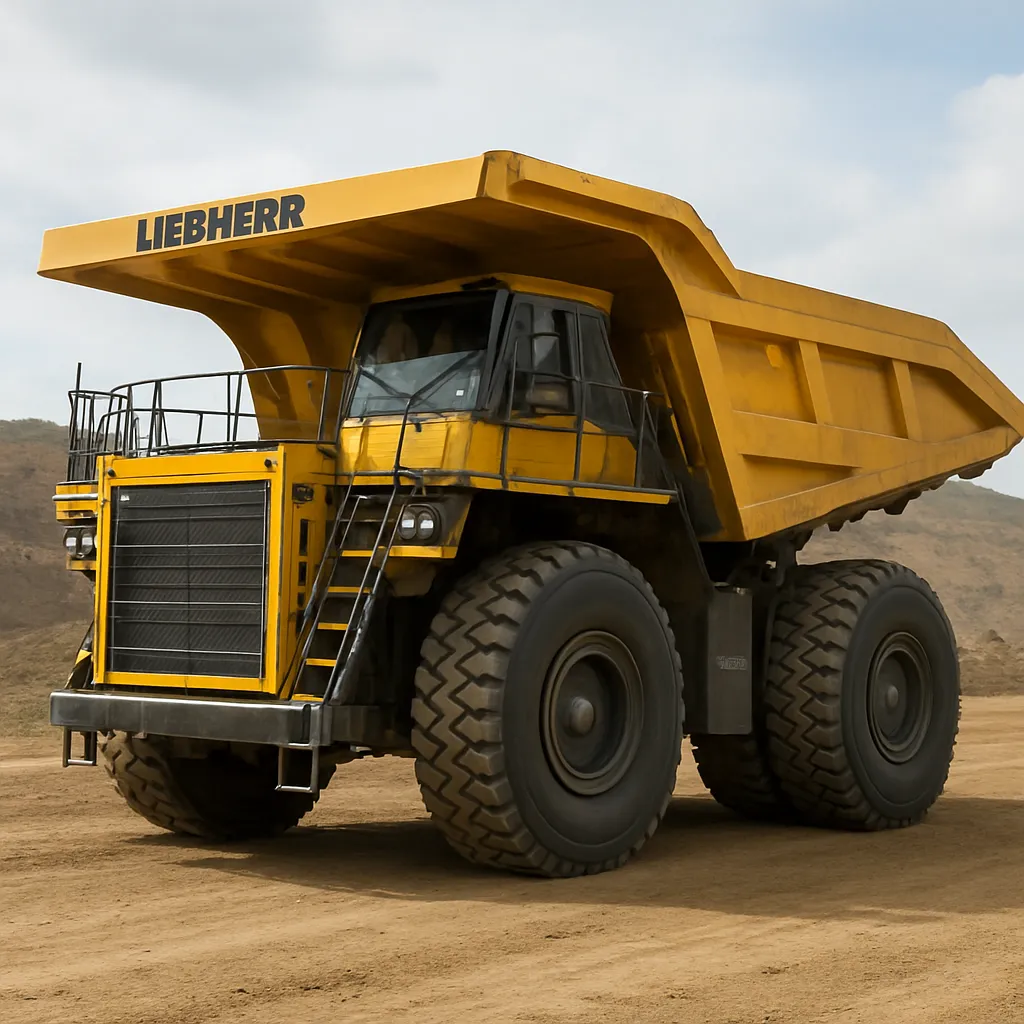
The Liebherr T 225 represents a class of ultra-heavy-duty machinery designed for the most demanding earthmoving and material-handling environments. As a purpose-built haul truck intended primarily for large-scale surface mining and heavy quarrying, this machine combines robust structural design with features aimed at optimizing cycle times, reducing downtime and improving overall fleet productivity. In the sections that follow, the article outlines the machine’s design intent, typical applications, operational characteristics, maintenance considerations, environmental and safety aspects, and its role within modern mining fleets. Where available, indicative statistical ranges are provided to give context to performance expectations; for precise figures consult manufacturer documentation or operator datasheets for the specific configuration.
Overview and design philosophy
The Liebherr T 225 is engineered to operate in physically and logistically challenging environments where moving very large volumes of overburden and ore quickly and reliably is a priority. The design emphasis for machines in this class focuses on structural strength, chassis durability, and systems that enable continuous operation under high loads. Key design priorities typically include optimized powertrain integration, heavy-duty axles and suspension, large-capacity dump bodies, and operator comfort to sustain long shifts.
Core structural features
- High-strength steel frames and reinforced pivot joints to resist cyclical stresses.
- Large dump body geometry that balances maximum payload with stable center-of-gravity characteristics during travel and dumping.
- Robust wheel and axle assemblies designed for the specific tire sizes used in ultra-class trucks.
- Redundant systems for critical functions (braking, steering assist, cooling) to reduce the risk of single-point failure.
Modern iterations prioritize modular component layouts to simplify replacement and repairs on site. Electrical and hydraulic systems are routed and protected to reduce exposure to impact and dust, while filtration systems keep engine and auxiliary components operating within design tolerances despite harsh conditions.
Primary applications and operational roles
The Liebherr T 225 is most frequently deployed in large open-pit mining operations where high-volume haulage is required. Typical roles include moving overburden, transporting blasted ore to processing facilities, and feeding crushers or conveyors. Its size class positions it as a workhorse in operations that require economy of scale — fewer, larger trucks move more material per shift than many smaller trucks.
- Mining: The predominant use case. Suited for copper, iron ore, coal and other large-scale extractive operations.
- Quarrying: Large dimension stone and aggregate quarries that require high payloads and heavy hauling.
- Bulk earthworks: Infrastructure projects with significant cut-and-fill requirements where temporary high-capacity haulage lanes exist.
- Port and terminal operations (limited): In some terminals where large ore or coal stockpiles are moved short distances, ultra-class trucks can be part of the handling chain.
Operationally, the truck is intended to be integrated into a fleet with complementary equipment—high-capacity excavators, shovels or wheel loaders and pit infrastructure such as haul roads designed for heavy loads. Maximizing productivity depends on optimizing loading cycles, minimizing dead time, and synchronizing payload size with the excavator’s bucket capacity.
Technical characteristics and performance (indicative)
Exact technical specifications for a particular Liebherr T 225 configuration should be obtained from Liebherr or authorized dealers. The figures below are indicative ranges typical of trucks in the 200–250 tonne nominal payload class and are provided to help readers understand expected performance envelopes.
Indicative performance and dimensional ranges
- Nominal payload: approximately 200–230 metric tonnes (indicative).
- Engine power: typical power plants in this size class range from roughly 2,200 to 3,200 kW (diesel engines or hybrid arrangements in some designs).
- Operating speed: maximum travel speeds empty commonly fall in the 50–65 km/h range, while loaded speeds are lower depending on grade and haul road conditions.
- Fuel consumption: very dependent on duty cycle, payload and haul road profile; fleet managers often measure consumption in litres per tonne-kilometre or engine hours to correlate with production.
- Tires: ultra-class tires sized to match load and axle ratings; tire life and cost are a major component of operating expense.
Powertrain designs across ultra-class trucks vary: some manufacturers use mechanical transmissions while others employ diesel-electric drive systems with AC traction motors. The choice affects maintenance patterns, torque delivery characteristics and fuel efficiency under different duty cycles. The T 225 is designed to adopt systems that balance high tractive effort with durability for sustained heavy hauling.
Work cycle and productivity metrics
A fundamental productivity measure is tonnes moved per hour, which depends on the payload, cycle time (loading, haul, dump, return) and availability. Typical haul cycle determinants include:
- Average loading time dictated by excavator bucket size and operator technique.
- Haul distance and road grade (increasing grade significantly affects loaded speeds and fuel consumption).
- Queueing and pit traffic management—well-managed operations reduce idle time and increase effective utilization.
Fleet managers commonly track availability (percentage of scheduled time the truck is ready to work), mean time between failures (MTBF), and mean time to repair (MTTR). Improvements in telematics and predictive maintenance have a direct impact on these indicators.
Safety, maintenance and lifecycle management
When operating machines of this size, safety protocols and maintenance regimes define both human and capital outcomes. The Liebherr T 225 is typically outfitted with systems and access provisions to support safe servicing and operation.
Safety features and operator ergonomics
- High-visibility cabs with climate control and vibration damping to reduce operator fatigue and improve situational awareness.
- Integrated braking systems with multiple redundancies (service, parking, emergency) and retardation aids on steep grades.
- Camera systems, proximity detection and haul-road management interfaces to minimize collision and run-off incidents.
- Fall-protection, handrails and ladder arrangements complying with industry standards for safe access.
Maintenance strategies
Effective maintenance extends tire life, prolongs component integrity and reduces unplanned downtime. Key maintenance approaches include:
- Condition-based maintenance using oil analysis, vibration sensors and thermal imaging to detect problems early.
- Scheduled component rotations (e.g., brake replacements, wheel bearing servicing) to maintain predictable availability.
- On-site parts inventory for common wear items such as hydraulic hoses, filters and seals to speed repairs.
- Training for local technicians and operator-level daily inspection checklists to catch defects before they escalate.
Lifecycle cost assessment typically accounts for acquisition, fuel, tires, scheduled maintenance, unscheduled repairs, and resale value. Large fleet operators often purchase through long-term service agreements or fleet management contracts that shift some maintenance burdens to the manufacturer or dealer network in exchange for predictable costs and uptime guarantees.
Economics and operational efficiency
Decisions to deploy a T 225-class truck depend on the economics of scale. Using fewer, larger trucks can reduce the number of operators and simplify certain logistics, but it also concentrates risk: a single truck failure removes a larger fraction of hauling capacity than the failure of a smaller unit.
- Cost per tonne moved: This is the central economic indicator. It reflects capital amortization, fuel, tires and maintenance divided by tonnes hauled over a period.
- Fleet balance: An optimal fleet mixes large and smaller trucks to match excavation rates, pit geometry and variability in ore grades.
- Resale and residual value: High-demand machines retain value better; manufacturer support history, regional aftermarket parts availability and local operator familiarity influence residual pricing.
Operators performing continuous improvement measures—route optimization, better loading discipline, lower idle times—realize measurable reductions in unit haul costs. The use of telematics and data analytics increasingly enables targeted interventions that raise productivity and reduce unplanned maintenance.
Telematics, automation and digital integration
Modern ultra-class trucks benefit from integration into digital mine-management ecosystems. The T 225 is compatible with typical fleet telemetry packages that transmit operational and health data in near real-time.
- Payload monitoring systems inform dispatch and help reduce overloading/underloading cycles.
- GPS and fleet-management software improve routing and scheduling, reducing queue times.
- Predictive maintenance modules analyze sensor trends to forecast component failure, allowing planned interventions.
- Automation-ready platforms allow integration with semi-autonomous or fully autonomous haulage systems where regulatory and operational environments permit.
Automation and remote operation reduce exposure of personnel to hazardous environments and can increase utilization by extending operating hours (with appropriate shift and monitoring arrangements). However, they require capital investment in infrastructure, training and cybersecurity measures.
Environmental considerations and emissions
Environmental performance increasingly influences procurement decisions. Key considerations for large haul trucks include fuel consumption, particulate emissions, dust suppression on haul roads and noise. Manufacturers and mining companies pursue several strategies to reduce environmental impact:
- Engine efficiency improvements and after-treatment systems to comply with emissions standards (e.g., Tier/Stage regulations).
- Use of biodiesel blends or renewable diesel compatible engines where available to lower lifecycle greenhouse gas (GHG) emissions.
- Hybridization or electrification: electric-drive trucks or trolley-assist systems on long hauls reduce in-pit diesel fuel consumption.
- Operational measures such as smoother acceleration profiles, optimized road grades and better maintenance to reduce fuel burn.
Choice of tires and their rolling resistance, as well as reduction of empty-haul distances through mine planning, also contribute to improved environmental performance. Ultimately, integration of haulage into broader mine decarbonization strategies is becoming a competitive and regulatory imperative.
Comparative positioning and market considerations
The T 225 competes with similar ultra-class haul trucks from other major manufacturers. Selection criteria that buyers evaluate include:
- Reliability and total cost of ownership: long intervals between major overhauls and predictable maintenance costs are highly valued.
- Parts and service network: proximity of dealer support and availability of spare parts influences downtime risk.
- Adaptability to local conditions: ease of modification for dust, temperature extremes and altitude.
- Integration with existing fleet telemetry and operational processes.
Manufacturers increasingly offer lifecycle services, on-site support, operator training and fleet analytics to differentiate their trucks beyond hardware alone. For mines with long project lives, local skill development for maintenance and repair becomes a critical factor.
Operational case examples and best practices
Best practices when operating a T 225-class truck center on planning, monitoring and people. Examples from industry experience include:
- Matching excavator bucket capacity to truck payload to avoid double handling or underutilization.
- Designing haul roads with attention to grade, curvature and drainage to maintain predictable cycle times and tire life.
- Using shift-level telematics reviews to identify repeat causes of delays and addressing root causes (e.g., loading sequences, intersection management).
- Implementing continuous training programs for drivers to improve fuel-efficient driving techniques and safety awareness.
Periodic operational audits can uncover incremental gains in tonnes-per-hour and reductions in per-tonne costs. Because one large truck can move the equivalent of several smaller trucks, each percentage point gained in availability or fuel efficiency has outsized economic impact.
Summary and strategic considerations
The Liebherr T 225-class haul truck is a strategic asset for large mining and heavy earthmoving operations seeking to optimize material movement at scale. Its value proposition rests on high nominal payload capacity, engineering resilience and the potential for integration into data-driven fleet operations. Key considerations for buyers and fleet managers include maintenance regimes, telematics and automation readiness, environmental strategies and the match between excavator and truck capacities.
For accurate, model-specific technical data, such as exact engine output, gross vehicle weight, hydraulic system specifications, tire sizes and fuel consumption rates under defined duty cycles, always consult the official Liebherr product documentation or a licensed dealer. Real-world performance will vary by configuration, operating profile and the operational discipline of the owning organization.


)
)