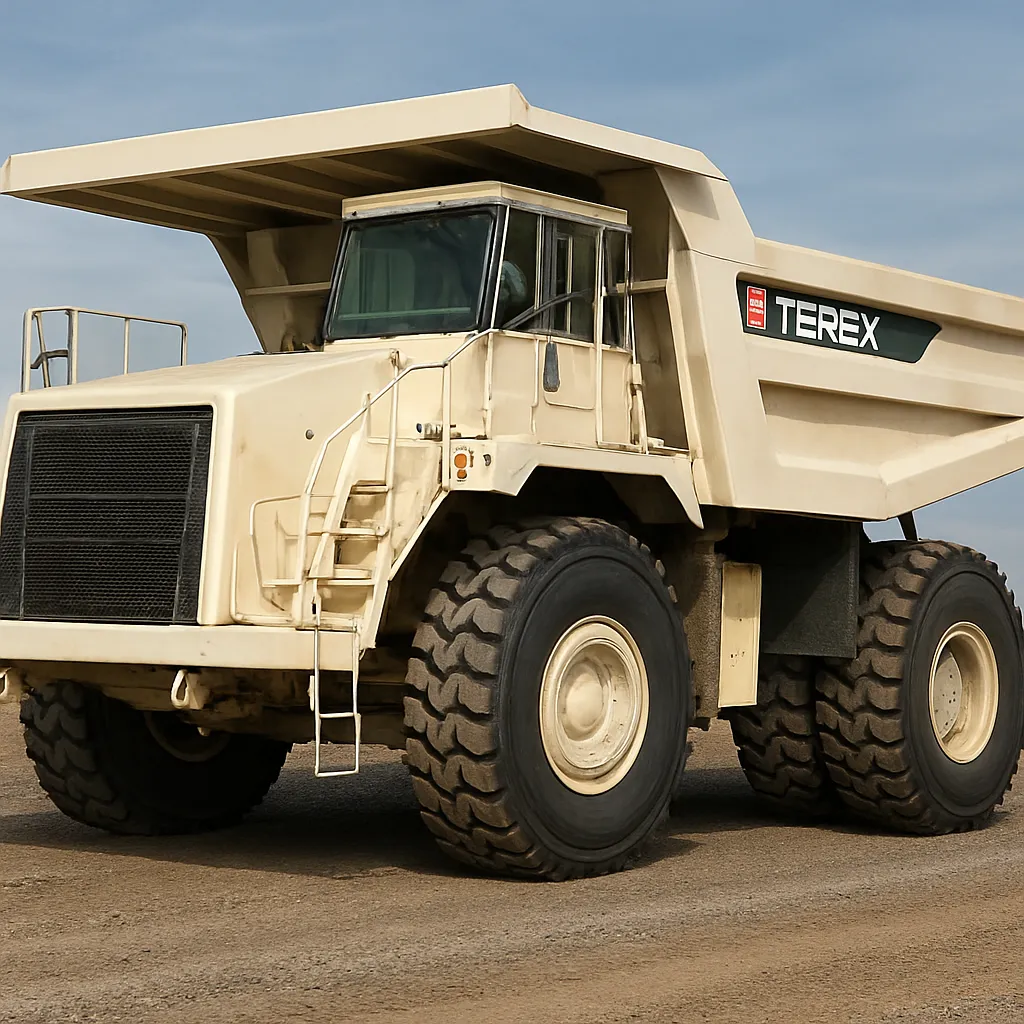
The Terex TR35 is a purpose-built off-highway haul truck designed for the demanding conditions of mining, quarrying and large-scale earthmoving. Combining a durable frame, robust powertrain and proven simplicity, the TR35 aims to deliver reliable material-moving capacity with an emphasis on low operating cost and ease of maintenance. This article explores the TR35’s design, typical applications, technical characteristics, operational considerations and lifecycle factors, offering practical insights for fleet managers, operators and enthusiasts.
Design and key technical characteristics
The Terex TR35 is a rigid-frame, rear-dump haul truck commonly identified by its nominal payload capacity of approximately 35 tonnes (metric). Its architecture follows the conventional layout for medium-capacity mining trucks: a forward-mounted engine, operator cab above the chassis, and a high-capacity dump body at the rear. The truck emphasizes mechanical simplicity and durability rather than advanced electronic complexity, which appeals to operations prioritizing easy servicing and robust uptime.
Powertrain and mobility
Typical TR35 configurations are equipped with high-torque diesel engines from reputable manufacturers. Engine power for trucks in this class commonly ranges from roughly 350 to 450 kW (about 470–600 horsepower), depending on engine choice and emission configuration. Power is transmitted to the rear axles through heavy-duty torque converters and planetary final drives or modern automatic transmissions designed to withstand repeated loaded starts on steep grades.
- Drive arrangement: 6×4 (rear-wheel drive on two axles) rigid configuration.
- Suspension and axles: solid axles with serviceable differential and planetary final drives designed for heavy loads and rough surfaces.
- Tyres: large radial off-road tyres (varies by spec and application; sizes and compound selections tailored to haul profile and ground conditions).
Dimensions and capacities
Exact dimensions and capacities vary by year and custom specification, but typical figures for a TR35-class machine include:
- Nominal payload: ~35 tonnes (metric).
- Operating weight: commonly in the 30–45 tonne range depending on options (dump body, cab fittings, fuel and ballast).
- Fuel tank capacity: often several hundred litres (many trucks in this class carry between 600 and 900 litres), sized for long shifts in remote operations.
Because manufacturers and refurbishers offer varied options (emission upgrades, auxiliary equipment, payload-monitoring systems), always consult the truck’s data plate or official Terex documentation for precise numbers on a given unit.
Primary applications and operational roles
The TR35 is engineered for heavy hauling tasks where reliability, load-and-carry efficiency and cost-effectiveness are prioritized. Its most common uses include:
- Open-pit mining: transporting blasted rock, ore and waste between loading points and crushers, stockpiles or processing areas.
- Quarrying: moving aggregate material such as crushed stone, sand and gravel on relatively compact sites.
- Large civil earthworks: infrastructure projects requiring repeated heavy material transport over short to medium distances.
- Bulk handling operations: ports or terminals where predictable haul cycles and rough-surface capability are needed.
For these roles the TR35’s balance of payload, manoeuvrability and maintenance characteristics makes it attractive to medium-sized operations or as part of larger fleets where smaller-size trucks complement heavier units.
Performance, productivity and statistics
Operators evaluate haul trucks like the TR35 on productivity factors such as payload delivered per cycle, fuel consumption, mean time between failures (MTBF), and cycle times. While precise numbers depend heavily on site conditions, loading method and operator practice, the following generalized performance indicators are useful as benchmarks:
- Typical cycle time: For short-haul operations (less than 1 km), a loaded cycle time of under 10 minutes is feasible; longer hauls increase cycle time proportionally.
- Fuel consumption: medium-duty haul trucks in this payload class commonly use roughly 30–60 litres per hour under working conditions; hourly consumption varies with grade, load factor and operator behaviour.
- Availability: well-maintained TR35s can achieve high availability figures (above 85–90%) in organized fleets, but actual uptime depends on maintenance discipline and parts supply.
- Payload efficiency: matching load size to body geometry and hauling equipment (shovels or loaders) is critical—over-sizing the loader or poor tramline planning reduces truck utilization.
Note: these figures are indicative; for contracting or procurement decisions request measured data from the vendor or perform a site-specific productivity study.
Maintenance, serviceability and lifecycle management
A major advantage of trucks like the TR35 is their straightforward maintainability. The design typically prioritizes accessible service points, modular components and parts compatibility across years, which simplifies field servicing and reduces downtime.
Planned maintenance
- Daily/shift checks: fluid levels, tyre condition, visual inspections for leaks and structural damage, and basic safety systems.
- Scheduled services: engine oil and filter changes, transmission service intervals, brake inspections, and differential oil changes—intervals depend on operating hours and loads.
- Major overhauls: engine rebuilds, transmission refurbishment and final drive replacements become necessary after tens of thousands of operating hours, depending on maintenance quality and operating severity.
Common wear items
Wearing components include tyres, brake linings, bucket-to-truck interface points, hydraulic hoses (if present for body tilt), bushings and pins on steering/hoist linkages. A predictable replacement schedule and stock of critical spares can dramatically reduce Mean Time To Repair (MTTR).
Safety, ergonomics and operator considerations
Safety features on modern or refurbished TR35 units typically include rollover protective structures (ROPS), falling-object protective structures (FOPS), engine shutdown interlocks, and visibility aids like mirrors and optional cameras. Ergonomics focus on operator comfort to reduce fatigue and improve productivity.
- Visibility: high-mounted cabs offer improved sightlines; optional camera systems can further reduce blind spots, especially behind the vehicle.
- Controls: simple, robust controls minimize operator error; some fleets retrofit telematics and automation aids to coach fuel-efficient driving.
- Safety systems: seatbelt interlocks, fire suppression systems (on request), and automated shutdowns for high-temperature or low-oil-pressure conditions.
Training is essential: even mechanically simple trucks require skilled operators to manage fuel-efficient shifting, loading discipline and safe manoeuvring around other site traffic.
Economics, lifecycle cost and resale
Acquisition cost for a TR35-class unit historically positions it below the largest haul trucks, making it attractive for operations seeking a cost-effective capacity level. Total cost of ownership (TCO) should be assessed across acquisition, fuel, maintenance, tire costs, operator wages and resale value.
- Fuel: Because fuel is often the largest single operating cost, strategies to reduce consumption—operator training, optimized gearing, and efficient loading patterns—yield quick payback.
- Maintenance: a predictable preventive schedule and local parts availability maintain uptime and preserve resale value.
- Resale and refurbishment: many TR35 units have strong secondary markets; proper documentation and mid-life upgrades (powertrain rebuilding, emissions retrofits) extend useful life significantly.
Fleet planners often compare the TR35 to both smaller pickup-style off-road trucks and larger 40–60 tonne-class haul trucks to align capacity with production goals and shovel/loader pairings.
Environmental aspects and emissions
Like all diesel-powered heavy equipment, emissions and fuel consumption are central environmental considerations. Typical mitigation strategies used with TR35 trucks include:
- Engine upgrades: fitting engines that meet modern emissions standards (Tier/Stage levels) or installing after-treatment systems.
- Operational controls: driver coaching and telematics to reduce idle time and optimize shift patterns.
- Alternative fuels: in some cases, trucks can be adapted for biodiesel blends or cleaner fuel sources to lower lifecycle CO2 impact.
Operators should evaluate local emissions regulations, fuel availability and total lifecycle emissions when choosing or upgrading units.
Comparisons, modernizations and variants
The TR35 sits in a competitive market that includes machines from several manufacturers offering similar payload classes. Key differentiators are dealer support, parts networks, ease of maintenance and the availability of factory or aftermarket modernization packages.
- Modernization options: engine retrofits, telematics and payload monitoring systems, enhanced braking and safety packages, and body redesigns for improved payload distribution.
- Hybridization and electrification: while full electrification is more common for rigid trucks in very large capacities or specialized operations, some fleets explore hybrid assistance or electric drive retrofits to reduce fuel consumption and emissions.
Historical notes and interesting facts
The TR35 belongs to a lineage of medium-capacity haul trucks that have been valued for their combination of durability and flexibility. Smaller than the massive 200-tonne class trucks used in the largest mines, machines like the TR35 excel where haul distances are shorter and loading cycles frequent. Their balance of payload and manoeuvrability makes them a preferred choice for quarries and many open-pit mining tasks.
Operational longevity is a recurring theme with the TR35. With diligent maintenance and periodic overhauls, these trucks often provide many years of effective service, and used units remain in demand on secondary markets globally.
Practical advice for procurement and deployment
If you are considering the Terex TR35 for your operation, here are practical steps to ensure fit and performance:
- Match truck to loader: align average bucket size and loader productivity to the truck’s payload to avoid under-loading or time losses.
- Audit site profile: assess haul distances, grades and loading surface conditions—these drive fuel use and cycle time and influence optimal gearing and tyre selection.
- Plan for spares: maintain an inventory of critical wear parts and consumables that can otherwise extend downtime.
- Operator training: invest in driver training programs that focus on fuel-efficient operation, safe manoeuvring, and proper inspection routines.
- Consider telematics: even on mechanically simple units, telematics and fleet management systems deliver measurable gains in utilization, fuel economy and maintenance planning.
Conclusion
The Terex TR35 remains a pragmatic choice for medium-capacity hauling tasks where reliability, serviceability and cost control are priorities. Its approximately 35-tonne payload class places it squarely between smaller utility trucks and the largest mining giants, offering a versatile platform for quarries, mines and heavy civil applications. While precise specifications differ by build and year, the TR35’s strengths are its robust mechanical design, ease of maintenance and adaptability to refurbishment and modernization—factors that contribute to a long and productive service life when properly managed.


)
)