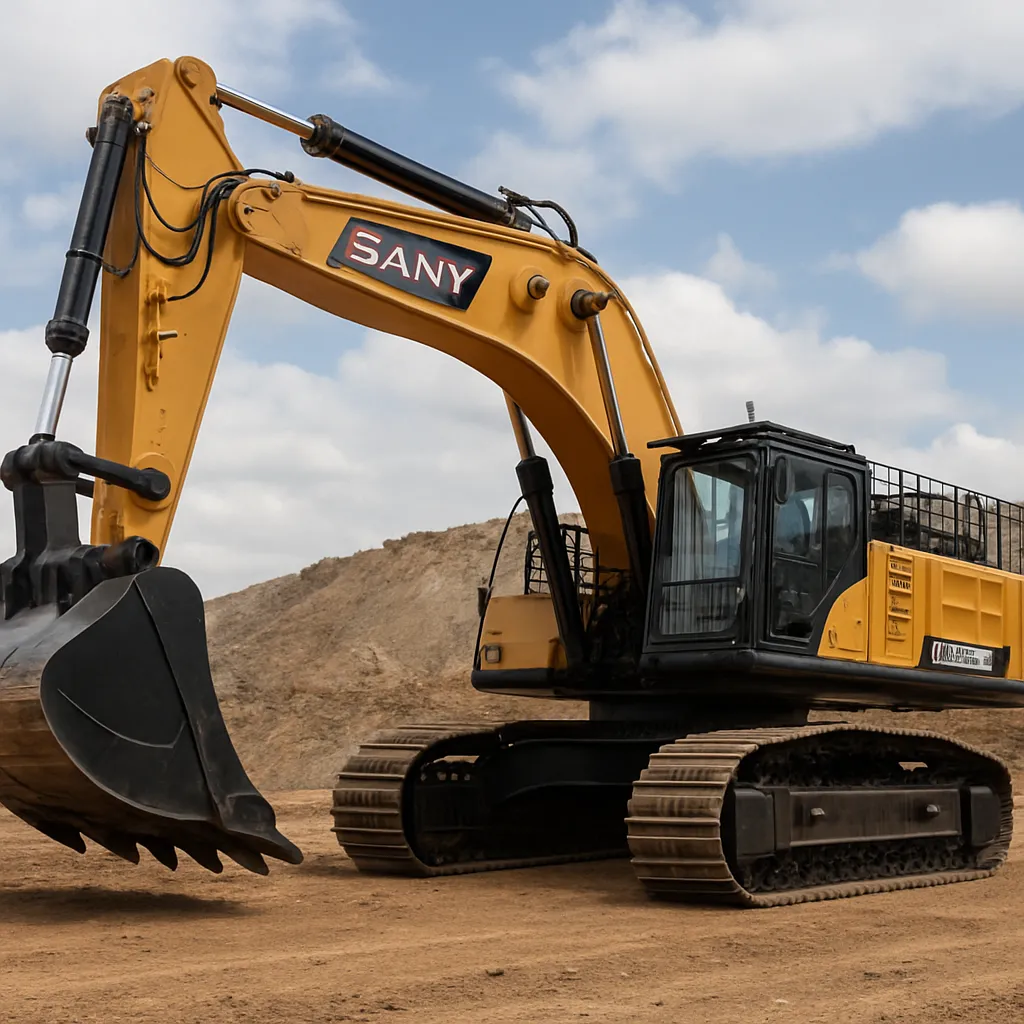
The SANY SY1250H is a purpose-built heavy-duty machine in the class of large hydraulic mining excavators. Designed for demanding open-pit operations and large material-movement projects, it combines robust structural design, advanced hydraulic systems and ergonomic operator environments to deliver steady, high-volume digging and loading performance. Below is a comprehensive look at its design philosophy, typical applications, technical considerations and operational guidance that mining engineers, fleet managers and equipment specialists will find useful.
Overview and purpose
The SANY SY1250H is intended for heavy excavation tasks where large daily volumes of material must be moved reliably and efficiently. In such environments, the primary goals are high hourly production, low unplanned downtime and manageable life-cycle costs. The SY1250H occupies the class often referred to as a “125‑ton” excavator, indicating its approximate operating weight and its role in matching with large haul trucks and loading cycles.
This machine is typically deployed in open-pit mining, quarry operations, large-scale civil engineering projects and major bulk-material handling sites. Its design focuses on delivering continuous digging power, structural durability and systems that support simplified maintenance and remote monitoring.
Key features and design
Robust structural components
The SY1250H is engineered around a heavy-duty undercarriage and reinforced upper structure to withstand repeated high-impact loading. Key elements include heat-treated booms and arms with optimized cross-sections for torsional stiffness, and wear-resistant attachment points. Reinforced bucket linkages and high-strength pivot pins reduce deformation under heavy loads and extend useful life between component renewals. These structural choices directly improve machine reliability and reduce total cost of ownership in harsh working conditions.
Powertrain and hydraulic systems
Large hydraulic excavators like the SY1250H rely on high-capacity hydraulic systems and robust diesel engines to produce continuous digging force and efficient cycle performance. Typical characteristics include variable-displacement axial-piston pumps, modular hydraulic control valves and optimized cooling systems to maintain consistent performance during long work shifts. The hydraulic architecture generally emphasizes quick response, smooth control and energy efficiency to maximize operator productivity and minimize fuel draw.
Attachments and bucket options
One of the strengths of the 125‑ton class is flexibility in attachment sizing. Bucket capacities for machines in this class commonly range from moderate buckets for high-density rock to large-volume buckets for softer overburden. Typical bucket types include:
- Rock buckets with reinforced lips and wear plates for face digging.
- General-purpose buckets for loading and benching.
- High-capacity buckets for low-density material where volume not weight controls productivity.
- Specialized tools such as hydraulic breakers and grapples for secondary tasks.
Selecting the right bucket has a direct effect on cycle time, material moved per pass and matching to haul-truck capacities.
Operator environment and safety
The cab on a machine of this class is designed for long shifts: spacious layout, fully adjustable seating, climate control and low vibration. Ergonomic controls and clear sightlines reduce operator fatigue and can materially increase hourly output. Safety features often include reinforced cab structures, ROPS/FOPS certification, multiple camera views, audible alarms and emergency egress provisions. Emphasis on operator comfort translates into improved operational productivity and reduced error rates.
Serviceability and diagnostics
Ease of access to service points (filters, drains, grease fittings), centralized maintenance platforms and modular systems reduce service time and cost. Modern versions may integrate on-board diagnostic tools and telematics to monitor machine health remotely, schedule preventative maintenance and track fuel use and operating hours. These systems are essential to sustain high fleet availability in continuous operations.
Typical technical and performance data (approximate)
Exact specifications vary by configuration, region and optional packages. The values below are indicative for planning and comparison; consult SANY or an authorized dealer for certified data for a given machine.
- Operating weight: approximately 120–140 metric tonnes (typical class designation: 125 t).
- Bucket capacity: commonly between 6 and 12 cubic meters depending on material and bucket type.
- Engine power: medium-to-large diesel engines in the range of about 350–550 kW (design and emission stage dependent).
- Operating pressure: high-pressure hydraulic circuits typically 3000–3500 psi (200–240 bar) range for primary implements.
- Digging force / breakout: substantial category figures suitable for heavy ripping and loading—precise values depend on boom/arm geometry and hydraulic settings.
- Fuel consumption: highly variable with duty cycle, but efficient hydraulic systems and engine management help control hourly fuel burn; fleet-level fuel monitoring is essential to estimate operational cost.
Applications and use cases
The SY1250H is versatile within heavy industries where large volumes of material must be moved efficiently and reliably. Key application domains include:
Open-pit mining
In surface mining, the excavator loads large haul trucks, performs bench preparation and assists in ore and waste stripping. The SY1250H fits well where a balance between digging power and bucket volume is required to maintain continuous truck-loading cycles. Matching the excavator bucket to truck capacity is critical: the goal is to achieve full truck loads in a stable number of passes while maintaining acceptable cycle times.
Quarrying and aggregate production
Quarries use excavators for primary loading, face maintenance and secondary processing tasks. When working with hard rock and abrasive materials, wear-resistant components and reliable hydraulic performance are essential to keep throughput consistent.
Major civil engineering and bulk handling
Large infrastructure works (dams, port construction, land reclamation) and bulk-handling terminals may deploy the SY1250H for earthmoving, dredged material handling and stockpile management due to its capacity to handle both mass and density variations.
Operational planning and productivity metrics
Estimating real-world productivity requires combining bucket size, cycle time, material density and loading efficiency. Example planning calculations provide useful planning anchors:
- If a bucket is 8 m3 and the operator achieves 18 effective cycles per hour, gross theoretical volume is 144 m3/h. Adjust for swell and material density to convert to mass/hour.
- For high-density rock, a smaller bucket may be used to avoid overloading the swing system and to ensure safe fill factors; for low-density overburden, larger buckets increase volume moved per cycle.
- Operator skill, bench conditions, and haul-truck positioning affect cycle time; site optimization (truck queueing, bench design, and swing clearance) can improve effective productivity by 10–25% compared to baseline.
These back-of-envelope calculations help in fleet sizing and shift planning but should be validated with short site trials under representative conditions.
Maintenance intervals, lifecycle and reliability
Robust maintenance regimes are crucial for maximizing availability and extending the residual value of heavy mining excavators.
- Daily checks: visual inspection, fluid levels, grease points, and track/undercarriage condition.
- Short-term services (every 250–500 hours): filter changes, inspection of hydraulic hoses and fittings, and minor adjustments.
- Major services (commonly around 2,000–3,000 hours): engine overhauls, hydraulic system flushes, and in-depth wear inspections.
Planned preventive maintenance, coupled with telematics-based predictive alerts, typically reduces unscheduled downtime and can improve mean-time-between-failure (MTBF) figures materially. A well-maintained SY1250H can achieve operational life measured in tens of thousands of hours before requiring major rebuilds; many mining fleets plan multi-year replacement strategies or rebuild cycles to sustain performance.
Economic considerations and total cost of ownership
Capital procurement for a machine in the 125‑ton class is a significant investment. Factors that influence total cost of ownership include purchase price (or lease terms), fuel consumption, maintenance and parts, operator training, transport and depreciation. Key economic levers for fleet managers include:
- Matching bucket size and machine configuration to the prevailing material and truck fleet to avoid under- or over-utilization.
- Implementing predictive maintenance and remote monitoring to reduce reactive repairs and extend component life.
- Training operators to optimize digging cycles, reduce idling and improve fuel efficiency.
When calculating cost-per-ton moved, include all direct and indirect costs: fuel, maintenance labor, consumables, wear parts, and the capital recovery cost of the machine. Proper monitoring and optimization can reduce cost-per-ton substantially over the life of the machine.
Environmental, regulatory and safety factors
Mines and construction sites increasingly require equipment that meets local emissions and noise standards. Modern machines are typically fitted with engines that comply with regional emission tiers (e.g., Tier 3/4, Stage III/IV/V), and may include selective catalytic reduction (SCR) or diesel particulate filters depending on regulatory requirements. Additionally, environmental best practices include dust suppression during loading and spill containment for fluids.
From a safety perspective, rigorous lockout/tagout procedures, fall protection for maintenance work, guarding of hot surfaces and moving parts, and clear signage are all part of standard operating procedures for machines this size. Integrating cameras, proximity detection systems and automated alarms enhances on-site safety when operating around vehicles and personnel.
Matching to haul fleet and site logistics
Successful deployment depends on matching the excavator to the haul fleet and designing loading zones for minimal delays. Considerations include:
- Truck bed geometry and payload—optimizing bucket fill factors reduces partial loads and improves turnaround.
- Truck arrival patterns—minimizing truck wait times by proper dispatching improves machine utilization.
- Bench height and swing radius—ensuring adequate space for full range of motion and safe dumping into truck beds.
Operational modeling and short field trials are recommended to refine truck-excavator matching before committing to large-scale fleet changes.
Comparative advantages and market positioning
Compared to smaller hydraulic excavators, the SY1250H offers higher single-machine throughput and better suitability for large-truck loading and heavy ripping tasks. Versus rope shovels and hydraulic mining shovels, such large hydraulic excavators often deliver greater mobility, lower initial capital investment and easier maintenance in certain site conditions. The optimal choice depends on material characteristics, mine scale and desired production profile.
Conclusion
The SANY SY1250H class excavator is engineered for high-capacity earthmoving and loading applications where efficiency, durability and operational reliability are paramount. Its combination of heavy-duty structure, advanced hydraulics and operator-focused design makes it a practical choice for open-pit mining, quarrying and major civil projects. When integrated with thoughtful site planning, an appropriate maintenance program and correct attachment selection—especially the right bucket—machines like the SY1250H can deliver consistent, high-volume performance while controlling life-cycle costs.


)
)