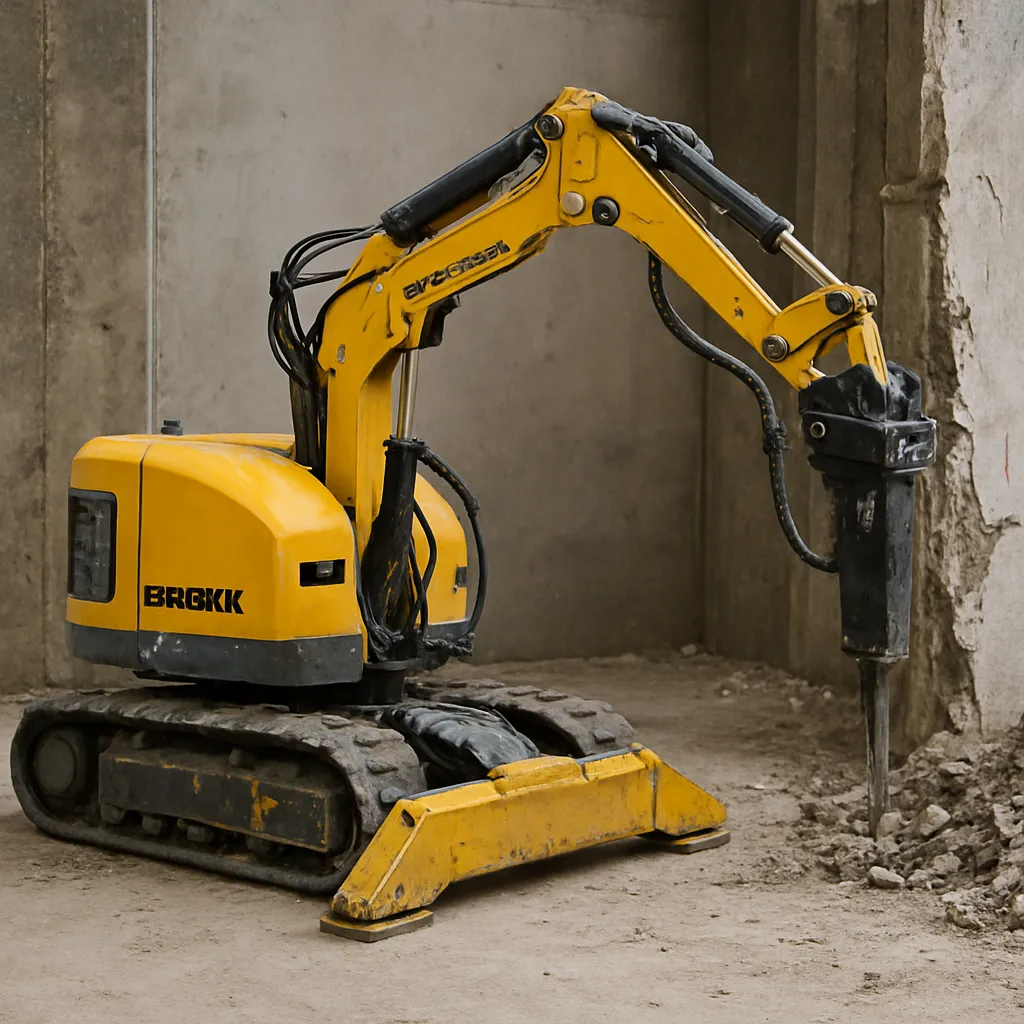
The Brokk 300 is a proven workhorse in the world of construction and industrial dismantling. Designed as a robust, highly maneuverable remote machine, it brings levels of productivity and operator protection that are difficult to achieve using conventional hand-held tools. In the following article we explore the machine’s design, common applications, technical highlights, attachments, operational procedures, and the practical benefits it offers across multiple industries. Throughout the text you will find concise technical context, real-world use cases, and practical considerations for buyers and operators.
Overview and design philosophy
The Brokk 300 is a compact, remote-controlled demolition robot built to perform heavy-duty tasks in confined or hazardous environments. Its core design centers on three priorities: operator protection, site accessibility, and forceful, efficient material removal. The machine replaces manual labor in many scenarios, enabling one operator to control a powerful machine from a safe distance.
The Brokk 300’s chassis and boom are arranged to deliver excellent stability while remaining small enough to enter tight openings, stairwells, and poorly accessible floors. Because it is remote-controlled, the unit eliminates the need for an operator to be physically close to falling debris, dust, or toxic atmospheres. The machine’s modular layout allows a variety of power packs and attachments to be mounted, making the robot a very versatile tool in a contractor’s fleet.
Key features and components
Chassis and mobility
The Brokk 300 uses a tracked undercarriage designed to provide traction on uneven surfaces and stability during heavy breaking tasks. Tracks are rubberized or steel-reinforced depending on application, and the low ground pressure allows the unit to work on sensitive flooring and in damaged structures. The compact footprint and telescopic or articulated boom options allow the machine to reach over obstacles and work at various elevations while keeping the base in a safe position.
Powertrain and hydraulics
The Brokk 300 is typically driven by an electric motor with a remote-controlled power pack. Some configurations include diesel or hybrid powerpacks for sites where grid power is not available. The hydraulic system is engineered to supply steady, high-flow pressure for attachments such as breakers, crushers, and shears. This hydraulic power is what enables the machine to generate the force required to break reinforced concrete, cut steel, and handle heavy demolition tasks with precision and speed.
Control system and safety
Control is via a radio remote unit with an ergonomically designed layout, enabling the operator to manage travel, boom motion, tool actuation, and swing with fingertip control. The remote includes safety interlocks, an emergency stop, and feedback on machine status (such as overload alerts and maintenance reminders). Additional safety features often include automatic shutoff for tilt or overcurrent conditions, integrated cameras, and audible warnings—features that significantly enhance jobsite safety.
Applications and typical use cases
The Brokk 300 is used across multiple sectors where heavy material removal, precision, and operator safety are priorities. Below are the most common applications:
- Building demolition and selective dismantling: removing staircases, interior walls, and floors without the need for large, disruptive equipment.
- Concrete removal in renovation and rehabilitation projects, including facades, slabs, and foundations.
- Industrial plant maintenance and decommissioning: taking down machinery and structures inside plants where space is limited and human exposure is risky.
- Nuclear and hazardous environments: removing contaminated structures or materials where remote operation is mandatory for health reasons.
- Tunneling and underground works: clearing rock and concrete in tunnels, shafts, and subway stations where compact size and low vibration are advantages.
- Shipyards and offshore: cutting and dismantling ship components in confined locations or from stable positions on shore.
In each of these cases, the Brokk 300 delivers solutions where larger conventional excavators cannot fit, and where manual methods would endanger workers or be prohibitively slow.
Attachments and tooling options
One of the Brokk 300’s strengths is the extensive list of compatible attachments, designed to handle a wide variety of demolition and processing tasks. Common attachments include:
- Hydraulic breakers (pneumatic-style hammers) for breaking concrete and rock.
- Hydraulic crushers and pulverizers for primary and secondary concrete processing.
- Hydraulic shears and plate cutters for dismantling steel structures and piping.
- Concrete crushers and multi-processors that combine crushing and cutting functionality.
- Buckets and grapples for material handling and sorting of debris.
- Core drilling and wire saw attachments for precision cuts and removal.
- Vacuum and water suppression systems to manage dust and airborne particulates when breaking concrete.
Because attachments are quick-change and powered by the same hydraulic supply, operators can switch between tasks without moving additional heavy equipment into position. This flexibility increases jobsite efficiency and reduces downtime.
Technical highlights and typical specifications
Specifications vary by configuration and model year, but the Brokk 300 typically sits in the mid-range of the Brokk product line. The following figures are representative ranges to give a practical sense of capability (figures are approximate and depend on configuration, attachments, and power pack):
- Operating weight: approximately 1.8–2.8 tonnes, depending on attachment and powerpack selection.
- Working reach: boom outreach commonly in the 3–6 meter range (reach and height depend on boom option).
- Hydraulic pressure: designed to operate at high pressures appropriate for heavy demolition tools (often well over 200 bar in many setups).
- Power source: electric motor configurations for grid-powered sites; diesel or hybrid power packs for remote or mobile locations.
- Rotation: 360-degree slew for full-area access without repositioning the base.
- Remote control range: typically up to 100–200 meters of line-of-sight operation, often expanded with signal boosters or local protocol options.
Manufacturers provide model-specific datasheets that specify exact weights, hydraulic flow rates, and attachment operating envelopes, so prospective buyers should consult the official technical documentation or a certified dealer for precise figures for a given unit.
Operation, training, and maintenance
Operating a Brokk 300 requires specialized training to ensure safe, efficient performance. Operators must learn remote operation techniques, attachment handling, and routine checks. Typical operator and maintenance best practices include:
- Pre-start checks for hydraulic leaks, track condition, and attachment fittings.
- Daily inspection of safety interlocks, emergency stop functionality, and remote-link integrity.
- Scheduled hydraulic fluid and filter changes based on operating hours and site conditions.
- Proper storage and handling of attachments to prevent wear and contamination.
- Operator certification programs often provided by dealers or manufacturer training centers, covering remote-control ergonomics, signaling, and operational limits.
Because the machine replaces manual demolition tools, maintenance attention shifts from handheld tool upkeep to maintaining hydraulic systems, track treads, and electronic components. Well-maintained units deliver long service lives and consistent productivity.
Health, safety, and environmental benefits
Using a Brokk 300 can significantly reduce occupational hazards associated with demolition. The remote operation keeps workers away from falling debris, dust, and potential airborne contaminants. This is particularly valuable in nuclear, chemical, and confined-space projects where human exposure must be minimized.
Other health and environmental advantages include:
- Lower dust generation when combined with water suppression or vacuum attachments, improving air quality on site.
- Reduced noise exposure to operators because they work remotely and can be positioned further from the machine.
- Precision demolition minimizes collateral damage to surrounding structures, which reduces waste and the need for additional repairs.
- Electric configurations reduce on-site emissions compared with diesel-powered hand tools or larger demolition rigs.
Economic considerations and productivity
While the initial purchase price of a Brokk 300 can be substantial compared to manual tools, the machine often proves cost-effective when considering productivity gains, reduced labor costs, and lower insurance and health-related expenses. Key economic factors include:
- Increased demolition speed per operator, since one operator may replace several manual laborers.
- Reduced downtime due to better control in confined spaces and fewer safety interruptions.
- Lower overall risk of injury and associated costs, which can reduce insurance premiums and lost-time incidents.
- Greater jobsite flexibility that can shorten project timelines and reduce total labor hours.
Contractors who specialize in selective demolition, internal fit-outs, or hazardous-site decommissioning often find that the machine more than pays for itself over multiple projects.
Case studies and notable deployments
Brokk machines, including models equivalent to the 300 class, have been deployed worldwide in challenging environments. Notable categories of deployments include:
- Demolition and remodeling of urban buildings where surrounding structures limit the use of large excavators.
- Underground metro and tunnel maintenance where size constraints and vibration control are essential.
- Industrial facility decommissioning—chemical plants, refineries, and power stations—where remote operation reduces exposure to hazardous substances.
- Nuclear decommissioning projects, where remote handling is mandatory for radiological protection.
These real-world deployments demonstrate the robot’s value in projects prioritizing operator safety, precision, and minimal collateral damage.
Procurement and lifecycle considerations
When evaluating a Brokk 300, buyers should consider total lifecycle costs and support options:
- Warranty and service agreements: Many manufacturers and dealers offer extended warranties and preventive maintenance packages.
- Spare parts availability: Quick access to hydraulic seals, hoses, and electronic modules reduces downtime.
- Attachment compatibility: Confirm that the attachments required for typical jobs are available and easy to swap.
- Resale and fleet flexibility: Brokk robots retain value due to wide industry adoption and modular design.
Leasing or renting prior to purchase is a practical way to assess whether the machine integrates well into an operator’s workflow and project types.
Future developments and trends
Demolition robotics continue to evolve. Trends likely to influence future iterations of the Brokk 300-class machines include:
- Increased electrification and battery-hybrid solutions for quieter, zero-emission operation on urban sites.
- Advanced teleoperation with augmented reality displays and live video feeds to improve precision and situational awareness.
- Autonomous or semi-autonomous functions for repetitive tasks, such as trenching or slab removal by pattern recognition and automated tool control.
- Improved sensor integration for predictive maintenance and operational analytics, increasing uptime and optimizing fleet use.
These improvements aim to enhance both precision and productivity while further reducing the environmental footprint of demolition activities.
Conclusion
The Brokk 300 is a powerful and adaptable demolition robot well-suited to modern construction, industrial, and hazardous-environment projects. With a focus on operator protection, compact accessibility, and hydraulic force, it offers clear advantages over manual and conventional mechanical methods. Attachments broaden its utility across many tasks—from heavy concrete breaking to precise cutting and material handling—while remote operation reduces risk and improves site management. For contractors and owners focused on safety, efficiency, and versatility, the Brokk 300-class machines present a compelling solution for a wide range of challenging demolition and maintenance applications.
demolition remote-controlled compact hydraulic safety attachments versatility efficiency concrete precision
)
)