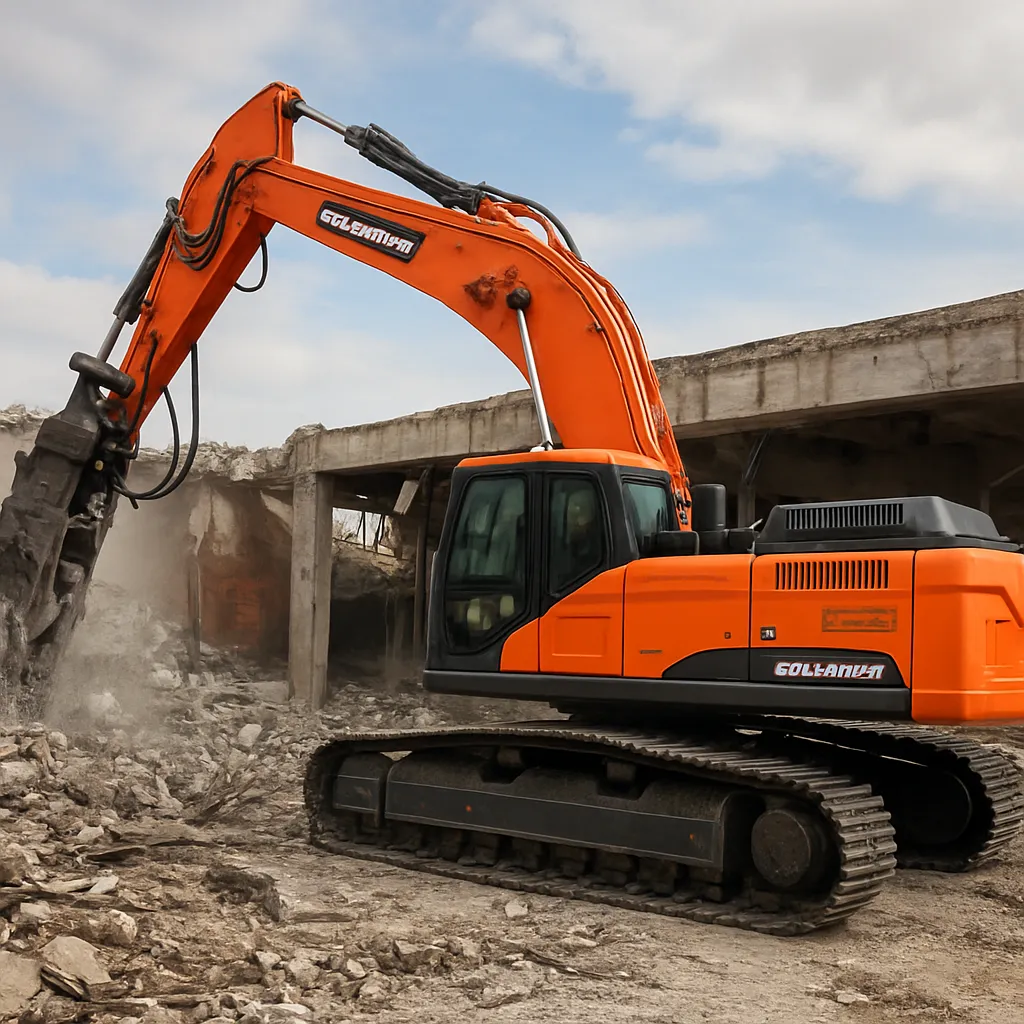
The Doosan DX530DM-7 is a heavy-duty demolition variant built on Doosan’s large excavator platform, designed to meet the demanding requirements of controlled tearing down of large structures, industrial dismantling and selective deconstruction. Combining the proven base machine characteristics of Doosan’s DX500–DX530-class machines with demolition-specific reinforcements, reach options and purpose-built attachments, the DX530DM-7 positions itself as a versatile and powerful tool for demolition contractors who need both reach and precision in the toughest environments. The following article examines its design philosophy, typical applications, technical considerations, operational best practices and purchasing/ownership factors important to professionals in the demolition sector.
General overview and design intent
The DX530DM-7 is engineered primarily for large-scale demolition tasks where enhanced structural strength, stability and reach are paramount. Unlike standard excavators used for earthmoving, the demolition variant focuses on three main areas: structural reinforcement of the upperworks and undercarriage, specialized boom and arm geometries to provide extended reach and control, and integration with heavy-duty demolition attachments such as shears, crushers, pulverizers and grapples.
Key traits that characterize the DX530DM-7 include an emphasis on operator visibility, reinforced boom/arm and housings, larger counterweights for stability during high-reach operations, and hydraulic systems tuned to supply steady power to demolition tools. These adaptations help the machine withstand impacts, lateral forces and the repetitive loads that demolition attachments generate.
Primary applications and real-world uses
Demolition work involves a wide range of tasks beyond simply knocking down walls. The DX530DM-7 typically finds use in:
- High-reach building demolition — safe removal of multi-storey structures where controlled dismantling is needed.
- Industrial plant dismantling — decommissioning of factories, power plants and steelworks where large structural components and machinery must be safely removed and processed.
- Concrete processing and sorting — primary crushing and secondary processing of concrete, rebar separation using dedicated attachments.
- Selective deconstruction — careful removal of specific components to salvage materials, often in urban or environmentally sensitive sites.
- Infrastructure removal — bridges, large culverts and overpasses where high capacity and stability are required for lifting and cutting tasks.
Because demolition often occurs in constrained or urban environments, machines like the DX530DM-7 are frequently fitted with specialized cabs (with enhanced protection), remote-control capability for hazardous situations, and modular counterweights to tune stability versus transportability.
Construction and technical highlights
While precise factory specifications can vary by market and optional equipment, the DX530DM-7 typically shares the following technical emphases:
Engine and hydraulic system
- The engine is tuned to provide consistent torque at low RPM to power large hydraulic demolition attachments without frequent surging or overheating.
- High-flow hydraulic circuits and dedicated attachment circuits enable operation of heavy-duty shears, crushers and pulverizers with steady force and speed.
- Robust cooling systems ensure stable performance during continuous high-load demolition cycles.
Structural reinforcements
- Reinforced boom and arm with thicker wall sections and wear plates to resist impact and bending loads.
- Under-carriage and swing frame strengthened to handle side loads and ensure longevity under harsh operating conditions.
- Additional or adjustable counterweights to maintain required tipping resistance when using extended reach or heavy attachments.
Cabin and operator protection
- Falling object protective structures (FOPS) and optional reinforced glass or screens for front and top protection.
- Ergonomic controls, improved visibility camera packages and climate control to enhance productivity and reduce operator fatigue.
- Optional remote-control operation for extreme-risk tasks, reducing the need for direct operator exposure to hazards.
Attachments and adaptability
A demolition machine’s utility depends heavily on available attachments. The DX530DM-7 supports a wide palette of tools designed for different phases of a demolition job:
- Hydraulic shears for cutting steel structures and rebar.
- Concrete crushers and pulverizers for breaking large concrete sections into transportable sizes.
- Sorting grapples for material handling and separation tasks.
- Hydraulic hammers (for selective removal and breaking).
- Specialty tools such as drum cutters or milling wheels for precision removal of concrete layers and encapsulated materials.
Quick couplers and modular hydraulic plumbing options reduce downtime when swapping tools, while electronic presets allow operators to switch hydraulic flow and response characteristics for each attachment efficiently. This combination of mechanical and hydraulic flexibility makes the DX530DM-7 viable for mixed-demolition projects where multiple tool types are needed.
Safety, compliance and operator considerations
Safety is central to demolition operations. The DX530DM-7 is frequently equipped with or compatible with features intended to meet strict site safety protocols:
- Remote operation systems or tethered control stations for tasks with a high risk of structural collapse.
- Advanced camera suites and 360-degree monitoring to manage blind spots on congested sites.
- Emergency dumps and quick-stop controls to reduce reaction time in case of falling debris or structural give.
- Compliant emissions controls (where required by regional regulations) to allow operation in urban settings without violating local air quality rules.
Proper planning and skilled operators are essential. Demolition requires sequencing to control debris fall paths, load handling capabilities, and careful use of attachments — factors that make experienced crews and well-maintained machines a requirement for safe, efficient work.
Maintenance, lifecycle and durability
Demolition machines are subjected to punishing duty cycles. The DX530DM-7’s design choices aim to lengthen service life and reduce downtime through:
- Hard-facing and wear-resistant materials on booms, arms and attachment pins to extend intervals between replacements.
- Accessible daily service points and modular component layouts to speed routine maintenance tasks.
- Preventive maintenance schedules tailored for demolition duty — more frequent inspections of hydraulic hoses, cylinders and structural welds than for standard excavation use.
- Optional telematics and machine health monitoring to track usage, hydraulic pressures and fuel consumption; early detection of anomalies can prevent catastrophic failures and costly downtime.
Operators and fleet managers should expect higher maintenance expenditure per hour compared to earthmoving machines, mainly due to the heavy-duty attachments and the high shock loads typical in demolition. However, when properly specified and maintained, the DX530DM-7 can deliver long service life and predictable ownership costs.
Economic and procurement considerations
Choosing a machine like the DX530DM-7 involves balancing capital cost, jobsite productivity, attachment ecosystem and resale value. Key financial considerations include:
- Upfront cost vs. versatility: Demolition-specific variants carry a premium over standard excavators, but they reduce the need for specialized subcontractors or additional lifting equipment.
- Attachment lifecycle costs: Heavy shears or crushers have wear parts that require regular replacement — factor those consumable costs into long-term budgets.
- Fuel and operating efficiency: Engines optimized for low-end torque can be more fuel-efficient when wielding heavy attachments, particularly if operators adopt fuel-smart practices and idle reduction policies.
- Resale and rental market: Well-maintained demolition machines maintain good resale value because demand exists from contractors and rental houses that specialize in heavy demolition.
Leasing or rental can be attractive for firms handling episodic demolition work. Rental units often include maintenance support and rapid attachment availability, reducing capital burden and downtime risk.
Performance data and operational metrics (typical ranges)
Exact specifications vary by regional configuration and attachments. Below are typical performance ranges and metrics observed in machines in this class and purpose-built demolition variants:
- Operating weight: commonly in the range of 45–60 tonnes for large demolition excavators derived from the DX530 platform, depending on counterweight and boom configuration.
- Hydraulic flow and pressure: high-flow circuits capable of supporting large hydraulic attachments with variable flow presets and pressures designed for steady crushing/sawing operations.
- Reach: demolition-specific long-boom and long-arm options often allow working heights from 10 to 20 meters (or more) depending on configuration, enabling controlled removal of multi-storey structures.
- Fuel consumption: heavily dependent on attachment and duty cycle. Typical demolition duty may consume significantly more fuel per operating hour than standard earthmoving — crews should plan for higher hourly fuel costs and track consumption via telematics.
- Availability and uptime targets: fleets aim for >85–90% uptime; proactive maintenance and parts logistics are key to achieving these levels on demolition sites.
These ranges are intended as practical guidance rather than definitive factory numbers; buyers should consult Doosan’s official specification sheets and local dealers for machine data matched to a chosen configuration.
Operational best practices and tips
To maximize machine life, safety and productivity when operating a DX530DM-7, consider these recommendations:
- Match the attachment to the task — using a heavy crusher where a shear is better can increase cycle times and wear costs.
- Use modular counterweights and ballast to optimize stability for each task while keeping within transport limits.
- Implement stringent inspection routines for hydraulic lines, cylinder rods and pin bushings due to the severe shock loads in demolition.
- Train operators on attachment-specific hydraulics and feedback characteristics — good operators reduce attachment wear and improve cycle times.
- Deploy dust suppression and noise mitigation strategies on urban sites to meet local regulations and community expectations.
Market context and trends
The demolition equipment sector is influenced by several macro trends that affect demand for machines like the DX530DM-7:
- Urban redevelopment and infrastructure renewal programs expand demand for controlled demolition and selective deconstruction.
- Increasing focus on material recovery and recycling raises the importance of attachments and workflows that separate rebar, concrete and other reusable materials on-site.
- Emission regulations push manufacturers to offer Stage V / Tier 4 Final compliant engines and aftertreatment systems, enabling operation in regulated urban environments.
- Telematics and remote-control systems are becoming standard expectations for large demolition fleets to improve safety and monitor productivity remotely.
Buying and fleet integration considerations
When evaluating a DX530DM-7 for purchase or lease, consider the following checklist:
- Attachment inventory and compatibility — ensure the dealer or rental house stocks the required demolition tools.
- Service network and parts availability — rapid parts supply is essential to keep downtime minimal on demolition projects.
- Operator training and support — ask about factory or dealer-delivered operator programs and site-commissioning assistance.
- Telematics and data access — confirm what machine health and operational data are available and if they integrate with your fleet systems.
- Transport logistics — heavy counterweights and long booms may require special transport permits and planning for moving the machine between sites.
Summary and outlook
The Doosan DX530DM-7 represents a purpose-built solution for contractors who perform heavy demolition, deconstruction and industrial dismantling. By combining reinforced structures, specialized hydraulics and a broad attachment ecosystem, the machine is well-suited to projects that demand reach, power and robust durability. While demolition duty increases maintenance and operating costs relative to earthmoving tasks, disciplined maintenance, skilled operators and appropriate attachment choices can deliver strong productivity and favorable lifecycle economics.
For any potential buyer or fleet manager, the next step should be to work with an authorized Doosan dealer to review the exact machine configuration, confirm emissions compliance for your operating region, and plan a support package that includes spare parts, operator training and telematics tailored to your business needs.


)
)