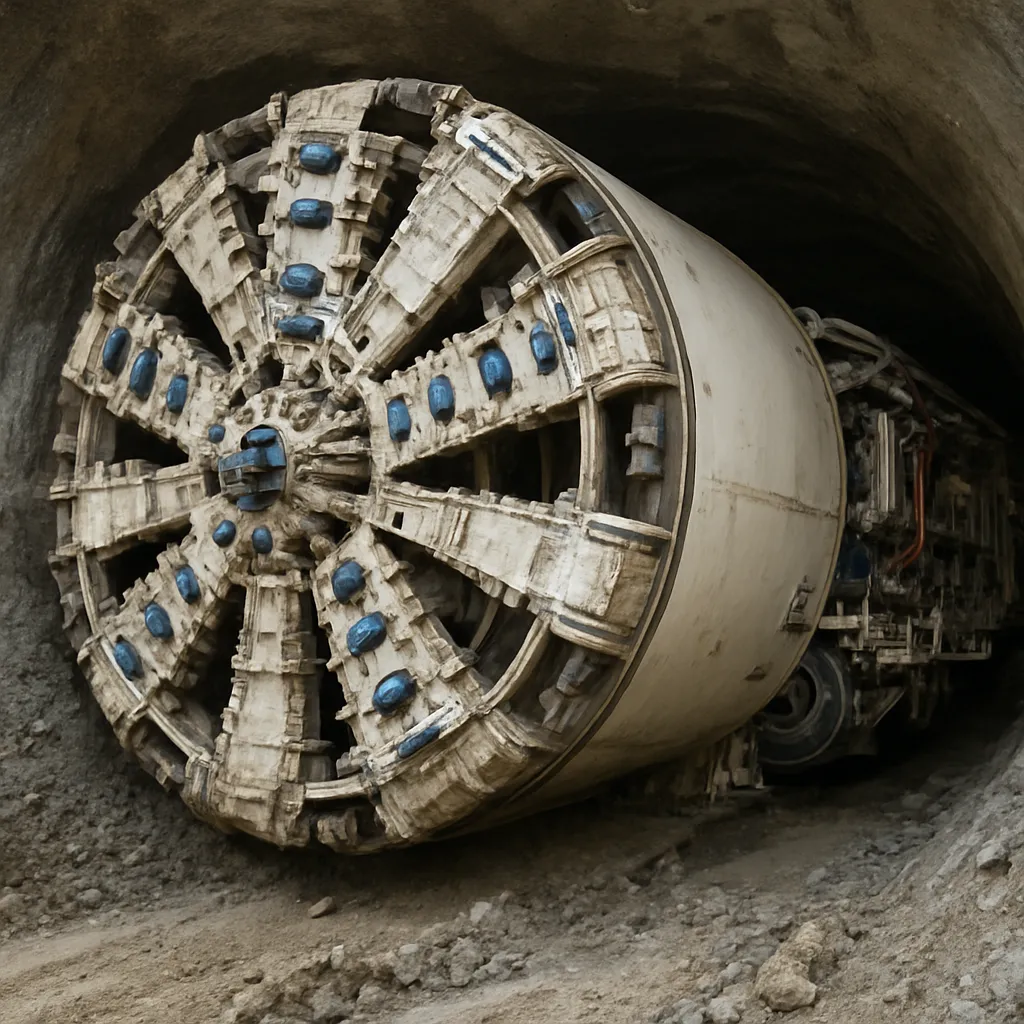
The CRCHI Earth Pressure Balance (EPB) Tunnel Boring Machine represents a class of purpose-built mechanized tunneling equipment designed to excavate soft ground and cohesive soils while maintaining balanced face pressure. These machines are central to modern urban tunneling programs — from metro systems and road tunnels to utility and sewerage conduits — where controlling ground settlement and protecting surface structures are paramount. Below you will find a detailed examination of the machine’s design, operational principles, typical applications, logistics, environmental impacts and performance characteristics, along with practical notes on maintenance and selection criteria.
Overview of CRCHI Earth Pressure Balance TBMs
The term CRCHI refers to China Railway Construction Heavy Industry, a major manufacturer of tunneling equipment and one of the leading global suppliers of TBMs. The CRCHI EPB machines are engineered to operate in fine-grained, water-bearing and mixed soils where face stability is required to prevent dangerous inflows and surface settlement. An EPB TBM uses the excavated material itself — conditioned as necessary — to hold the tunnel face at near-equilibrium pressure, allowing controlled removal of spoil through a screw conveyor while the machine advances.
Key advantages of the CRCHI EPB design include precise control of face pressure, reduced surface disturbance, integrated segmental lining installation, and compatibility with urban construction constraints. CRCHI’s product line ranges from small-diameter units suited to utility tunnels (roughly 2.5–3 m) to large-diameter machines for metro and rail tunnels (commonly up to 12–13 m and in specialized cases above). CRCHI also produces slurry TBMs and mixed-shield variants, but the EPB family remains popular for its operational simplicity in cohesive soils.
Technical characteristics and working principles
An EPB TBM is composed of several core subsystems: head/cutterhead, shield and trunk, screw conveyor and muck system, hydraulic thrust and steering, segment erector, and a control/monitoring cabin. CRCHI machines integrate these components into modular arrangements to adapt to job-specific requirements.
Working principle
- Excavation: Rotating cutterhead with picks, disks or mixed tools peels the soil from the face.
- Pressure balance: Excavated material accumulates in the pressure chamber behind the cutterhead. By controlling the volume removed via the screw conveyor and conditioning the soil (foam, polymers, bentonite), operators maintain an equilibrium face pressure.
- Forward thrust and advance: Hydraulic jacks push the shield forward against segmental lining plates. A segment erector installs precast concrete rings as the machine progresses.
- Spoil handling: Muck is transported out of the tunnel by conveyor belts, trains, or via thrustable muck cars after passing through the screw conveyor.
- Control and automation: Modern CRCHI EPBs include SCADA-type systems, geotechnical sensors and remote diagnostics to monitor torque, thrust, chamber pressure, face deformation and ground settlement.
Important technical parameters vary by model and project conditions. Typical ranges (industry norms) include cutterhead diameters from about 2.5 m to 14 m, cutterhead torque from a few hundred to several thousand kNm, and thrust forces from several thousand to tens of thousands of kilonewtons. Cutterhead rotation speeds are generally low (fractions of 1 to a few rpm) due to the high torque environment. Screw conveyor designs are critical: CRCHI offers variable-pitch and variable-density conveyors to manage different soil consistencies and to adjust muck extraction rates.
Design features common to CRCHI EPBs
- Modular shield and truss assemblies for transport and site assembly.
- Face support systems that allow for adjustable chamber volumes and segmented pressure control.
- Soil conditioning systems for precise injection of foams, polymers and bentonite slurries to create an optimal muck rheology.
- Advanced instrumentation for predictive control — incl. face pressure sensors, inclinometers, torque and thrust monitoring.
- Integrated ground treatment options (jet grouting, freezing interfaces) when traversing problematic zones.
Applications and project types
CRCHI EPB TBMs are most frequently deployed in projects where subsurface conditions are dominated by fine sands, silts, clays, or mixed ground with groundwater presence. Typical applications include:
- Urban metro and rail tunnels — where minimal settlement and disruption are required beneath buildings, historic structures and utilities.
- Road tunnels and underpasses running beneath dense urban areas.
- Sewage and drainage tunnels — long runs with consistent soft ground conditions where continuous mechanized excavation is efficient.
- Utility tunnels and cable ducts — smaller-diameter EPBs provide controlled excavation for congested service corridors.
- Underwater or near-shore crossing where groundwater control is a major design constraint.
CRCHI machines have been selected for projects across Asia, the Middle East, Africa and parts of Europe and Latin America, primarily where cost-effective manufacturing and local support networks make Chinese-built TBMs competitive. Applications often require the TBM manufacturer’s technical assistance during assembly, launch, operations and retrieval.
Operational performance: rates, efficiency and typical metrics
Tunneling performance is highly dependent on geology, machine size, crew experience and logistics. However, some industry and CRCHI-relevant performance indicators are commonly observed:
- Daily advance: In favorable conditions EPB TBMs can achieve peak advances of over 100 m/day in very soft, homogeneous soils, but typical sustained production rates are in the range of 10–40 m/day for most urban projects.
- Average availability: Well-supported TBM operations commonly report machine availability above 75–85%, but this depends on supply chain and ground surprises.
- Spoil removal capacity: Screw conveyors and conveyor belt systems are sized to maintain pressure control without creating backlogs; capacities correlate with diameter and expected face cut volume.
- Settlement control: Properly operated EPBs can limit surface settlement to a few millimetres to tens of millimetres depending on overburden and depth, which is often within the strict thresholds required by urban contracts.
When considering performance, project planners should use realistic average advance rates rather than peak statistics. Large-diameter projects may have lower meters-per-day due to greater segment handling, ring closure time and increased logistical demands, while small-diameter drives often realize higher daily progress per metre of diameter.
Case examples and notable deployments
CRCHI has delivered numerous machines to transit authorities, infrastructure contractors and municipalities. Typical case deployments include metro extensions and long stormwater tunnels. While project specifics vary, the following types of achievements are representative:
- Multiple EPB units working in pressurized urban environments with strict settlement limits, enabling tunnel alignments beneath sensitive structures.
- Long drives exceeding several kilometres achieved through staged assembly, intermediate ventilation and multiple logistics shafts.
- Complex ground conditions managed by mixing EPB operation with pre-treatment (jet grouting) or with mixed-mode cutterheads to negotiate cobbles and variable strata.
Specific project names and statistics are often published by clients and CRCHI in technical bulletins and project reports. For detailed, project-level performance metrics it is best to consult project case studies, operator reports or the manufacturer’s published data for the particular model.
Environmental, safety and urban integration aspects
EPB TBMs are particularly valued for their ability to minimize the environmental and social impacts of tunneling in built-up areas. Key benefits and considerations include:
- Reduced surface settlement and ground disturbance compared with open-cut alternatives, lowering the risk to buildings and infrastructure.
- Lower noise and vibration levels during excavation, which is crucial for densely populated corridors.
- Contained spoil handling and dust mitigation — TBMs limit open exposure of excavated soils.
- Controlled groundwater management — EPB operation reduces the need for widespread dewatering, protecting nearby foundations and groundwater-dependent ecosystems.
- Safety: EPB operations, when paired with rigorous monitoring and emergency protocols, reduce the risk of sudden face failures and inflows. Safety systems include automatic shut-downs, pressure relief valves and evacuation procedures.
Environmental systems on CRCHI machines often include on-board slurry and foam storage, spill containment, and treatment facilities for lubricants and process water. Contractors commonly pair TBMs with on-site muck treatment plants and recycling systems to manage throughput and reduce disposal costs.
Logistics, assembly and site requirements
Deploying a CRCHI EPB requires careful logistical planning. Typical stages include manufacture and test-assembly at factory, transport to site in modular pieces, assembly in a launch pit or shaft, operation and eventual retrieval or decommissioning. Important logistical considerations:
- Shaft and launch pit size must accommodate the TBM’s assembled shield and trailing gear. Larger diameters require more space.
- Power supply: TBMs demand substantial and stable electrical power; supply redundancy is often required to prevent interruptions.
- Material handling: Segment manufacture/storage, grout batching and backfill, and muck transport must be sequenced to match the TBM advance rate.
- Site access: Road, rail or sea access for oversized components and careful lifting planning for heavy parts during assembly.
CRCHI provides installation supervision and commissioning support. Experience shows that time for assembly and commissioning can range from several weeks for small units to several months for very large shields, plus additional time for system integration and staff training.
Maintenance, lifecycle and spare parts
Like all heavy tunneling equipment, EPB TBMs are capital-intensive assets whose lifecycle value depends on maintenance regimes, spare part logistics and operator skill. Maintenance planning should include:
- Regular cutterhead/tool inspection and replacement (wear parts like picks and discs).
- Screw conveyor wear plates and seals replacement intervals determined by abrasiveness of the soil.
- Hydraulic system checks and replacement of hoses, seals and cylinders.
- Monitoring of drive motors, gearboxes and electrical panels with predictive maintenance tools.
- Stocking critical spares (seals, hydraulic components, sensor modules) on-site or regionally to minimize downtime.
CRCHI often offers service contracts and local training to enhance operational reliability. Long-term availability depends on a partnership between the contractor, the manufacturer and the client to ensure uninterrupted supply chains for wear components, utensils and consumables.
Selection criteria and design considerations for projects
Choosing a CRCHI EPB TBM (or any EPB) requires matching machine characteristics to ground conditions and project constraints. Important selection criteria include:
- Geotechnical profile: Soil type, grain size distribution, water content and presence of cobbles or boulders.
- Groundwater pressure: High water tables may necessitate additional face support or slurry systems.
- Tunnel diameter and lining preference: Segmental concrete linings are standard; ring geometry and segment handling must be planned.
- Logistics and site footprint: Shaft sizes, spoil handling capacity and plant availability shape the machine configuration.
- Risk management and contingency planning: Plans for mixed-face operation, unexpected obstructions, and emergency face stabilization.
Design options such as mixed-mode cutterheads, reinforced screw conveyors, and enhanced conditioning systems are available to tailor the TBM to the ground’s behaviour. Pre-construction investigations and pilot bores significantly reduce uncertainty when selecting the optimal machine configuration.
Industry statistics and typical benchmarks
While exact numbers vary by project, several benchmarks help in planning:
- Common drive lengths for single TBM deployments range from a few hundred metres up to 10 kilometres, with longer projects often employing intermediate adits or slurry treatment stations.
- Typical diameter bands: small (2.5–4 m), medium (4–8 m), large (8–13+ m). Each range has distinct logistical and cost characteristics.
- Typical peak daily metrics: ideal-case peaks above 100 m/day; realistic sustained averages often 10–40 m/day for urban projects.
- Machine availability and utilization targets: planning for 70–85% availability allows for scheduled maintenance, ring building and supply constraints.
For project costing, TBM rental or purchase price, assembly and commissioning, site-specific civil work (shafts, segment factory, ventilation), and ongoing operating costs should all be modelled. CRCHI and other manufacturers can provide tailored technical and financial proposals based on the project’s geotechnical dataset.
Innovation trends and future directions
Recent developments in TBM design reflect broader industry trends: increased automation, enhanced sensor suites for predictive maintenance, improved material conditioning systems, and integration with digital twin platforms for real-time optimization. CRCHI invests in improving the reliability of EPB systems, reducing tool-change times and enhancing the responsiveness of face pressure control systems. Sustainability trends include re-using excavated material where feasible, improving energy efficiency of drives, and minimizing the carbon footprint of TBM manufacturing and operation.
Mixed-use, adaptive cutterheads and modular systems allow CRCHI EPBs to handle more variable ground without stopping for significant reconfiguration. Digital monitoring and control will continue to reduce the human workload while improving safety margins and performance forecasting.
Practical guidance for contractors and owners
Successful EPB tunneling projects emphasize preparation and communication:
- Invest in thorough geotechnical investigations and ground-conditioning trials before finalizing TBM specifications.
- Engage the TBM supplier early for design reviews, assembly planning and operator training.
- Plan spare parts logistics and predictive maintenance processes to keep availability targets within contractual limits.
- Implement a robust instrumentation and monitoring program to manage settlement, face behaviour and system health in real time.
- Coordinate urban stakeholders early to manage surface impacts and maintain public confidence.
With competent planning, CRCHI EPB TBMs offer a proven method to deliver complex underground infrastructure with controlled risk and favorable urban integration characteristics.
Key terms: CRCHI, EPB, TBM, cutterhead, face pressure, shield, screw conveyor, segment erector, settlement, automation.


)
)