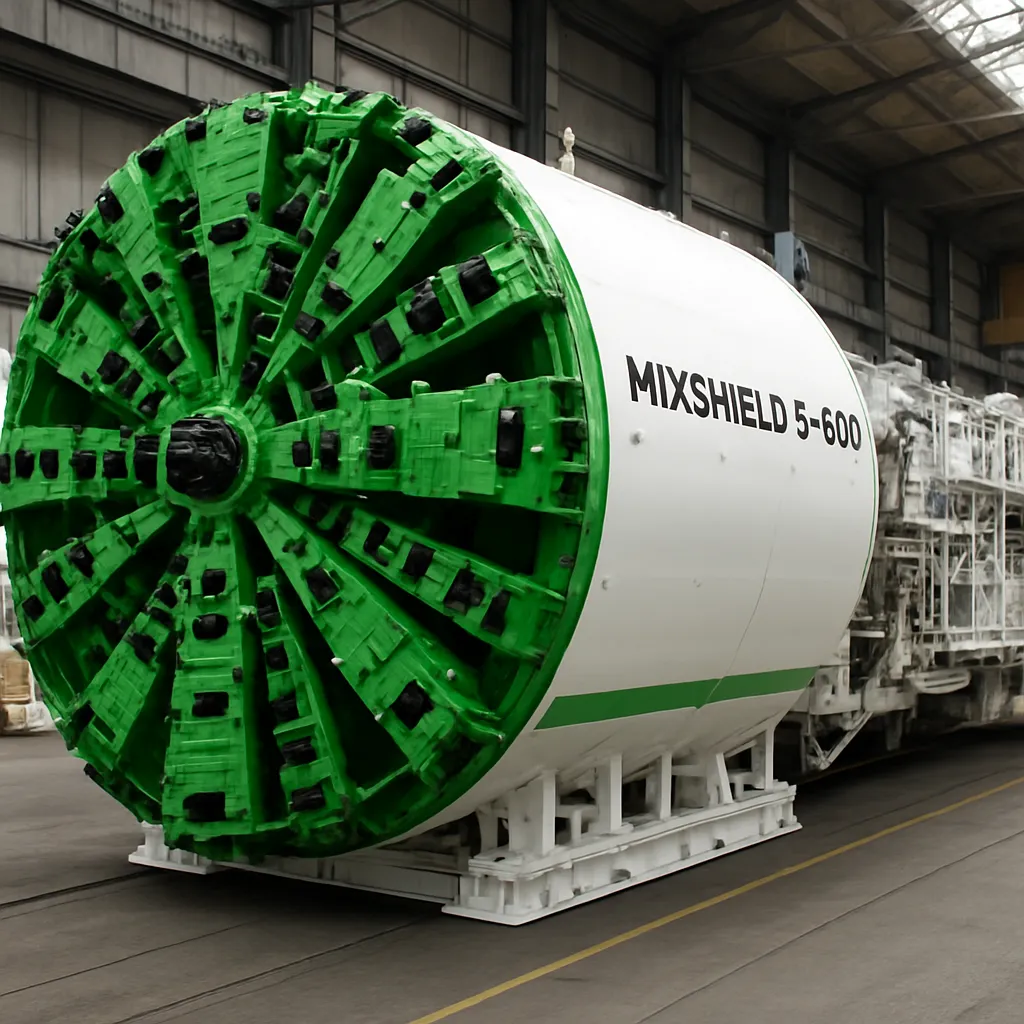
The Herrenknecht Mixshield S-850 represents a class of specialized tunnel boring machines designed to tackle complex, water-bearing and mixed ground conditions while ensuring high levels of safety, precision and environmental control. Combining elements of slurry-shield and Earth Pressure Balance (EPB) technologies, Mixshield systems are engineered to maintain face stability in heterogeneous soils, mitigate settlement in urban environments and enable efficient, continuous tunneling for metro lines, sewer systems, utility ducts and hydraulic tunnels. Below is a comprehensive overview of the machine’s design, applications, operation, performance characteristics and practical considerations for contractors and engineering teams.
Design and technical features
The Herrenknecht Mixshield family, including the model often referred to as the S-850, is tailored to the demands of mixed-face tunneling where ground conditions change frequently between cohesive soils, sands, gravels and cobbles, often with high groundwater pressure. The design objective is stable face support, reliable muck transport, and safe installation of segmental lining while adapting to variable geotechnical challenges.
Core components
- Cutterhead and cutting tools: a robust, often articulated cutterhead equipped with wear-resistant discs, carbide picks or boulder-cutting tools designed to handle abrasive and heterogeneous materials. The cutterhead is optimized for a controlled balance between excavation and mixing with the slurry.
- Pressure-tight shield and bulkhead: a sealed working chamber that allows controlled communication between the excavation face and the slurry or support medium, including ports for injection, sampling and instrumentation.
- Slurry processing and handling: slurry support systems keep the tunnel face stabilized. Excavated material is mixed with slurry in a separation system, then transported out via pipelines to a surface-based slurry treatment plant for separation, reclamation and disposal.
- Drive and hydraulic system: high-capacity drive motors and hydraulic thrust units deliver rotation and forward thrust. These systems are dimensioned to cope with the mechanical demands of breaking up cobbles and boulders and pushing through resistant strata.
- Segment erector and lining assembly: integrated mechanisms for placing precast concrete segments to form the permanent lining, ensuring alignment, grout injection and final sealing.
- Instrumentation and control: real-time monitoring of face pressure, torque, thrust, slurry pressure, cutterhead speed and settlement sensors. Many Mixshield machines are equipped for remote diagnostics and process automation.
Working principle
The Mixshield operates by maintaining a pressurized medium (usually a bentonite-based slurry or conditioned soil) in contact with the excavation face. The cutterhead loosens and mixes the excavated material with the slurry within the chamber. This mixture is then pumped out through a pipeline to a separation plant where solids are removed and the slurry recycled. The pressurization in the face and chamber compensates for groundwater pressure and prevents uncontrolled inflows and surface subsidence.
Indicative technical data (typical for an S-class Mixshield around 8.5 m)
Exact specifications vary by project and configuration. The figures below are indicative ranges typical for a Mixshield machine of approximately 8.5 m diameter and are provided to illustrate scale and capability:
- Machine diameter (shield outer): approximately 8.5 m (varies with lining and overcut)
- Excavation diameter: typically slightly larger than shield diameter to allow for overcut and segment installation
- Installed drive power: in the order of 1,500–4,000 kW depending on cutterhead and electrical configuration
- Cutterhead torque: ranges from several hundred to a few thousand kNm depending on tooling and geology
- Thrust capacity: in the order of several thousand to tens of thousands of kN (machine configuration dependent)
- Typical advance rate: 5–30 m/day under mixed conditions; short bursts higher in favorable ground
- Operational weight: several thousand tonnes when accounting for shield, backup system, conveyors and slurry plant
Applications and typical projects
The Mixshield S-850 is especially suited to urban and environmentally sensitive tunneling where face stability, groundwater control and minimal surface settlement are critical. Its versatility makes it widely used in the following sectors:
- Metro and rail tunnels — urban transit projects with complex subsoil layers, high groundwater tables and proximity to buildings and buried infrastructure.
- Sewage and stormwater tunnels — long-running tunnels under rivers or through mixed soils where flow capacity and structural durability are required.
- Utility and service tunnels — ducts for cables, pipelines and district heating where alignment precision and minimal disturbance are important.
- River crossings and undersea approaches — sections under watercourses where pressure control and slurry stabilization are necessary to avoid inflows.
- Hydropower and pressure tunnels — when mixed geology and high water ingress risk demand a pressure-balanced approach.
Why contractors choose Mixshield for these applications
- Adaptability: Blend of slurry and mechanical excavation methods allows smooth transition across strata.
- Face stability: Continuous pressure balancing reduces the risk of loss of ground and surface settlements.
- Muck handling efficiency: Slurry transport and separation facilitate continuous operation and minimize downtime due to clogged conveyors.
- Environmental control: Sealed systems and treatment plants manage spoil and reclaim slurry, reducing environmental footprint.
- Safety: Reduced risk of sudden inflows and collapses compared with open-face methods in similar soils.
Operation, logistics and performance management
Tunneling with a Mixshield S-850 is not only about the machine; it is a complete system including surface plants, supply chains and trained personnel. Successful projects emphasize process control, contingency planning and integrated monitoring.
Start-up and geological investigation
Before launching a Mixshield drive, extensive site investigation is mandatory: boreholes, geophysical surveys, in situ testing and laboratory characterization of soils. These data inform cutterhead design, tool selection, slurry recipe and ground conditioning strategies. Even with excellent investigations, the Mixshield is chosen because it can react to unexpected cobbles, boulder layers and varying permeability.
Muck transport and slurry system
- Excavated spoil mixed with slurry is pumped to a surface separation plant.
- Separation trains typically include hydrocyclones, centrifuges, screens and settling tanks.
- Recovered slurry is conditioned and recirculated; solids are dewatered and transported away.
Automation and monitoring
Modern Mixshield operations rely on automated control loops and comprehensive instrumentation to monitor:
- Face and slurry pressure to maintain stability
- Cutterhead torque, rotation speed and thrust load to detect changing ground conditions
- Volume of excavated material and slurry flow to manage the separation process
- Settlement and building response using surface sensors and inclinometers
Advance rates and productivity factors
Several variables influence daily progress, including geological variability, length of drive, logistics at the portal, and time for segment erection and grouting. Typical productivity guidance:
- In consistent soft ground with limited obstructions: progressive rates can reach the upper end of the typical range (20–30 m/day in short sections).
- In very mixed ground with cobbles and boulders or high water pressures: expect conservative rates (5–10 m/day) to ensure safety and avoid equipment damage.
- Machine availability and slurry plant uptime are critical; scheduled maintenance windows and spare parts stock significantly affect average advance.
Benefits, challenges and environmental aspects
Deploying a TBM such as the Mixshield S-850 brings tangible benefits along with operational challenges. Understanding both helps clients manage risks and optimize outcomes.
Main benefits
- Reduced surface settlement: Pressure-balanced excavation minimizes ground loss, which is crucial under sensitive urban infrastructure.
- Continuous tunneling: The slurry transport system enables continuous face support and consistent muck removal, improving schedule predictability.
- Versatility: Designed to cope with transitions between fine and coarse materials, including cobble layers that would impede other machines.
- Improved safety: Sealed face conditions reduce uncontrolled inflows, keeping workers safer during tunneling.
- Environmental management: Slurry recycling and controlled spoil disposal lower environmental impact compared with open-excavation methods.
Operational challenges
- Complex logistics: Slurry separation plants, disposal facilities and pipeline routing require significant space and coordination at the site portal.
- High capital and mobilization cost: Large specialized TBMs and support systems represent major investments; project economics must justify mobilization.
- Maintenance demands: Cutterhead wear, seal replacements and hydraulic system upkeep demand experienced crews and spare parts.
- Management of unexpected geology: Even with Mixshield technology, severe boulder zones or unpredictable groundwater behavior can cause delays.
Environmental and regulatory considerations
Most Mixshield projects operate under strict environmental controls, including:
- Management of slurry effluents and solids in accordance with permits and water protection laws
- Noise and vibration mitigation, especially in urban drives
- Monitoring of ground and building movements with threshold-based alarm systems
- Remediation plans for any unexpected contamination encountered during excavation
Maintenance, personnel and safety
To extract the full potential of a Mixshield S-850, the project team must prioritize machine maintenance, staff training and robust safety management.
Maintenance strategy
- Routine inspection of cutterhead tools and replaceable wear parts based on run-time and cumulative torque metrics.
- Hydrostatic and seal integrity checks to prevent slurry leaks into the shield annulus.
- Scheduled maintenance on pumps, valves and control electronics in the slurry separation plant to prevent downtime.
- Spare parts planning keyed to the project timeline, with critical spares stored on site to minimize procurement delays.
Workforce and training
Skilled operators, geotechnical engineers and plant technicians are essential. Training programs should include machine-specific operation, emergency procedures for water inflow, slurry plant operation and confined-space protocols for shield interventions.
Safety systems
- Redundant pressure monitoring and automatic shutdowns if face pressure thresholds are exceeded.
- Evacuation and rescue plans tailored to enclosed shield spaces.
- Continuous ventilation and gas monitoring within the tunnel and shield compartments.
- Lockout/tagout procedures and safe-access protocols for maintenance of rotating equipment.
Economic and project planning considerations
Choosing a Mixshield S-850 is a strategic decision that should be integrated into early project planning and financial models. Key considerations include procurement model, expected lifetime of the machine, and the trade-off between upfront TBM cost and long-term savings from lower mitigation works and reduced compensation claims for settlement damage.
Cost drivers
- TBM acquisition or rental cost and mobilization/demobilization expenses
- Slurry separation plant and associated civil works at the portal
- Operational fuel/electricity and consumables cost (slurry agents, wear parts)
- Insurance and risk mitigation for high-profile urban projects
Scheduling and risk management
Proper schedule buffers must be included for unforeseen ground conditions, longer-than-expected maintenance times and logistical constraints. A historic rule of thumb in mixed-ground projects is to plan conservatively for average advance and to develop contingency plans for impediments such as large boulder zones or supply-chain interruptions.
Examples of performance metrics and monitoring
Projects employing Mixshield technology typically adopt a metric-driven approach to monitor performance and control risk. Representative indicators include:
- Daily advance (m/day) — tracked against baseline schedule and geology-specific expectations
- Face pressure and torque trends — to detect imminent changes in ground conditions
- Slurry quality parameters — solids concentration, viscosity and bentonite content to maintain separation efficiency
- Settlement and building instrumentation — settlements are compared to trigger levels that mandate changes to tunneling parameters or temporary stoppage
- Machine availability — proportion of time the TBM is in active excavation vs. maintenance or idle
Future developments and innovations
The TBM industry continues to evolve, and Mixshield-type machines benefit from innovations in materials, sensor technology and process automation. Areas of active development include:
- Advanced cutterhead designs with modular, quick-change tooling for faster adaptation to ground changes
- Improved slurry separation technologies that reduce water usage and enhance solids handling
- Integration of digital twins and machine-learning models to predict wear, optimize advance parameters and forecast maintenance needs
- Lower-emission power systems and electrification strategies to reduce the carbon footprint of tunneling sites
Summary and practical guidance
The Herrenknecht Mixshield S-850 is a powerful solution for projects that demand robust face support in variable, water-bearing and mixed ground. Its strengths lie in controlled pressure balancing, continuous slurry-based spoil handling and the capacity to place segmental lining with high precision. For optimal results, projects must invest in thorough geological investigations, an experienced operations team, effective slurry treatment plants, and rigorous monitoring and maintenance regimes. While capital and logistical demands are substantial, the Mixshield approach often reduces long-term project risk by limiting settlement, improving safety and maintaining steady progress through challenging ground conditions.
Key highlighted concepts: Herrenknecht, Mixshield, S-850, tunneling, slurry, cutterhead, segmental lining, ground conditioning, settlement, TBM.


)
)