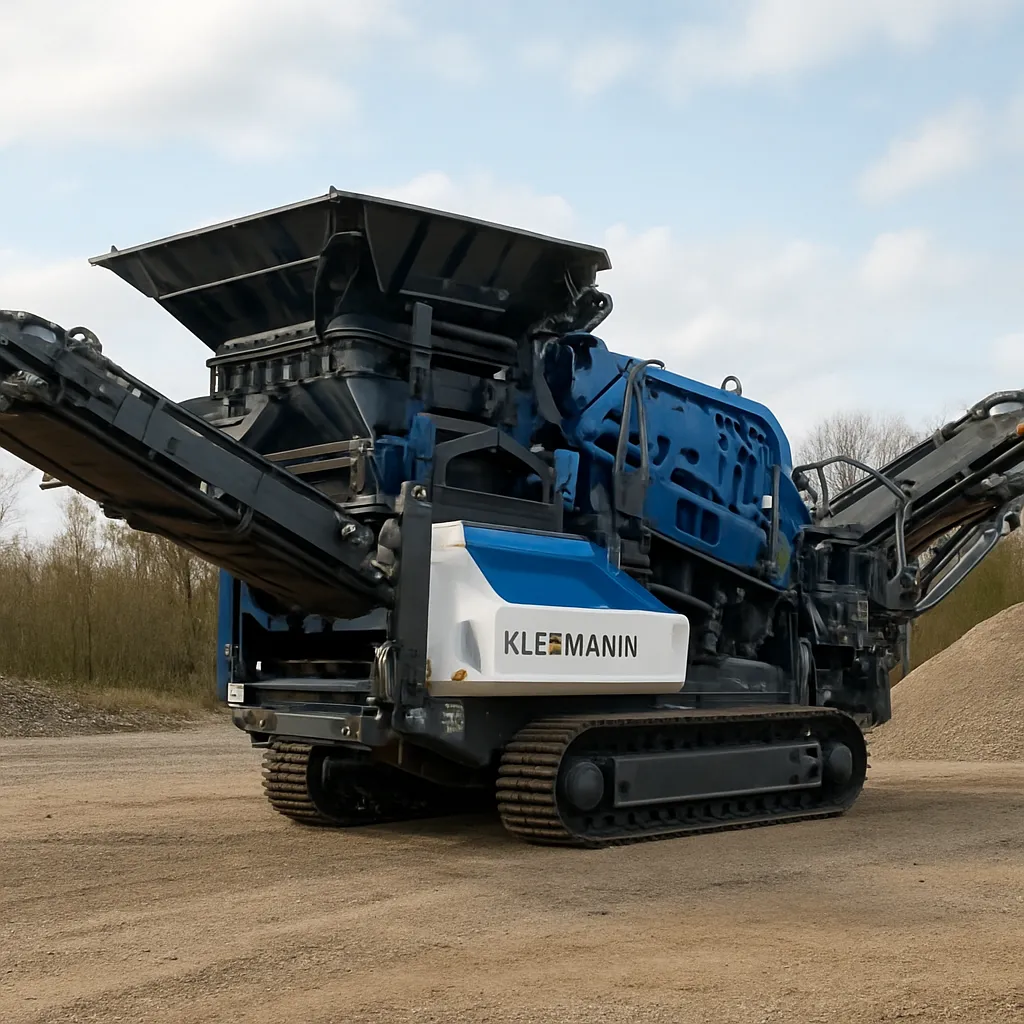
The Kleemann MOBICONE MCO 9 is a widely recognized **mobile cone crusher** designed for demanding secondary and tertiary crushing tasks in quarrying, mining, and recycling applications. Combining the advantages of a powerful cone crusher with the flexibility of a mobile plant, the MCO 9 is engineered to deliver consistent **aggregate** quality, high uptime and easy operation on congested or temporary sites. Below you will find an in-depth overview of the machine, its typical uses, main technical characteristics (presented as typical ranges where exact numbers vary by configuration), operational benefits, and practical guidance for owners and operators.
Design and key features
The MOBICONE MCO 9 is built around a robust cone crusher unit mounted on a tracked or wheeled chassis, allowing it to be moved between sites without the need for a fixed foundation. The design emphasizes compactness, quick setup, and integration with feeding and conveying systems. Key technological and design elements include:
- Modular mobility for fast transport and quick on-site assembly.
- A high-performance cone crusher chamber designed for fine and medium crushing tasks, with adjustable crushing settings.
- Integrated prescreening and circulating systems that boost overall throughput and product quality.
- Advanced hydraulic systems for rapid setting adjustment, crusher cavity changes and maintenance access.
- Operator-friendly control systems that allow remote monitoring of performance and machine parameters.
- Durable wear components and service points designed for fast replacement to minimize downtime and optimize maintenance cycles.
Typical technical specifications (indicative)
Models and configurations of the MOBICONE MCO 9 can vary by market and year. The figures below are typical values provided to give a practical sense of capability; always consult the machine’s official documentation or a dealer for exact specifications for a particular machine and configuration.
- Crushing principle: cone (hydraulically protected)
- Feed size: typically up to approx. 200–300 mm depending on feed material and crusher cavity
- Closed-side setting (CSS): adjustable, typical ranges approx. 6–50 mm depending on desired product
- Throughput/capacity: highly dependent on material hardness, feed gradation and settings; typical ranges for the MCO 9 family often fall between 100–350 t/h for medium-duty operation
- Engine power: depending on configuration and auxiliary systems, main drive power often ranges from ~150 kW to 250 kW (diesel-electric or diesel-hydraulic arrangements)
- Transport weight: variable with configuration, typical mobile cone units can be in the range of 25–45 tonnes
- Hydraulic features: automatic tramp release, hydraulic tilt and setting adjustment, and easy access for liner change
Because real-world capacity can swing considerably with rock type (e.g., limestone vs. granite), moisture content and feed size, these numbers are guidance rather than guarantees. The machine is often paired with vibrating grizzly feeders, scalping screens and conveyors that further influence performance.
Applications and industries
The MOBICONE MCO 9 is used across multiple sectors where reliable medium- to fine-crushing is required. Typical applications include:
- Quarrying: Producing aggregates for concrete, asphalt and road base, where consistent grain shape and size are essential.
- Mining: Secondary and tertiary crushing of ore where portability can shorten development times on bench faces or temporary operations.
- Construction and demolition (C&D) recycling: Reprocessing concrete, brick and masonry into reusable aggregate fractions—especially useful in urban sites where minimizing transport is crucial.
- Infrastructure projects: On-site processing of rock to supply materials for road construction, dams and rail ballast.
- Specialty applications such as producing sand fractions or shaping products for specific engineering requirements.
In recycling, the machine’s ability to handle reinforced concrete and heterogeneous feed can make it an attractive option for contractors aiming to reduce landfill disposal and purchase costs for new aggregates.
Operation, control and process integration
One of the MOBICONE MCO 9’s strengths is its capability to be integrated into a compact crushing circuit with minimal infrastructure. Operation and process aspects include:
- Integrated PLC-based controls for start/stop sequences, overload protection, and simple diagnostics.
- Remote monitoring features in many modern units, enabling supervisors to check performance data, hydraulic status and fuel consumption from a safe distance.
- Seamless connection to feed hoppers, scalping screens and conveyor networks, allowing operators to create single-truck mobile circuits or larger multi-stage systems.
- Hydraulic adjustment of the crusher gap allows operators to tweak product size on-the-fly, reducing downtime and enabling rapid response to changing product specs.
Attention to feed preparation (screening out fines and oversize) and consistent feed distribution are critical for maximizing the crusher’s efficiency and liner life.
Maintenance, wear parts and lifecycle costs
Lifecycle costs of any cone crushing plant are influenced by wear part consumption, serviceability and downtime. Key maintenance considerations for the MOBICONE MCO 9 include:
- Regular inspection of cone liners and bowl liners—wear rates depend on rock abrasivity and feed grading. Replacing liners on schedule helps preserve product quality and protects the crusher’s internal components.
- Hydraulic system service: periodic checks of hoses, seals and hydraulic oil cleanliness to avoid unexpected failures and maintain the effectiveness of safety and adjustment systems.
- Drive system checks: belts, couplings and gearbox oil levels should be inspected based on hours of operation, especially where high dust or moisture is present.
- A preventative maintenance program, including quick access panels and modular components, reduces service time. Many owners contract OEM or dealer service to ensure optimal uptime.
Good material handling practices—such as removing tramp metal and ensuring even feed—extend wear part life. When set up and maintained correctly, mobile cone units like the MCO 9 can deliver competitive lifecycle costs compared to stationary crushers because they reduce haul distances and site preparation costs.
Safety and environmental considerations
Modern mobile crushers incorporate a variety of safety and environmental features. For the MOBICONE MCO 9, these typically include:
- Hydraulic and mechanical emergency stops and lock-out systems to protect maintenance personnel during liner changes and inspections.
- Dust suppression measures such as water sprays, enclosed conveyors and dust extraction attachments to reduce airborne particulates on site.
- Noise reduction technologies and acoustic enclosures for engines and drives—important on urban or environmentally sensitive sites.
- Fuel-efficient engine management and the option of electric drives (where available) to lower emissions and fuel costs.
Adhering to site-specific environmental controls and local regulations is crucial, particularly when operating near residential areas or protected natural habitats.
Advantages and limitations
Understanding where the MOBICONE MCO 9 excels—and where it may be less suitable—helps match machine selection to project requirements:
- Advantages:
- Mobility: rapid relocation and reduced need for fixed infrastructure.
- Good product cubicality and consistent grain shape typical for cone-crushed material.
- Flexible operation with hydraulic adjustments and integrated prescreening.
- Lower secondary crusher footprint compared with multi-plant stationary installations.
- Limitations:
- For extremely coarse primary reduction, jaw crushers are generally preferred—cone crushers perform best in secondary and tertiary roles.
- Throughput is more sensitive to feed gradation and moisture than with some gyratory or larger stationary installations.
- Wear part consumption can be substantial in highly abrasive materials; planning and spare parts inventory are important.
Upgrades, options and aftermarket support
Owners commonly specify options to tailor the MCO 9 to task-specific needs. Typical optional items and aftermarket services include:
- Pre-screen or recirculating screens to increase production of target fractions and remove fines before crushing.
- Variable speed conveyors and feeder options to better match material flow to crusher capacity.
- Remote monitoring packages and telematics for fleet management and preventative maintenance alerts.
- OEM wear part kits and exchange programs to reduce replacement time and improve cost predictability.
Local dealer networks are often available for training, spare parts, scheduled maintenance and emergency repairs—critical for minimizing unplanned downtime on high-value projects.
Practical deployment scenarios and examples
Below are realistic deployment scenarios where the MOBICONE MCO 9 provides tangible benefits:
- Urban road rehabilitation: A contracting crew moves the MCO 9 between adjacent job sites, crushing asphalt and concrete into reusable base material, significantly cutting haul costs and disposal fees.
- Temporary mine face operation: When a mine needs a mobile secondary crusher to handle a new bench, the MCO 9 can be positioned close to the face to shorten haul cycles and accelerate ramp-up.
- Construction of remote infrastructure: On a remote dam site, the plant supplies various aggregate sizes without requiring a fixed crushing station, saving on capital works and permitting time.
Market and resale considerations
Mobile cone crushers tend to retain strong demand on resale markets due to their flexibility and wide applicability. Factors that influence resale value include machine hours, documented maintenance, condition of wear parts and availability of service records. Investing in a maintenance history, timely parts replacement and telemetry upgrades can preserve asset value.
Operator tips and best practices
To get the best performance and longest life from an MCO 9-style mobile cone unit, operators should follow these practical tips:
- Ensure consistent, well-graded feed and use a scalping screen to remove fines that reduce crusher efficiency.
- Monitor the crusher’s oil temperature, hydraulic pressures and acoustic signals—early detection of anomalies prevents major failures.
- Rotate and inspect liners at recommended intervals and keep a modest inventory of critical wear parts on site.
- Train operators on hydraulic lockout procedures, safe lifting points and correct liner replacement sequences to minimize risk and downtime.
Summary
The Kleemann MOBICONE MCO 9 is a versatile, high-quality mobile cone crusher that serves a broad range of secondary and tertiary crushing applications. Its strengths are mobility, adaptability and the ability to deliver consistent, well-shaped aggregates while minimizing the need for fixed infrastructure. While exact performance depends on feed characteristics and configuration, operators can typically expect robust throughput in medium-duty applications, straightforward maintenance routines and significant operational flexibility. With proper setup, maintenance and training, the MCO 9 can be a productive centerpiece in quarrying, recycling and construction operations.


)
)