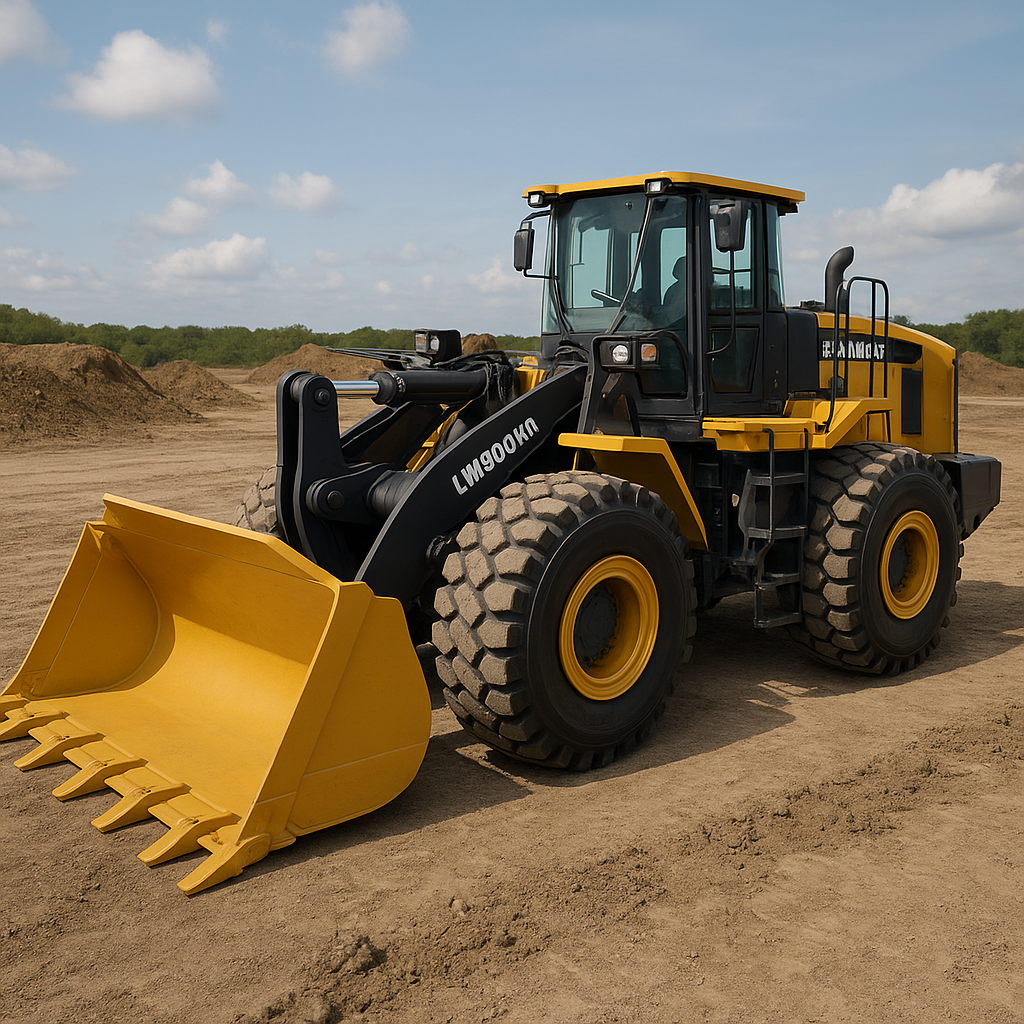
The XCMG LW900KN is a heavy-duty wheel loader designed for high-production operations in mining, quarrying, bulk material handling and large civil engineering projects. Combining robust structural design, powerful drive systems and advanced hydraulics, the LW900KN targets contractors and mine operators who need a machine with high productivity, durability and relatively low cost of ownership. This article explores the machine’s design, typical specifications, main applications, operational advantages, maintenance considerations and market position, providing practical insight for fleet managers and equipment specifiers.
Overview and design philosophy
The LW900KN is part of XCMG’s strategy to expand its presence in the large wheel loader segment by offering machines that compete on both price and capability with established global brands. The design emphasizes a balance between heavy lifting capacity and endurance in harsh environments. Key features of the design philosophy include:
- High-strength frame and boom geometry engineered for fatigue resistance and long service intervals.
- Powertrain tuned for torque and reliable operation under sustained heavy loads.
- Modular systems for easier maintenance and parts replacement.
- Cab ergonomics and visibility improvements aimed at reducing operator fatigue and increasing safety.
Engineers focus on delivering a machine that performs well in both short-cycle loading tasks and continuous haul-and-dump operations, while offering competitive fuel efficiency and parts commonality with other models in XCMG’s lineup.
Typical technical specifications and performance figures
Exact specifications for the LW900KN can vary depending on configuration, region and optional packages. Below are representative figures and metrics commonly associated with large wheel loaders in this class and with published manufacturer data where available. These should be verified with the latest manufacturer data sheets for any procurement decision.
- Operating weight: typically in the range of 35,000–45,000 kg (approximate, depending on bucket and counterweight).
- Rated bucket capacity: commonly from 6.0 to 9.0 m³ for general-purpose buckets; higher capacities available for light-density materials.
- Engine power: in the region of 300–400 kW (approximately 400–540 hp), depending on emission stage and tuning.
- Breakout force: high breakout and tilt forces to handle compacted materials and large loads; often specified in kN by the manufacturer.
- Transmission: heavy-duty torque converter with multi-gear planetary transmission or power-shift transmission designed for smooth shifting under load.
- Hydraulic system: load-sensing or fixed displacement pumps with high flow rates to ensure fast bucket cycle times and responsive controls.
- Fuel capacity: large tanks to support long shifts between refuelling (often several hundred liters).
- Tyres: designed for heavy-duty service, commonly 29.5R25 or similar sizes depending on application and bucket weight.
- Payload per pass: depending on bucket size and material density, effective payloads for production calculations typically range from 10 to 20 tonnes per pass for this machine class.
Performance measurements such as cycle time, fuel consumption per hour and tonnes per hour will depend heavily on application, material type, operator technique and site layout. In well-optimized operations, machines in this size category can achieve very high hourly throughputs when paired with appropriately sized haul trucks and optimized bucket matching.
Primary applications and use cases
The LW900KN is suited to several demanding industries where high-volume, repetitive loading is required. Typical applications include:
- Open-pit mining: loading of large haul trucks with overburden, ROM (run-of-mine) ore, waste rock and other materials.
- Quarrying and aggregates: handling blasted stone, gravel, sand and crushed aggregate into crushers, conveyors and trucks.
- Bulk material handling: transfer of coal, fertilizers, salt and other bulk materials at stockyards, ports and terminals.
- Infrastructure projects: earthmoving and backfilling on large civil works where high bucket capacity accelerates progress.
- Recycling and waste: moving bulky, heavy refuse and recyclables in transfer stations and landfill operations.
For each application, fleet planners must match bucket type and size to material density and truck capacity to avoid overloading or inefficient underloading. The LW900KN’s range of bucket options and attachments helps it adapt to a wide range of tasks.
Key components and technologies
Modern wheel loaders integrate a range of technologies aimed at improving productivity, uptime and operator experience. The LW900KN typically incorporates several such components:
- Engine and emissions systems: turbocharged diesel engines with aftertreatment to meet local emissions regulations; emphasis on fuel efficiency and long service intervals.
- Transmission and driveline: robust planetary axles and power-shift or electronically controlled transmissions to deliver power efficiently to wheels under heavy load.
- Hydraulics: high-flow hydraulic pumps and control valves for rapid bucket cycles, with options for electro-hydraulic controls.
- Cooling systems: oversized radiators and dust-tolerant fan systems to ensure reliable operation in high ambient temperatures and dusty environments.
- Operator station: comfort features such as air conditioning, adjustable seating, intuitive joystick or lever controls and clear sightlines to the working area.
- Telematics and monitoring: onboard diagnostic systems and optional fleet management telematics for remote monitoring of operating hours, fuel use, fault codes and maintenance scheduling.
- Attachment versatility: a range of buckets (general purpose, multipurpose, rock, coal), forks and specialty tools to optimise the machine for each task.
Operator comfort, controls and safety features
Productivity is strongly influenced by the comfort and safety of the operator. The LW900KN addresses these areas with several design elements:
- Spacious cab layout and reduced noise and vibration levels to decrease operator fatigue during long shifts.
- Ergonomic controls and adjustable seating to accommodate operators of differing sizes and preferences.
- High-visibility glazing and strategically positioned mirrors or camera systems to reduce blind spots and improve safety in confined yards.
- Integrated safety systems, including ROPS/FOPS structures, emergency shutdowns and system interlocks to prevent unsafe operations.
- Optional rear-view cameras, 360-degree camera packages and proximity sensors for operation in crowded environments.
Training and proper operational procedures remain essential; technology reduces risk but does not replace safe practices and competent operators.
Fuel efficiency and environmental considerations
Large wheel loaders consume significant fuel in heavy applications, so manufacturers aim to improve specific fuel consumption (fuel per tonne moved) through a combination of engine efficiency, hydraulic control and drivetrain optimization. For the LW900KN class, fuel-saving strategies include:
- Engine management systems that optimize fuel delivery for power demands rather than running at maximum output continuously.
- Hydraulic systems that reduce parasitic losses and recover energy where possible (e.g., flow-sharing valves and pump control).
- Operator aids such as automatic engine idle-down, eco modes and reversible fan functions to reduce unnecessary fuel use.
- Use of high-efficiency components and properly matched tires to reduce rolling resistance.
Operators can further improve environmental performance through correct matching of bucket size to truck payload (reducing overfill and spillage), maintaining optimal tire pressures and employing good loading techniques.
Maintenance, serviceability and lifecycle costs
One of the most important considerations for heavy equipment buyers is total cost of ownership. The LW900KN is designed with maintenance accessibility and modular components to reduce downtime. Important aspects include:
- Ground-level service points for routine checks (fluids, filters, greasing) to speed daily maintenance tasks.
- Modular engine and hydraulic components that simplify replacement and lower repair time.
- Wear-resistant materials in high-wear areas (pins, bearing surfaces, bucket teeth and cutting edges) to extend intervals between replacements.
- Availability of parts and dealer support networks can significantly affect operating costs and should be considered when purchasing.
Regular preventive maintenance and condition monitoring (oil analysis, vibration analysis for driveline components) are essential to maximize machine life and avoid costly unplanned downtime. Fleet managers should budget for consumables (tires, filters, fluids, wear parts) and potential rebuilds after heavy service life.
Market position, competitors and procurement considerations
XCMG positions the LW900KN as a value-oriented alternative to established global manufacturers, offering similar capability with competitive pricing and a strong warranty/support model in many regions. When evaluating the LW900KN against competitors, consider:
- Initial acquisition cost versus expected lifecycle costs — a lower purchase price may be offset by higher operating costs if parts and service are less accessible.
- Dealer and service network proximity — long-term uptime depends heavily on rapid parts supply and technical support.
- Resale value and brand recognition in your region — these factors influence total cost of ownership and fleet planning.
- Technical features and available options — telematics, emission standards, operator aids and attachments can differ between manufacturers.
Comparisons with loaders from other manufacturers should use real-world productivity metrics (e.g., tonnes per hour, fuel consumption per tonne) rather than only relying on spec-sheet numbers, as site conditions and operator skill heavily influence outcomes.
Case studies and example workflows
To illustrate how the LW900KN might be used in practice, here are a few example workflows and tasks where the machine can deliver value:
- In a large quarry: an LW900KN with a 7 m³ rock bucket loads 40–60 tonne haul trucks in high-cycling operations. Optimized bucket match and operator training can yield high truck fill factors and reduced truck cycle times.
- In a port terminal: used for stockpile reclaim and truck loading with a coal or bulk material bucket; telematics allow scheduling to minimize congestion and improve turnaround times.
- On a mine site: used for overburden stripping and ore feeding to primary crushers. The machine’s durability under abrasive conditions and availability of heavy-duty wear packages are key to productive uptime.
In each scenario, the LW900KN’s combination of lift capability and bucket capacity supports continuous, high-volume operations that keep downstream equipment fully loaded for maximum site efficiency.
Procurement tips and spec-matching guidance
When specifying an LW900KN or any large wheel loader, follow a structured process to ensure optimal performance and return on investment:
- Conduct a material analysis: determine typical densities, abrasiveness and lump sizes to select appropriate bucket type and capacity.
- Match loader to truck fleet: ensure single-pass loading aligns with truck payload to avoid underutilization.
- Assess site conditions: ground bearing capacity, access roads, ramp angles and turning radii affect machine mobility and tyre selection.
- Review lifecycle cost estimates: include fuel, maintenance, parts, tires and operator training in the total cost of ownership model.
- Specify telematics and monitoring options: remote data helps optimize utilisation and schedule preventive maintenance.
Strengths and limitations
Strengths of the LW900KN typically include competitive acquisition cost, strong loading performance and adaptability to a range of heavy-duty applications. Other advantages often cited by operators include robust build quality for the price and an improving global support network from the manufacturer.
Limitations may include variability in parts availability in some regions, the need to verify local dealer capabilities for complex repairs, and potential differences in operator training and documentation compared with long-established brands. Buyers should also confirm emissions compliance for their operating jurisdictions if importing machines between regions with different standards.
Future trends and developments
The heavy equipment sector is seeing several trends that will influence models like the LW900KN:
- Electrification and hybrid drivetrains for reduced fuel use and emissions in some loader classes — while full-electric large wheel loaders are still emerging, hybrid assist systems may become common.
- Advanced telematics and predictive maintenance using cloud analytics to reduce unplanned downtime and optimize parts inventory.
- Automation and operator-assist technologies that improve productivity and safety, including load-assist systems, collision avoidance and semi-autonomous loading functions.
- Materials and wear-component innovations that extend service life and reduce lifetime costs.
How quickly these technologies are adopted for machines in the LW900KN’s class will depend on regulatory pressure, fuel cost economics and operator willingness to invest in advanced systems.
Summary and practical recommendations
The XCMG LW900KN is a capable heavy wheel loader intended to serve demanding industries where high-volume material movement is required. For companies considering this machine, practical recommendations include:
- Validate specifications against your site’s material characteristics and truck fleet to choose the right bucket and drivetrain options.
- Confirm local dealer support, parts availability and warranty terms before purchase.
- Implement operator training and routine maintenance programs to maximize uptime and control operating costs.
- Consider telematics and monitoring packages from the outset to enable data-driven fleet management.
When properly specified and supported, the LW900KN can deliver strong production performance and a competitive lifecycle cost, especially for operations that require large-capacity loading and robust machinery.
Representative specification snapshot (to verify with dealer)
- Operating weight: approx. 35,000–45,000 kg
- Engine power: approx. 300–400 kW
- Bucket capacity: approx. 6.0–9.0 m³ (depending on bucket type)
- Fuel tank: several hundred liters (site-dependent)
- Recommended tyre size: heavy-duty 29.5R25 or equivalent
Final note: For procurement and operational planning, always request the latest manufacturer data sheet, optional equipment list and local support details from an authorised XCMG dealer. Real-world performance depends on correct specification, operator skill and site management practices.


)
)