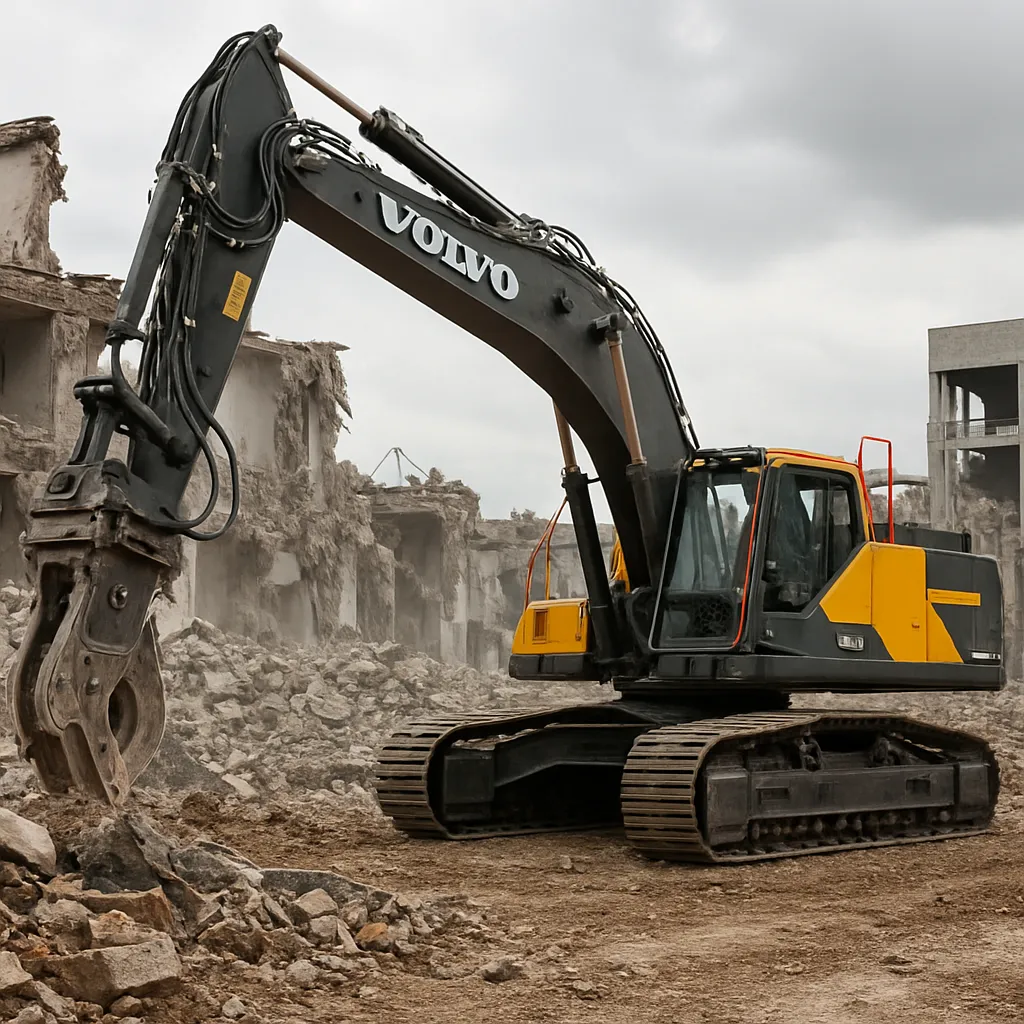
The Volvo EC380E HR is a heavy-duty excavator adapted for demanding demolition tasks and specialized earthmoving roles. Combining robust construction with purpose-built demolition options, the machine is engineered to deliver controlled, efficient, and safe performance on complex job sites. This article explores the EC380E HR’s design, typical specifications, primary applications, available attachments, operational best practices, safety and environmental features, maintenance considerations, and economic factors that influence its selection for demolition projects.
Overview and design philosophy
At its core, the Volvo EC380E HR embodies a balance between structural strength and refined hydraulic control tuned for demolition. The HR suffix indicates the high-reach capability that differentiates this variant from standard excavator configurations, allowing operators to work vertically above ground level with enhanced reach and precision. Volvo’s engineering focus for this class of machine emphasizes frame durability, reinforced undercarriage components, and hydraulic systems capable of handling long-boom loads and demolition attachments.
Key design priorities include operator visibility, stability when working with extended booms, and modularity to accept a wide range of attachments. Reinforced boom and stick geometry, heavy-duty counterweights, and a strengthened upper structure are common features on HR models to resist the increased bending moments and forces encountered during demolition. Additionally, the design often incorporates quick-coupler readiness and auxiliary hydraulic circuits to support shears, grapples, crushers, and hydraulic breakers.
Typical technical specifications and performance
Exact specifications for the EC380E HR vary by market and configuration, but typical values for the model class are useful for understanding its capabilities. These figures should be treated as approximate ranges since final numbers depend on factory options, attachment combinations, and regional variants.
- Operating weight: approximately 38,000–41,000 kg (38–41 tonnes), depending on boom length, counterweight, and attachments.
- Engine power: typical net power in the range of 180–210 kW (240–282 hp); modern Volvo engines emphasize torque delivery and emissions compliance.
- High-reach boom length: HR configurations commonly offer boom+stick combinations from about 10 m up to 18 m or more, depending on the intended demolition height and machine stability provisions.
- Hydraulic flow: auxiliary hydraulic flow and pressure are calibrated to power demolition attachments; flow ranges and pressure ratings vary by pump configuration and attachment needs.
- Bucket capacity (standard excavator): ranges from 1.2 to 2.2 m3 for general-purpose buckets when the machine is used for earthmoving rather than demolition.
- Fuel consumption: typical fuel burn for demolition work varies with intensity—moderate operations can be in the 15–25 L/h range, with heavier cutting and high-reach workloads reaching 30–40 L/h at peak demand.
- Lifting and reach capability: load capacities at extended reach are reduced compared with short-reach operation; manufacturers provide load charts specific to each HR boom configuration that should be consulted for safe lifting and attachment selection.
These performance characteristics make the EC380E HR suitable for mid-to-large scale demolition tasks where precision, reach, and stable lifting are required. The machine’s hydraulic power and robust undercarriage enable it to handle demanding attachments while retaining travel mobility between work areas.
Primary applications in demolition and supporting roles
The EC380E HR is primarily used in demolition environments where vertical reach, controlled dismantling, and material segregation are needed. Typical applications include:
- Selective dismantling of multi-storey buildings using high-reach booms to remove facades and upper floors.
- Concrete and reinforced concrete cutting with hydraulic shears and concrete crushers, supporting recycling and volume reduction of structural elements.
- Structural preparation for controlled implosions—pre-weakening or partial dismantling to reduce collapse unpredictability.
- Site clearance and sorting when fitted with grapples and sorting heads to separate steel, concrete, wood, and other materials for recycling.
- Bridge and civil structure rehabilitation where precise reach and controlled force are required to remove sections without damaging surrounding infrastructure.
- Demolition in confined urban sites where telescoping or articulating HR booms allow work from a single footprint, minimizing disturbance to adjacent properties.
Beyond pure demolition, the EC380E HR can also be configured for heavy excavation, rock work with ripper attachments, quarry loading with adapted buckets, and specialized tasks such as piling support or material handling when matched with appropriate tools.
Attachments and modularity
One of the EC380E HR’s strengths is its ability to accept a wide range of attachments, making it a versatile asset on mixed-use projects. Common options include:
- Hydraulic shears (different jaw profiles for light to heavy structural steel)
- Concrete crushers and pulverizers for primary demolition and on-site recycling
- Hydraulic breakers (pistons) for localized concrete and rock breaking
- Sorting grapples for waste handling and material segregation
- Demolition booms and sticks with multiple reach/angle configurations
- Quick couplers for rapid changeover between tools, improving productivity
- Demolition-specific protective packages for cab and hydraulics (guards, screens, hose bursts)
Choosing the correct attachment and boom geometry is critical to optimizing the balance between reach and stability. Longer booms increase reach but substantially reduce lifting capacity at the tip; therefore, job planning and adherence to the equipment’s load charts are essential for safe operations.
Safety systems and site considerations
Safety is a central concern in demolition, and the EC380E HR is typically equipped or can be fitted with features that enhance operator and site safety. These include:
- ROPS/FOPS-certified cab structures and protective guard packages for glass and windows
- Improved visibility packages: wide-view cabs, rear and side cameras, and proximity sensors
- Hydraulic lockouts, automatic idle, and engine management features to reduce unintended movements
- Emergency stop systems and remote shutdown capability in some configurations
- Specialized hose routing, guards, and abrasion-resistant lines to reduce hydraulic failure risk under impact
- Operator training and site-specific risk assessments, which are mandatory complements to the machine’s built-in safety features
Demolition sites demand strict adherence to load charts, planned demolition sequences, exclusion zones, and environmental controls (dust suppression, noise limits). The EC380E HR’s stability when equipped with correct counterweights and ground conditions is crucial—shallow soft ground or previously undermined terrain should be avoided or reinforced before HR operations.
Operator comfort and controls
Volvo places emphasis on operator comfort to improve productivity and reduce fatigue on long demolition shifts. Typical cab features include ergonomic seating with adjustable controls, climate control, low-vibration mounting, and noise insulation. Modern EC380E HR cabs often have:
- Adjustable joysticks and pedal ergonomics to suit operator preference
- Intuitive monitor displays for machine diagnostics, load indications, and camera feeds
- Visibility enhancements such as large glazed areas and thoughtfully placed mirrors
- Operator aids, including programmable work modes, attachment presets, and sometimes telematics integration for remote monitoring
Better operator conditions translate directly to safer, faster work and improved decision-making in complex demolition tasks.
Maintenance, lifecycle, and cost considerations
Total cost of ownership for a demolition-class excavator like the EC380E HR includes purchase or lease/rental cost, attachment investment, fuel, scheduled maintenance, unexpected repairs, and resale value. Key points:
- Preventive maintenance (regular hydraulic oil/filter changes, greasing of pins, inspection of wear parts) significantly extends service intervals and reduces unscheduled downtime.
- Demolition uses often accelerate component wear—hydraulic hoses, boom pins, and tracks require close monitoring.
- Use of on-site filtration systems, proper attachment matching, and operator training reduces wear and fuel consumption.
- Telematics systems (if fitted) provide valuable data on machine utilization, hours, idle time, and fault codes that facilitate proactive maintenance.
- Resale value is influenced by maintenance history, attachment inventory, and documented repair records. Well-maintained demolition machines command higher prices due to the trust in their condition.
Careful consideration of rental vs. purchase often favors rental for short-term or specialized demolition projects, where the cost to own an underutilized HR configuration may not be justified.
Environmental performance and regulations
Environmental regulations around emissions, noise, and dust control increasingly shape demolition machinery design and on-site procedures. Volvo engines typically comply with current emissions standards for each market (Tier/Stage), and machine systems include features that help reduce emissions and overall environmental impact:
- Engine management systems and selective catalytic reduction (SCR) or equivalent aftertreatment to meet emissions standards
- Idle management and auto-shutdown to reduce fuel consumption and emissions during waiting periods
- Options for biodegradable hydraulic fluids and reduced-risk lubricants
- Noise-reduction features and acoustic cab insulation to meet urban site limits
On demolition projects, environmental best practices include water spraying and dust suppression, controlled cutting methods to reduce particulate generation, and on-site material sorting to increase recycling rates. The EC380E HR’s ability to operate with sorting grapples and crushers supports higher on-site recycling, lowering transport emissions and disposal costs.
Operational tips and best practices
To maximize the effectiveness of an EC380E HR on demolition assignments, consider the following practical recommendations:
- Always consult the manufacturer’s load charts for the specific HR boom configuration before lifting or cutting near edges—capacity at reach is significantly reduced.
- Use the correct attachment for the material and operation—shears for steel, crushers for concrete, breakers for localized demolition—to improve efficiency and reduce stress on the carrier machine.
- Pre-visualize the collapse pattern when removing upper sections of structures to control debris fall and minimize secondary damage.
- Maintain clear communication with site personnel, including spotters and banksmen for operations near pedestrians and sensitive infrastructure.
- Plan for ground reinforcement or mats when operating extended reach booms to avoid ground penetration and tipping risks.
- Regularly inspect the boom, pins, hoses, and counterweights for signs of fatigue or damage; early repair prevents catastrophic failures.
Case examples and productivity indicators
While productivity varies dramatically by project complexity, attachment choice, and operator skill, some illustrative examples help contextualize the EC380E HR’s usefulness:
- Facade stripping on a mid-rise building: With a 12–14 m HR boom and sorting grapple, one machine can remove façade panels and segregate materials at a steady pace that replaces the need for multiple smaller machines plus manual labor, potentially decreasing total task time by 20–40% compared with conventional methods.
- Concrete reduction and on-site processing: Using a crusher and sorting grapple, the EC380E HR can reduce transport volumes by crushing and sorting concrete for reuse as fill, delivering both cost savings and environmental benefits.
- Steel processing with shears: For structures rich in steel, the HR machine equipped with a dedicated shear can process beams and columns efficiently, producing manageable cut lengths for recycling.
Real-world productivity metrics should always be benchmarked through initial site trials, and rental agreements that allow for trial days can help owners assess whether the EC380E HR configuration matches their project demands.
Buying, renting, and economic considerations
Deciding whether to buy or rent an EC380E HR depends on utilization forecasts, project timelines, and capital availability. Key economic considerations include:
- Fleet utilization: Purchase is attractive if the machine will be used frequently across projects; rental is better for short-term or sporadic needs.
- Attachment flexibility: Renting a base EC380E and hiring HR booms and demolition attachments as needed can be cost-effective if HR work is infrequent.
- Financing and tax incentives: Leasing options, depreciation allowances, and local incentives for low-emission machinery may influence the acquisition strategy.
- Operational cost modeling: Estimate total cost per hour including fuel, maintenance, operator, attachment wear, and transportation to determine project pricing and bid competitiveness.
Conclusion
The Volvo EC380E HR is a capable, versatile platform for a wide range of demolition tasks requiring extended vertical reach, hydraulic power, and robust machine structure. When properly configured—with the right boom length, attachments, and safety package—it enables efficient selective dismantling, material processing, and on-site recycling while offering operator comfort and advanced control features. Success with the EC380E HR depends on matching machine configuration to job requirements, diligent maintenance, and strict adherence to safety and load guidance to manage the unique risks of high-reach demolition.
Volvo’s heritage in heavy equipment, combined with the EC380E HR’s demolition-focused adaptations, make this class of machine an important tool for contractors tackling complex urban and industrial dismantling projects. Careful planning around safety, attachment selection, and site logistics will unlock the machine’s full potential, improving productivity, enabling higher recycling rates, and optimizing lifecycle costs while maintaining compliance with environmental and regulatory expectations.


)
)