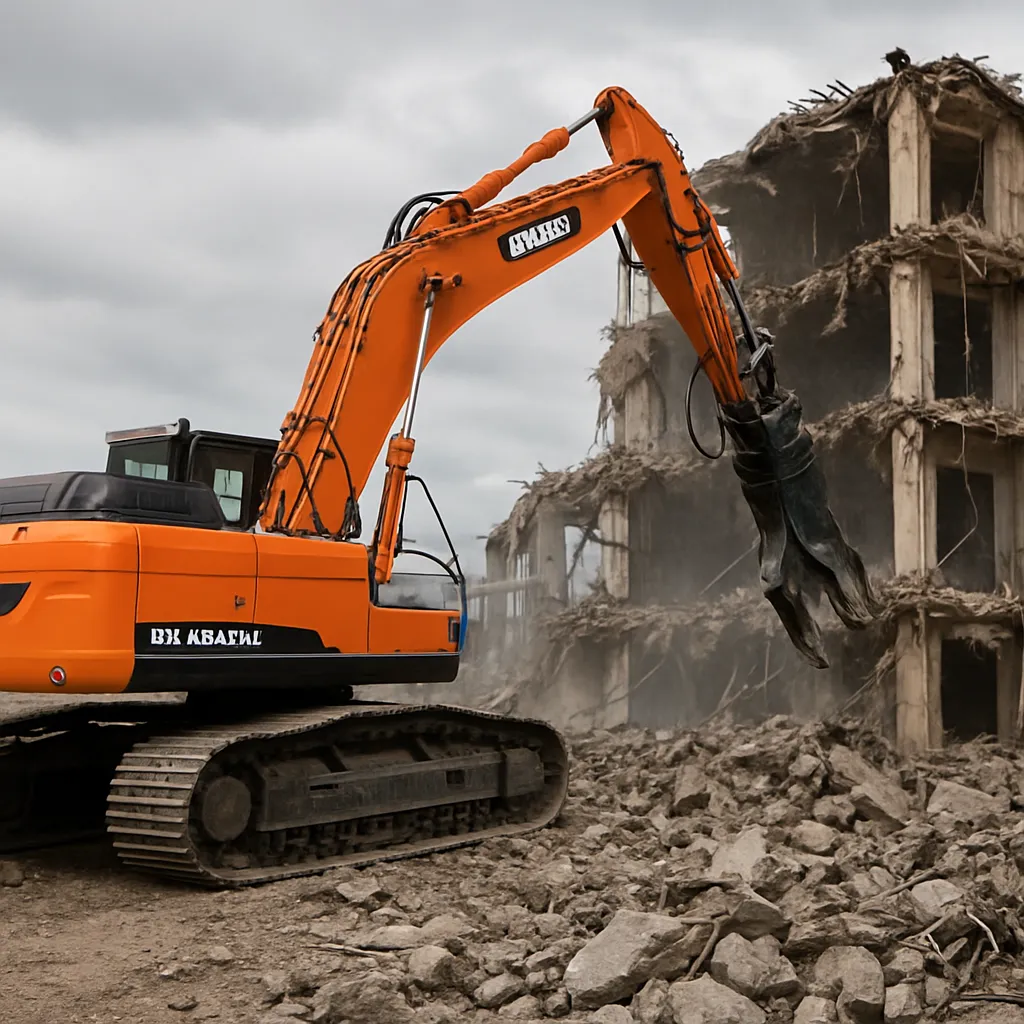
The Doosan DX380DM is a purpose-built demolition variant of Doosan’s mid-to-large excavator family, engineered to perform heavy-duty dismantling, selective deconstruction and material processing tasks on complex job sites. Combining the proven undercarriage and hydraulic platform of the DX380 series with reinforced structural components, extended reach options and a suite of specialized attachments, the DX380DM aims to deliver increased productivity, on-site safety and more efficient material handling in demanding demolition environments. This article describes the machine’s design intent, real-world applications, key technical attributes, operational considerations, and practical tips for maximizing return on investment when deploying a DX380DM on demolition projects.
Overview and design philosophy
The Doosan DX380DM derives from a robust family of crawler excavators and is adapted specifically for demolition work. At its core, the design philosophy emphasizes structural reinforcement, modularity for a variety of attachments, and operator protection in hazardous conditions. Unlike standard excavator models that are optimized for earthmoving or general construction tasks, the DX380DM typically includes:
- Reinforced booms and sticks to resist the high stresses of demolition tools and repeated impact loading.
- Additional counterweight options for improved stability during work with heavy attachments or when working at extended reaches.
- Enhanced undercarriage durability to withstand abrasive debris and the shocks generated during demolition cycles.
- Comprehensive guarding packages for the cab, hydraulic lines and critical components to reduce the risk of damage from falling debris.
The machine is often offered in configurable layouts to match job requirements: shorter-reach setups for high-power, close-in processing tasks; long-reach configurations for selective wall or structural removal; and specialty frames for scrap handling or dismantling industrial plants.
Where the DX380DM is used: primary applications
The Doosan DX380DM is tailored to multiple demolition-specific scenarios. Its capabilities make it suitable for:
- Building demolition — from selective interior strip-outs to full structure takedowns, especially where mechanical precision is required to protect adjacent structures.
- Industrial plant dismantling — decommissioning of factories, processing facilities and power plants where controlled piece-by-piece removal is necessary for safety and salvage.
- Bridge and civil structure removal — selective removal of decks, piers and approach structures, often combined with concrete processing attachments for recycling.
- Concrete and material processing — feeding crushers, mobile screens and recycling plants with processed material for reuse on site or for sale.
- Scrap handling and sorting — handling scrap steel, demolition rubble and mixed waste streams using grapples and magnets.
- Emergency response and de-risking — stabilizing damaged structures, removing hazardous components and enabling safe access for inspection and repair teams.
In each of these roles, the DX380DM’s combination of reach, hydraulic power and attachment flexibility allows contractors to adapt to fast-changing site demands while maintaining a focus on controlled, safe operations.
Key technical features and typical specifications
Doosan’s demolition machines are engineered around a durable hydraulic and undercarriage platform. While exact specifications vary by model year and regional configuration, the DX380DM typically occupies the mid- to upper-30-ton class and shares many characteristics with other large demolition excavators. Typical attributes include:
- Operating weight: generally in the range of roughly 35–40 tonnes depending on counterweights and demolition-package options, providing the mass required for stability with heavy attachments.
- Engine power: hydraulic systems are driven by engines in the 200–300 kW class (roughly 270–400 hp equivalent), tuned for consistent torque delivery at low engine speeds to power breakers, shears and processors.
- Hydraulic flow and pressure: high-flow circuits and reinforced valves delivering peak flow for large hydraulic breakers or multi-processor attachments, with system pressures often calibrated for durability under heavy cyclical loads.
- Reach options: available standard, short, long and ultra-long reach arms, with long-reach variants extending reach to 15–25 meters depending on boom/stick configurations used, enabling safe standoff demolition of tall structures.
- Attachments compatibility: a wide range including hydraulic breakers, pulverizers, shears, multi-processors, rotating grapples, sorting grapples, concrete crushers, and heavy-duty thumbs; many machines also support quick-change couplers for rapid attachment swaps.
- Cab and protection: reinforced FOPS/ROPS-certified cabs, optional mesh or polycarbonate windows, top and front guards, and slat screens for radiator and engine protection.
- Counterweight: modular counterweight plates for tailoring machine balance to specific attachment and reach setups.
These specifications are intended to be indicative; exact numbers for a particular DX380DM unit will depend on factory options, aftermarket modifications and regional emission or noise compliance packages. Contractors typically select configurations that balance reach, hydraulic power and stability for the tasks they perform most frequently.
Attachments and tooling: the heart of demolition capability
Attachments determine what the DX380DM can do on site. Because demolition tasks range from precise selective removal to brute-force dismantling, a DX380DM fleet will often include a portfolio of specialized tools:
- Hydraulic breakers — for breaking concrete and reinforced slabs; available in various sizes, breakers provide percussive force optimized for repeated impact in demanding cycles.
- Pulverizers and concrete crushers — designed to split and crush concrete while separating rebar; these can significantly reduce material volume and enable onsite recycling.
- Shears — hydraulic shears (rotating and fixed) allow cutting of steel structures, beams and rebar, making them essential in industrial dismantling.
- Multi-processors — versatile heads that combine cutting, crushing and crushing-to-cutting actions in a single attachment, optimizing cycle times in mixed-material demolition.
- Grapples — demolition and sorting grapples (rotating and fixed) for handling demolished material, performing sorting tasks and feeding processing equipment.
- Magnets and clamshells — used for scrap handling and loading tasks in recycling or salvage operations.
The DX380DM’s hydraulic power and reinforced linkage accommodate large attachments, but operators must always verify flow/pressure compatibility and use proper mounting and counterweight adjustments to ensure stability and safety when switching between tools.
Performance, fuel efficiency and productivity metrics
In demolition, productivity is measured not only by throughput (tonnes per hour of demolished material) but also by cycle times for typical operations (e.g., cut, remove, process), fuel consumption per tonne processed, and machine availability. The DX380DM is designed to optimize these metrics through:
- Powerful low-end torque for hydraulic attachments, resulting in shorter cycle times on heavy cutting and crushing tasks.
- Hydraulic load-sensing systems (on many configurations) that allocate power where it’s needed, improving fuel economy during partial-load operations.
- Robust cooling and filtration systems to maintain consistent performance during prolonged high-demand work shifts.
- Telematics and machine monitoring (often included via platforms like DoosanCONNECT or equivalent) that provide uptime statistics, fuel usage trends and maintenance alerts to maximize availability.
Typical fuel consumption will vary widely depending on attachment type, duty cycle and operator technique. For heavy demolition work with large hydraulic attachments, fuel burn rates are higher than for earthmoving: contractors can expect significantly elevated hourly consumption during peak cutting/crushing periods versus travel or idle phases. Monitoring telematics to identify high-consumption patterns and training operators on efficient attachment use can materially reduce fuel costs.
Safety, operator protection and site controls
Safety is paramount in demolition, and the DX380DM incorporates multiple systems designed to protect the operator and nearby workers:
- Cab protection — FOPS/ROPS-certified structures, laminated or polycarbonate glazing, front and top guards, and reinforced pillars to shield against falling debris and lateral impacts.
- Hydraulic line protection — armored or routed lines and protective covers to prevent sudden loss of hydraulic function from external damage.
- Visibility and sensing — large sightlines, optional cameras and proximity sensors help operators monitor attachment positions and blind spots, which is critical when working near structures and people.
- Safe standoff working — long-reach configurations enable operators to maintain a safe distance from unstable or collapsing structures.
- Ground stability monitoring — best practices include frequent ground condition assessments and ensuring that the excavator’s ground pressure and undercarriage are matched to site conditions to prevent overturning or track sinkage.
Proper personal protective equipment (PPE), exclusion zones and communication protocols remain essential complements to machine-level safety features. Demolition managers should integrate machine capabilities with site-specific safety plans and daily pre-shift inspections focusing on guarding, hydraulic integrity and attachment security.
Maintenance, lifecycle and total cost of ownership
Demolition duties are tough on equipment. To preserve asset value and keep the DX380DM productive, operators and fleet managers should prioritize:
- Daily inspections of wear items: pins and bushings, boom/stick welds, wear plates, undercarriage components and attachment interfaces.
- Hydraulic system checks: filter changes, fluid analysis and hose inspections to avoid catastrophic failures under pressure.
- Cooling system maintenance: cleaning radiators and coolers to prevent overheating when machines operate in dusty, debris-filled environments.
- Scheduled preventive maintenance: adhering to manufacturer-recommended service intervals for engine, transmission and hydraulic components.
- Use of telematics for predictive maintenance: monitoring trends in operating hours, fuel consumption and fault codes to schedule service before failures occur.
Although initial acquisition cost for a demolition-configured DX380DM will be higher than a standard excavator (due to reinforced structures, guarding and specialized attachments), total cost of ownership can be favorable when factoring in reduced downtime, higher throughput and resale value for well-maintained demolition machines. Investment in high-quality attachments and training for operators further improves lifecycle economics by reducing wear and increasing efficiency.
Operational best practices and tips
To get the most out of a DX380DM on demolition projects, the following practices are commonly recommended by experienced contractors:
- Match reach and attachment size to the task: avoid using the largest attachment possible if a smaller tool would be more precise and consume less fuel.
- Plan material flow: sequence demolition so that processed material can be efficiently sorted and moved, minimizing re-handling.
- Train operators on attachment control and maintenance: skillful operators reduce cycle times and prevent unnecessary damage to the machine and attachment.
- Use remote cameras and spotters when working near utilities or in confined spaces where visibility is limited.
- Rotate machines and attachments across the fleet to balance wear and extend component life.
Applying these techniques helps to maximize uptime and ensures that the machine’s capabilities are aligned with project timelines and safety requirements.
Market context and statistical considerations
Specific public domain statistics for a single model like the DX380DM can be limited because demolition variants are often sold as customized units through dealers and aftermarket specialists. However, some general market observations are useful:
- The 30–40 tonne excavator class remains one of the most popular for medium-to-large building demolition and plant dismantling because it balances mobility and attachment capacity.
- Demolition-focused machines typically achieve higher utilization rates on urban projects and industrial decommissioning sites compared with general-purpose excavators because of their specialized nature.
- Telematics adoption across construction fleets has been increasing, and machines equipped with monitoring systems can reduce unplanned downtime by a noticeable margin—industry studies often cite reductions in downtime of 10–25% with active telematics and predictive maintenance programs in place.
- Recycling of construction and demolition waste is a growing priority; excavators fitted with pulverizers and crushers can help contractors recover material that offsets disposal costs and even generates revenue, improving per-project economics.
When evaluating the DX380DM, fleet managers should compare acquisition and operating cost per tonne of demolished material against alternatives (e.g., smaller excavators operating alongside mobile crushers, or larger stationary demolition rigs) to determine the optimal equipment mix for their market.
Case studies and real-world examples
While specifics vary between projects, typical examples of where a DX380DM excels include:
- Urban selective demolition: contractors use the DX380DM in a dense downtown teardown, employing long reach for façade removal while protecting neighboring properties; a rotating grapple and pulverizer allow onsite separation and size reduction for recycling.
- Industrial plant decommissioning: the DX380DM dismantles structural steel columns using shears and a rotating grapple to sort recyclable steel, while pulverizers process concrete floor slabs for reuse as sub-base material.
- Bridge demolition and replacement: using an extended reach configuration, the machine removes spans in controlled segments; processed concrete is crushed and stockpiled for future use on the same job.
Each of these use cases highlights the machine’s role in improving safety by enabling stand-off work, enhancing productivity through attachment versatility, and contributing to sustainability by enabling material recovery and recycling.
Choosing the right DX380DM configuration
Selecting the correct configuration depends on project profile. Consider:
- Primary duties — predominately cutting and shearing, or crushing and processing? Choose attachments and hydraulic packages accordingly.
- Typical reach requirements — urban, close-in work requires different booms than high standoff demolition.
- Transport and logistics — larger long-reach setups may require special transport permits; factor transport costs into the equipment plan.
- Support infrastructure — ensure that the site can accommodate the machine’s weight and that adequate fuel and maintenance support are available.
Working with a dealer experienced in demolition packages can greatly simplify the selection and spec process, ensuring machine balance, hydraulic matching and correct guarding are applied before the machine arrives on site.
Conclusion
The Doosan DX380DM represents a purpose-engineered solution for demolition contractors seeking a balance of power, versatility and protection. Its reinforced platform, compatibility with a broad array of demolition attachments, and emphasis on operator safety make it a strong candidate for a range of tasks from selective deconstruction to heavy industrial dismantling. While precise specifications depend on configuration and regional variants, the DX380DM’s core strengths are its adaptability to different demolition roles, its ability to operate with large hydraulic tools, and its contribution to safer, more efficient demolition workflows. Contractors considering this machine should weigh attachment needs, reach requirements, transport logistics and maintenance support to ensure the selected build delivers the best long-term value on their projects.


)
)