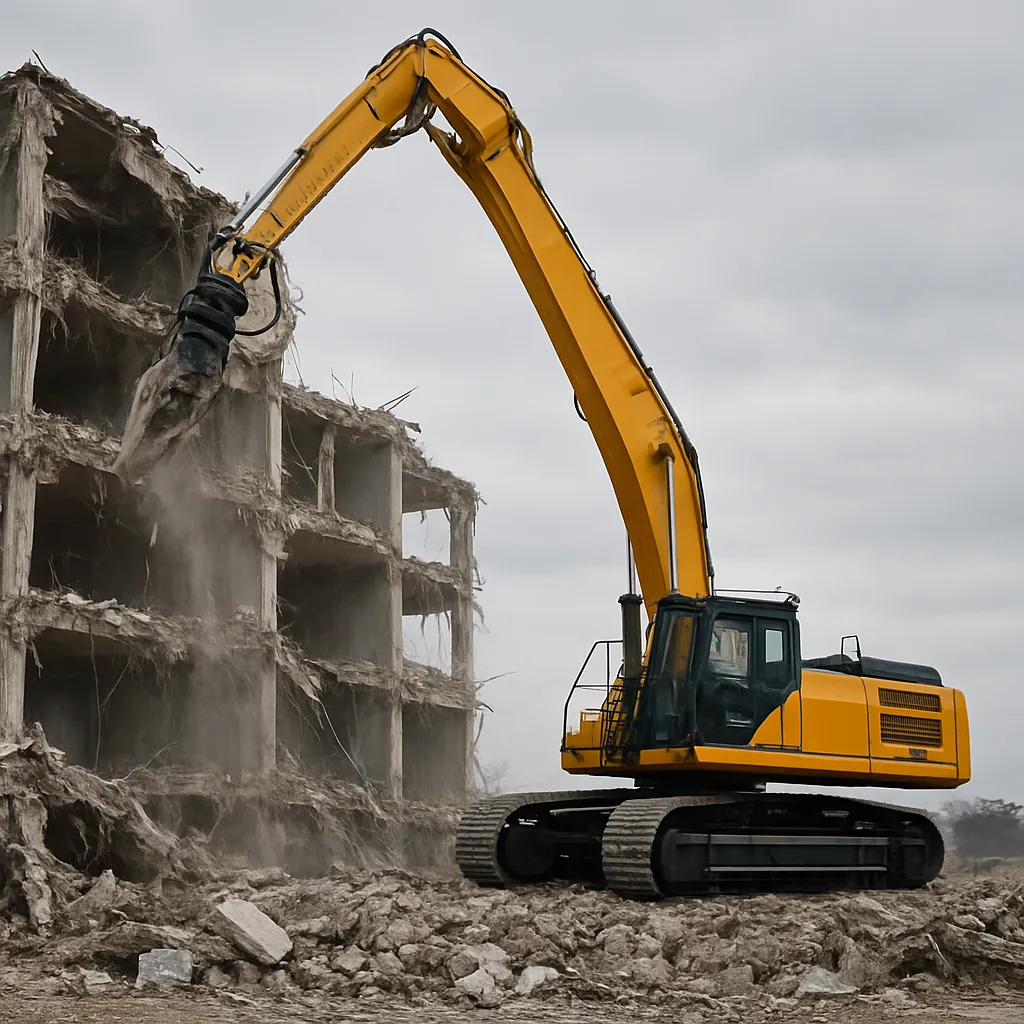
The CAT 330 UHD (Ultra High Demolition) is a purpose-built excavator variant designed to meet the demanding needs of controlled demolition and selective deconstruction in urban and industrial environments. Combining the proven undercarriage and hydraulic systems of the Cat 330 family with reinforced structures, extended booms and specialized attachments, the 330 UHD delivers the reach, strength and operator protection required for complex tear-down jobs. This article explores the machine’s typical uses, technical characteristics, operational advantages, and practical considerations for owners and operators.
Design and core features
The CAT 330 UHD is not simply a standard excavator with a longer boom: it is re-engineered in several areas to handle the unique stresses of high-reach demolition work. Key design elements focus on structural reinforcement, safety, and hydraulic power distribution so the machine can safely control heavy attachments at extended radii.
Structural and chassis modifications
- Reinforced upper frame and strengthened boom and stick pins to withstand high bending moments and repetitive impact.
- Heavy-duty counterweight packages to maintain stability when working at long reach distances and with heavy tools.
- Optional track and undercarriage configurations to adapt ground pressure and mobility for urban demolition sites.
Hydraulics, controls and cab protection
- High-flow hydraulic circuits to power large demolition attachments such as shears, crushers, pulverizers and hydraulic breakers.
- Advanced control systems enabling smooth, precise movement of long booms and tools, often with flow sharing and pilot controls for nuanced operation.
- Operator protection packages including reinforced cages, ballistic glass alternatives, and blast- or falling-object guarding to ensure crew safety in hazardous environments.
Attachments and quick-change systems
One of the machine’s principal strengths is the ability to switch between a range of demolition attachments. Quick couplers and dedicated hydraulic plumbing let operators move from shears to grapples to crushers efficiently, maximizing uptime and adaptability on multi-stage projects.
Where the CAT 330 UHD is used
The 330 UHD is most at home in projects where reach, controlled dismantling and operator safety are essential. Its specific applications include:
- Urban building demolition — taking down façades, upper floors and load-bearing structures in confined city sites without the need for explosives or large wrecking balls.
- Selective deconstruction — removing structural elements for salvage or refurbishment where precision is necessary to protect adjacent structures.
- Industrial plant dismantling — decommissioning factories, chimneys and process equipment where reach and specialized tools are required to access elevated components.
- Bridge and elevated structure work — selective removal of concrete and steel spans where reach and stability are critical.
- Post-disaster recovery — careful removal of damaged structural elements to support search-and-rescue and stabilization activities.
Because the machine can operate from a safe distance and handle a variety of tools, it reduces the need for scaffolding, reduces human exposure to falling debris, and accelerates phased demolition schedules.
Typical specifications and performance (general guidance)
Exact specifications for a CAT 330 UHD vary by model year, configuration and regional emission package, but the following ranges and performance characteristics are representative of the class and the UHD adaptation. Values should be confirmed with the manufacturer or equipment dealer for specific serial numbers and builds.
- Operating weight: typically in the 30 to 40 metric ton range for UHD-configured machines, depending on counterweight and attachments.
- Working reach: UHD booms commonly extend the working reach to roughly 15–25 meters (50–82 feet) measured to the tool pivot, with specialized long-reach options possibly exceeding this.
- Engine power: mid-class excavator engines in the 150–250 kW (200–335 hp) band are common, adjusted for emissions standards (Stage V, Tier 4 Final, etc.).
- Hydraulic flow: high-flow circuits delivering hundreds of liters per minute to support power-hungry attachments; exact flow rates depend on pump configuration.
- Lifting capacity: load charts vary with boom/stick geometry and counterweight; lifting capacity decreases significantly at long reach distances and must be validated from manufacturer load tables for safe operation.
Fuel consumption and operating costs are highly variable. Typical heavy demolition cycles will consume more fuel than earthmoving due to sustained hydraulic loads, intermittent high-power peaks and extended idling for repositioning. Operators can expect fuel burn that fluctuates widely based on attachment type and duty cycle; in general, heavy demolition can consume tens of liters per hour under continuous heavy loads.
Operational advantages and real-world benefits
The 330 UHD delivers several practical benefits that make it a preferred choice for specific demolition scenarios:
- Precision and control: The machine’s hydraulic characteristics and extended reach allow operators to remove targeted elements without collateral damage to neighboring structures.
- Reduced site footprint: Compared with larger heavy demolition platforms or implosion approaches, the CAT 330 UHD can work from smaller staging areas, an advantage in dense urban settings.
- Lower overall cost for many jobs: For mid-rise buildings and selective deconstruction, the machine often provides cost savings versus mobilizing much larger high-reach excavators or multi-crane demolition rigs.
- Improved safety: Engineered cab protection, remote-control options and the distance afforded by the long reach reduce operator exposure to falling debris and other hazards.
- Versatility: Quick-change attachment systems allow one machine to perform multiple demolition tasks within a single job, increasing productivity and utilization.
Productivity considerations
Productivity of a 330 UHD on demolition tasks depends on: attachment selection, operator skill, sequencing of demolition, and site logistics such as material handling and access. Typical productivity advantages over smaller excavators include the ability to work at elevation without erecting temporary platforms and the capacity to handle larger pieces of structure in single lifts when conditions permit.
Safety, regulations and environmental factors
Demolition is a high-risk activity that is governed by local regulations and site-specific safety plans. The 330 UHD integrates many design features to help comply with rules and protect crews, but safe operation requires an organizational commitment to training, inspections, and regulatory compliance.
Safety systems and operator protection
- ROPS/FOPS-certified cabs and optional external cages or guards to protect against falling-object hazards.
- Visibility aids such as cameras and proximity sensors to help operators maintain situational awareness when working at height or around adjacent structures.
- Remote-control operation options on some units allow operators to control the machine from a safer distance when collapse risk is high.
- Integrated or aftermarket fire suppression and dust control systems to mitigate secondary hazards during demolition.
Environmental and emissions considerations
Modern Cat engines are offered to meet regional emissions standards (Tier 4 Final in North America, Stage V in Europe). UHD demolition work can generate significant dust and noise; mitigating measures include:
- Water misting and dust suppression systems attached to the machine or deployed on site.
- Acoustic enclosures, scheduling noisy operations to minimize community impact, and compliance with local noise ordinances.
- Segregation and recycling plans for concrete, steel and other materials to reduce landfill disposal and achieve sustainability targets.
Maintenance, lifecycle and total cost of ownership
To keep a CAT 330 UHD productive and safe, proactive maintenance is essential. Because UHD machines operate under severe load cycles at extended reaches, wear rates on structural pins, bushings, hydraulic hoses and boom components can be higher than standard excavator service profiles.
Key maintenance practices
- Frequent inspection of boom and stick welds, pins and bushings for signs of fatigue or wear.
- Regular hydraulic oil and filter changes using manufacturer-recommended fluids and contamination-control practices.
- Monitoring undercarriage wear and maintaining proper track tension to avoid uneven stresses during high-reach operations.
- Attachment inspection and maintenance—particularly shear blades and jaw teeth—because damaged tooling significantly reduces productivity and can overload the machine.
- Scheduled structural inspections and non-destructive testing on components exposed to high-stress cycles, especially before and after major jobs.
Well-maintained units retain higher resale values and have lower unplanned downtime. For owners, total cost of ownership should account for fuel, attachments, transport (long-reach booms and counterweights can increase shipping requirements), insurance, and specialized maintenance.
Choosing the right machine and attachments
Selecting the correct CAT 330 UHD configuration requires aligning project requirements with machine capabilities. Factors to evaluate include building height and structure, attachment types, site access constraints and the expected production rate.
- Attachment selection: Shears and crushers are common for structural steel and concrete; pulverizers and breakers are used for concrete reduction; grapples and thumbs facilitate material handling and sorting.
- Reach versus stability: Longer booms increase reach but reduce lifting capacity and stability at extended radii. Matching counterweight and boom geometry to expected lifts is crucial.
- Transport and logistics: Some UHD configurations require disassembly or specialized trailers. Assess mobilization times and costs when planning bids.
- Operator skill and training: High-reach demolition demands experienced operators and often specific training on attachments and demolition sequencing.
Market context and comparative considerations
Within the demolition industry, the 330 UHD occupies a niche between smaller demolition excavators (used for low-rise selective work) and much larger, purpose-built high-reach platforms used for very tall structures. Its advantages lie in flexibility and lower operating costs for mid-rise and selective demolition projects. Fleet managers often pair the 330 UHD with material-handling machines, mobile crushers and trucks to create an integrated demolition and recycling workflow.
While specific sales and fleet statistics for the CAT 330 UHD vary by region and over time, the broader trend in demolition equipment has been toward machines that offer improved fuel efficiency, modular attachments, and enhanced safety systems. These trends favor machines like the 330 UHD that can be adapted to multiple task profiles without the need for multiple specialty machines.
Best practices for site planning and operation
Successful demolition with a 330 UHD depends as much on planning as on machine capability. Recommended best practices include:
- Comprehensive pre-demolition surveys to locate utilities, asbestos and structural conditions that could affect sequencing.
- Detailed lift and demolition plans that account for load charts at specific boom reaches and the impact of dynamic loads.
- Dust, noise and vibration mitigation strategies tailored to surrounding communities and adjacent assets.
- Coordination with rigging and transport teams to manage the movement of large components that the excavator cannot handle safely.
- Continuous operator training and toolbox talks focused on attachment-specific hazards and emergency procedures.
Concluding perspective
The CAT 330 UHD fulfills a vital role in modern demolition and deconstruction, combining extended reach, adaptability and safety to execute complex projects in constrained or sensitive environments. For contractors focused on urban demolition, industrial dismantling, or selective deconstruction, the 330 UHD can provide a strong balance of productivity and operational flexibility. Selecting the right configuration, investing in operator training and committing to rigorous maintenance are the keys to realizing the full value of the machine.
Key terms: high-reach, demolition, reach, versatility, safety, operator, attachments, fuel efficiency, maintenance, productivity


)
)