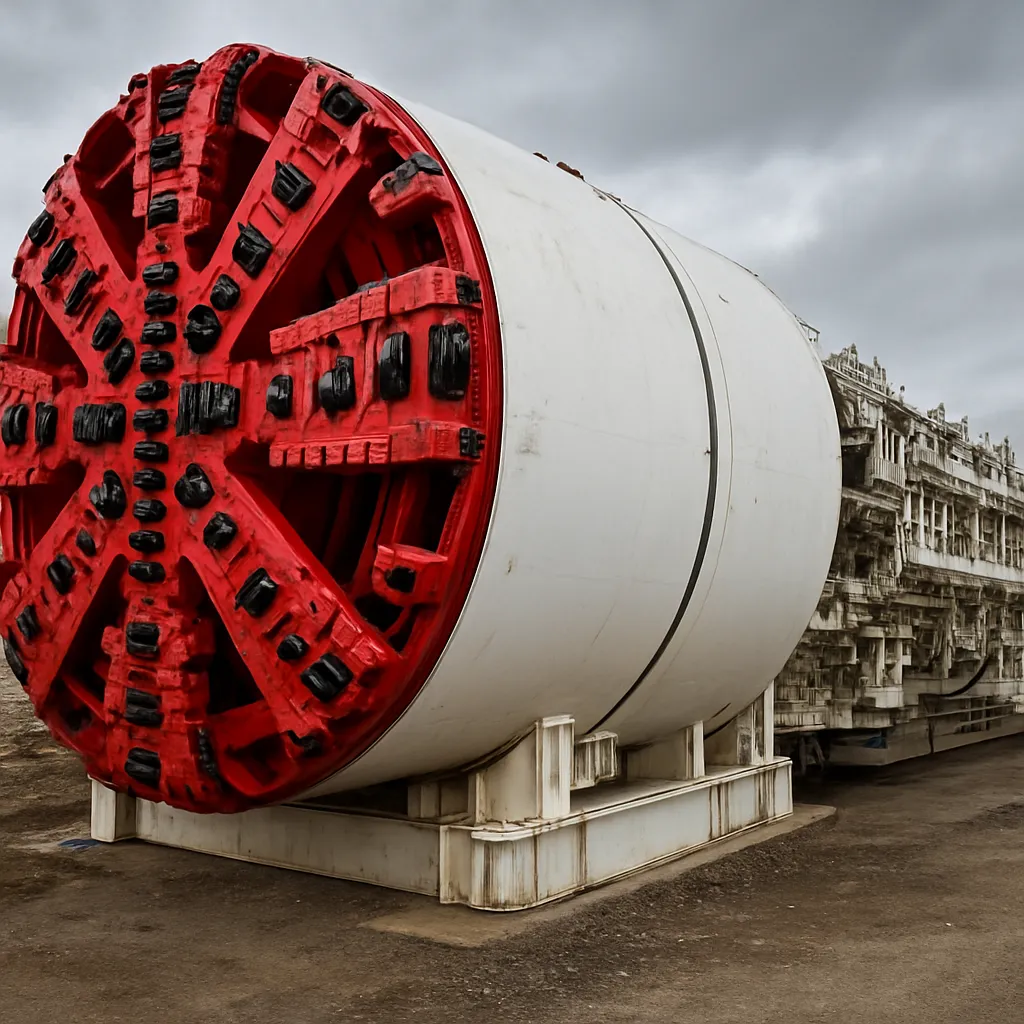
The Mitsubishi TBM EPBM represents a class of modern underground construction equipment developed to cope with the most demanding soft-ground tunneling projects. Combining decades of engineering experience with specialized features for face support and spoil handling, this type of machine is frequently selected for urban metro lines, utility tunnels, sewer and water conveyance projects, and any application where stable excavation through variable, often water-bearing soils is required. The following article examines the machine’s characteristics, uses, operational principles, and practical considerations for owners, contractors, and engineers.
Overview of Mitsubishi TBM EPBM
The term EPBM stands for Earth Pressure Balance Machine — a type of tunnel boring machine designed specifically to balance the earth and groundwater pressures at the tunnel face during excavation. Mitsubishi, as a major engineering and manufacturing company, has provided TBMs and tunneling systems that incorporate EPB principles, often tailored to specific project needs. EPBMs are recognized for enabling continuous excavation in soft and mixed ground by maintaining a controlled pressure in a chamber directly behind the cutterhead and at the face.
Key conceptual features of an EPBM from Mitsubishi or any major supplier include a rotating cutterhead with replaceable tools, a pressurized excavation chamber, spoil treatment and removal systems (typically screw conveyors), a powerful thrust and torque system, and an integrated trailing gear area for segmental lining erection, slurry or chemical conditioning units, and control equipment.
Design and Technical Features
Mitsubishi TBM EPBMs are engineered with attention to several critical sub-systems. While exact configurations vary by contract and ground conditions, the general technical components and design philosophies include:
- Geometry and Diameter: EPBMs are manufactured in a wide range of diameters to match the tunnel cross-section — from small service tunnels to large twin-track metro bores. Diameters typically span from below 4 m to well above 10 m depending on the project.
- Pressurized Face Control: The machine contains a sealed excavation chamber immediately behind the cutterhead where the soil is retained and its pressure controlled. This balances the external groundwater and earth pressures to prevent face collapse and surface settlement.
- Spoil Handling: A primary feature is a screw conveyor or series of conveyors that transport excavated material from the pressure chamber to the rear of the machine. Conditioning agents (foam, bentonite slurry, polymers) may be injected to change the rheology of the spoil and ease removal.
- Traction and Thrust: Hydraulic jacks anchored against the previously installed lining push the cutterhead forward. Thrust systems are sized to overcome cutterhead resistance and friction between the shield and ground.
- Segmental Lining System: Most EPBM-driven tunnels use precast concrete segmental rings installed via a trailing assembly. The lining provides immediate structural support as the machine advances.
- Instrumentation and Controls: Modern Mitsubishi units include advanced control cabins, automated data logging for parameters (face pressure, torque, thrust, advance rate, spoil volume), and remote diagnostic capabilities.
- Adaptability: Modular cutterheads, replaceable wear components, and configurable chamber volumes allow the machine to be adapted for mixed-face tunneling where soils change along alignment.
Applications and Use Cases
The primary advantage of the EPB-type TBM is its suitability for soft ground and water-bearing strata where controlling face stability is critical. Typical project types are:
- Urban metro and light rail tunnels where surface settlement must be minimized to protect existing structures and utilities.
- Utility tunnels such as stormwater, sewage, and potable water conveyance where continuous, lined bores are required.
- Under-river or harbor crossings where groundwater pressures and mixed sediments are common.
- Road bypass tunnels and service ducts in suburban and rural settings, particularly where open-cut methods are impractical.
Because they maintain a pressurized face and can control muck properties, EPBMs are particularly effective in clays, silts, sandy clays, and heterogeneous mixed-face conditions, and can be used where groundwater control by dewatering would be environmentally or technically challenging.
Operational Principles and Workflow
Understanding how an EPBM operates clarifies why it is selected for sensitive projects. The typical excavation cycle comprises:
- Face Excavation: The cutterhead rotates and cuts or loosens soil at the face. Cutters and tools are chosen for ground types.
- Chamber Filling and Pressure Control: Excavated material fills the pressure chamber, and the machine operator regulates chamber pressure to balance the outside pressures, preventing inflow of water or collapse.
- Spoil Conditioning: Additives such as foam, polymers, or bentonite are injected to condition spoil rheology, reducing adhesion and improving conveyance.
- Spoil Removal: Conditioned spoil is moved rearward by a screw conveyor and discharged to conveyors or muck cars in the trailing gear area.
- Advance and Lining Erection: Hydraulic thrusting pushes the shield forward a controlled stroke. Segmental concrete rings are lowered and assembled in the tail void behind the shield, often accompanied by grout injection to fill annulus gaps.
- Instrumentation Feedback: Operators continuously monitor pressures, torque, thrust, and cutterhead speed, adjusting conditioning and operational parameters to maintain safe and productive advance.
Performance and Statistical Ranges
Performance metrics for an EPBM depend heavily on geology, machine diameter, conditioning strategy, and project logistics. Some typical ranges and industry observations include:
- Advance Rates: In favorable soft ground, small-diameter EPBMs can achieve daily advances measured in tens of meters; however, in mixed or challenging ground, rates can fall to under a meter per day. A realistic expectation for planning is a wide range, often from a few meters up to 20–30 m/day in optimal conditions for smaller machines; larger diameter machines commonly post lower linear advances due to increased excavation volume per meter.
- Power and Torque: Drive power and cutterhead torque scale with machine diameter. Typical cutterhead torque for small-to-medium EPBMs may be in the low hundreds to low thousands of kN·m, and electric drive power can range from a few hundred kilowatts to several megawatts for larger machines.
- Spoil Volume: Spoil volume is governed by tunnel cross-sectional area and overcut; for each meter of tunnel, the carved volume can be calculated and used to size conveyors, muck handling, and disposal arrangements.
- Shield and Lining Tolerance: Modern EPBMs maintain very precise line and level by using guidance systems and jacking control, enabling minimal overcut and reduced secondary grouting requirements.
- Reliability and Availability: Machine availability depends on maintenance strategies; well-managed EPBM projects report high availability percentages (often exceeding 70–80% on some projects), but this varies significantly with site conditions and logistics.
Note: the values above are indicative industry ranges. Individual Mitsubishi EPBM installations are customized and their actual daily progress, power, and torque will be specific to a given jobsite.
Maintenance, Wear Parts, and Logistic Considerations
Like all TBMs, the Mitsubishi EPBM requires a comprehensive maintenance regime to sustain performance and safety. Important aspects include:
- Wear Parts Management: Cutter tools, cutterhead segments, screw conveyors, and seal systems are subject to wear. Proactive replacement schedules and onsite spare stocks reduce downtime.
- Predictive Maintenance: Vibration monitoring, thermography, and oil analysis help predict failures in gearboxes, bearings, and hydraulic components.
- Access and Retrieval: The design must allow cutterhead and drive component replacement, often in constrained underground spaces. Removable cutterhead segments and modular shields streamline repairs.
- Logistics: Muck removal, lining segment supply, spoil disposal sites, and conditioned-material storage must be coordinated. Urban projects often require night deliveries and tight traffic management.
- Spare Parts and Supply Chain: For major components, lead times can be substantial. Contractors and owners often negotiate spare part packages and local stocking to avoid long stoppages.
Ground Conditioning and Additives
One of the EPBM’s strengths is its ability to work with chemical and mechanical ground conditioning to make spoil transport and face stability easier. Typical conditioning techniques include:
- Foam Injection: Reduces adhesion and improves flow of cohesive soils into the screw conveyor.
- Bentonite Slurry: Creates a lubricating layer and stabilizes the face, commonly used where fines and clays dominate.
- Polymer Slurries: Tailored polymers modify spoil rheology to reduce torque peaks and clogging.
- Mechanical Mixing Devices: Some machines include internal mixers to blend additives thoroughly with excavated material.
Conditioning is adjusted dynamically based on sensor feedback to maintain the optimal balance between face pressure and spoil properties.
Safety, Settlement Control and Environmental Factors
Safety and environmental performance are central to EPBM selection in urban settings. Considerations include:
- Settlement Management: By controlling face pressure and annular grout, EPBMs can limit surface settlement to millimeter-scale in many circumstances, protecting buildings and utilities.
- Groundwater Control: EPBMs avoid aggressive dewatering that could cause subsidence or affect nearby wells; managing groundwater inflow via the pressurized chamber is preferred.
- Muck and Water Treatment: Conditioning agents and soil fines require appropriate treatment before disposal. Slurry separation plants and dewatering systems are commonly integrated into jobsite logistics.
- Worker Safety: The pressurized environment reduces ground collapse risk but introduces confined-space and pressurization hazards managed via strict procedures and training.
Case Types and Notable Project Profiles
While Mitsubishi TBM EPBMs have been applied across a wide spectrum of tunnels worldwide, the types of projects where they excel include:
- Deep urban metro lines often tunneled beneath sensitive historical centers or densely built neighborhoods where settlement control is vital.
- Long water conveyance tunnels under rivers or coastal zones where slurry pressures and heterogeneous sediments exist.
- Utility diversions in congested corridors where surface disruption must be minimized and continuous lined bores are required.
Project profiles typically highlight customization: cutterheads designed for mixed face with open and closed tool arrangements, sophisticated spoil conditioning circuits for high clay content, and enhanced instrumentation for real-time decision making.
Economic Considerations and Project Planning
Selecting an EPBM involves cost-benefit trade-offs. Upfront investment in a TBM and supporting infrastructure is significant, but benefits include:
- Reduced surface disruption compared with open-cut methods.
- Enhanced safety and predictable schedule in challenging ground conditions.
- Lower long-term environmental impact due to minimal dewatering and controlled spoil handling.
Key planning items for owners and contractors include detailed geotechnical investigations, risk allowances for schedule and performance, contingency planning for mixed-face conditions, and clear arrangements for spoil disposal and segment production.
Technological Trends and Innovations
Mitsubishi and the broader TBM industry continue to innovate. Current trends include:
- Advanced sensor suites and automation to provide better face control and to reduce operator dependence.
- Improved materials and coatings for wear parts to extend life and reduce replacement frequency.
- Hybrid face systems capable of switching modes for different strata during a single drive.
- Energy-efficient drives and regenerative systems to reduce operational power consumption.
- Remote monitoring and digital twin systems enabling off-site specialists to support troubleshooting and optimization.
Practical Tips for Contractors Considering a Mitsubishi EPBM
For contractors evaluating EPBM procurement or rental, several practical recommendations can improve outcomes:
- Invest in comprehensive geotechnical exploration along the full alignment to minimize surprises.
- Negotiate spares and service agreements to reduce idle time during critical wear events.
- Plan muck logistics and treatment before machine launch, including contingency for higher-than-expected spoil volumes.
- Train operators and maintenance teams specifically for EPB operation, spoil conditioning, and pressurized chamber safety.
- Use trial sections or pilot bores where project budgets and timelines permit, especially for novel ground conditions.
Summary and Key Takeaways
The Mitsubishi TBM EPBM embodies a purpose-built approach to soft-ground and mixed-face tunneling by combining a pressurized face, integrated spoil conditioning and removal, and robust lining installation systems. Its principal advantages are the ability to control settlement, manage groundwater, and sustain continuous excavation in challenging soils. Successful deployment depends on meticulous geotechnical characterization, effective spoil conditioning and logistics, disciplined maintenance and replacement of wear parts, and careful planning for environmental and safety controls.
For those planning or executing subterranean projects where subsurface conditions are variable and surface impact must be minimized, the EPBM is often the preferred machine type. When paired with experienced operational teams and a sound risk-management strategy, a Mitsubishi EPBM can deliver safe, efficient, and predictable tunneling performance.


)
)