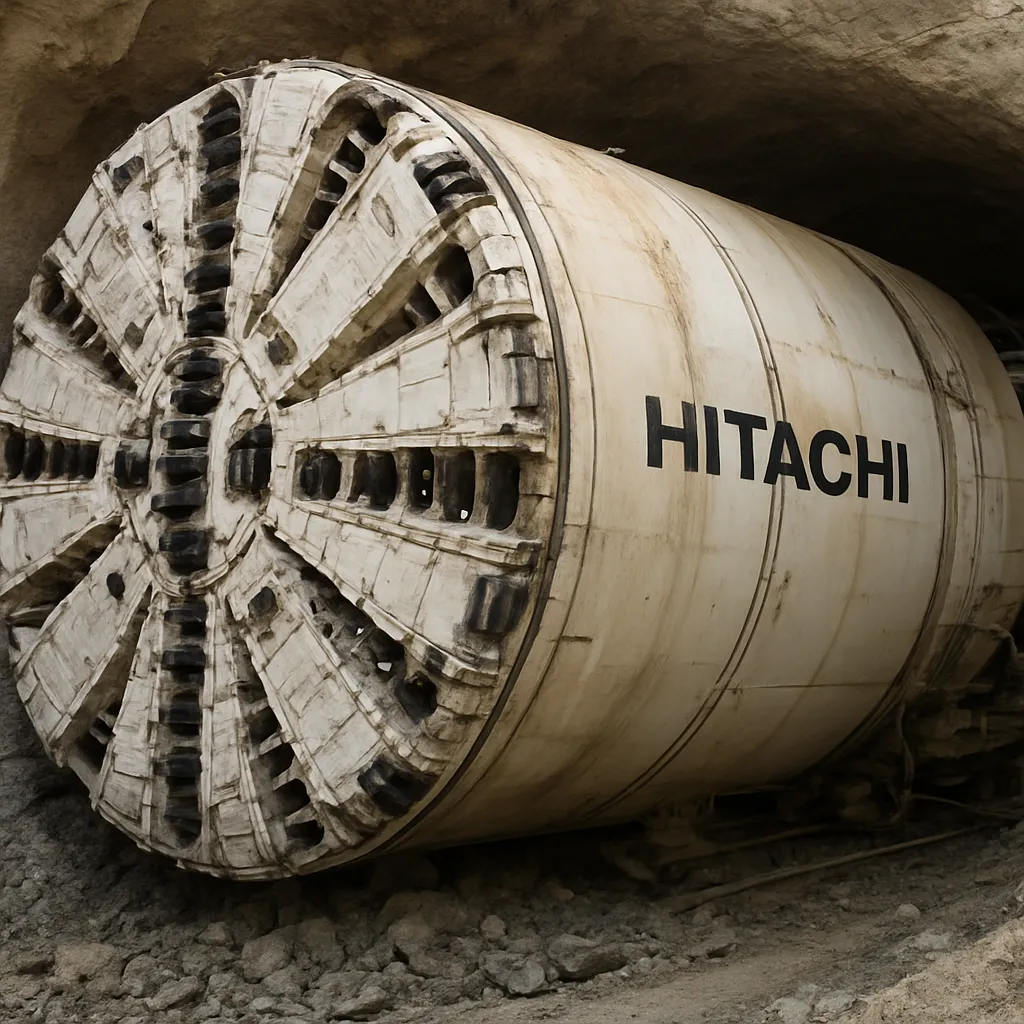
The Hitachi S-700 tunnel boring machine represents a class of modern mechanized excavation equipment engineered for efficient, safe and precise construction of underground tunnels in a variety of ground conditions. Combining shielded design principles with advanced systems for muck removal, ground conditioning and operator automation, this machine is tailored to meet the demands of urban infrastructure projects, utilities, and transportation corridors. Below you will find a detailed overview of the S-700’s design, typical applications, operational practices, environmental and safety considerations, representative technical figures and comparative strengths and limitations.
Design and core technical features
The Hitachi S-700 is built around a shielded tunneling concept designed to manage unstable or water-bearing ground. Key elements of its design include a robust cutterhead assembly, an integrated backup system, and dedicated facilities for slurry or spoil management depending on configuration. The S-series naming convention commonly implies a nominal cutterhead diameter — in the case of S-700 the model designation typically corresponds to a cutterhead diameter in the neighborhood of 7.0 meters, though final dimensions can vary by project-specific customization.
Cutterhead and excavation system
- The cutterhead is the primary excavation component. Depending on the ground, the S-700 can be equipped with disc cutters or mixed-cutting tools to address rock, stiff soils, clay, or mixed-face conditions.
- For saturated or loose granular ground the S-700 is often configured as a slurry-shield or closed-face machine with a pressurized excavation chamber that maintains face support while excavated material is transported away in slurry form.
- In firmer ground or stable rock environments a more open-face arrangement with conveyor-type muck removal may be used.
Shield, machine body and backup
- The machine’s shield provides temporary support to the excavated tunnel face and adjacent ground while lining segments are installed.
- Behind the cutterhead, a crawler-mounted backup train carries essential subsystems: power packs, hydraulic units, slurry pumps (when configured), conveyor belts or screw conveyors, segment erectors and personnel/work platforms.
- Automated alignment systems and jacking thrust cylinders enable controlled steering and incremental progress with minimal deviation from design alignment.
Muck handling, slurry systems and segmental lining
- When operated as a slurry-shield, excavated material mixes with a carrier fluid and is pumped through a slurry pipeline to an aboveground processing plant where solids are separated and the carrier fluid is recycled.
- For closed-face machines using conveyors, spoil is removed directly from the backup train and transported out of the tunnel on belt conveyors or muck cars.
- Segment erectors inside the shield install precast concrete rings immediately behind the cutterhead, providing instant structural support and controlling settlement risk.
Applications and suitability
The S-700 is engineered for a broad range of underground construction tasks. Typical applications include:
- Urban metro and rail tunnels where precise alignment, limited surface disruption and settlement control are critical.
- Road tunnels in congested or environmentally sensitive corridors.
- Utility tunnels for water, sewage, district heating, and multi-utility ducts requiring long, continuous excavations.
- Hydropower diversion tunnels and water conveyance schemes where water-bearing strata demand face support and fluid management systems.
- Undersea and river-crossing tunnels where pressurized-face operation (slurry or EPB-type) and robust segmental linings reduce inflow risk and seepage.
Because the S-700 can be adapted between slurry-shield and other closed-face configurations, it is particularly effective in water-bearing soils, soft ground with high permeability and heterogeneous strata where conventional drill-and-blast or open-cut methods are impractical or too disruptive.
Operational performance and productivity
Performance of an S-700 in the field depends heavily on ground conditions, project logistics, tunneling method (slurry vs. conveyor), and site management. Representative operational characteristics include:
- Average advance rates in favorable, homogeneous soft ground can reach into the low tens of meters per day; in mixed-face or difficult conditions daily progress may be far lower (single-digit meters per day).
- Short-term peak penetration rates during favorable hours can be significantly higher but are constrained by time required for segment erection, slurry processing, and routine maintenance.
- Continuous operation with well-coordinated support systems often yields higher cumulative progress than machines hampered by logistical or processing bottlenecks.
Key factors that influence productivity include the efficiency of the slurry treatment plant (if used), reliability of the cutter tools, speed of segment erection, the capacity of backup systems, and ability to quickly respond to face changes or obstructions.
Representative technical specifications (typical ranges)
Publicly available, model-specific datasheets for the S-700 are often project-dependent. The following numbers are representative ranges for a machine in this class and intended to provide a realistic engineering sense rather than an exact specification. Actual machine values should be confirmed with the manufacturer or project documentation.
- Nominal cutterhead diameter: approx. 6.5–7.5 m (model designation S-700 typically near 7.0 m)
- Power: typically several 100s to a few 1000s of kW for cutterhead drive and ancillaries (combined installed power often in the 1,500–4,000 kW range depending on configuration)
- Thrust: several thousand kN (representative range 5,000–20,000 kN) — used by multiple hydraulic jacking cylinders to push the cutterhead forward
- Torque: cutterhead drive torque rated to match thrust and cutting forces (representative range tens of kN·m to several hundred kN·m depending on gearboxes)
- Weight: entire TBM and backup train can weigh several thousand tonnes, installed and sometimes shipped in modules
- Cutterhead rotation speed: typically adjustable, low rpm for high torque conditions and higher rpm for softer ground
- Slurry flow capacity (when configured): sized to match excavation rate and solids transport needs; may be several hundred to a few thousand cubic meters per hour
- Segment ring installation: standard precast segment sizes and ring thicknesses vary with design loadings and lining requirements
Maintenance, monitoring and life-cycle considerations
Large shield TBMs like the S-700 require rigorous condition-based maintenance and continuous monitoring. Typical activities and systems include:
- Predictive maintenance programs based on wear rates of cutter tools, bearing conditions, gearbox health and hydraulic system performance.
- Instrumentation for face pressure, cutterhead torque, thrust and advance rate, which feed into automated control systems to keep the machine within safe operating envelopes.
- Spare parts planning for critical components such as cutters, seals, pumps and hydraulic valves to minimize unscheduled downtime.
- Periodic inspection and replacement of segment erector components, conveyor belts and slurry pumps, usually scheduled during planned maintenance windows.
Modern TBMs incorporate advanced monitoring with remote diagnostics and data logging so engineering teams can analyze performance trends, optimize advance strategies and reduce unexpected failures.
Safety, environmental and regulatory aspects
Because TBM projects often proceed beneath urban centers, safety and environmental control are paramount. Key considerations include:
- Strict face pressure management to avoid blowouts or ground heave, together with continuous settlement monitoring at surface points and structures along the alignment.
- Containment and treatment of slurries and contaminated spoil. Slurry plants must be operated to regulatory standards for solids handling and water discharge or reuse.
- Ventilation and air quality control inside the tunnel for worker safety, plus methane or other gas monitoring if tunneling through hazardous strata.
- Noise and vibration control measures during shaft construction, breakthrough events and certain maintenance operations to reduce community impact.
- Emergency egress planning and on-board safety equipment embedded in backup trains and shield interiors to protect personnel.
The S-700 platform is designed to interface with instrumentation and environmental systems that support compliance with local and international construction standards.
Comparative strengths and limitations
Strengths
- Shielded and pressurized-face capability makes the S-700 well-suited for water-bearing and unstable soils, limiting inflows and ground settlement risk.
- Robust backup and automation features help maintain alignment precision even in long urban drives.
- Segmental lining integration allows immediate structural support, enhancing safety and speeding construction schedules in densely built environments.
- Flexibility to be configured for slurry or conveyor spoil removal depending on project needs.
Limitations
- Large shield TBMs are capital intensive: procurement, mobilisation, launch shaft construction and slurry plant setup require significant upfront investment and time.
- In extremely rocky, boulder-strewn or karstic terrains, cutterhead wear and the risk of blockages are greater; alternative methods or specialized rock TBMs may be preferable.
- Logistics for handling spoil, slurry disposal or treatment can be complex in urban environments with restricted space.
Project planning and launch considerations
Deploying an S-700 requires careful planning from the earliest project stages. Important planning tasks include:
- Geotechnical investigations along the entire alignment to identify variations in strata, groundwater conditions and potential obstructions.
- Design of suitably sized launch and reception shafts, including access for modular assembly and disassembly of the TBM.
- Provision of aboveground infrastructure: slurry treatment plant (if used), spoil handling areas, power supply, and logistics for segment manufacturing and delivery.
- Stakeholder engagement and permits for surface works, environmental discharge, and construction traffic.
- Contingency planning for adverse ground conditions and emergency response procedures for TBM stoppage or breakthrough events.
Use cases and typical project metrics
While individual project metrics vary widely, typical numbers for completed mechanized tunneling projects using TBMs in the 6–8 m diameter range can illustrate what to expect:
- Drive lengths commonly range from a few hundred metres up to several kilometers per TBM. Long drives may require intermediate access or maintenance alcoves.
- Production rates averaged over long projects often fall in the single to low double digits of meters per day, but this is highly ground-dependent.
- Turnaround times for cutter replacement or major interventions may range from days to weeks depending on severity and accessibility.
These figures demonstrate the influence of geological uncertainty, project logistics and maintenance strategy on final productivity.
Innovation, automation and future trends
TBM technology continues to evolve with advances in sensor integration, machine learning for predictive maintenance, and improved cutter materials that extend service life in abrasive conditions. Key trends relevant to machines like the S-700 include:
- Enhanced automation for steering control and process optimization, reducing reliance on manual adjustments and increasing repeatable performance.
- Real-time data analytics feeding cloud platforms to enable remote monitoring and decision support across multi-disciplinary project teams.
- Improved environmental systems for slurry separation and water recycling, aligning tunneling projects with strict sustainability goals.
- Hybrid cutterhead designs and adaptable support systems that allow a single TBM to handle a wider range of ground types without major retrofits.
Summary
The Hitachi S-700 class TBM embodies a balance of robustness, adaptability and precision required for modern underground construction in urban and difficult ground conditions. Its shielded design, options for slurry-face operation, integrated backup systems and alignment control make it a strong choice for metro, utility, water and other long-run tunnel projects where settlement control and environmental mitigation are priorities. As always, the success of any TBM deployment depends on thorough geotechnical investigation, careful logistics planning, rigorous maintenance regimes and trained operational teams. For project-specific specification, performance projections and procurement, direct consultation with the manufacturer and review of project geotechnical data remain essential to achieve optimal outcomes.


)
)