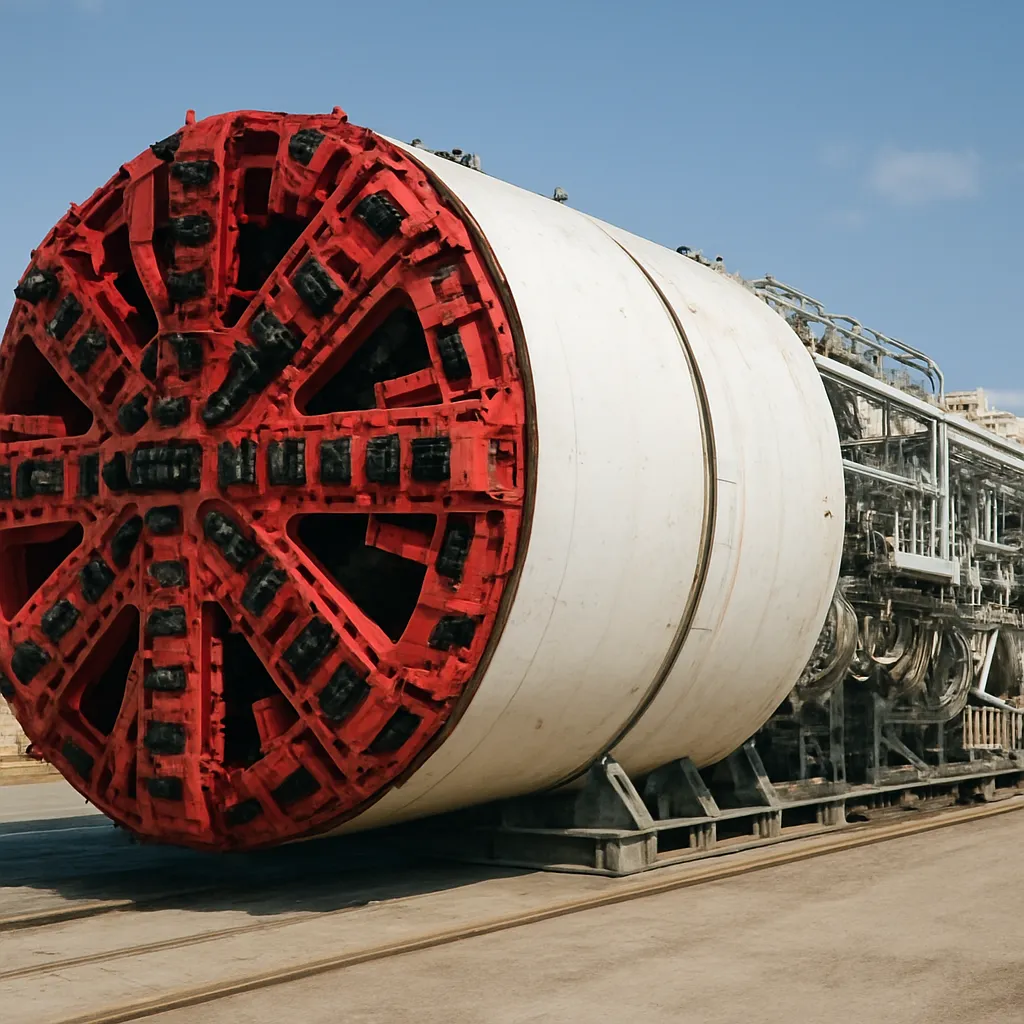
The CRCHI 12m EPB TBM represents a category of large-diameter mechanized tunneling machines designed to tackle complex urban and interurban underground works. Built by China Railway Construction Heavy Industry (CRCHI) and similar manufacturers, these machines combine a robust structural design with an Earth Pressure Balance system to manage variable ground conditions, minimize settlement, and maximize excavation efficiency. This article examines the machine’s design principles, typical applications, operational characteristics, and practical considerations for planners, contractors, and engineers involved in large-bore tunneling projects.
Overview of the CRCHI 12m EPB TBM
The term CRCHI 12m EPB TBM broadly refers to a shield-type tunnel boring machine with an approximate 12-meter outer diameter, equipped with an EPB system for face support. This class of machine is commonly used for long runs in soft ground, mixed face conditions, and urban environments where controlling surface settlement and ground loss is critical. The 12m size is particularly suited for tunnels that need to accommodate multiple transport lanes, double-track railway tunnels, or large-diameter utility and service passages.
Key conceptual features include a rotating cutterhead with adaptable tooling patterns, a pressure-controlled muck management chamber, a robust shield that protects the working face and crew, and a comprehensive backup system that houses conveyors, grout plants, and other ancillary equipment. The overall design is engineered to balance excavation performance with operational safety and environmental control.
Applications and Operating Environments
The CRCHI 12m EPB TBM finds use in a wide range of projects where a large-diameter, mechanized approach offers benefits over conventional methods (drill-and-blast, pipe jacking, or cut-and-cover). Typical applications include:
- Urban metro and rail tunnels requiring double-track sections or expansive cross-passages that reduce cost and complexity compared to two separate bores.
- Highway and road tunnels designed to carry multiple lanes of traffic and large cross-sectional profiles.
- Hydropower and water conveyance tunnels that demand large internal diameters for flow capacity or maintenance access.
- Utility and multi-service corridors where space is needed for large pipes, cables, and inspection walkways inside a single tunnel.
- Interchange caverns and underground stations where large openings are required and mechanized excavation can improve schedule and reduce surface disruption.
Operating environments for a 12m EPB range from soft clays and silts to mixed face conditions with lenses of sand, gravel, or weathered rock. The EPB approach excels in cohesive or low- to medium-plasticity soils where maintaining balanced earth pressure at the face reduces the risk of collapse and surface settlement. For highly granular, flowing sands or pressurized groundwater conditions, additional ground improvement, soil conditioning agents, or switching to slurry-type TBMs may be considered.
Technical features and components
Cutterhead and tooling
The cutterhead is the machine’s front-end component and is customized to the anticipated ground profile. For the 12m class, cutterhead designs may include combination tooling sets that allow mechanical excavation of mixed ground and the attachment of disc cutters or scrapers. The cutterhead design balances penetration rate, power consumption, and wear life. For EPB operation, the head incorporates openings and mixing elements that help transfer excavated material into the pressure chamber.
EPB pressure chamber and muck handling
The defining element of an EPB TBM is the pressurized chamber directly behind the cutterhead where excavated material is stored and conditioned. By controlling the volume and pressure of muck inside this chamber, operators maintain face stability and minimize surface movements. Conditioning agents—such as foam, polymers, or bentonite slurry—are frequently injected to modify shear strength and lubricity of the spoil to achieve stable pressure and good flowability.
Muck is typically transported rearward via a screw conveyor (auger) into a conveyor belt system on the backup train. For large-diameter machines, the capacity and reliability of the conveyor system are crucial to maintain continuous advance and manage high spoil volumes.
Shield, main drive and thrust system
The structural shield protects workers and equipment during excavation and provides support until permanent lining segments are installed. The main drive—an electric motor or multiple motors—transmits torque to the cutterhead and is sized to handle the high loads of large-diameter boring. Thrust jacks mounted in the shield reaction frame push the TBM forward against the installed lining. Thrust forces for a 12m class machine can be considerable and are designed to match the resistance of segment erection and ground conditions.
Segment erector and lining system
Most EPB TBMs are equipped with a segment erector to place precast concrete lining segments immediately behind the shield. Segment sets for a 12m machine will typically form rings subdivided into multiple segments (for instance, 6–8 segments plus a key) sized to create a watertight and structurally strong lining. The segment erector’s precision reduces ring assembly time and ensures proper geometry for design loads.
Backup system and support facilities
The backup train houses essential plant and services: conveyor belts, slurry and chemical dosing systems, hydraulic and electrical rooms, ventilation, and worker access. For long drives, the backup may extend hundreds of meters and include modular platforms for maintenance and storage. The backup design is a critical factor in logistic planning, spoil management, and machine uptime.
Instrumentation and control
Modern 12m EPB TBMs include extensive instrumentation: face pressure sensors, guidance and navigation systems, torque and thrust monitoring, and automated controls for chemical dosing and conveyor operation. Real-time data acquisition allows tunneling teams to adjust operating parameters to optimize advance rates and minimize ground impacts. Guidance systems (such as laser theodolites and inertial navigation) keep the alignment within tight tolerances essential for long, curved, or multi-bore projects.
Performance, productivity and statistical insights
Performance of a CRCHI 12m EPB TBM depends strongly on geology, ground water, machine configuration, and site logistics. Rather than absolute numbers, typical ranges and influencing factors provide a practical picture:
- Typical advance rates: Daily advances for large-diameter EPB machines commonly range from a few meters to more than 20 meters per day. In favorable soft-ground conditions with efficient spoil handling and continuous operation, sustained averages of 10–15 meters per day are achievable. Short bursts under ideal conditions can exceed that, but long-term averages are influenced by maintenance, segment erection speed, and unforeseen ground variability.
- Spoil volume and handling: A 12m external diameter tunnel produces significant spoil volume—often thousands of cubic meters per kilometer of tunnel. Efficient conveyor systems, intermediate shafts, or slurry dewatering plants are essential to handle spoil continuously and avoid production bottlenecks.
- Power and torque: The installed electrical power for a machine in this class typically amounts to several thousand kilowatts, spread across main drive, hydraulic units, backup systems, and auxiliary services. The required cutterhead torque and thrust capacity scale with ground resistance and machine diameter; design values are selected with safety margins for abrasive or mixed conditions.
- Station and logistics: For urban projects, assembly time for a 12m TBM at the launch pit can take weeks to months, requiring specialized cranes and large staging areas. Similarly, receiving and retrieval operations at the tunnel end are complex and require detailed planning.
Project statistical records often show that the single most influential factors on productivity are uninterrupted spoil transport (conveyor uptime), consistent face conditioning (foam/polymer dosing), and the rate of segment erection. Well-managed projects that coordinate tunnel excavation, segment supply, and surface logistics can realize substantial time savings compared to smaller, multiple-bore approaches.
Advantages and limitations
Using a CRCHI 12m EPB TBM provides several notable advantages:
- Reduced surface settlement due to controlled face pressure and balanced excavation, particularly valuable in dense urban settings.
- Large clear internal space allowing multi-modal infrastructure or maintenance access without the need for parallel bores.
- Improved safety through mechanized excavation, enclosed working environment, and continuous monitoring.
- Economy of scale for large flow-through projects: fewer bores and fewer portals reduce surface disruption and some repetitive costs.
Limitations and challenges include:
- Higher capital and mobilization cost compared to smaller machines or non-mechanized methods, including assembly, transportation, and launch pit construction.
- Complex logistics for spoil removal, segment production and delivery, and long backup trains.
- Geological constraints—very hard rock, boulders, or highly permeable sands with high artesian pressure may require alternative TBM types or ground improvement.
- Longer repair times when major component failures occur, due to scale and integrated systems.
Safety, environmental and ground control practices
Safety and environmental stewardship are integral to successful TBM deployment. For an EPB TBM, key practices include face pressure management to prevent sinkholes, careful handling and disposal or reuse of conditioned spoil to avoid contamination, and control of slurry or chemical additives. Typical measures adopted on modern projects include:
- Continuous monitoring of face pressure, settlement points, and groundwater levels with automated alarms.
- Use of biodegradable conditioning agents when possible to reduce environmental impact.
- Dust suppression, enclosed conveyors, and covered spoil storage areas to limit airborne contaminants.
- Emergency procedures for pressurized faces and contingency plans for ground collapse or water ingress.
Ground improvement techniques—such as jet grouting, ground freezing, or compensation grouting—are often used ahead of or around TBM paths to stabilize weak soils, reduce permeability, and protect sensitive structures on the surface.
Lifecycle, maintenance and decommissioning
Large TBMs are significant project assets that require planned maintenance intervals, component replacement strategies, and end-of-life considerations. Regular maintenance includes cutterhead inspection and tooling replacement, screw conveyor and seal checks, hydraulic system servicing, and electrical system diagnostics. The modular nature of backup trains allows targeted interventions without stopping the cutterhead for short repairs.
At the end of a drive, large TBMs can be disassembled and retrieved from a reception chamber if designed, or, in some projects, left in situ if removal is impractical and permitted. Decommissioning logistics must be accounted for in project planning, especially in constrained urban sites.
Cost considerations and project planning
Project cost for a CRCHI 12m EPB TBM-based tunnel varies widely with geology, alignment length, number of stations or cross-passages, and local labor and material prices. Costs to consider in tendering and planning:
- Machine procurement or rental and mobilization/demobilization
- Launch and retrieval pit construction
- Segment production, quality control, and lining logistics
- Spoil transport and disposal
- Ground improvement and utility diversions
- Operation, maintenance, and contingency allowances for unforeseeable ground conditions
Because a 12m TBM reduces the need for multiple parallel tunnels, overall project costs can be favorable for schemes requiring large internal diameters, despite higher unit-machine costs.
Case studies and industry context
While project-specific machine design varies, large EPB TBMs around the 12m size have been applied in metro projects, transport tunnels, and utility conveyance works across Asia, Europe, and the Middle East. Industry records show that optimized projects—where soil conditioning, spoil logistics and segment supply are well-managed—achieve higher average daily advances and lower cost per meter compared to fragmented tunneling approaches. Manufacturers like CRCHI have developed modular platforms for this class of machine to suit specific project demands, offering customizable cutterheads, dosing systems, and backup configurations.
For planners evaluating the CRCHI 12m EPB TBM option, common lessons from the field include the need for thorough geotechnical investigation, early engagement with segment suppliers, allowance for robust spoil handling systems, and contingency planning for unexpected ground conditions.
Concluding remarks
The CRCHI 12m EPB TBM embodies a powerful solution for large-diameter tunneling demands where minimizing surface impact, achieving high quality lining installation, and maintaining steady production are priorities. Its combination of an adaptable cutterhead, a controllable EPB pressure chamber, and a full backup train makes it particularly suitable for urban rail, highway, and large utility tunnels. Successful deployment depends on meticulous planning, comprehensive ground investigation, integrated logistics, and skilled operation and maintenance teams. When those elements align, a 12m EPB TBM can deliver efficient, safe, and environmentally responsible tunneling outcomes.


)
)