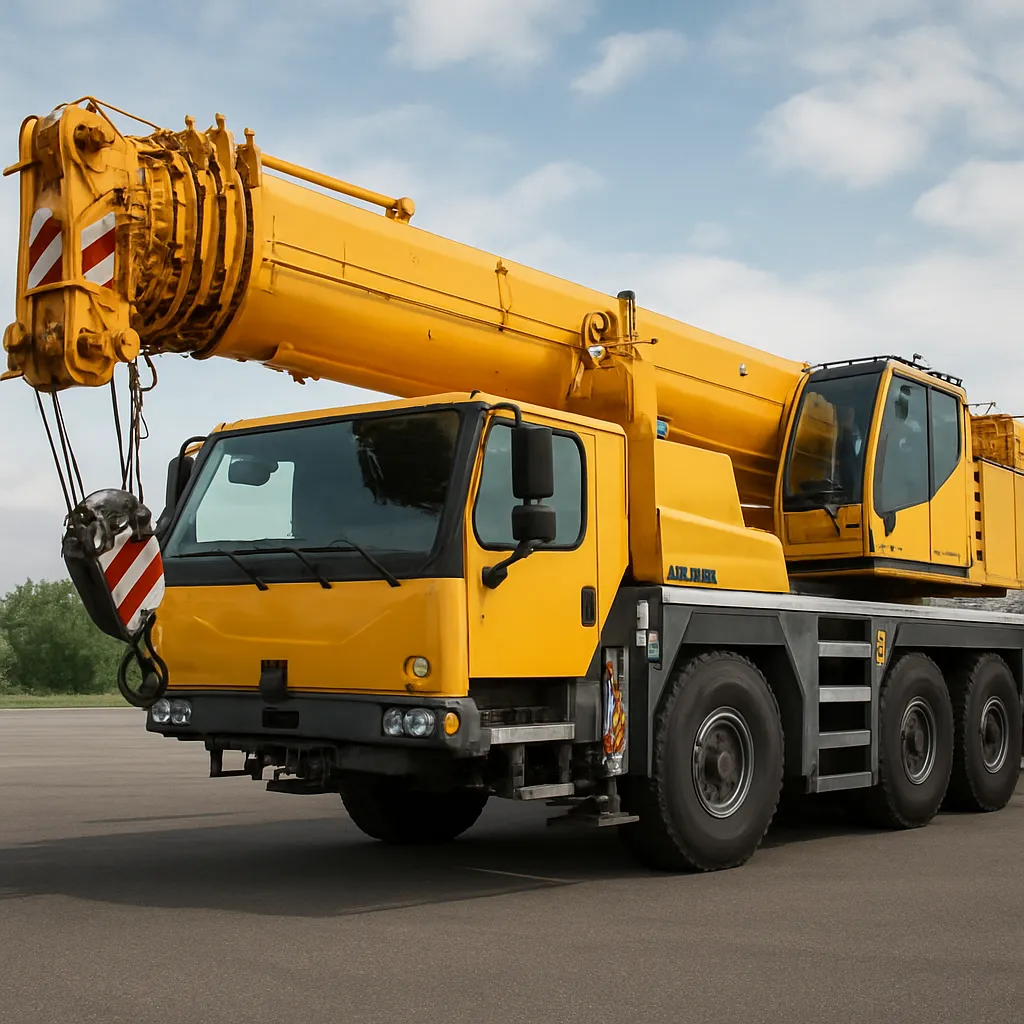
The Liebherr LTM 1150-5.3 is a versatile and widely used 5-axle mobile crane designed to combine high lifting capacity with road mobility and site adaptability. Built to serve sectors ranging from heavy civil construction to energy and industrial maintenance, this model represents a balance of power, safety and transportability. The following article examines its design, technical characteristics, real-world applications and operational considerations to help fleet managers, project planners and crane operators understand why the LTM 1150-5.3 is a popular choice in the 100–200 tonne mobile crane segment.
Design and technical overview
The LTM 1150-5.3 is part of Liebherr’s line of five-axle all-terrain cranes. Its architecture emphasizes a compact transport footprint without sacrificing lifting capability. The crane combines a robust carrier chassis with a hydraulically telescoping superstructure and a range of modular jib and counterweight options. This combination makes it suitable for long-distance transfers on public roads and fast set-up at job sites.
Chassis and mobility
- The carrier is a five-axle design engineered to meet axle-load limits in many regions while allowing the crane to carry a significant amount of ballast for lifting operations. The drive and steering axles give it excellent maneuverability for a machine in its class.
- Advanced chassis features often include axle load sensing, hydraulic suspension/steering systems and the option for variable axle load distribution to comply with regional regulations.
- High road speed capabilities allow efficient repositioning between sites, reducing the need for trailers or heavy haulage for medium-distance travel.
Superstructure, boom and lifting gear
The LTM 1150-5.3 uses a multi-section telescopic boom as its main lifting member. The telescopic system provides quick, precise extension and retraction for routine lifts, while modular lattice jibs or extension sections extend outreach and height for specialized projects.
- The primary boom is designed with hydraulic extension for ease of use and fast configuration changes.
- Optional luffing and fixed lattice extension jibs increase tip height and outreach for tall or distant lifts.
- Robust winch systems with multiple reeving options allow for variable line speeds and lifting arrangements to suit both heavy and precise lifts.
Control, safety and electronics
Liebherr equips its cranes with advanced control systems. The LTM 1150-5.3 typically includes the manufacturer’s proven electronic control platform, providing lift planning, load moment limitation and safety monitoring. Systems available or commonly fitted include:
- Load moment limiter and overload protection with real-time feedback
- Outrigger monitoring and pressure sensors to ensure safe setup
- Remote control options and intuitive operator interfaces for precise maneuvering
- VarioBase or similar support monitoring systems that allow safe lifting with asymmetric outrigger setups by calculating permissible loads based on actual support geometry
Performance figures and technical specifications (typical)
When discussing specifications, exact numbers depend on configuration, optional equipment and region-specific versions. Below are representative figures commonly associated with the LTM 1150-5.3 package; owners and operators should always consult Liebherr data sheets and the crane’s load charts for precise values relevant to the installed configuration.
- Maximum rated lifting capacity: approximately 150 tonnes (150 t class)
- Carrier axles: 5 axles (all-terrain configuration)
- Main boom length: typically up to around 60 meters for the hydraulic telescopic sections; extended outreach with lattice jib modules can increase tip height to approximately 80–100 meters depending on the jib choice
- Counterweight and ballast: modular ballast systems allow operators to adapt the ballast mass to the lift requirements, balancing transportability and lifting performance
- Engine power: modern variants typically feature diesel engines in the medium–high power band (commonly in the range of 300–350 kW), meeting contemporary emission regulations in many markets
- Travel weight (typical, without extra ballast): approximately 45–55 tonnes, depending on configuration
- Maximum road speed: up to allowed legal limits for heavy vehicles in the operating country (typical top speeds around 70–80 km/h achievable when permitted)
- Outrigger footprint: wide, hydraulically extendable outriggers to provide stable support on uneven ground
- Control system: Liebherr’s electronic control architecture (often known in the field under names such as LICCON or VarioBase depending on model year and options)
These figures should be treated as indicative. The precise lift table for any lift is derived from the installed configuration of boom length, counterweight, outrigger position and reeving of the hook block. The crane’s rated charts will specify allowable loads for every radius and configuration.
Primary applications and sectors
The LTM 1150-5.3 is frequently chosen for applications requiring a blend of medium-high capacity and flexibility. Typical application areas include:
Construction and civil engineering
- Erection of precast concrete elements, steel girders, bridge sections and building modules where access and mobility matter.
- Municipal construction projects requiring medium lifting capacity with road mobility and fast set-up times.
Energy sector and wind turbine installation
- Smaller onshore wind projects and service work often use 150 t-class cranes for nacelle and tower segment erection on sites where larger cranes would be inefficient or too costly to mobilize.
- Maintenance and blade replacement operations benefit from the cranes’ ability to travel between turbines and reconfigure quickly.
Industrial maintenance and plant shutdowns
- Refineries, chemical plants and manufacturing facilities frequently require mobile cranes with precise control and flexible outreach for equipment replacement and maintenance.
- Confined areas and tight access corridors make the all-terrain mobility and compact transport dimensions advantageous.
Utilities, rail and infrastructure
- Utility companies use the crane for substation transformers, pole and mast installation.
- Trackside and bridge repair works are common, where outriggers and narrow transport dimensions are useful.
Operational advantages and practical considerations
Operators and fleet managers choose the LTM 1150-5.3 for several practical reasons. Knowing these helps with planning and optimizing crane use on projects.
Transportability and mobilization
- Five-axle carrier plus compact design reduces the need for multi-unit transport for many jobs, lowering mobilization costs.
- Modular ballast allows transport in road-legal configurations; ballast can be added on-site to reach necessary lifting capacities.
Setup time and site adaptability
- Hydraulic outriggers with clear position indicators speed up leveling and stabilization.
- Systems like VarioBase enhance safety and allow lifting in constrained outrigger layouts, increasing usable range without complex re-rigging.
Precision and control
- Modern controls and optional remote operation improve precision for delicate placements, especially relevant in plant maintenance and assembly of prefabricated units.
- Anti-two-block systems and automatic load moment limitation help protect equipment and personnel.
Costs and efficiency
- Compared to larger all-terrain cranes, the LTM 1150-5.3 typically offers more economical fuel consumption and lower operating costs for mid-range lifts.
- Its ability to perform a wide variety of jobs reduces the need to charter larger, more expensive cranes for jobs that do not require maximum capacity.
Attachments, options and custom configurations
One reason for the model’s popularity is the breadth of optional equipment and configurations available, permitting customization to match job demands.
- Fixed and luffing lattice jibs of various lengths to increase reach and tip height.
- Different hook blocks and reeving arrangements to balance speed and capacity.
- Telematics and fleet-management modules for remote data on utilization, servicing and diagnostics.
- Specialized ballast kits to maximize rated capacity while remaining within transport limits.
- Cab comforts and operator-assistance packages for fatigue reduction and precision work during long shifts.
Safety, maintenance and lifecycle considerations
Like all heavy lifting equipment, safety and maintenance are critical. The LTM 1150-5.3 includes design features to simplify these tasks, but successful operation relies on disciplined procedures and regular upkeep.
Inspection and preventive maintenance
- Regular scheduled inspections of the boom sections, hydraulic systems, wire ropes and winches are essential to maintain rated performance and safety.
- Hydraulic oil, filters, brake systems and engine servicing should follow manufacturer intervals; telematics systems can help track hours and trigger alerts for maintenance tasks.
Operator qualification and lift planning
- Certified crane operators and riggers are required for safe operation. Lift plans should be drafted for each critical lift and reviewed by competent personnel.
- Site surveys to verify ground-bearing capacity, access routes and transportation constraints reduce delays and unexpected costs.
Regulatory compliance and documentation
- Adherence to regional safety codes (for example, EN standards in Europe, OSHA and ANSI guidelines in the U.S., or local country regulations) is mandatory.
- Load charts must be available and interpreted for the actual configuration in use, including boom and jib combinations and ballast arrangements.
Market position and comparisons
The LTM 1150-5.3 sits in a competitive segment populated by other major manufacturers producing 100–200 t class all-terrain cranes. Its strengths are the blend of mobility, modularity and Liebherr’s established service and support network. Competitors typically include models from brands like Grove, Terex, Tadano and Manitowoc in similar capacity classes. Buyers often compare:
- Transport dimensions and road legality vs. required ballast for site lifts
- Setup speed and adaptability to asymmetric outrigger positions
- Operator cab ergonomics, control systems and diagnostics
- Overall total cost of ownership, including fuel consumption, maintenance intervals and resale value
Case studies and typical project profiles
Examples of how the LTM 1150-5.3 is used on real projects illustrate its value:
- Bridge deck segment positioning in urban environments where narrow streets require a compact crane with robust capacity.
- Installation of medium-size wind turbines or service lifts on wind farms where multiple moves and reconfigurations are needed across a spread-out site.
- Factory line replacement of heavy equipment during scheduled outages, where accuracy and controlled lifting are more important than extreme capacity.
- Transformer placement in substations where precise positioning and limited access demand a crane that travels on public roads between sites.
Buying, renting and fleet management advice
Deciding whether to buy or rent an LTM 1150-5.3 depends on utilization rates, project pipelines and capital constraints.
- High-utilization contractors may benefit from ownership and the ability to customize units with specific attachments and telematics packages.
- For occasional or one-off projects, rental companies provide configured units with insured transport and operator options, allowing access to the crane’s capabilities without capital outlay.
- Fleet managers should evaluate fuel efficiency, expected downtime, support network proximity and residual values when comparing the LTM 1150-5.3 with alternatives.
Conclusion
The Liebherr LTM 1150-5.3 is a flexible and reliable member of the 150-tonne class of all-terrain cranes. Its combination of road mobility, modular lifting gear and modern control and safety systems make it well suited to a variety of sectors, from urban construction and industrial maintenance to renewable energy and infrastructure projects. While precise performance depends on configuration and options, the crane’s design philosophy emphasizes adaptable capacity, operator safety and economical operation. For project managers and operators seeking a machine that balances transportability with substantial lifting capability, the LTM 1150-5.3 remains a strong contender.
Liebherr LTM 1150-5.3 150 tonnes all-terrain telescopic boom VarioBase LICCON outriggers wind energy capacity


)
)