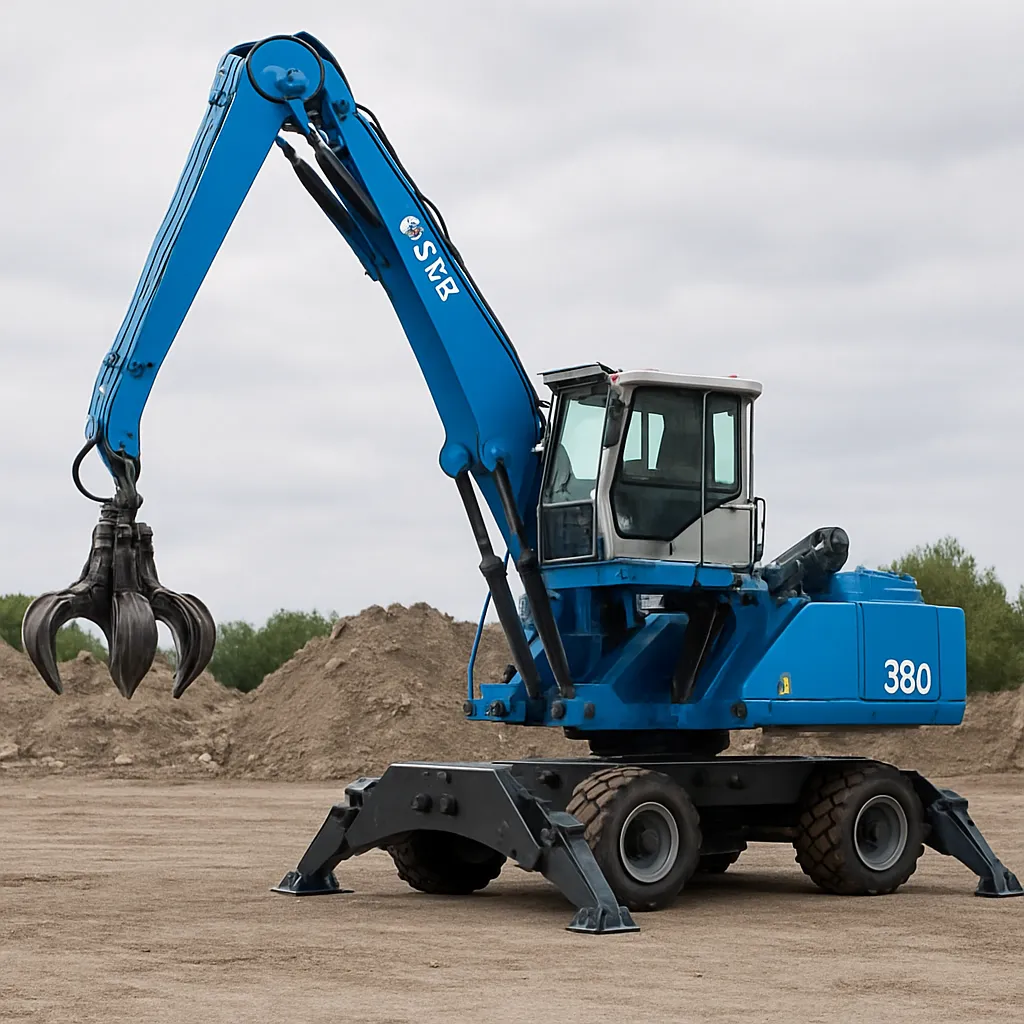
The Fuchs MHL 380 is a purpose-built industrial material handler that has earned a reputation for robustness, versatility and long service life in heavy-duty handling environments. Designed to move bulk materials, scrap, containers and heavy loads with precision, the MHL 380 combines an elevated, rotatable cab and a long-reach boom with powerful hydraulic systems to deliver reliable performance in ports, recycling yards, steel plants, demolition sites and other demanding locations. This article explores the machine’s design and features, typical applications, technical considerations, operational and maintenance aspects, and market context to give a comprehensive view of why machines like the Fuchs MHL 380 are central to modern material-handling operations.
Overview and key design characteristics
The MHL 380 is part of a family of material handlers developed by Fuchs Hydraulik (now often co-branded or associated with larger construction equipment groups depending on the region and production year) that emphasize a combination of reach, lifting capacity and operator visibility. Unlike standard excavators, material handlers are optimized for lifting and placing heavy or awkward bulk loads rather than digging. Typical design attributes of the MHL 380 include a tall, elevated cab mounted on a stable undercarriage, an articulated or telescopic boom configured for long reach, and an attachment-ready boom tip that accepts a variety of tools.
Chassis and mobility
Material handlers like the MHL 380 are commonly configured on either tracked or wheeled undercarriages depending on the intended use and site mobility requirements. Tracked variants provide superior stability on uneven terrain and are preferred where ground-bearing load and traction are priorities. Wheeled versions are often chosen for port or yard applications where machine repositioning on paved surfaces is frequent. The undercarriage is engineered to provide a low center of gravity and to support the loads transmitted through the boom and attachments.
Hydraulics and powertrain
A defining characteristic of the MHL 380 is its advanced hydraulic system, which supplies smooth, proportional control for lifting, slewing and attachment operation. The powertrain typically consists of a diesel engine sized to balance power and fuel consumption, coupled with hydraulic pumps and control valves optimized for continuous duty cycles. Modern iterations may include electronically controlled injection systems and after-treatment to meet emissions standards; in some regions, options for improved fuel efficiency or hybrid assistance have been offered.
Operator environment
Operator visibility and comfort are central design priorities. The elevated cab on the MHL 380 provides a panoramic view of the work area, reducing blind spots and enabling accurate placement of material. Inside the cab, ergonomic seating, joystick controls, climate control and vibration damping are standard considerations to minimize operator fatigue during long shifts. Safety features such as safety glazing, rollover and falling object protective systems (ROPS/FOPS), and seat belt interlocks are common in contemporary machines.
Primary applications and industry uses
The MHL 380 is versatile and finds application across several industries where bulk material movement and precision handling are required. Its combination of reach, lifting power and attachment flexibility allows it to operate in environments that demand both strength and finesse.
- Scrap and recycling yards: The MHL 380 is frequently used to sort, load and stack scrap metal. Hydraulic grapples allow efficient handling of mixed scrap, while magnet attachments enable rapid separation of ferrous materials.
- Ports and terminals: In container yards, bulk handling quays and general cargo terminals, the machine’s long reach and cab elevation offer operators the ability to work over stacks and conveyors safely and efficiently.
- Steel mills and foundries: Handling heavy ingots, billets and slag requires reliable lifting capacity and precise control—tasks for which the MHL 380 is well suited.
- Demolition and scrap processing: With heavy-duty shears and pulverizers fitted to the boom, the machine can dismantle structures and process demolition material on-site.
- Waste-to-energy and biomass: Feeding furnace hoppers and moving heterogeneous waste streams benefit from the machine’s versatility and attachment change capability.
- Forestry and bulk material handling: Clamshell buckets and specialized grapples enable handling of wood chips, logs and other biomass products in terminal environments.
Advantages in these environments
The MHL 380’s elevated cab, long boom, and adaptable attachment options make it particularly effective where materials must be handled at height or across obstacles. Its design reduces the need for manual intervention, increases throughput by enabling continuous cycles, and improves safety by allowing operators to stay inside a protected, climate-controlled cab while performing complex tasks.
Attachments and modularity
A major strength of the MHL 380 is its ability to accept a wide array of specialized attachments, turning a single machine into a multi-role asset. The ease of switching tools—often via mechanical or hydraulic quick couplers—enhances operational flexibility.
- Hydraulic grapples (orange-peel, scrap grapples)
- Electro or hydraulic rotating magnets for ferrous separation
- Clamshell buckets for bulk loading/unloading
- Multi-tine grapples for timber and loose material
- Demolition shears, pulverizers and spreaders
- Specialized lifting hooks and spreader bars for container or fabrication work
Each attachment places different demands on the boom and hydraulics. For example, heavy lifting with a magnet requires sustained hydraulic flow and robust structural reinforcement, while high-frequency grappling in scrap yards demands responsive controls and durable seals. The ability to tailor the machine to the task is a core contributor to the MHL 380’s widespread adoption.
Performance, fuel economy and environmental considerations
Performance metrics for the MHL 380 are influenced by configuration—boom length, counterweight, undercarriage type and chosen attachments all affect capacity and reach. Manufacturers and vendors often publish lifting charts showing maximum capacities at specific radii and elevations; these must be consulted to ensure safe operation under field conditions.
- Lifting capacity: Material handlers in the 30–40 tonne class often have rated lifts that range from a few tonnes at full outreach to substantially higher capacities at short radius. Exact figures for any MHL 380 configuration depend on boom geometry and counterweight.
- Reach: Typical boom designs enable outreach suitable for stacking, loading and sorting; extended versions can reach over conveyors, stacks and container rows. Outreach can range from single-digit meters to well over ten meters depending on boom type and attachment.
- Fuel efficiency: Historically, hydraulic material handlers consume significant fuel under heavy cycles. Improvements in engine technology, variable-speed hydraulics and control software have reduced specific fuel consumption. In many applications, proper matching of engine power to hydraulic demand and operator training yields meaningful reductions in fuel use.
- Emissions: Newer machine variants comply with applicable emissions regulations (e.g., Stage V / Tier 4 Final in certain jurisdictions). After-treatment and optimized combustion cycles help reduce particulate and NOx emissions.
Because precise performance statistics vary by model year and equipment package, prospective buyers should request manufacturer specification sheets and lifting charts for the exact MHL 380 unit under consideration. When evaluating operational costs, include fuel consumption, hydraulic oil usage, wear parts (e.g., pins, bushings, teeth), and attachment maintenance in total cost of ownership calculations.
Safety systems and operator aids
Safety is paramount in environments where large loads are moved near personnel and infrastructure. The MHL 380 incorporates several design features and optional systems to reduce risk and improve control:
- Load moment indicators and rated capacity limiters to prevent overload conditions
- 360-degree cameras and proximity sensors to help monitor blind spots
- FOPS/ROPS-certified cab structures and reinforced glazing
- Automatic engine and hydraulic interlocks for emergency situations
- Operator training aids, including telematics systems that record cycles, fuel use and fault codes
Modern telematics provide fleet managers with near-real-time information on machine health, utilization and location. This data supports predictive maintenance, efficient scheduling and improved safety oversight, which cumulatively reduce downtime and long-term costs.
Maintenance, durability and life-cycle considerations
Longevity is a core selling point for material handlers. The MHL 380 is engineered for continuous, heavy-duty work, and proper maintenance practices extend its service life:
- Adherence to scheduled service intervals for engine, hydraulic and ancillary systems
- Regular inspection and replacement of high-wear components (pins, bushings, hydraulic hoses)
- Hydraulic oil analysis and filtration to prevent contamination-related failures
- Periodic structural inspections of boom sections and chassis to detect fatigue or cracking
- Timely replacement of attachment wear parts to avoid damage to the boom and linkage
Refurbishment programs and factory remanufacturing options are common for machines like the MHL 380. These programs can restore core components—engine, hydraulic pumps, swing units and cab systems—extending machine life and improving residual value. For fleet operators, balancing preventive maintenance costs against unexpected repair downtime is crucial in minimizing total cost of ownership.
Market context, acquisition and resale
Material handlers occupy a niche between heavy excavators and bespoke port cranes. Their value proposition is greatest where flexible, mobile handling is required without the capital expense and infrastructure of fixed cranes. The market for machines like the MHL 380 is influenced by global trade activity, steel production, recycling demand and infrastructure investment.
- New vs used: Purchasing new provides the latest emission-compliant engines, warranties and potential customization. The used market offers lower entry costs but requires careful inspection for wear and documented maintenance history.
- Rental: Renting or leasing can make sense for temporary projects or seasonal peaks; rental rates reflect machine size, demand and required attachments.
- Resale value: Machines with detailed service records and factory refurbishments retain higher resale value. Popular attachments (magnets, grapples) also influence marketability.
When evaluating purchase decisions for an MHL 380, consider application-specific parameters: cycle times, average lift weights, required reach, ground conditions and attachment mix. These factors determine the optimal configuration and whether additional counterweight, boom options or undercarriage types are warranted.
Real-world examples and operational perspectives
To illustrate typical uses and expected benefits, consider a few representative scenarios:
- In a large scrap yard, an MHL 380 equipped with an orange-peel grapple and a rotating magnet increases throughput by enabling fast separation and loading of scrap into shredders and trucks, reducing cycle times compared to mobile cranes or excavators with less specialized attachments.
- At a bulk terminal, a wheeled MHL 380 with a clamshell bucket can quickly transfer coal or aggregate from storage piles to conveyor points, while its elevated cab provides visibility over pile contours to enable precise filling and reduced spillage.
- During demolition of a mid-rise industrial building, a machine fitted with a shear and guided by an experienced operator can dismantle structural elements efficiently while keeping the operator sheltered and at a safe distance from falling debris.
Operators often report that the combination of visibility, reach and responsive hydraulics reduces material rehandling and improves safety. Fleet managers note that telematics-driven maintenance and careful operator training are keys to realizing the full productivity potential of the machine.
Buying tips and practical recommendations
Whether acquiring a new or used MHL 380, attention to detail at purchase affects long-term satisfaction and cost:
- Request complete lifting charts and verify that required lifts at specific radii are within rated capacities for the proposed configuration.
- Inspect structural components carefully on used machines—look for welding repairs, uneven boom wear, and evidence of overloading.
- Confirm emission compliance and engine service history, especially when relocating machines between regions with different regulatory standards.
- Evaluate attachment compatibility and the condition of hydraulic couplers and control circuits.
- Factor in operator training, spare parts availability and local dealer support when estimating life-cycle costs.
Undertaking a test period or demo run under realistic site conditions is highly recommended; real-world cycles often reveal issues or advantages that specification sheets cannot capture.
Concluding perspective
The Fuchs MHL 380 represents a class of purpose-built material handlers engineered for demanding bulk-handling and heavy-lift tasks. With a focus on elevated operator visibility, robust hydraulic performance, and wide compatibility with specialized attachments, the MHL 380 is suited to scrap yards, ports, steel plants and many other industrial settings. While exact technical data vary by year and configuration, the machine’s core strengths—reach, lifting capacity, versatility and operator-focused design—make it a valuable asset where efficient, safe and continuous handling of heavy or awkward materials is required.
Note: For precise numerical specifications—engine power, operating weight, maximum reach and rated lifting capacities—consult the manufacturer’s current technical datasheets or an authorized dealer, because published figures depend on the exact model variant, regional configuration and optional equipment fitted to any MHL 380 unit.


)
)