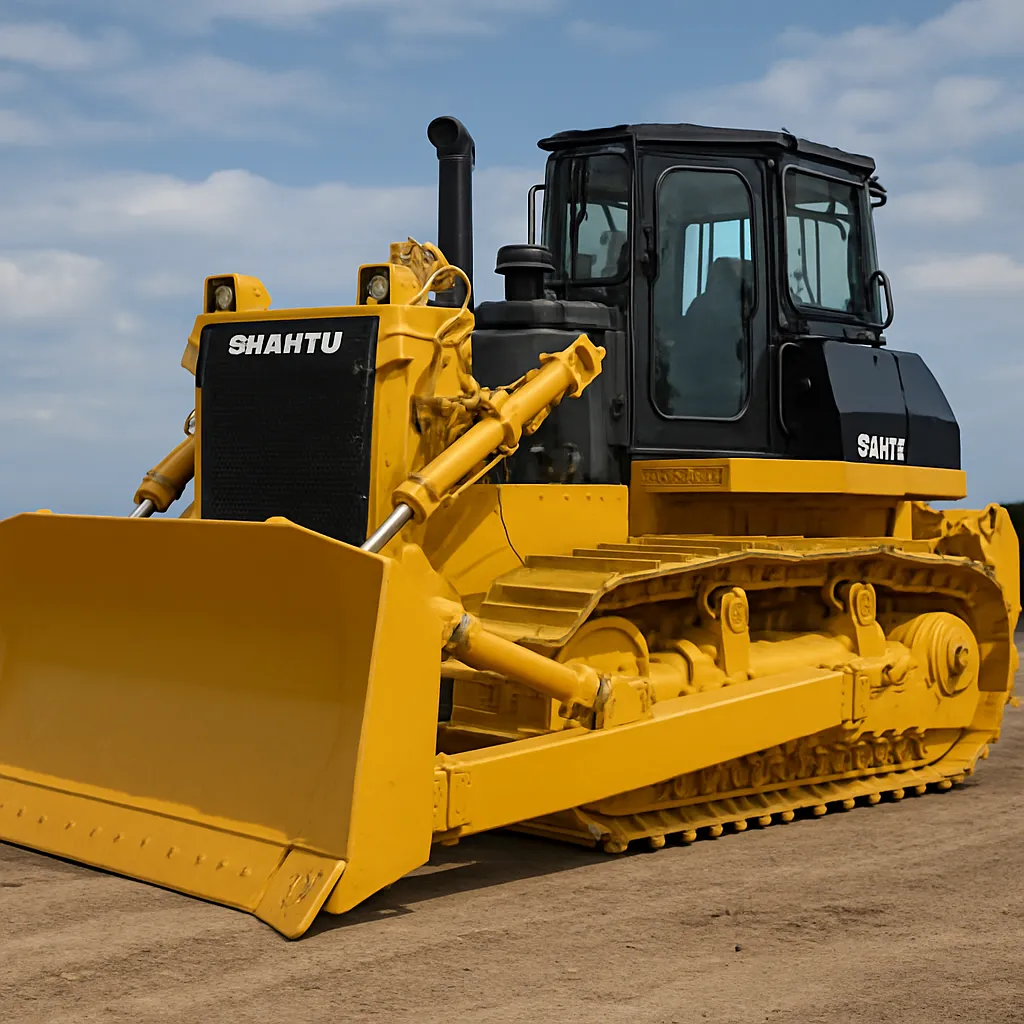
The Shantui SD32 is a heavy-duty crawler dozer widely used in earthmoving, mining, road building and large-scale civil engineering projects. Combining a robust design with adaptable configurations, the SD32 series aims to deliver strong pushing power, long-term reliability and competitive operating costs. This article provides a detailed look at the machine’s technical characteristics, typical applications, operation and maintenance considerations, and market context. It also offers practical recommendations for buyers and fleet managers who consider integrating the SD32 into their equipment lineup.
General overview and design philosophy
The Shantui SD32 is part of Shantui Construction Machinery’s line of large crawler dozers, positioned to compete in the medium-to-large dozer market segment. Shantui—a major Chinese manufacturer—focuses on producing machines that emphasize durability, straightforward serviceability and cost-effectiveness. The SD32 is engineered to handle demanding tasks that require significant traction and blade capacity while remaining accessible in terms of purchase price and maintenance.
Core components and layout
- The powertrain typically consists of a diesel engine coupled to a torque-converter or direct-drive transmission with planetary final drives, providing high tractive effort and smooth torque delivery.
- The undercarriage uses heavy-duty rollers, idlers and track chains designed for long life in abrasive conditions; track shoe width options allow tailoring for varying ground pressures.
- Blade options include Straight (S), Universal (U), and Semi-U (S-U) variants, each suited to different pushing and spreading tasks.
- The operator cab integrates ergonomic controls, clear visibility, and basic climate control; higher trim packages may offer enhanced seating and instrumentation.
Technical specifications and typical performance figures
Exact specifications can vary by model year and regional configuration; the SD32 has been produced in several variants and updates. Below are representative figures that describe the machine’s typical capability range. These values should be verified with the specific local model’s data sheet.
- Operating weight: approximately 30,000 to 36,000 kg (30–36 tonnes), depending on blade, ripper and undercarriage configuration.
- Engine power: generally in the range of 200–260 kW (270–350 HP) for many SD32 variants; some later or higher-spec versions may reach higher gross ratings.
- Blade capacity: straight or S-U blades commonly 5.0–7.0 m³; full U blades can be larger for bulk material handling.
- Track gauge and shoe widths: multiple track shoe widths (e.g., 560 mm, 700 mm) to adjust ground pressure and traction.
- Drawbar pull / tractive effort: designed to match heavy pushing and rough-terrain maneuvers; typical drawbar pull figures are competitive with other 30–36 t class dozers.
- Fuel tank capacity: configured for extended work shifts (commonly several hundred liters) to minimize downtime for refueling.
These specifications make the SD32 suitable for tasks that require sustained force and volume handling—pushing, spreading, rough grading and site stripping among them. The combination of mass, engine output and blade geometry allows efficient displacement of large volumes of soil and rock per pass.
Applications and jobsite roles
The SD32 finds use across multiple sectors due to its balance of size, power and affordability. Typical applications include:
- Mining and quarrying: pushing waste overburden, building haul roads, bench maintenance and reclaiming stockpiles.
- Civil construction and infrastructure: site preparation, grading for highways and rail works, dam construction and levee building.
- Land reclamation and coastal works: spreading fill material, constructing bunds and shaping large earthworks.
- Forestry and land clearing: initial clearing and pushing windrows, though specialized protective measures may be needed for extremely abrasive debris.
- Pipeline and utility corridors: right-of-way clearing, trench backfilling and compacting material in long linear projects.
Because of the machine’s robust mass and pushing capability, the SD32 is often used where heavy earth displacement is needed but clients prefer a more economical alternative to premium-branded dozers. It is especially attractive for contractors and operators in regions where Shantui has a strong dealer and parts support network.
Attachments, variants and customization
Versatility is a critical advantage for heavy dozers. The SD32 can be equipped with several factory or aftermarket attachments and options to expand its use:
- Rippers: single-shank and multi-shank rippers for breaking compacted material or rock layers.
- Winches: for specialized towing or logging tasks where recovery capability is needed.
- Specialized blades: rock blades, coal blades and low-ground-pressure (LGP) blade/undercarriage packages for soft soils.
- Protective kits: heavy-duty seals, guards and cooling packages for extreme dust, heat or abrasive environments.
- Cab packages: from basic to more comfortable configurations, including enhanced HVAC, improved seats and sound insulation.
Choosing the correct combination of blade, ripper and undercarriage is essential to maximize productivity and minimize wear. Many fleet managers standardize configurations by application—LGP setups for marshy areas, rock blades in mining, and standard S-U blades for general grading work.
Operation, productivity and fleet integration
To get the most from an SD32, operators and fleet managers should consider a few practical aspects:
Operator technique and training
- Well-trained operators produce higher hourly output and reduce fuel consumption. Training should emphasize blade management, efficient pass planning and track/undercarriage care.
- Using correct gear selection and avoiding excessive high-rpm work can extend engine life and lower operating costs.
Maintenance planning
- Routine undercarriage inspection and wear part rotation (track shoes, pins & bushings, rollers) significantly affect life-cycle costs.
- Regular oil and filter changes, cooling system maintenance and monitoring of hydraulic conditions prevent major failures.
- Maintaining a small inventory of critical consumables (filters, belts, seals) reduces downtime in remote jobsites.
Telematics and monitoring
- Many modern fleets retrofit or specify telematics to track fuel use, idle time and machine faults—tools that directly improve utilization and lower cost per hour.
- Data-driven maintenance scheduling helps catch issues early and aligns service windows with project phases to optimize uptime.
When well maintained, the SD32 can deliver competitive hourly productivity for bulk earthworks, making it a cost-effective component in mixed-brand fleets.
Fuel efficiency and environmental considerations
Heavy dozers are fuel-intensive machines; managing fuel consumption is important for both operating cost and environmental footprint. The SD32’s fuel efficiency depends on engine tuning, hydraulic management and operator behavior.
- Some later SD32 variants comply with stricter emissions stages (e.g., Tier 3/Tier 4 equivalents depending on market and engine supplier). Retrofitting or ordering Stage-compliant engines may be necessary in regulated regions.
- Proper sizing of the blade and avoiding overworking the machine (when a smaller dozer would suffice) are simple ways to reduce fuel consumption and emissions per cubic meter moved.
- Idle reduction measures, scheduled shutdowns, and monitoring can cut fuel use significantly over a season.
Safety and operator comfort
Dozer operation involves inherent risks: rollovers, striking buried obstacles and exposure to dust and noise. The SD32 addresses these through structural and ergonomic measures.
- ROPS/FOPS-certified cabs protect operators from overturns and falling objects where applicable.
- Good visibility to the blade and rear attachments is essential; mirror and camera options improve situational awareness.
- Comfort features—adjustable seats, climate control and vibration isolation—reduce operator fatigue, improving safety and productivity.
Comparisons, strengths and limitations
Compared to premium dozer brands, the SD32’s principal strengths are price competitiveness, simplicity of design and availability of local parts in markets where Shantui has established dealerships. Typical strengths include:
- Cost-effectiveness: lower acquisition cost than some Western brands.
- Robust frame and proven undercarriage components suited for heavy pushing tasks.
- Flexible configurations for a wide range of jobsite conditions.
Limitations to consider:
- In regions without strong dealer support, parts lead times and service quality can affect uptime.
- Resale values may be lower than those of premium competitors in some markets.
- Advanced electronics and emission controls found in some Western machines may be less sophisticated in basic SD32 variants, which can be an advantage (simplicity) or disadvantage (emissions, telematics) depending on needs.
Market presence and purchasing considerations
Shantui has expanded globally, with strong presence in Asia, Africa, Latin America and parts of Europe. When considering purchase or lease of an SD32, evaluate the following:
- Local dealer network and parts availability—critical for minimizing downtime.
- Total cost of ownership—including fuel, consumables and expected undercarriage life—rather than comparing only purchase price.
- Warranty terms and availability of extended service plans or certified rebuild programs.
- Compatibility of attachments and aftermarket support for rippers, winches and specialized blades.
Case studies and real-world usage notes
Examples from contractors and operators often highlight the SD32’s role in long-duration, high-volume earthmoving tasks where initial cost savings and adequate service support produce favorable economics. Common lessons from experienced users include:
- Match the machine to the task—using an SD32 where a smaller dozer would suffice increases fuel and wear costs unnecessarily.
- Invest in operator training to realize the machine’s full potential and reduce wear from aggressive or inefficient techniques.
- Establish clear maintenance intervals and keep wear part inventories for continuous operations, especially in remote locations.
Recommendations for buyers and fleet managers
For organizations evaluating the SD32, consider these practical steps:
- Conduct an operational needs assessment to determine the correct blade, ripper and undercarriage configuration for your typical projects.
- Request performance data, fuel consumption figures and service history from dealers or reference customers operating similar models.
- Negotiate a parts and service agreement that ensures rapid access to critical components—undercarriage parts are frequently the limiting factor in dozer uptime.
- Plan for telematics or monitoring solutions early; even basic systems add measurable value through reduced idle time and better maintenance planning.
Final observations
The Shantui SD32 is a capable and pragmatic solution in the heavy dozer market. Its blend of pushing power, configurable options and competitive pricing make it attractive for many large-scale earthmoving tasks. While potential buyers should weigh dealer support, total cost of ownership and specific model variants, the SD32 can deliver strong productivity where ruggedness and value are priorities. Proper configuration, operator training and disciplined maintenance will maximize return on investment and ensure the machine performs reliably across a wide range of applications.


)
)